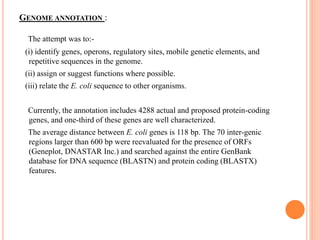
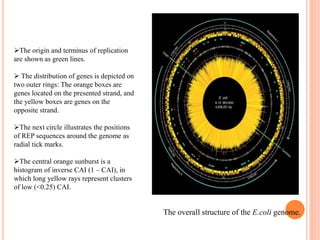
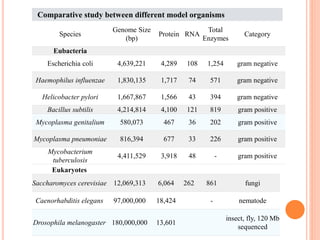
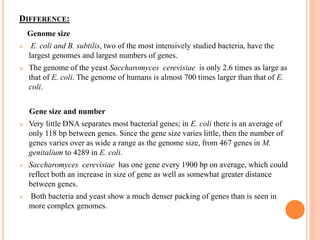
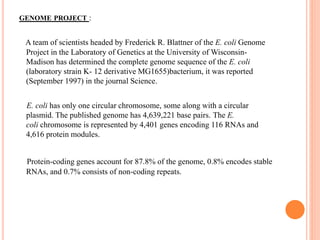
This document discusses Escherichia coli (E. coli), a bacterium commonly found in the lower intestine of warm-blooded organisms. It was discovered in 1885 by German pediatrician Theodor Escherich and has since become a model organism for research. E. coli has a circular chromosome of around 4,639,221 base pairs that encodes over 4,000 genes. Its small genome size and rapid growth make it well-suited for laboratory experiments and cloning genes. The complete genome sequence of E. coli was determined in 1997, providing valuable insights into bacterial genetics, metabolism, and physiology.
![SEQUENCING STRATEGY :
Sequencing was carried out in sections, with steadily improving technical
approaches. The M13 Janus shotgun strategy proved to be the most efficient
strategy for data collection and closure, followed by limited primer walking.
The first 1.92 Mb, positions 2,686,777 to 4,639,221 [in base pairs (bp)], was
sequenced from overlapping set of 15- to 20-kb MG1655 lambda clones by
means of radioactive chemistry .Subsequently, switched to dye-terminator
fluorescence sequencing (Applied Bio-systems).
For the next segment (positions 2,475,719 to 2,690,160), they obtained
DNA for sequencing by the pop-out plasmid approach , in which non -
overlapping segments were excised directly from the chromosome in
circular form, gel-purified, and shot-gunned for sequencing.](https://image.slidesharecdn.com/genomicsppt-210314035601/85/presentation-on-E-coli-6-320.jpg)