Mahesh Patil 
M130379ME 
Thermal Science
Phase I 
Introduction 
Research papers 
Phase II 
CFD analysis
Research Paper 1 
 Progress in Aerospace Sciences 37 (2001) 385– 
418 
 Anthony M. Mitchell, Jean Delery 
 Vortex breakdown detrimental or beneficial 
effects, depending on the application. 
 Diverse control methods developed 
 Still a superior efficiency or effectiveness in 
controlling either the vertical flow structure or the 
vortex breakdown location? – not fully 
understood
 In a water tunnel over a slender delta wing as 
a result of the emission of colored dye near 
the apex 
 The control and exact location vortex 
breakdown- requires basic understanding and 
physics of the phenomenon 
 Techniques- mechanical, pneumatic 
 Major obstacles in vortex breakdown 
implementation in new generation aircrafts 
like delta winged.
Research Paper 2 
 The numerical simulation of the flow around a 
65◦ delta wing configuration with rounded 
leading edges is presented 
 Numerical solutions: RANS ( Reynolds-Averaged 
Navier-Stoke eqs.) using different turbulent 
models 
 How flow topology depends on angle of attack 
and Reynolds no.
Wilcox k-w model (k-w) 
Spalart Allmaras model (SA) 
CFD simulations around a 65◦ delta wing 
with rounded leading edges and angle of 
attack α = 13.3◦ carried out 
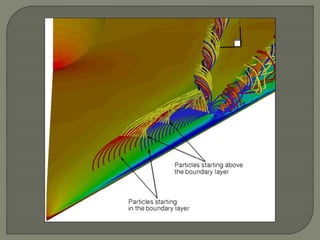
inner vortex is generated out of a vorticity 
layer moving downstream 
inner vortex occurs before the outer vortex 
is generated
Research Paper 3 
Azize Akcayoglu (2011) 
Experimental study of flow structure in 
horizontal equilateral triangular ducts 
having double rows of half delta-wing 
type vortex generators mounted on the 
duct’s slant surfaces 
Flow field measurements using PIV 
(particle image velocimetry)
CFU & CFD ( common flow up & common 
flow down ) 
Contradictory results in earlier litterature 
So verified through experiment
Reynolds no. varied from 1000 to 8000 
Duct 1 : pair of CFU (common flow up) 
Duct 2: CFU + CFD 
Motivation: which duct gives larger vortex 
formation 
Result: duct 2 gives larger vortex formation 
& greater induced vorticity
Research Paper 4 
 A. Joardar, A.M. Jacobi (2005) 
 Experimentally verified the effectiveness of delta 
wing type vortex generators using full scale wind 
tunnel 
 Compact heat exchanger is used (eg. 
Automobile radiator)
Average heat transfer enhancement by 
21% 
Pressure drop penalty of 6%
Reseach Paper 5 
Russell M. Cummings, Andreas Schütte 
(2013) 
 International VFE (vortex flow experiment) 
Numerical solution within for VFE-2 delta 
wing 
with rounded leading edge 
 Simulation software: Cobalt Navier-Stoke 
solver 
SA, SARC, DES, DDES
 CFD calculation with the unstructured Cobalt 
code are presented 
 Used various turbulent models and compared 
with experimental data available (surface 
pressure, PIV) 
 RANS simulation results close to experimental 
results than DES, DDES.
CFD analysis of flow over delta wing to 
evaluate the thermal performance of 
automboile radiator
Presentation on delta wing

Presentation on delta wing

  • 1.
    Mahesh Patil M130379ME Thermal Science
  • 2.
    Phase I Introduction Research papers Phase II CFD analysis
  • 3.
    Research Paper 1  Progress in Aerospace Sciences 37 (2001) 385– 418  Anthony M. Mitchell, Jean Delery  Vortex breakdown detrimental or beneficial effects, depending on the application.  Diverse control methods developed  Still a superior efficiency or effectiveness in controlling either the vertical flow structure or the vortex breakdown location? – not fully understood
  • 4.
     In awater tunnel over a slender delta wing as a result of the emission of colored dye near the apex  The control and exact location vortex breakdown- requires basic understanding and physics of the phenomenon  Techniques- mechanical, pneumatic  Major obstacles in vortex breakdown implementation in new generation aircrafts like delta winged.
  • 5.
    Research Paper 2  The numerical simulation of the flow around a 65◦ delta wing configuration with rounded leading edges is presented  Numerical solutions: RANS ( Reynolds-Averaged Navier-Stoke eqs.) using different turbulent models  How flow topology depends on angle of attack and Reynolds no.
  • 6.
    Wilcox k-w model(k-w) Spalart Allmaras model (SA) CFD simulations around a 65◦ delta wing with rounded leading edges and angle of attack α = 13.3◦ carried out inner vortex is generated out of a vorticity layer moving downstream inner vortex occurs before the outer vortex is generated
  • 8.
    Research Paper 3 Azize Akcayoglu (2011) Experimental study of flow structure in horizontal equilateral triangular ducts having double rows of half delta-wing type vortex generators mounted on the duct’s slant surfaces Flow field measurements using PIV (particle image velocimetry)
  • 9.
    CFU & CFD( common flow up & common flow down ) Contradictory results in earlier litterature So verified through experiment
  • 10.
    Reynolds no. variedfrom 1000 to 8000 Duct 1 : pair of CFU (common flow up) Duct 2: CFU + CFD Motivation: which duct gives larger vortex formation Result: duct 2 gives larger vortex formation & greater induced vorticity
  • 11.
    Research Paper 4  A. Joardar, A.M. Jacobi (2005)  Experimentally verified the effectiveness of delta wing type vortex generators using full scale wind tunnel  Compact heat exchanger is used (eg. Automobile radiator)
  • 12.
    Average heat transferenhancement by 21% Pressure drop penalty of 6%
  • 13.
    Reseach Paper 5 Russell M. Cummings, Andreas Schütte (2013)  International VFE (vortex flow experiment) Numerical solution within for VFE-2 delta wing with rounded leading edge  Simulation software: Cobalt Navier-Stoke solver SA, SARC, DES, DDES
  • 14.
     CFD calculationwith the unstructured Cobalt code are presented  Used various turbulent models and compared with experimental data available (surface pressure, PIV)  RANS simulation results close to experimental results than DES, DDES.
  • 15.
    CFD analysis offlow over delta wing to evaluate the thermal performance of automboile radiator