INTRODUCTION TO
CRYPTOGRAPHY
Name: Karan Jaiswal
Dept.: B.C.A(H), 6th Semester
College: Siliguri Institute of Technology
CONTENTS
• Security
• Security Threats
• Security Goals
• Cryptography
• Types of Cryptography
• Symmetric Key Cryptography
• Asymmetric Key Cryptography
• Basic Terms
• Cipher
• Types of Cipher
• Substitution Cipher
• Transposition Cipher
• Ciphertext
• Encryption & Decryption
• Types of Keys
• Symmetric Vs Asymmetric
• Applications of Cryptography
• Conclusion
ARE WE SECURE TODAY?
Security?
SECURITY THREATS
Passive Threats Active Threats
Release of
Message Contents
Traffic Analysis Masquerade Replay Modification of
Message Contents
Denial of Service
Passive & Active Security Threats
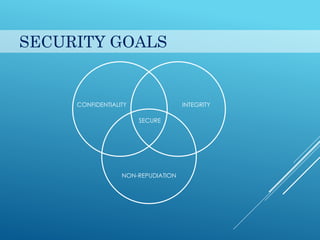
SECURITY GOALS
CONFIDENTIALITY INTEGRITY
NON-REPUDIATION
SECURE
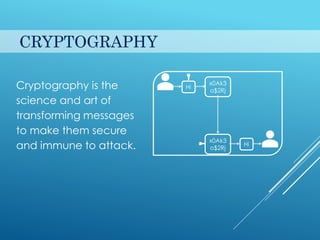
CRYPTOGRAPHY
Cryptography is the
science and art of
transforming messages
to make them secure
and immune to attack.
Hi
Hi
x0Ak3
o$2Rj
x0Ak3
o$2Rj
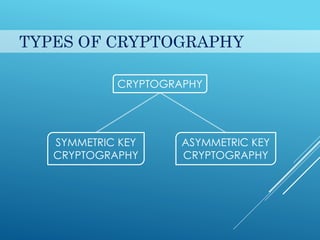
TYPES OF CRYPTOGRAPHY
CRYPTOGRAPHY
SYMMETRIC KEY
CRYPTOGRAPHY
ASYMMETRIC KEY
CRYPTOGRAPHY
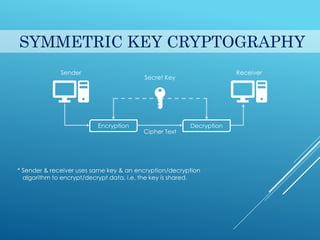
SYMMETRIC KEY CRYPTOGRAPHY
Encryption Decryption
Cipher Text
Sender Receiver
Secret Key
* Sender & receiver uses same key & an encryption/decryption
algorithm to encrypt/decrypt data. i.e. the key is shared.
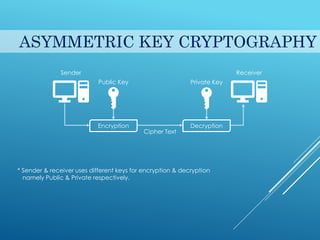
ASYMMETRIC KEY CRYPTOGRAPHY
Encryption Decryption
Cipher Text
Sender Receiver
Public Key
* Sender & receiver uses different keys for encryption & decryption
namely Public & Private respectively.
Private Key
BASIC TERMS
• CIPHER
• CIPHERTEXT
• ENCRYPTION & DECRYPTION
• KEYS
CIPHER
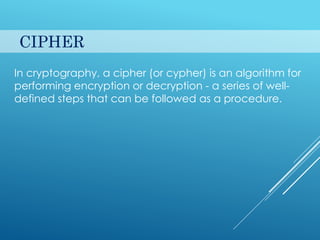
In cryptography, a cipher (or cypher) is an algorithm for
performing encryption or decryption - a series of well-
defined steps that can be followed as a procedure.
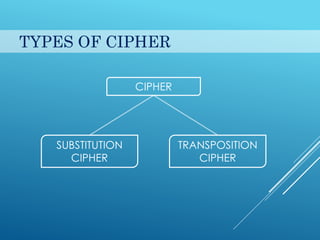
TYPES OF CIPHER
CIPHER
SUBSTITUTION
CIPHER
TRANSPOSITION
CIPHER
SUBSTITUTION CIPHER
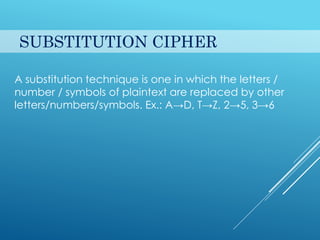
A substitution technique is one in which the letters /
number / symbols of plaintext are replaced by other
letters/numbers/symbols. Ex.: A→D, T→Z, 2→5, 3→6
TRANSPOSITION CIPHER
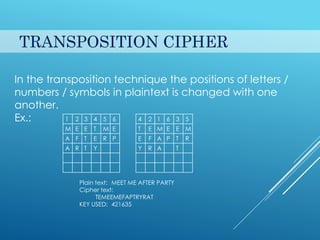
In the transposition technique the positions of letters /
numbers / symbols in plaintext is changed with one
another.
Ex.: 1 2 3 4 5 6
M E E T M E
A F T E R P
A R T Y
4 2 1 6 3 5
T E M E E M
E F A P T R
Y R A T
Plain text: MEET ME AFTER PARTY
Cipher text:
TEMEEMEFAPTRYRAT
KEY USED: 421635
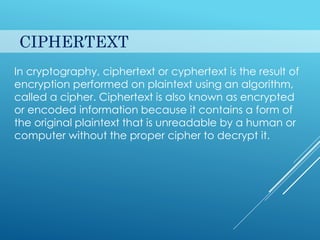
CIPHERTEXT
In cryptography, ciphertext or cyphertext is the result of
encryption performed on plaintext using an algorithm,
called a cipher. Ciphertext is also known as encrypted
or encoded information because it contains a form of
the original plaintext that is unreadable by a human or
computer without the proper cipher to decrypt it.
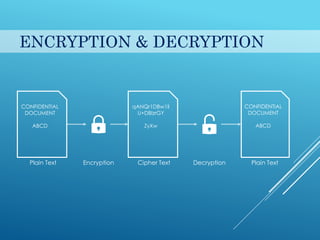
ENCRYPTION & DECRYPTION
CONFIDENTIAL
DOCUMENT
ABCD
qANQr1DBw1il
U+DBlzrGY
ZyXw
CONFIDENTIAL
DOCUMENT
ABCD
Plain Text Plain TextCipher TextEncryption Decryption
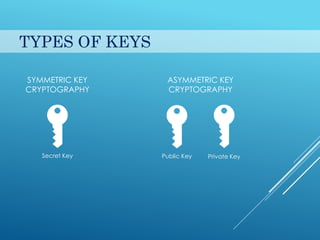
TYPES OF KEYS
Public Key Private KeySecret Key
SYMMETRIC KEY
CRYPTOGRAPHY
ASYMMETRIC KEY
CRYPTOGRAPHY
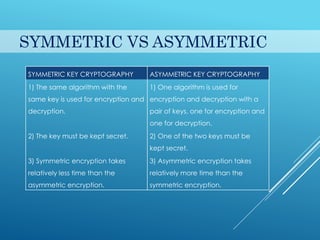
SYMMETRIC VS ASYMMETRIC
SYMMETRIC KEY CRYPTOGRAPHY ASYMMETRIC KEY CRYPTOGRAPHY
1) The same algorithm with the
same key is used for encryption and
decryption.
1) One algorithm is used for
encryption and decryption with a
pair of keys, one for encryption and
one for decryption.
2) The key must be kept secret. 2) One of the two keys must be
kept secret.
3) Symmetric encryption takes
relatively less time than the
asymmetric encryption.
3) Asymmetric encryption takes
relatively more time than the
symmetric encryption.
APPLICATIONS OF CRYPTOGRAPHY
• Defence services
• Secure data manipulation
• E – commerce
• Business transactions
• Internet payment systems
• User identification systems
• Access control
• Data security
CONCLUSION
By the use of cryptography a fair unit of confidentiality,
authentication, integrity, access control and availability
of data is maintained.
Thanks for
watching!

Presentation on Cryptography