Presentation of Types of Incentive plan
Standard Hour Plans

Presented to:
Dr. Piyali Ghosh
Presented by:
Mudit Chandra (2012MB76)
Kamal Kumar (2012MB35)
Mithlesh Chaubey (2012MB29)
Jitendra Yadav (2012MB14)
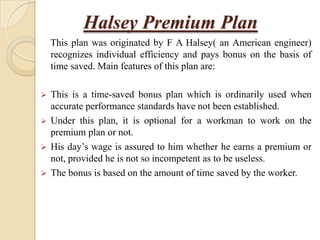
Halsey Premium Plan
This plan was originated by F A Halsey( an American engineer)
recognizes individual efficiency and pays bonus on the basis of
time saved. Main features of this plan are:


This is a time-saved bonus plan which is ordinarily used when
accurate performance standards have not been established.
 Under this plan, it is optional for a workman to work on the
premium plan or not.
 His day’s wage is assured to him whether he earns a premium or
not, provided he is not so incompetent as to be useless.
 The bonus is based on the amount of time saved by the worker.
EXAMPLE : If 8 hours is the standard time of a job, & Rs. 0.50 is
the guaranteed wage per hour, calculate wages of workers and
premium earned by them under different time saved slots ?
PREMIUM
(half of the time saved)

If the work is
completed

TOTAL
WAGES
(Rs.)

Effective
Hourly Rate
(Rs.)

in 6 hours, 0.5

3.5

3.5/6 = 0.58

in 4 hours,1.00

3.0

3.0/4 = 0.75

in 2 hours, 1.50

2.5

2.5/2 = 1.25

in 1 hour, 1.75

2.25

2.25/1 = 2.25

Wages under Halsey System = [Time taken * Time rate] + (50% of
time saved * time rate)
Effective Hourly Rate = Total Wages under Halsey Plan
Actual time taken
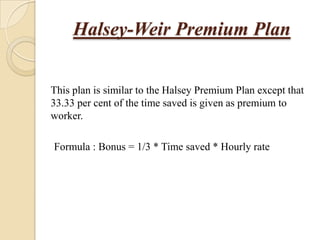
Halsey-Weir Premium Plan
This plan is similar to the Halsey Premium Plan except that
33.33 per cent of the time saved is given as premium to
worker.
Formula : Bonus = 1/3 * Time saved * Hourly rate
Merits
(i)

Simple

(ii)

Beneficial to efficient worker

(iii)

Causes no harm to new worker, trainee, or slow worker

(iv)

Management shares benefits of over-achievement by
workers

(v)

Minimum base wage is guaranteed.
Demerits
(i)Workers get only a percentage of return on their overachievement
(ii)Due to undue
quality suffers.

importance on

over-achievement

(iii)Management gets wrong picture of worker’s ability.
Rowan Premium Plan


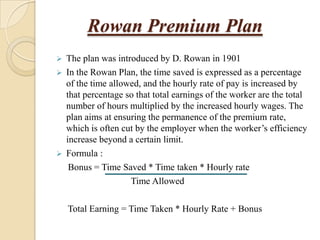
The plan was introduced by D. Rowan in 1901
 In the Rowan Plan, the time saved is expressed as a percentage
of the time allowed, and the hourly rate of pay is increased by
that percentage so that total earnings of the worker are the total
number of hours multiplied by the increased hourly wages. The
plan aims at ensuring the permanence of the premium rate,
which is often cut by the employer when the worker’s efficiency
increase beyond a certain limit.
 Formula :
Bonus = Time Saved * Time taken * Hourly rate
Time Allowed
Total Earning = Time Taken * Hourly Rate + Bonus
Merits


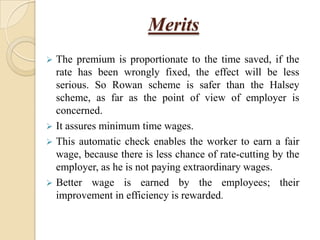
The premium is proportionate to the time saved, if the
rate has been wrongly fixed, the effect will be less
serious. So Rowan scheme is safer than the Halsey
scheme, as far as the point of view of employer is
concerned.
 It assures minimum time wages.
 This automatic check enables the worker to earn a fair
wage, because there is less chance of rate-cutting by the
employer, as he is not paying extraordinary wages.
 Better wage is earned by the employees; their
improvement in efficiency is rewarded.
Demerits


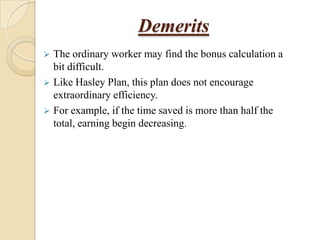
The ordinary worker may find the bonus calculation a
bit difficult.
 Like Hasley Plan, this plan does not encourage
extraordinary efficiency.
 For example, if the time saved is more than half the
total, earning begin decreasing.
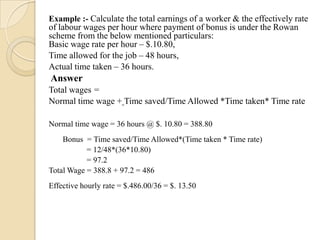
Example :- Calculate the total earnings of a worker & the effectively rate

of labour wages per hour where payment of bonus is under the Rowan
scheme from the below mentioned particulars:
Basic wage rate per hour – $.10.80,
Time allowed for the job – 48 hours,
Actual time taken – 36 hours.

Answer
Total wages =
Normal time wage + Time saved/Time Allowed *Time taken* Time rate
Normal time wage = 36 hours @ $. 10.80 = 388.80
Bonus = Time saved/Time Allowed*(Time taken * Time rate)
= 12/48*(36*10.80)
= 97.2
Total Wage = 388.8 + 97.2 = 486

Effective hourly rate = $.486.00/36 = $. 13.50
Observations From Halsey &
Rowan Plans








Under Halsey system, with the increase in efficiency the bonus
increases steadily. On the other hand, under Rowan system, up to
certain level of efficiency, i.e. where time saved is 50% of allotted
time, bonus increases & then it begins to decline.
More wages is earned by the worker under Rowan system than under
Halsey system, where time saved is less than 50% of the standard
time.
If worker saves 2/3rd of the standard time, doubles his earnings per
hour under Halsey system whereas earnings per hour can never be
doubled under Rowan system.
Bonus under both the systems is the same, when the time saved is ½
of the standard time.


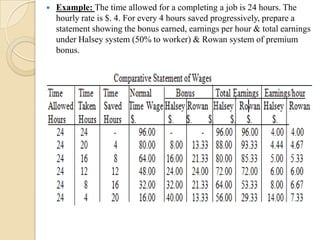
Example: The time allowed for a completing a job is 24 hours. The
hourly rate is $. 4. For every 4 hours saved progressively, prepare a
statement showing the bonus earned, earnings per hour & total earnings
under Halsey system (50% to worker) & Rowan system of premium
bonus.
Bedeaux Plan
 Under

this plan, all operation or job is expressed
in terms of so many standard minutes, which are
called ‘Bedeaux points’.
 Each B representing one minute through motion
& time study. Upto 100% performance,
 i.e., up to standard B's, a worker is salaried time
wages without any premium for efficiency. If the
real performance exceeds the standard
performance in terms of B's, then 75% of the
wages of the time saved is salaried to the worker
as bonus and 25 % is earned by the foremen.
Example
If the standard time is 10 hours real time taken is 8 hours
and rate per hour Re.1, the worker will obtain.
= 8 hours at Re 1 + 75% of 120 (points saved) x 1/60
= Rs 9.50/-

Presentation of types_of_incentive_plan

  • 1.
    Presentation of Typesof Incentive plan Standard Hour Plans Presented to: Dr. Piyali Ghosh Presented by: Mudit Chandra (2012MB76) Kamal Kumar (2012MB35) Mithlesh Chaubey (2012MB29) Jitendra Yadav (2012MB14)
  • 2.
    Halsey Premium Plan Thisplan was originated by F A Halsey( an American engineer) recognizes individual efficiency and pays bonus on the basis of time saved. Main features of this plan are:  This is a time-saved bonus plan which is ordinarily used when accurate performance standards have not been established.  Under this plan, it is optional for a workman to work on the premium plan or not.  His day’s wage is assured to him whether he earns a premium or not, provided he is not so incompetent as to be useless.  The bonus is based on the amount of time saved by the worker.
  • 3.
    EXAMPLE : If8 hours is the standard time of a job, & Rs. 0.50 is the guaranteed wage per hour, calculate wages of workers and premium earned by them under different time saved slots ? PREMIUM (half of the time saved) If the work is completed TOTAL WAGES (Rs.) Effective Hourly Rate (Rs.) in 6 hours, 0.5 3.5 3.5/6 = 0.58 in 4 hours,1.00 3.0 3.0/4 = 0.75 in 2 hours, 1.50 2.5 2.5/2 = 1.25 in 1 hour, 1.75 2.25 2.25/1 = 2.25 Wages under Halsey System = [Time taken * Time rate] + (50% of time saved * time rate) Effective Hourly Rate = Total Wages under Halsey Plan Actual time taken
  • 4.
    Halsey-Weir Premium Plan Thisplan is similar to the Halsey Premium Plan except that 33.33 per cent of the time saved is given as premium to worker. Formula : Bonus = 1/3 * Time saved * Hourly rate
  • 5.
    Merits (i) Simple (ii) Beneficial to efficientworker (iii) Causes no harm to new worker, trainee, or slow worker (iv) Management shares benefits of over-achievement by workers (v) Minimum base wage is guaranteed.
  • 6.
    Demerits (i)Workers get onlya percentage of return on their overachievement (ii)Due to undue quality suffers. importance on over-achievement (iii)Management gets wrong picture of worker’s ability.
  • 7.
    Rowan Premium Plan  Theplan was introduced by D. Rowan in 1901  In the Rowan Plan, the time saved is expressed as a percentage of the time allowed, and the hourly rate of pay is increased by that percentage so that total earnings of the worker are the total number of hours multiplied by the increased hourly wages. The plan aims at ensuring the permanence of the premium rate, which is often cut by the employer when the worker’s efficiency increase beyond a certain limit.  Formula : Bonus = Time Saved * Time taken * Hourly rate Time Allowed Total Earning = Time Taken * Hourly Rate + Bonus
  • 8.
    Merits  The premium isproportionate to the time saved, if the rate has been wrongly fixed, the effect will be less serious. So Rowan scheme is safer than the Halsey scheme, as far as the point of view of employer is concerned.  It assures minimum time wages.  This automatic check enables the worker to earn a fair wage, because there is less chance of rate-cutting by the employer, as he is not paying extraordinary wages.  Better wage is earned by the employees; their improvement in efficiency is rewarded.
  • 9.
    Demerits  The ordinary workermay find the bonus calculation a bit difficult.  Like Hasley Plan, this plan does not encourage extraordinary efficiency.  For example, if the time saved is more than half the total, earning begin decreasing.
  • 10.
    Example :- Calculatethe total earnings of a worker & the effectively rate of labour wages per hour where payment of bonus is under the Rowan scheme from the below mentioned particulars: Basic wage rate per hour – $.10.80, Time allowed for the job – 48 hours, Actual time taken – 36 hours. Answer Total wages = Normal time wage + Time saved/Time Allowed *Time taken* Time rate Normal time wage = 36 hours @ $. 10.80 = 388.80 Bonus = Time saved/Time Allowed*(Time taken * Time rate) = 12/48*(36*10.80) = 97.2 Total Wage = 388.8 + 97.2 = 486 Effective hourly rate = $.486.00/36 = $. 13.50
  • 11.
    Observations From Halsey& Rowan Plans     Under Halsey system, with the increase in efficiency the bonus increases steadily. On the other hand, under Rowan system, up to certain level of efficiency, i.e. where time saved is 50% of allotted time, bonus increases & then it begins to decline. More wages is earned by the worker under Rowan system than under Halsey system, where time saved is less than 50% of the standard time. If worker saves 2/3rd of the standard time, doubles his earnings per hour under Halsey system whereas earnings per hour can never be doubled under Rowan system. Bonus under both the systems is the same, when the time saved is ½ of the standard time.
  • 12.
     Example: The timeallowed for a completing a job is 24 hours. The hourly rate is $. 4. For every 4 hours saved progressively, prepare a statement showing the bonus earned, earnings per hour & total earnings under Halsey system (50% to worker) & Rowan system of premium bonus.
  • 13.
    Bedeaux Plan  Under thisplan, all operation or job is expressed in terms of so many standard minutes, which are called ‘Bedeaux points’.  Each B representing one minute through motion & time study. Upto 100% performance,  i.e., up to standard B's, a worker is salaried time wages without any premium for efficiency. If the real performance exceeds the standard performance in terms of B's, then 75% of the wages of the time saved is salaried to the worker as bonus and 25 % is earned by the foremen.
  • 14.
    Example If the standardtime is 10 hours real time taken is 8 hours and rate per hour Re.1, the worker will obtain. = 8 hours at Re 1 + 75% of 120 (points saved) x 1/60 = Rs 9.50/-