Incentive Schemes or Plans
Presented by
Dr. B. N. Shinde
Assistant Professor
Department of Commerce
Deogiri College, Aurangabad
Incentive Schemes or Plans
I) Taylor’s Differential Piece Rate System
Differential Piece Rate System was introduced by Taylor,
the father of scientific management. The underlying
principle of this system is to penalize a slow worker by
paying him a low piece rate for low production and to
reward an efficient worker by giving him a higher piece
rate for a higher production. Taylor was of the view that an
inefficient worker should have no place in the organization
and he should be compelled to leave the organization by
paying him a low piece rate for low production.
Continue…
• Taylor proceeded on the assumption that through
time and motion study it is possible to fix a
standard time for doing a particular task. To
encourage the workers to complete the work within
the standard time, Taylor advocated two piece
rates, so that if a worker performs the work within
or less than the standard time, he is paid a higher
piece rate, and if he does not complete the work
within the standard time, he is given a lower piece
rate.
Continue…
• Taylor decided to give a large reward to those
who would complete the work within or less
than the standard time and much less wages
to those who would not complete the job
within the standard time. The system is very
harsh to the inefficient workers because they
earn much less wages on account of lower
output and lower rate.
Continue…
• Moreover, minimum wages are not
guaranteed under this method. Another
drawback of the system is that if a worker just
fails to complete the work within the standard
time earns much less wages than a worker
who just completes the job within the
standard time. Therefore, the system is now
almost out of use.
Continue…
• Under this system two widely differing wage rates are fixed. The
lower rate is @83% of the normal piece rate and higher rate
@125% of the normal piece rate and sometimes 50% of the wage
rate is added in it. These percentages may vary concern to
concern as per their convenience.
• As there are two different piece rates are used the system is
called as differential piece rate system. For operating this system
the efficiency of worker is measured either by using the formula.
Standard Time Actual Output
100 Or 100
Actual Time Taken Standard Output
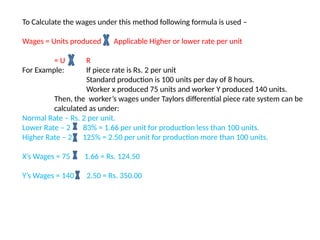
To Calculate the wages under this method following formula is used –
Wages = Units produced Applicable Higher or lower rate per unit
= U R
For Example: If piece rate is Rs. 2 per unit
Standard production is 100 units per day of 8 hours.
Worker x produced 75 units and worker Y produced 140 units.
Then, the worker’s wages under Taylors differential piece rate system can be
calculated as under:
Normal Rate – Rs. 2 per unit.
Lower Rate – 2 83% = 1.66 per unit for production less than 100 units.
Higher Rate – 2 125% = 2.50 per unit for production more than 100 units.
X’s Wages = 75 1.66 = Rs. 124.50
Y’s Wages = 140 2.50 = Rs. 350.00
II)Halsey Plan
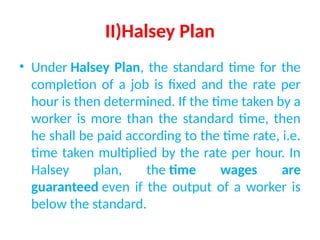
• Under Halsey Plan, the standard time for the
completion of a job is fixed and the rate per
hour is then determined. If the time taken by a
worker is more than the standard time, then
he shall be paid according to the time rate, i.e.
time taken multiplied by the rate per hour. In
Halsey plan, the time wages are
guaranteed even if the output of a worker is
below the standard.
Continue…
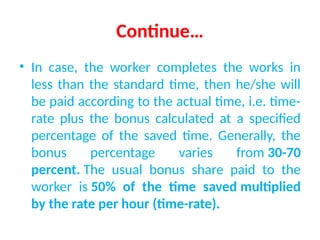
• In case, the worker completes the works in
less than the standard time, then he/she will
be paid according to the actual time, i.e. time-
rate plus the bonus calculated at a specified
percentage of the saved time. Generally, the
bonus percentage varies from 30-70
percent. The usual bonus share paid to the
worker is 50% of the time saved multiplied
by the rate per hour (time-rate).
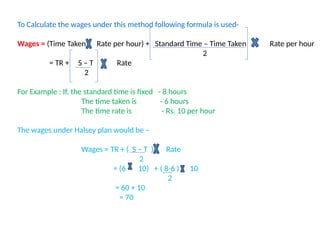
To Calculate the wages under this method following formula is used-
Wages = (Time Taken Rate per hour) + Standard Time – Time Taken Rate per hour
2
= TR + S – T Rate
2
For Example : If, the standard time is fixed - 8 hours
The time taken is - 6 hours
The time rate is - Rs. 10 per hour
The wages under Halsey plan would be –
Wages = TR + ( S – T ) Rate
2
= (6 10) + ( 8-6 ) 10
2
= 60 + 10
= 70
III) Rowan Plan
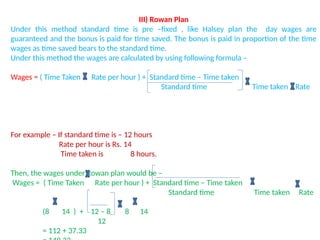
Under this method standard time is pre –fixed , like Halsey plan the day wages are
guaranteed and the bonus is paid for time saved. The bonus is paid in proportion of the time
wages as time saved bears to the standard time.
Under this method the wages are calculated by using following formula –
Wages = ( Time Taken Rate per hour ) + Standard time – Time taken
Standard time Time taken Rate
For example – If standard time is – 12 hours
Rate per hour is Rs. 14
Time taken is 8 hours.
Then, the wages under Rowan plan would be –
Wages = ( Time Taken Rate per hour ) + Standard time – Time taken
Standard time Time taken Rate
(8 14 ) + 12 – 8 8 14
12
= 112 + 37.33
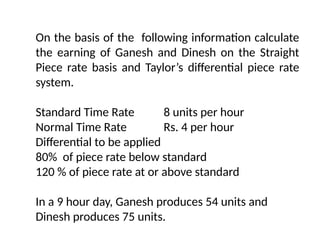
On the basis of the following information calculate
the earning of Ganesh and Dinesh on the Straight
Piece rate basis and Taylor’s differential piece rate
system.
Standard Time Rate 8 units per hour
Normal Time Rate Rs. 4 per hour
Differential to be applied
80% of piece rate below standard
120 % of piece rate at or above standard
In a 9 hour day, Ganesh produces 54 units and
Dinesh produces 75 units.
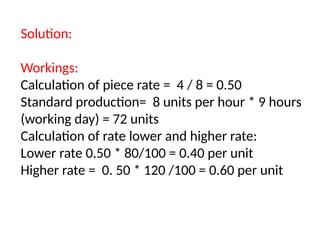
Solution:
Workings:
Calculation of piece rate = 4 / 8 = 0.50
Standard production= 8 units per hour * 9 hours
(working day) = 72 units
Calculation of rate lower and higher rate:
Lower rate 0.50 * 80/100 = 0.40 per unit
Higher rate = 0. 50 * 120 /100 = 0.60 per unit
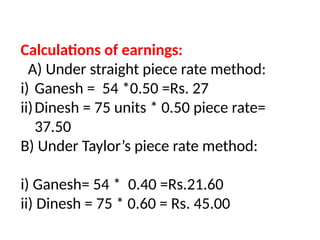
Calculations of earnings:
A) Under straight piece rate method:
i) Ganesh = 54 *0.50 =Rs. 27
ii)Dinesh = 75 units * 0.50 piece rate=
37.50
B) Under Taylor’s piece rate method:
i) Ganesh= 54 * 0.40 =Rs.21.60
ii) Dinesh = 75 * 0.60 = Rs. 45.00

Incentive Schemes or Plans. ……. .

  • 1.
    Incentive Schemes orPlans Presented by Dr. B. N. Shinde Assistant Professor Department of Commerce Deogiri College, Aurangabad
  • 2.
    Incentive Schemes orPlans I) Taylor’s Differential Piece Rate System Differential Piece Rate System was introduced by Taylor, the father of scientific management. The underlying principle of this system is to penalize a slow worker by paying him a low piece rate for low production and to reward an efficient worker by giving him a higher piece rate for a higher production. Taylor was of the view that an inefficient worker should have no place in the organization and he should be compelled to leave the organization by paying him a low piece rate for low production.
  • 3.
    Continue… • Taylor proceededon the assumption that through time and motion study it is possible to fix a standard time for doing a particular task. To encourage the workers to complete the work within the standard time, Taylor advocated two piece rates, so that if a worker performs the work within or less than the standard time, he is paid a higher piece rate, and if he does not complete the work within the standard time, he is given a lower piece rate.
  • 4.
    Continue… • Taylor decidedto give a large reward to those who would complete the work within or less than the standard time and much less wages to those who would not complete the job within the standard time. The system is very harsh to the inefficient workers because they earn much less wages on account of lower output and lower rate.
  • 5.
    Continue… • Moreover, minimumwages are not guaranteed under this method. Another drawback of the system is that if a worker just fails to complete the work within the standard time earns much less wages than a worker who just completes the job within the standard time. Therefore, the system is now almost out of use.
  • 6.
    Continue… • Under thissystem two widely differing wage rates are fixed. The lower rate is @83% of the normal piece rate and higher rate @125% of the normal piece rate and sometimes 50% of the wage rate is added in it. These percentages may vary concern to concern as per their convenience. • As there are two different piece rates are used the system is called as differential piece rate system. For operating this system the efficiency of worker is measured either by using the formula. Standard Time Actual Output 100 Or 100 Actual Time Taken Standard Output
  • 7.
    To Calculate thewages under this method following formula is used – Wages = Units produced Applicable Higher or lower rate per unit = U R For Example: If piece rate is Rs. 2 per unit Standard production is 100 units per day of 8 hours. Worker x produced 75 units and worker Y produced 140 units. Then, the worker’s wages under Taylors differential piece rate system can be calculated as under: Normal Rate – Rs. 2 per unit. Lower Rate – 2 83% = 1.66 per unit for production less than 100 units. Higher Rate – 2 125% = 2.50 per unit for production more than 100 units. X’s Wages = 75 1.66 = Rs. 124.50 Y’s Wages = 140 2.50 = Rs. 350.00
  • 8.
    II)Halsey Plan • UnderHalsey Plan, the standard time for the completion of a job is fixed and the rate per hour is then determined. If the time taken by a worker is more than the standard time, then he shall be paid according to the time rate, i.e. time taken multiplied by the rate per hour. In Halsey plan, the time wages are guaranteed even if the output of a worker is below the standard.
  • 9.
    Continue… • In case,the worker completes the works in less than the standard time, then he/she will be paid according to the actual time, i.e. time- rate plus the bonus calculated at a specified percentage of the saved time. Generally, the bonus percentage varies from 30-70 percent. The usual bonus share paid to the worker is 50% of the time saved multiplied by the rate per hour (time-rate).
  • 10.
    To Calculate thewages under this method following formula is used- Wages = (Time Taken Rate per hour) + Standard Time – Time Taken Rate per hour 2 = TR + S – T Rate 2 For Example : If, the standard time is fixed - 8 hours The time taken is - 6 hours The time rate is - Rs. 10 per hour The wages under Halsey plan would be – Wages = TR + ( S – T ) Rate 2 = (6 10) + ( 8-6 ) 10 2 = 60 + 10 = 70
  • 11.
    III) Rowan Plan Underthis method standard time is pre –fixed , like Halsey plan the day wages are guaranteed and the bonus is paid for time saved. The bonus is paid in proportion of the time wages as time saved bears to the standard time. Under this method the wages are calculated by using following formula – Wages = ( Time Taken Rate per hour ) + Standard time – Time taken Standard time Time taken Rate For example – If standard time is – 12 hours Rate per hour is Rs. 14 Time taken is 8 hours. Then, the wages under Rowan plan would be – Wages = ( Time Taken Rate per hour ) + Standard time – Time taken Standard time Time taken Rate (8 14 ) + 12 – 8 8 14 12 = 112 + 37.33
  • 12.
    On the basisof the following information calculate the earning of Ganesh and Dinesh on the Straight Piece rate basis and Taylor’s differential piece rate system. Standard Time Rate 8 units per hour Normal Time Rate Rs. 4 per hour Differential to be applied 80% of piece rate below standard 120 % of piece rate at or above standard In a 9 hour day, Ganesh produces 54 units and Dinesh produces 75 units.
  • 13.
    Solution: Workings: Calculation of piecerate = 4 / 8 = 0.50 Standard production= 8 units per hour * 9 hours (working day) = 72 units Calculation of rate lower and higher rate: Lower rate 0.50 * 80/100 = 0.40 per unit Higher rate = 0. 50 * 120 /100 = 0.60 per unit
  • 14.
    Calculations of earnings: A)Under straight piece rate method: i) Ganesh = 54 *0.50 =Rs. 27 ii)Dinesh = 75 units * 0.50 piece rate= 37.50 B) Under Taylor’s piece rate method: i) Ganesh= 54 * 0.40 =Rs.21.60 ii) Dinesh = 75 * 0.60 = Rs. 45.00