STOCK VALUATION
LEARNING GOALS
1. Market efficiency
2. Basic stock valuation (zero,
constant, and variable growth)
3. Free cash flow valuation
4. Other Approaches to Common
Stock Valuation
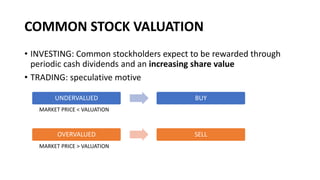
COMMON STOCK VALUATION
• INVESTING: Common stockholders expect to be rewarded through
periodic cash dividends and an increasing share value
• TRADING: speculative motive
UNDERVALUED BUY
OVERVALUED SELL
MARKET PRICE < VALUATION
MARKET PRICE > VALUATION
MARKET EFFICIENCY
• Economically rational buyers and sellers use their assessment of an
asset’s risk and return to determine its value
• In competitive market with many active participant, the interactions
of many buyers and sellers result in an equilibrium price - the market
value – for each security.
• Because the flow of the new information is almost constant, stock
prices fluctuate, continously moving toward a new equilibrium that
reflects the most recent information available. This general concept is
known as market efficiency.
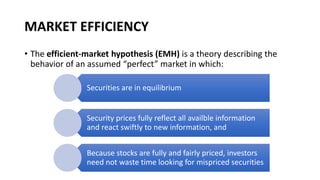
MARKET EFFICIENCY
• The efficient-market hypothesis (EMH) is a theory describing the
behavior of an assumed “perfect” market in which:
Securities are in equilibrium
Security prices fully reflect all availble information
and react swiftly to new information, and
Because stocks are fully and fairly priced, investors
need not waste time looking for mispriced securities
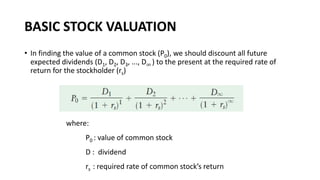
BASIC STOCK VALUATION
• In finding the value of a common stock (P0), we should discount all future
expected dividends (D1, D2, D3, ..., D∞ ) to the present at the required rate of
return for the stockholder (rs)
where:
P0 : value of common stock
D : dividend
rs : required rate of common stock’s return
BASIC STOCK VALUATION
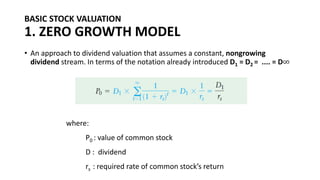
1. ZERO GROWTH MODEL
• An approach to dividend valuation that assumes a constant, nongrowing
dividend stream. In terms of the notation already introduced D1 = D2 = .... = D∞
where:
P0 : value of common stock
D : dividend
rs : required rate of common stock’s return
BASIC STOCK VALUATION
1. ZERO GROWTH MODEL
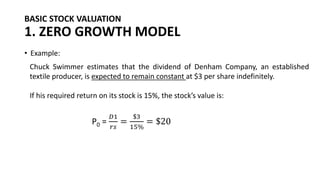
• Example:
Chuck Swimmer estimates that the dividend of Denham Company, an established
textile producer, is expected to remain constant at $3 per share indefinitely.
If his required return on its stock is 15%, the stock’s value is:
P0 =
𝐷1
𝑟𝑠
=
$3
15%
= $20
BASIC STOCK VALUATION
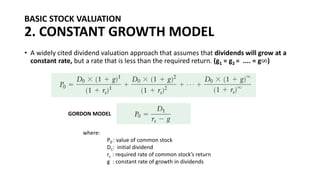
2. CONSTANT GROWTH MODEL
• A widely cited dividend valuation approach that assumes that dividends will grow at a
constant rate, but a rate that is less than the required return. (g1 = g2 = .... = g∞)
where:
P0 : value of common stock
D1: initial dividend
rs : required rate of common stock’s return
g : constant rate of growth in dividends
GORDON MODEL
BASIC STOCK VALUATION
2. CONSTANT GROWTH MODEL
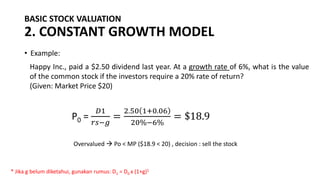
• Example:
Happy Inc., paid a $2.50 dividend last year. At a growth rate of 6%, what is the value
of the common stock if the investors require a 20% rate of return?
(Given: Market Price $20)
P0 =
𝐷1
𝑟𝑠−𝑔
=
2.50 1+0.06
20%−6%
= $18.9
Overvalued → Po < MP ($18.9 < 20) , decision : sell the stock
* Jika g belum diketahui, gunakan rumus: D1 = D0 x (1+g)1
BASIC STOCK VALUATION
3. VARIABLE-GROWTH MODEL
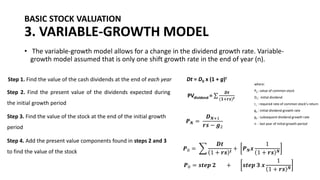
• The variable-growth model allows for a change in the dividend growth rate. Variable-
growth model assumed that is only one shift growth rate in the end of year (n).
Step 1. Find the value of the cash dividends at the end of each year Dt = D0 x (1 + g)t
Step 2. Find the present value of the dividends expected during
the initial growth period
PVdividend = σ
𝑫𝒕
(𝟏+𝒓𝒔)𝒕
Step 3. Find the value of the stock at the end of the initial growth
period
𝑷𝑵 =
𝑫𝑵+1
𝒓𝒔 − 𝒈2
Step 4. Add the present value components found in steps 2 and 3
to find the value of the stock
𝑷0 = ෍
𝑫𝒕
1 + 𝒓𝒔 𝒕
+ 𝑷𝑵𝒙
1
1 + 𝒓𝒔 𝑵
where:
P0 : value of common stock
D1: initial dividend
rs : required rate of common stock’s return
g1 : initial dividend growth rate
g2 : subsequent dividend growth rate
n : last year of initial growth period
𝑷0 = 𝒔𝒕𝒆𝒑 𝟐 + 𝒔𝒕𝒆𝒑 𝟑 𝒙
1
1 + 𝒓𝒔 𝑵
BASIC STOCK VALUATION
3. VARIABLE-GROWTH MODEL
Example:
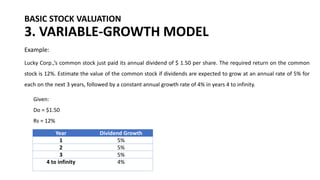
Lucky Corp.,’s common stock just paid its annual dividend of $ 1.50 per share. The required return on the common
stock is 12%. Estimate the value of the common stock if dividends are expected to grow at an annual rate of 5% for
each on the next 3 years, followed by a constant annual growth rate of 4% in years 4 to infinity.
Given:
Do = $1.50
Rs = 12%
Year Dividend Growth
1 5%
2 5%
3 5%
4 to infinity 4%
BASIC STOCK VALUATION
3. VARIABLE-GROWTH MODEL
Example:
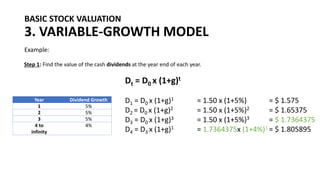
Step 1: Find the value of the cash dividends at the year end of each year.
Dt = D0 x (1+g)t
D1 = D0 x (1+g)1 = 1.50 x (1+5%) = $ 1.575
D2 = D0 x (1+g)2 = 1.50 x (1+5%)2 = $ 1.65375
D3 = D0 x (1+g)3 = 1.50 x (1+5%)3 = $ 1.7364375
D4 = D3 x (1+g)1 = 1.7364375x (1+4%)1 = $ 1.805895
Year Dividend Growth
1 5%
2 5%
3 5%
4 to
infinity
4%
BASIC STOCK VALUATION
3. VARIABLE-GROWTH MODEL
Example:
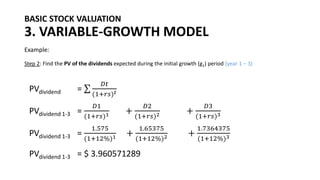
Step 2: Find the PV of the dividends expected during the initial growth (g1) period (year 1 – 3)
PVdividend = σ
𝐷𝑡
(1+𝑟𝑠)𝑡
PVdividend 1-3 =
𝐷1
(1+𝑟𝑠)1 +
𝐷2
(1+𝑟𝑠)2 +
𝐷3
(1+𝑟𝑠)3
PVdividend 1-3 =
1.575
(1+12%)1 +
1.65375
(1+12%)2 +
1.7364375
(1+12%)3
PVdividend 1-3 = $ 3.960571289
BASIC STOCK VALUATION
3. VARIABLE-GROWTH MODEL
Example:
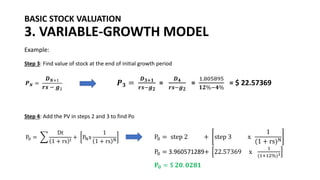
Step 3: Find value of stock at the end of initial growth period
𝑷𝑵 =
𝑫𝑵+1
𝒓𝒔 − 𝒈2
𝑷𝟑 =
𝑫𝟑+𝟏
𝒓𝒔−𝒈𝟐
=
𝑫𝟒
𝒓𝒔−𝒈𝟐
=
1.805895
𝟏𝟐%−𝟒%
= $ 22.57369
Step 4: Add the PV in steps 2 and 3 to find Po
P0 = ෍
Dt
1 + rs t
+ PNx
1
1 + rs N
P0 = step 2 + step 3 x
1
(1 + rs)N
P0 = 3.960571289+ 22.57369 x
1
(1+12%)3
𝐏𝟎 = $ 𝟐𝟎. 𝟎𝟐𝟖𝟏
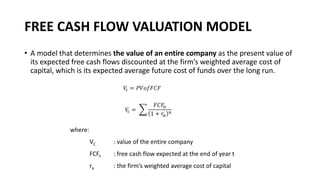
FREE CASH FLOW VALUATION MODEL
• A model that determines the value of an entire company as the present value of
its expected free cash flows discounted at the firm’s weighted average cost of
capital, which is its expected average future cost of funds over the long run.
where:
VC : value of the entire company
FCFt : free cash flow expected at the end of year t
ra : the firm’s weighted average cost of capital
𝑉
𝑐 = 𝑃𝑉𝑜𝑓𝐹𝐶𝐹
𝑉
𝑐 = ෍
𝐹𝐶𝐹𝑛
1 + 𝑟𝑎
𝑛
FREE CASH FLOW VALUATION MODEL
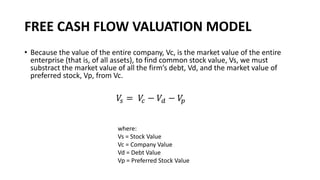
• Because the value of the entire company, Vc, is the market value of the entire
enterprise (that is, of all assets), to find common stock value, Vs, we must
substract the market value of all the firm’s debt, Vd, and the market value of
preferred stock, Vp, from Vc.
where:
Vs = Stock Value
Vc = Company Value
Vd = Debt Value
Vp = Preferred Stock Value
𝑉
𝑠 = 𝑉
𝑐 − 𝑉𝑑 − 𝑉
𝑝
FREE CASH FLOW VALUATION MODEL
CASE:
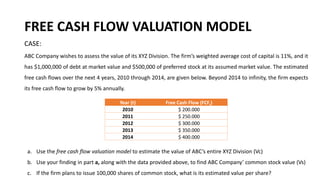
ABC Company wishes to assess the value of its XYZ Division. The firm’s weighted average cost of capital is 11%, and it
has $1,000,000 of debt at market value and $500,000 of preferred stock at its assumed market value. The estimated
free cash flows over the next 4 years, 2010 through 2014, are given below. Beyond 2014 to infinity, the firm expects
its free cash flow to grow by 5% annually.
Year (t) Free Cash Flow (FCFt)
2010 $ 200.000
2011 $ 250.000
2012 $ 300.000
2013 $ 350.000
2014 $ 400.000
a. Use the free cash flow valuation model to estimate the value of ABC’s entire XYZ Division (Vc)
b. Use your finding in part a, along with the data provided above, to find ABC Company’ common stock value (Vs)
c. If the firm plans to issue 100,000 shares of common stock, what is its estimated value per share?
FREE CASH FLOW VALUATION MODEL
CASE:
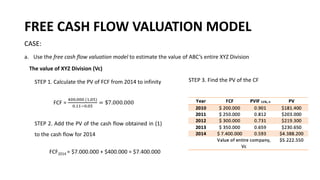
a. Use the free cash flow valuation model to estimate the value of ABC’s entire XYZ Division
The value of XYZ Division (Vc)
STEP 1. Calculate the PV of FCF from 2014 to infinity
FCF =
400.000 (1,05)
0.11−0.05
= $7.000.000
STEP 2. Add the PV of the cash flow obtained in (1)
to the cash flow for 2014
FCF2014 = $7.000.000 + $400.000 = $7.400.000
STEP 3. Find the PV of the CF
FREE CASH FLOW VALUATION MODEL
CASE:
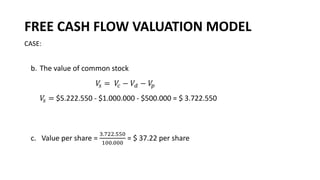
b. The value of common stock
𝑉
𝑠 = 𝑉
𝑐 − 𝑉𝑑 − 𝑉
𝑝
𝑉
𝑠 = $5.222.550 - $1.000.000 - $500.000 = $ 3.722.550
c. Value per share =
3.722.550
100.000
= $ 37.22 per share
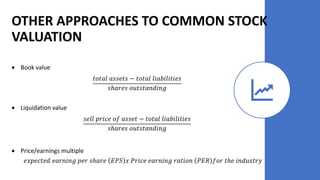
• Book value
𝑡𝑜𝑡𝑎𝑙 𝑎𝑠𝑠𝑒𝑡𝑠 − 𝑡𝑜𝑡𝑎𝑙 𝑙𝑖𝑎𝑏𝑖𝑙𝑖𝑡𝑖𝑒𝑠
𝑠ℎ𝑎𝑟𝑒𝑠 𝑜𝑢𝑡𝑠𝑡𝑎𝑛𝑑𝑖𝑛𝑔
• Liquidation value
𝑠𝑒𝑙𝑙 𝑝𝑟𝑖𝑐𝑒 𝑜𝑓 𝑎𝑠𝑠𝑒𝑡 − 𝑡𝑜𝑡𝑎𝑙 𝑙𝑖𝑎𝑏𝑖𝑙𝑖𝑡𝑖𝑒𝑠
𝑠ℎ𝑎𝑟𝑒𝑠 𝑜𝑢𝑡𝑠𝑡𝑎𝑛𝑑𝑖𝑛𝑔
• Price/earnings multiple
𝑒𝑥𝑝𝑒𝑐𝑡𝑒𝑑 𝑒𝑎𝑟𝑛𝑖𝑛𝑔 𝑝𝑒𝑟 𝑠ℎ𝑎𝑟𝑒 𝐸𝑃𝑆 𝑥 𝑃𝑟𝑖𝑐𝑒 𝑒𝑎𝑟𝑛𝑖𝑛𝑔 𝑟𝑎𝑡𝑖𝑜𝑛 𝑃𝐸𝑅 𝑓𝑜𝑟 𝑡ℎ𝑒 𝑖𝑛𝑑𝑢𝑠𝑡𝑟𝑦
OTHER APPROACHES TO COMMON STOCK
VALUATION


Stock Valuation-Financial Management.pdf

  • 1.
  • 2.
    LEARNING GOALS 1. Marketefficiency 2. Basic stock valuation (zero, constant, and variable growth) 3. Free cash flow valuation 4. Other Approaches to Common Stock Valuation
  • 3.
    COMMON STOCK VALUATION •INVESTING: Common stockholders expect to be rewarded through periodic cash dividends and an increasing share value • TRADING: speculative motive UNDERVALUED BUY OVERVALUED SELL MARKET PRICE < VALUATION MARKET PRICE > VALUATION
  • 4.
    MARKET EFFICIENCY • Economicallyrational buyers and sellers use their assessment of an asset’s risk and return to determine its value • In competitive market with many active participant, the interactions of many buyers and sellers result in an equilibrium price - the market value – for each security. • Because the flow of the new information is almost constant, stock prices fluctuate, continously moving toward a new equilibrium that reflects the most recent information available. This general concept is known as market efficiency.
  • 5.
    MARKET EFFICIENCY • Theefficient-market hypothesis (EMH) is a theory describing the behavior of an assumed “perfect” market in which: Securities are in equilibrium Security prices fully reflect all availble information and react swiftly to new information, and Because stocks are fully and fairly priced, investors need not waste time looking for mispriced securities
  • 6.
    BASIC STOCK VALUATION •In finding the value of a common stock (P0), we should discount all future expected dividends (D1, D2, D3, ..., D∞ ) to the present at the required rate of return for the stockholder (rs) where: P0 : value of common stock D : dividend rs : required rate of common stock’s return
  • 7.
    BASIC STOCK VALUATION 1.ZERO GROWTH MODEL • An approach to dividend valuation that assumes a constant, nongrowing dividend stream. In terms of the notation already introduced D1 = D2 = .... = D∞ where: P0 : value of common stock D : dividend rs : required rate of common stock’s return
  • 8.
    BASIC STOCK VALUATION 1.ZERO GROWTH MODEL • Example: Chuck Swimmer estimates that the dividend of Denham Company, an established textile producer, is expected to remain constant at $3 per share indefinitely. If his required return on its stock is 15%, the stock’s value is: P0 = 𝐷1 𝑟𝑠 = $3 15% = $20
  • 9.
    BASIC STOCK VALUATION 2.CONSTANT GROWTH MODEL • A widely cited dividend valuation approach that assumes that dividends will grow at a constant rate, but a rate that is less than the required return. (g1 = g2 = .... = g∞) where: P0 : value of common stock D1: initial dividend rs : required rate of common stock’s return g : constant rate of growth in dividends GORDON MODEL
  • 10.
    BASIC STOCK VALUATION 2.CONSTANT GROWTH MODEL • Example: Happy Inc., paid a $2.50 dividend last year. At a growth rate of 6%, what is the value of the common stock if the investors require a 20% rate of return? (Given: Market Price $20) P0 = 𝐷1 𝑟𝑠−𝑔 = 2.50 1+0.06 20%−6% = $18.9 Overvalued → Po < MP ($18.9 < 20) , decision : sell the stock * Jika g belum diketahui, gunakan rumus: D1 = D0 x (1+g)1
  • 11.
    BASIC STOCK VALUATION 3.VARIABLE-GROWTH MODEL • The variable-growth model allows for a change in the dividend growth rate. Variable- growth model assumed that is only one shift growth rate in the end of year (n). Step 1. Find the value of the cash dividends at the end of each year Dt = D0 x (1 + g)t Step 2. Find the present value of the dividends expected during the initial growth period PVdividend = σ 𝑫𝒕 (𝟏+𝒓𝒔)𝒕 Step 3. Find the value of the stock at the end of the initial growth period 𝑷𝑵 = 𝑫𝑵+1 𝒓𝒔 − 𝒈2 Step 4. Add the present value components found in steps 2 and 3 to find the value of the stock 𝑷0 = ෍ 𝑫𝒕 1 + 𝒓𝒔 𝒕 + 𝑷𝑵𝒙 1 1 + 𝒓𝒔 𝑵 where: P0 : value of common stock D1: initial dividend rs : required rate of common stock’s return g1 : initial dividend growth rate g2 : subsequent dividend growth rate n : last year of initial growth period 𝑷0 = 𝒔𝒕𝒆𝒑 𝟐 + 𝒔𝒕𝒆𝒑 𝟑 𝒙 1 1 + 𝒓𝒔 𝑵
  • 12.
    BASIC STOCK VALUATION 3.VARIABLE-GROWTH MODEL Example: Lucky Corp.,’s common stock just paid its annual dividend of $ 1.50 per share. The required return on the common stock is 12%. Estimate the value of the common stock if dividends are expected to grow at an annual rate of 5% for each on the next 3 years, followed by a constant annual growth rate of 4% in years 4 to infinity. Given: Do = $1.50 Rs = 12% Year Dividend Growth 1 5% 2 5% 3 5% 4 to infinity 4%
  • 13.
    BASIC STOCK VALUATION 3.VARIABLE-GROWTH MODEL Example: Step 1: Find the value of the cash dividends at the year end of each year. Dt = D0 x (1+g)t D1 = D0 x (1+g)1 = 1.50 x (1+5%) = $ 1.575 D2 = D0 x (1+g)2 = 1.50 x (1+5%)2 = $ 1.65375 D3 = D0 x (1+g)3 = 1.50 x (1+5%)3 = $ 1.7364375 D4 = D3 x (1+g)1 = 1.7364375x (1+4%)1 = $ 1.805895 Year Dividend Growth 1 5% 2 5% 3 5% 4 to infinity 4%
  • 14.
    BASIC STOCK VALUATION 3.VARIABLE-GROWTH MODEL Example: Step 2: Find the PV of the dividends expected during the initial growth (g1) period (year 1 – 3) PVdividend = σ 𝐷𝑡 (1+𝑟𝑠)𝑡 PVdividend 1-3 = 𝐷1 (1+𝑟𝑠)1 + 𝐷2 (1+𝑟𝑠)2 + 𝐷3 (1+𝑟𝑠)3 PVdividend 1-3 = 1.575 (1+12%)1 + 1.65375 (1+12%)2 + 1.7364375 (1+12%)3 PVdividend 1-3 = $ 3.960571289
  • 15.
    BASIC STOCK VALUATION 3.VARIABLE-GROWTH MODEL Example: Step 3: Find value of stock at the end of initial growth period 𝑷𝑵 = 𝑫𝑵+1 𝒓𝒔 − 𝒈2 𝑷𝟑 = 𝑫𝟑+𝟏 𝒓𝒔−𝒈𝟐 = 𝑫𝟒 𝒓𝒔−𝒈𝟐 = 1.805895 𝟏𝟐%−𝟒% = $ 22.57369 Step 4: Add the PV in steps 2 and 3 to find Po P0 = ෍ Dt 1 + rs t + PNx 1 1 + rs N P0 = step 2 + step 3 x 1 (1 + rs)N P0 = 3.960571289+ 22.57369 x 1 (1+12%)3 𝐏𝟎 = $ 𝟐𝟎. 𝟎𝟐𝟖𝟏
  • 16.
    FREE CASH FLOWVALUATION MODEL • A model that determines the value of an entire company as the present value of its expected free cash flows discounted at the firm’s weighted average cost of capital, which is its expected average future cost of funds over the long run. where: VC : value of the entire company FCFt : free cash flow expected at the end of year t ra : the firm’s weighted average cost of capital 𝑉 𝑐 = 𝑃𝑉𝑜𝑓𝐹𝐶𝐹 𝑉 𝑐 = ෍ 𝐹𝐶𝐹𝑛 1 + 𝑟𝑎 𝑛
  • 17.
    FREE CASH FLOWVALUATION MODEL • Because the value of the entire company, Vc, is the market value of the entire enterprise (that is, of all assets), to find common stock value, Vs, we must substract the market value of all the firm’s debt, Vd, and the market value of preferred stock, Vp, from Vc. where: Vs = Stock Value Vc = Company Value Vd = Debt Value Vp = Preferred Stock Value 𝑉 𝑠 = 𝑉 𝑐 − 𝑉𝑑 − 𝑉 𝑝
  • 18.
    FREE CASH FLOWVALUATION MODEL CASE: ABC Company wishes to assess the value of its XYZ Division. The firm’s weighted average cost of capital is 11%, and it has $1,000,000 of debt at market value and $500,000 of preferred stock at its assumed market value. The estimated free cash flows over the next 4 years, 2010 through 2014, are given below. Beyond 2014 to infinity, the firm expects its free cash flow to grow by 5% annually. Year (t) Free Cash Flow (FCFt) 2010 $ 200.000 2011 $ 250.000 2012 $ 300.000 2013 $ 350.000 2014 $ 400.000 a. Use the free cash flow valuation model to estimate the value of ABC’s entire XYZ Division (Vc) b. Use your finding in part a, along with the data provided above, to find ABC Company’ common stock value (Vs) c. If the firm plans to issue 100,000 shares of common stock, what is its estimated value per share?
  • 19.
    FREE CASH FLOWVALUATION MODEL CASE: a. Use the free cash flow valuation model to estimate the value of ABC’s entire XYZ Division The value of XYZ Division (Vc) STEP 1. Calculate the PV of FCF from 2014 to infinity FCF = 400.000 (1,05) 0.11−0.05 = $7.000.000 STEP 2. Add the PV of the cash flow obtained in (1) to the cash flow for 2014 FCF2014 = $7.000.000 + $400.000 = $7.400.000 STEP 3. Find the PV of the CF
  • 20.
    FREE CASH FLOWVALUATION MODEL CASE: b. The value of common stock 𝑉 𝑠 = 𝑉 𝑐 − 𝑉𝑑 − 𝑉 𝑝 𝑉 𝑠 = $5.222.550 - $1.000.000 - $500.000 = $ 3.722.550 c. Value per share = 3.722.550 100.000 = $ 37.22 per share
  • 21.
    • Book value 𝑡𝑜𝑡𝑎𝑙𝑎𝑠𝑠𝑒𝑡𝑠 − 𝑡𝑜𝑡𝑎𝑙 𝑙𝑖𝑎𝑏𝑖𝑙𝑖𝑡𝑖𝑒𝑠 𝑠ℎ𝑎𝑟𝑒𝑠 𝑜𝑢𝑡𝑠𝑡𝑎𝑛𝑑𝑖𝑛𝑔 • Liquidation value 𝑠𝑒𝑙𝑙 𝑝𝑟𝑖𝑐𝑒 𝑜𝑓 𝑎𝑠𝑠𝑒𝑡 − 𝑡𝑜𝑡𝑎𝑙 𝑙𝑖𝑎𝑏𝑖𝑙𝑖𝑡𝑖𝑒𝑠 𝑠ℎ𝑎𝑟𝑒𝑠 𝑜𝑢𝑡𝑠𝑡𝑎𝑛𝑑𝑖𝑛𝑔 • Price/earnings multiple 𝑒𝑥𝑝𝑒𝑐𝑡𝑒𝑑 𝑒𝑎𝑟𝑛𝑖𝑛𝑔 𝑝𝑒𝑟 𝑠ℎ𝑎𝑟𝑒 𝐸𝑃𝑆 𝑥 𝑃𝑟𝑖𝑐𝑒 𝑒𝑎𝑟𝑛𝑖𝑛𝑔 𝑟𝑎𝑡𝑖𝑜𝑛 𝑃𝐸𝑅 𝑓𝑜𝑟 𝑡ℎ𝑒 𝑖𝑛𝑑𝑢𝑠𝑡𝑟𝑦 OTHER APPROACHES TO COMMON STOCK VALUATION