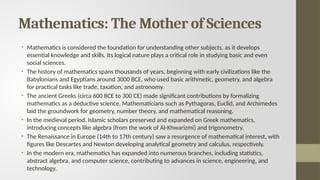
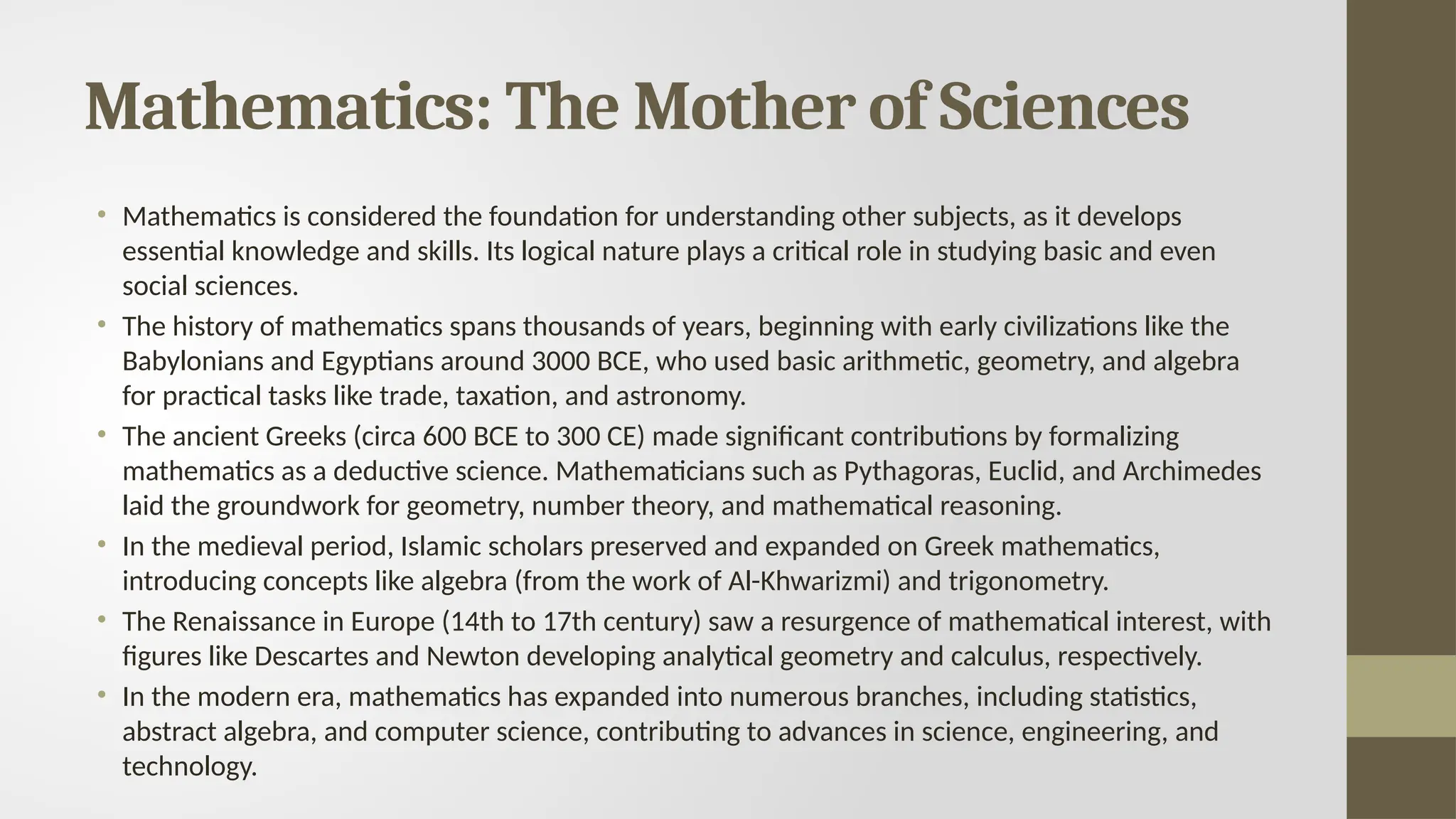
Mathematics: The Mother of Sciences
• Mathematics is considered the foundation for understanding other subjects, as it develops
essential knowledge and skills. Its logical nature plays a critical role in studying basic and even
social sciences.
• The history of mathematics spans thousands of years, beginning with early civilizations like the
Babylonians and Egyptians around 3000 BCE, who used basic arithmetic, geometry, and algebra
for practical tasks like trade, taxation, and astronomy.
• The ancient Greeks (circa 600 BCE to 300 CE) made significant contributions by formalizing
mathematics as a deductive science. Mathematicians such as Pythagoras, Euclid, and Archimedes
laid the groundwork for geometry, number theory, and mathematical reasoning.
• In the medieval period, Islamic scholars preserved and expanded on Greek mathematics,
introducing concepts like algebra (from the work of Al-Khwarizmi) and trigonometry.
• The Renaissance in Europe (14th to 17th century) saw a resurgence of mathematical interest, with
figures like Descartes and Newton developing analytical geometry and calculus, respectively.
• In the modern era, mathematics has expanded into numerous branches, including statistics,
abstract algebra, and computer science, contributing to advances in science, engineering, and
technology.
Mathematics Definition
Mathematics:
 Mathematics is a vast field that deals with the study of numbers, quantities, shapes,
structure and relationship between them. It involves the use of logical reasoning,
problem-solving skills, and mathematical symbols to express and analyze
mathematical ideas.
 Mathematics can be broadly divided into several branches, including:
Arithmetic:
 The study of numbers and their operations, such as addition, subtraction,
multiplication, and division.
Algebra:
 The study of variables and their relationships, often expressed through equations and
functions.
Geometry:
 The study of shapes, sizes, and positions of objects, including points, lines, angles,
and planes.
Branches of Mathematics
Calculus:
The study of rates of change, accumulation, and optimization, often
used to model real-world phenomena like motion, growth etc.
Number Theory:
The study of properties and behavior of integers and other whole
numbers.
Statistics:
The study of collecting, analyzing, interpreting, presenting, and
organizing data.
Topology:
The study of the properties of shapes and spaces.
Mathematics Definition
Mathematics is used in various fields to:
Model real-world phenomena:
Math is used to describe and analyze complex systems, such as population growth,
financial markets, and weather patterns.
Solve problems:
Math is used to find solutions to practical problems in fields like engineering,
physics, computer science, and economics.
Make predictions:
Math is used to make predictions about future events or outcomes based on data and
patterns.
Communicate ideas:
Math is used to express complex ideas and theories in a concise and precise manner.
Understand the natural world:
Math is used to describe the fundamental laws of physics, chemistry, and biology.
The Need and Importance of Teaching Mathematics:
Mathematics is a fundamental subject that plays a crucial role in various aspects of
life. It is essential for individuals to develop a strong foundation in mathematics to
succeed in their personal and professional lives. Here are some reasons why
teaching mathematics is crucial:
Problem-Solving Skills:
Mathematics helps students develop problem-solving skills, which are essential for
everyday life. By learning mathematical concepts, students can approach problems in a
logical and methodical way, making them more effective problem solvers.
Critical Thinking:
Mathematics requires critical thinking, which is valuable in many areas of life.
Students learn to analyze situations, identify patterns, and make informed decisions.
Science and Technology:
Mathematics is the language of science and technology. Without a strong understanding
of mathematical concepts, students may struggle to comprehend scientific and
technological advancements.
The Need and Importance of Teaching Mathematics:
Career Opportunities:
Mathematics is a key component in many careers, including science, engineering,
economics, finance, and medicine. A strong foundation in mathematics can open doors
to various career opportunities.
Real-World Applications:
Mathematics has numerous real-world applications, such as finance, data analysis, and
computer programming. Students learn to apply mathematical concepts to real-world
problems, making them more relevant and engaging.
Building Confidence:
Mathematics can help build confidence in students, especially when they understand
and can apply mathematical concepts to solve problems.
Developing Analytical Skills:
Mathematics helps students develop analytical skills, which are essential for evaluating
information, making informed decisions, and solving complex problems.
The Need and Importance of Teaching Mathematics:
Enhancing Creativity:
Mathematics can foster creativity by encouraging students to think outside the box
and explore new ideas and solutions.
Improving Cognitive Skills:
Mathematics has been shown to improve cognitive skills, such as memory,
attention, and spatial awareness.
Enhancing Spatial Awareness:
Mathematics helps students develop spatial awareness, which is essential for
understanding geometry, architecture, engineering, and other fields.
In conclusion, teaching mathematics is essential for developing problem-
solving skills, critical thinking, science and technology literacy, career
opportunities, and many other important skills that are valuable in everyday
life. By emphasizing the importance of mathematics education, we can inspire
students to develop a love for mathematics and prepare them for success in an
increasingly complex world.
NATURE, SCOPEAND IMPORTANCE OF MATHEMATICS
• Scope of Mathematics:
The Origin and Significance of Mathematics:
Mathematics comes from the Greek word "máthēma", meaning "related to learning" or
"studious". It is the study of numbers, sets, measurement, relationships, and patterns
using numbers and symbols.
Mathematics in Science and Everyday Life:
Mathematics is not just about numbers and geometry; it's a diverse discipline that deals
with measurements, data, observations, assumptions, deductions, conclusions, and
proof. It's also used in mathematical models of natural phenomena, human behavior, and
social systems.
Mathematics as a Science:
Mathematics is considered a science of pattern and order, focusing on algorithms,
numbers, formulas, and change. It's based on logic, not observation. Theorems and
theories are important and useful, and mathematical methods of thinking are flexible and
influential.
NATURE, SCOPEAND IMPORTANCE OF MATHEMATICS
• Scope of Mathematics:
The Importance of Mathematics in Education:
Mathematics provides a base of truth and a standard of certainty. It gives
students unique methods of thinking, which are essential for critical thinking,
problem-solving, and decision-making. In today's technological age,
mathematical thinking is a valuable competency that enables us to understand
the world better.
The Development of Mathematics:
Mathematics has developed rapidly over the centuries, with significant
contributions from scientists like Isaac Newton. The development of
electronic computing has made it possible to examine patterns and test
assumptions more efficiently.
The Importance of Mathematics in Everyday Life:
Mathematics is involved in many aspects of our daily lives, from simple tasks
to complex problems. It helps us make decisions, solve problems, and
understand the world around us.
NATURE, SCOPEAND IMPORTANCE OF MATHEMATICS
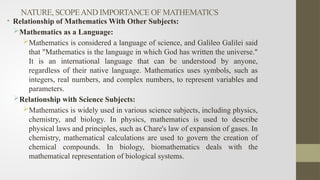
• Relationship of Mathematics With Other Subjects:
Mathematics as a Language:
Mathematics is considered a language of science, and Galileo Galilei said
that "Mathematics is the language in which God has written the universe."
It is an international language that can be understood by anyone,
regardless of their native language. Mathematics uses symbols, such as
integers, real numbers, and complex numbers, to represent variables and
parameters.
Relationship with Science Subjects:
Mathematics is widely used in various science subjects, including physics,
chemistry, and biology. In physics, mathematics is used to describe
physical laws and principles, such as Chare's law of expansion of gases. In
chemistry, mathematical calculations are used to govern the creation of
chemical compounds. In biology, biomathematics deals with the
mathematical representation of biological systems.
NATURE, SCOPEAND IMPORTANCE OF MATHEMATICS
• Relationship of Mathematics With Other Subjects:
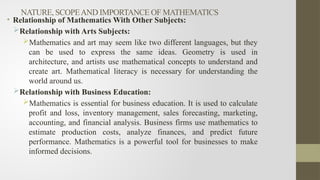
Relationship with Arts Subjects:
Mathematics and art may seem like two different languages, but they
can be used to express the same ideas. Geometry is used in
architecture, and artists use mathematical concepts to understand and
create art. Mathematical literacy is necessary for understanding the
world around us.
Relationship with Business Education:
Mathematics is essential for business education. It is used to calculate
profit and loss, inventory management, sales forecasting, marketing,
accounting, and financial analysis. Business firms use mathematics to
estimate production costs, analyze finances, and predict future
performance. Mathematics is a powerful tool for businesses to make
informed decisions.
NATURE, SCOPEAND IMPORTANCE OF MATHEMATICS
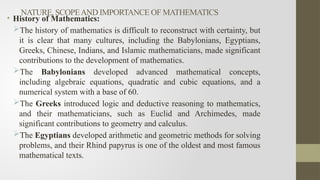
• History of Mathematics:
The history of mathematics is difficult to reconstruct with certainty, but
it is clear that many cultures, including the Babylonians, Egyptians,
Greeks, Chinese, Indians, and Islamic mathematicians, made significant
contributions to the development of mathematics.
The Babylonians developed advanced mathematical concepts,
including algebraic equations, quadratic and cubic equations, and a
numerical system with a base of 60.
The Greeks introduced logic and deductive reasoning to mathematics,
and their mathematicians, such as Euclid and Archimedes, made
significant contributions to geometry and calculus.
The Egyptians developed arithmetic and geometric methods for solving
problems, and their Rhind papyrus is one of the oldest and most famous
mathematical texts.
NATURE, SCOPEAND IMPORTANCE OF MATHEMATICS
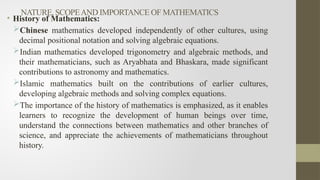
• History of Mathematics:
Chinese mathematics developed independently of other cultures, using
decimal positional notation and solving algebraic equations.
Indian mathematics developed trigonometry and algebraic methods, and
their mathematicians, such as Aryabhata and Bhaskara, made significant
contributions to astronomy and mathematics.
Islamic mathematics built on the contributions of earlier cultures,
developing algebraic methods and solving complex equations.
The importance of the history of mathematics is emphasized, as it enables
learners to recognize the development of human beings over time,
understand the connections between mathematics and other branches of
science, and appreciate the achievements of mathematicians throughout
history.
Thank You!

Teaching of Mathematics chapter number 1

  • 1.
    Mathematics: The Motherof Sciences • Mathematics is considered the foundation for understanding other subjects, as it develops essential knowledge and skills. Its logical nature plays a critical role in studying basic and even social sciences. • The history of mathematics spans thousands of years, beginning with early civilizations like the Babylonians and Egyptians around 3000 BCE, who used basic arithmetic, geometry, and algebra for practical tasks like trade, taxation, and astronomy. • The ancient Greeks (circa 600 BCE to 300 CE) made significant contributions by formalizing mathematics as a deductive science. Mathematicians such as Pythagoras, Euclid, and Archimedes laid the groundwork for geometry, number theory, and mathematical reasoning. • In the medieval period, Islamic scholars preserved and expanded on Greek mathematics, introducing concepts like algebra (from the work of Al-Khwarizmi) and trigonometry. • The Renaissance in Europe (14th to 17th century) saw a resurgence of mathematical interest, with figures like Descartes and Newton developing analytical geometry and calculus, respectively. • In the modern era, mathematics has expanded into numerous branches, including statistics, abstract algebra, and computer science, contributing to advances in science, engineering, and technology.
  • 2.
    Mathematics Definition Mathematics:  Mathematicsis a vast field that deals with the study of numbers, quantities, shapes, structure and relationship between them. It involves the use of logical reasoning, problem-solving skills, and mathematical symbols to express and analyze mathematical ideas.  Mathematics can be broadly divided into several branches, including: Arithmetic:  The study of numbers and their operations, such as addition, subtraction, multiplication, and division. Algebra:  The study of variables and their relationships, often expressed through equations and functions. Geometry:  The study of shapes, sizes, and positions of objects, including points, lines, angles, and planes.
  • 3.
    Branches of Mathematics Calculus: Thestudy of rates of change, accumulation, and optimization, often used to model real-world phenomena like motion, growth etc. Number Theory: The study of properties and behavior of integers and other whole numbers. Statistics: The study of collecting, analyzing, interpreting, presenting, and organizing data. Topology: The study of the properties of shapes and spaces.
  • 4.
    Mathematics Definition Mathematics isused in various fields to: Model real-world phenomena: Math is used to describe and analyze complex systems, such as population growth, financial markets, and weather patterns. Solve problems: Math is used to find solutions to practical problems in fields like engineering, physics, computer science, and economics. Make predictions: Math is used to make predictions about future events or outcomes based on data and patterns. Communicate ideas: Math is used to express complex ideas and theories in a concise and precise manner. Understand the natural world: Math is used to describe the fundamental laws of physics, chemistry, and biology.
  • 5.
    The Need andImportance of Teaching Mathematics: Mathematics is a fundamental subject that plays a crucial role in various aspects of life. It is essential for individuals to develop a strong foundation in mathematics to succeed in their personal and professional lives. Here are some reasons why teaching mathematics is crucial: Problem-Solving Skills: Mathematics helps students develop problem-solving skills, which are essential for everyday life. By learning mathematical concepts, students can approach problems in a logical and methodical way, making them more effective problem solvers. Critical Thinking: Mathematics requires critical thinking, which is valuable in many areas of life. Students learn to analyze situations, identify patterns, and make informed decisions. Science and Technology: Mathematics is the language of science and technology. Without a strong understanding of mathematical concepts, students may struggle to comprehend scientific and technological advancements.
  • 6.
    The Need andImportance of Teaching Mathematics: Career Opportunities: Mathematics is a key component in many careers, including science, engineering, economics, finance, and medicine. A strong foundation in mathematics can open doors to various career opportunities. Real-World Applications: Mathematics has numerous real-world applications, such as finance, data analysis, and computer programming. Students learn to apply mathematical concepts to real-world problems, making them more relevant and engaging. Building Confidence: Mathematics can help build confidence in students, especially when they understand and can apply mathematical concepts to solve problems. Developing Analytical Skills: Mathematics helps students develop analytical skills, which are essential for evaluating information, making informed decisions, and solving complex problems.
  • 7.
    The Need andImportance of Teaching Mathematics: Enhancing Creativity: Mathematics can foster creativity by encouraging students to think outside the box and explore new ideas and solutions. Improving Cognitive Skills: Mathematics has been shown to improve cognitive skills, such as memory, attention, and spatial awareness. Enhancing Spatial Awareness: Mathematics helps students develop spatial awareness, which is essential for understanding geometry, architecture, engineering, and other fields. In conclusion, teaching mathematics is essential for developing problem- solving skills, critical thinking, science and technology literacy, career opportunities, and many other important skills that are valuable in everyday life. By emphasizing the importance of mathematics education, we can inspire students to develop a love for mathematics and prepare them for success in an increasingly complex world.
  • 8.
    NATURE, SCOPEAND IMPORTANCEOF MATHEMATICS • Scope of Mathematics: The Origin and Significance of Mathematics: Mathematics comes from the Greek word "máthēma", meaning "related to learning" or "studious". It is the study of numbers, sets, measurement, relationships, and patterns using numbers and symbols. Mathematics in Science and Everyday Life: Mathematics is not just about numbers and geometry; it's a diverse discipline that deals with measurements, data, observations, assumptions, deductions, conclusions, and proof. It's also used in mathematical models of natural phenomena, human behavior, and social systems. Mathematics as a Science: Mathematics is considered a science of pattern and order, focusing on algorithms, numbers, formulas, and change. It's based on logic, not observation. Theorems and theories are important and useful, and mathematical methods of thinking are flexible and influential.
  • 9.
    NATURE, SCOPEAND IMPORTANCEOF MATHEMATICS • Scope of Mathematics: The Importance of Mathematics in Education: Mathematics provides a base of truth and a standard of certainty. It gives students unique methods of thinking, which are essential for critical thinking, problem-solving, and decision-making. In today's technological age, mathematical thinking is a valuable competency that enables us to understand the world better. The Development of Mathematics: Mathematics has developed rapidly over the centuries, with significant contributions from scientists like Isaac Newton. The development of electronic computing has made it possible to examine patterns and test assumptions more efficiently. The Importance of Mathematics in Everyday Life: Mathematics is involved in many aspects of our daily lives, from simple tasks to complex problems. It helps us make decisions, solve problems, and understand the world around us.
  • 10.
    NATURE, SCOPEAND IMPORTANCEOF MATHEMATICS • Relationship of Mathematics With Other Subjects: Mathematics as a Language: Mathematics is considered a language of science, and Galileo Galilei said that "Mathematics is the language in which God has written the universe." It is an international language that can be understood by anyone, regardless of their native language. Mathematics uses symbols, such as integers, real numbers, and complex numbers, to represent variables and parameters. Relationship with Science Subjects: Mathematics is widely used in various science subjects, including physics, chemistry, and biology. In physics, mathematics is used to describe physical laws and principles, such as Chare's law of expansion of gases. In chemistry, mathematical calculations are used to govern the creation of chemical compounds. In biology, biomathematics deals with the mathematical representation of biological systems.
  • 11.
    NATURE, SCOPEAND IMPORTANCEOF MATHEMATICS • Relationship of Mathematics With Other Subjects: Relationship with Arts Subjects: Mathematics and art may seem like two different languages, but they can be used to express the same ideas. Geometry is used in architecture, and artists use mathematical concepts to understand and create art. Mathematical literacy is necessary for understanding the world around us. Relationship with Business Education: Mathematics is essential for business education. It is used to calculate profit and loss, inventory management, sales forecasting, marketing, accounting, and financial analysis. Business firms use mathematics to estimate production costs, analyze finances, and predict future performance. Mathematics is a powerful tool for businesses to make informed decisions.
  • 12.
    NATURE, SCOPEAND IMPORTANCEOF MATHEMATICS • History of Mathematics: The history of mathematics is difficult to reconstruct with certainty, but it is clear that many cultures, including the Babylonians, Egyptians, Greeks, Chinese, Indians, and Islamic mathematicians, made significant contributions to the development of mathematics. The Babylonians developed advanced mathematical concepts, including algebraic equations, quadratic and cubic equations, and a numerical system with a base of 60. The Greeks introduced logic and deductive reasoning to mathematics, and their mathematicians, such as Euclid and Archimedes, made significant contributions to geometry and calculus. The Egyptians developed arithmetic and geometric methods for solving problems, and their Rhind papyrus is one of the oldest and most famous mathematical texts.
  • 13.
    NATURE, SCOPEAND IMPORTANCEOF MATHEMATICS • History of Mathematics: Chinese mathematics developed independently of other cultures, using decimal positional notation and solving algebraic equations. Indian mathematics developed trigonometry and algebraic methods, and their mathematicians, such as Aryabhata and Bhaskara, made significant contributions to astronomy and mathematics. Islamic mathematics built on the contributions of earlier cultures, developing algebraic methods and solving complex equations. The importance of the history of mathematics is emphasized, as it enables learners to recognize the development of human beings over time, understand the connections between mathematics and other branches of science, and appreciate the achievements of mathematicians throughout history.
  • 14.