This document discusses state and non-state institutions. It defines institutions as formal or informal rules that constrain behavior. It differentiates between state institutions, which govern the state, and non-state institutions, which participate in international affairs without being part of a state. Specific examples of state institutions include government branches, agencies, and local governments. Examples of non-state institutions include banks, corporations, trade unions, cooperatives, development agencies, civil organizations, and transnational advocacy groups. The document provides descriptions of the forms and functions of different state and non-state institutions.
Introduction to UCSP, defining state and non-state institutions. Objectives focus on their forms, functions, and societal impact.
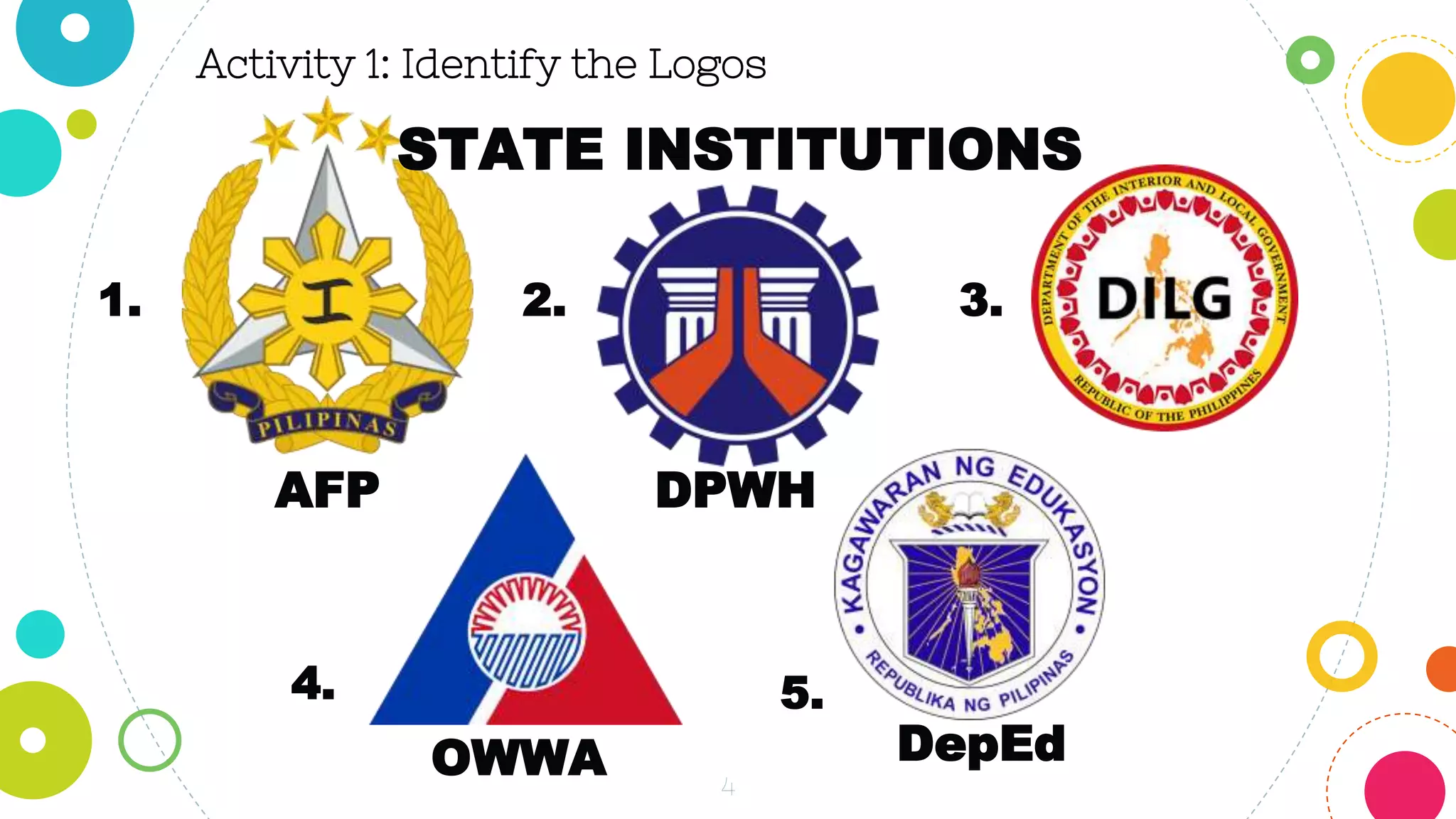
Activities on recognizing logos of state institutions and details of various state agencies, including local government units and constitutional commissions.
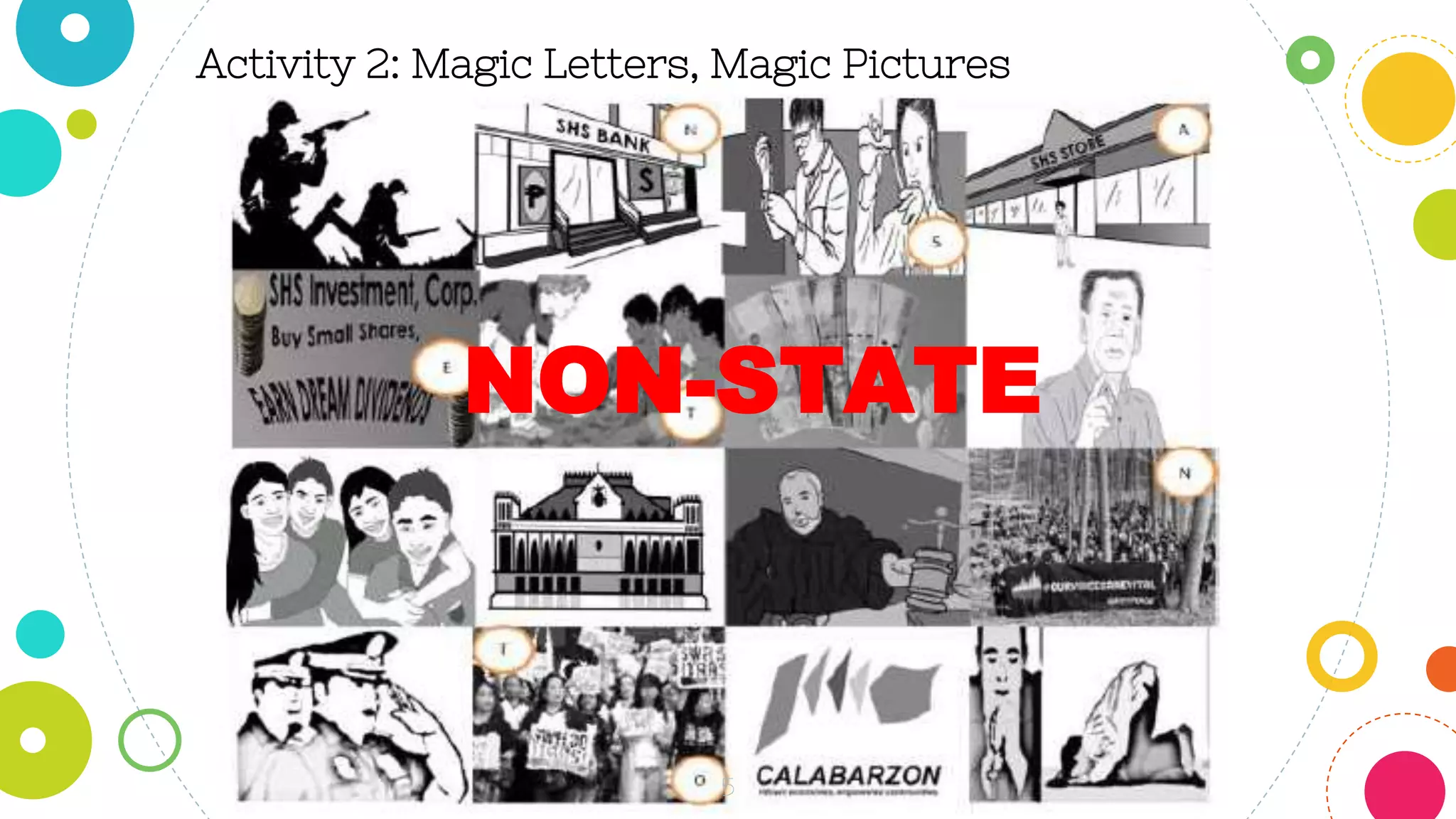
Definition and examples of non-state actors including banks, corporations, trade unions, cooperatives, development agencies, civil organizations, and advocacy groups.
Activities for self-reflection on state duties and the impact of non-state institutions, alongside an evaluation exercise.
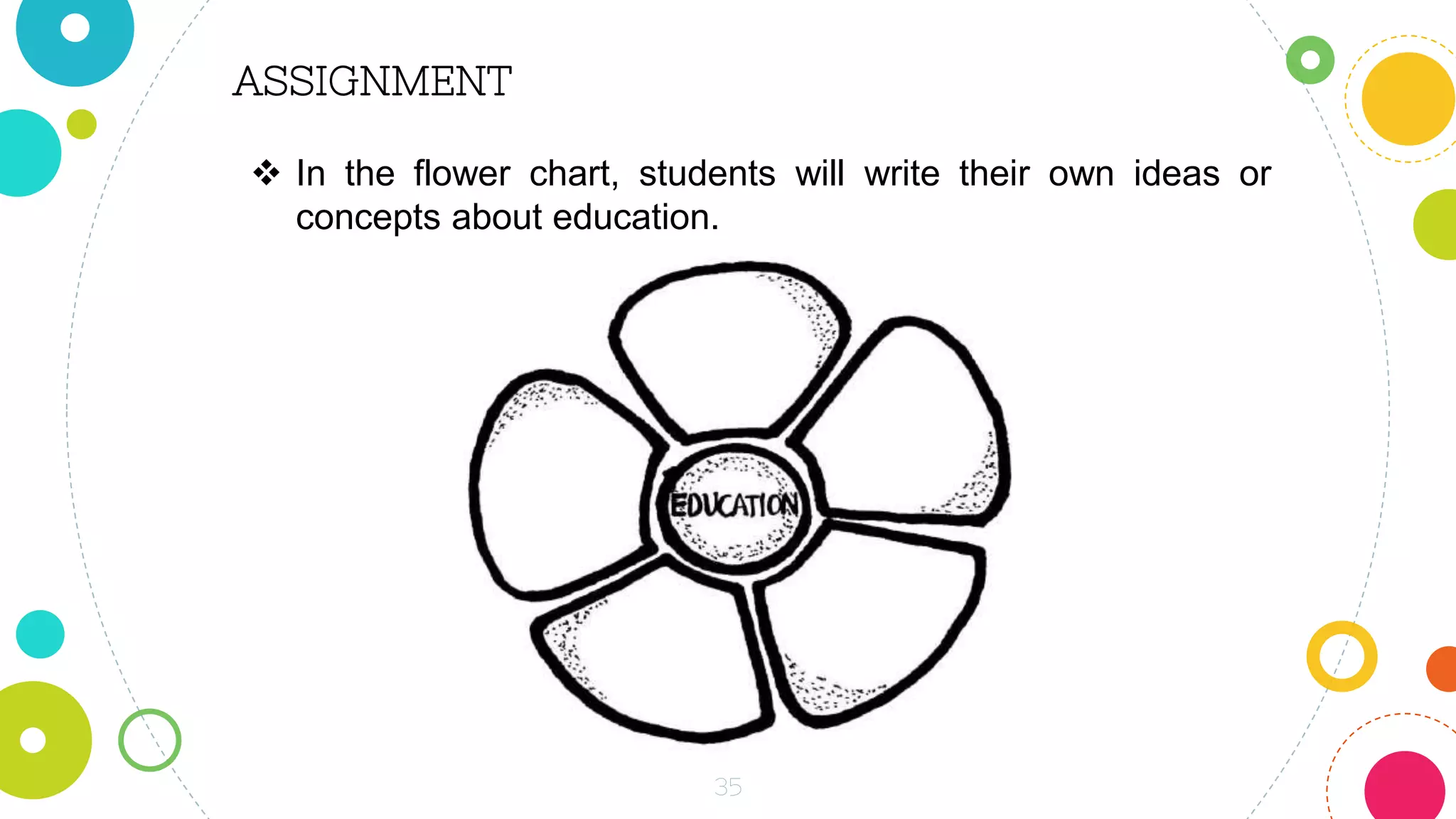
Instructions for an assignment on education concepts and a concluding thank-you note.
Most Essential
Learning Competency
OBJECTIVES
◎Describe the different forms of state and
non-state institutions.
◎ Differentiate the functions of state and non-
state institutions.
◎ Appraise the state and non-state institutions
in relation to personal development and
societal progress. 3
o Explain the forms and functions of
state and non-state institutions
What is an
Institution?
◎It is composed of a formal
rules, informal norms, or
agreed upon understanding
that constraint and prescribe
political actors’ behavior and
interaction wit one another.
◎ Main function: keep society
in order and implement
specific tasks assigned to
them.
◎ E.g. educational, economic,
political and social
institutions.
7
8.
Characteristics of
an Institution
oA cluster of social usage.
o Relative degree of permanence.
o Well known and defines
objectives.
o A bit resistant to social changes
due to well solidified beliefs.
o Transmitter of Social Heritage.
6
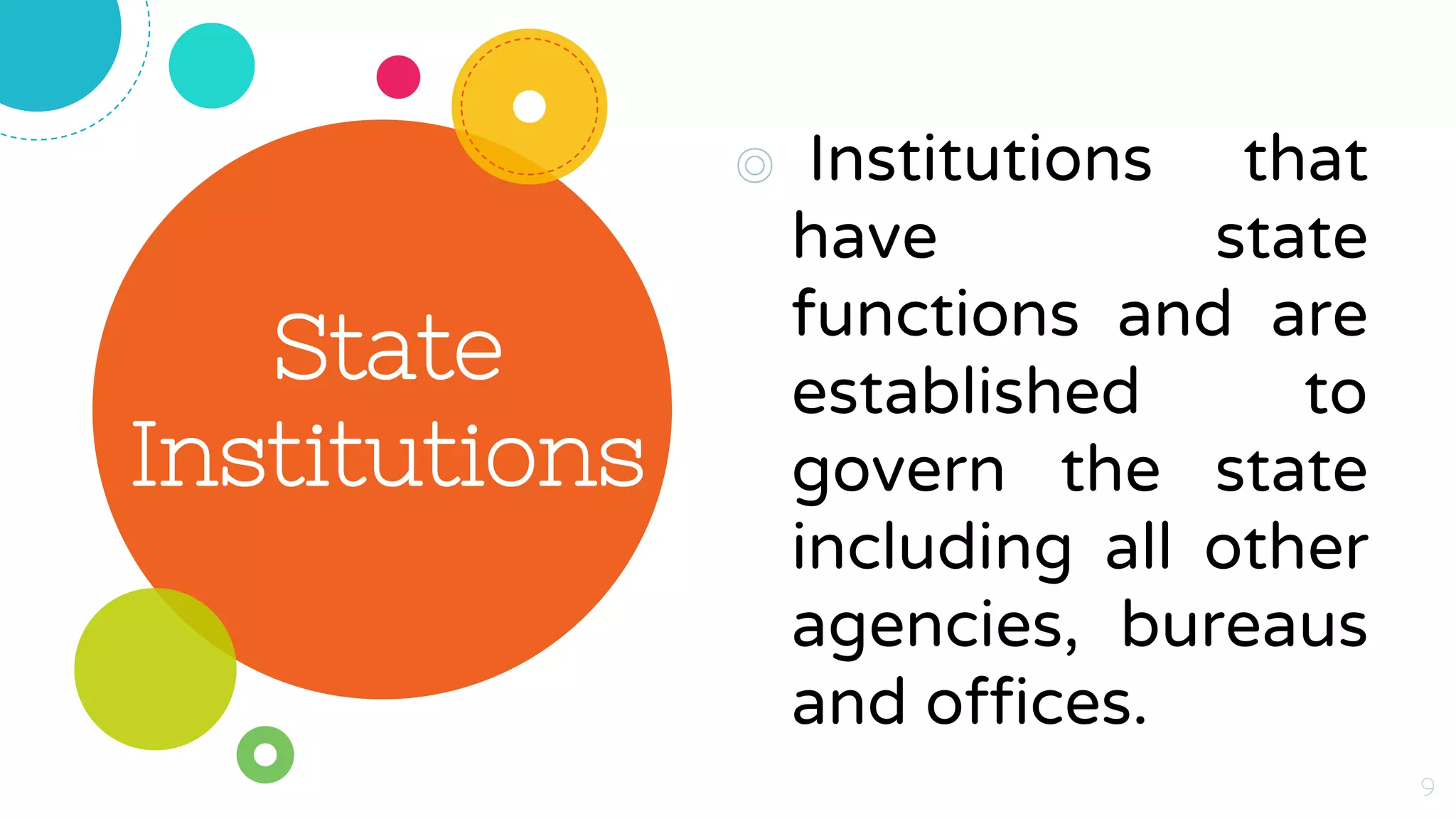
9.
◎ Institutions that
havestate
functions and are
established to
govern the state
including all other
agencies, bureaus
and offices.
9
State
Institutions
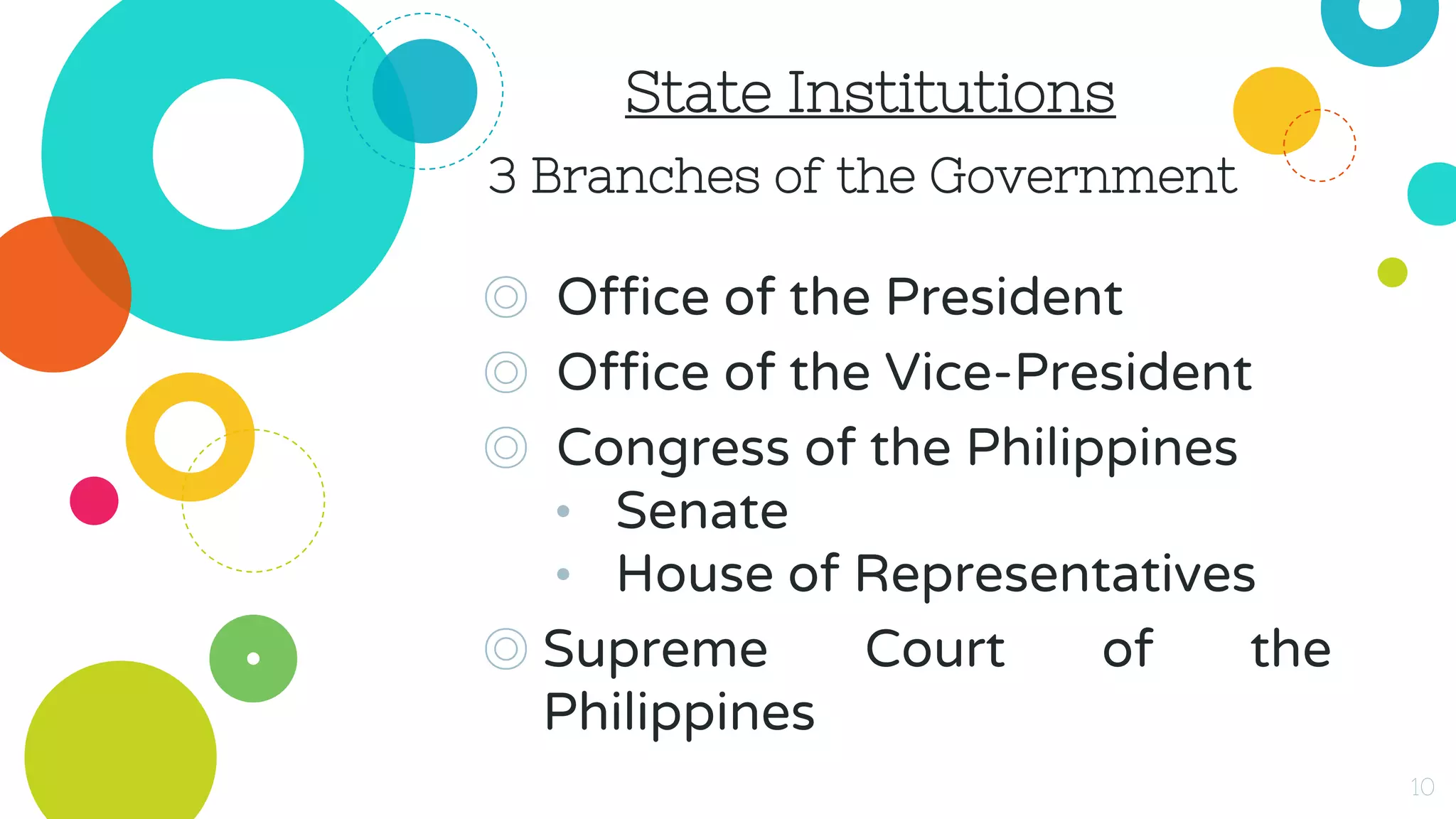
10.
State Institutions
◎ Officeof the President
◎ Office of the Vice-President
◎ Congress of the Philippines
• Senate
• House of Representatives
◎ Supreme Court of the
Philippines
10
3 Branches of the Government
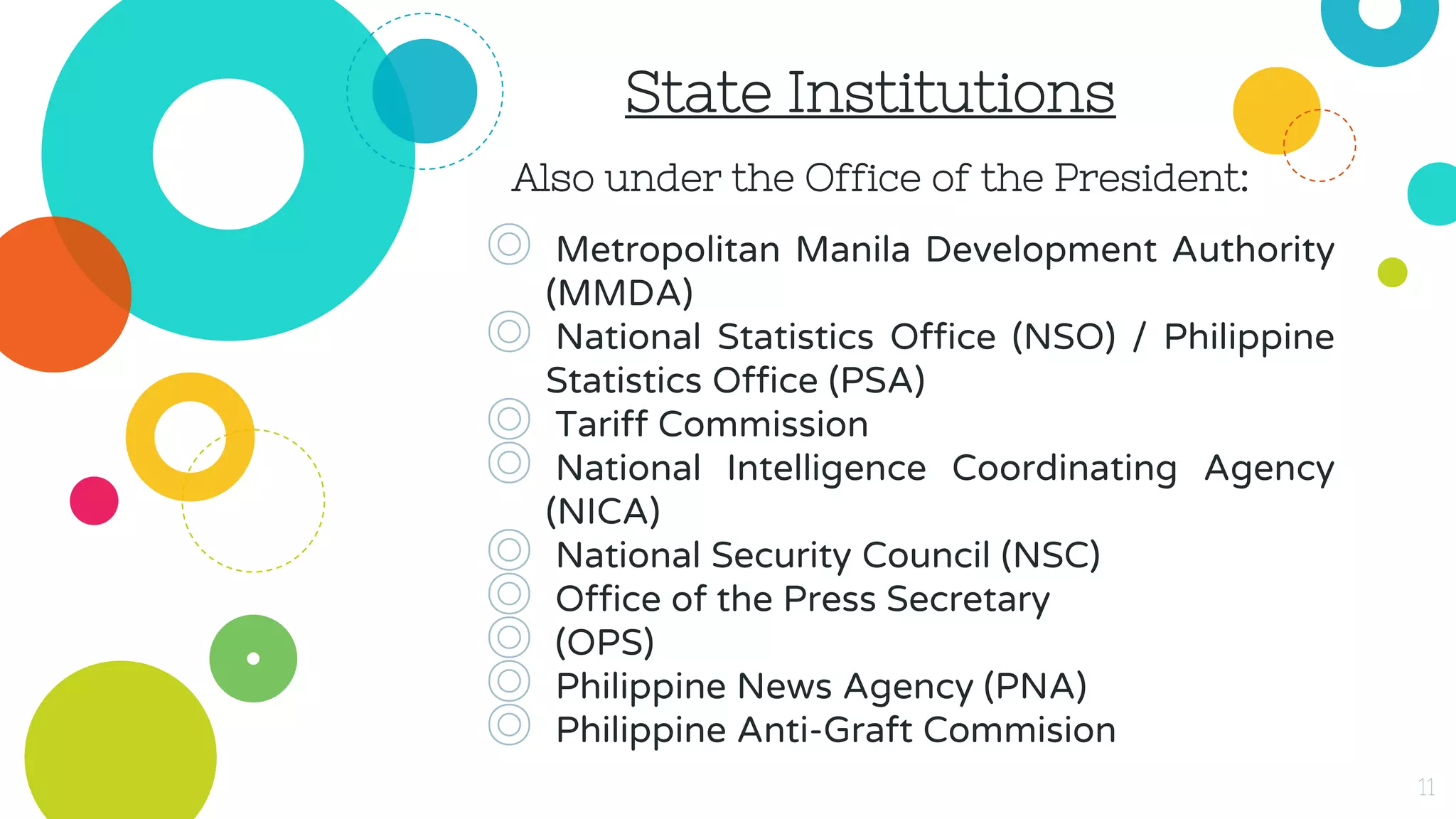
11.
State Institutions
◎ MetropolitanManila Development Authority
(MMDA)
◎ National Statistics Office (NSO) / Philippine
Statistics Office (PSA)
◎ Tariff Commission
◎ National Intelligence Coordinating Agency
(NICA)
◎ National Security Council (NSC)
◎ Office of the Press Secretary
◎ (OPS)
◎ Philippine News Agency (PNA)
◎ Philippine Anti-Graft Commision
11
Also under the Office of the President:
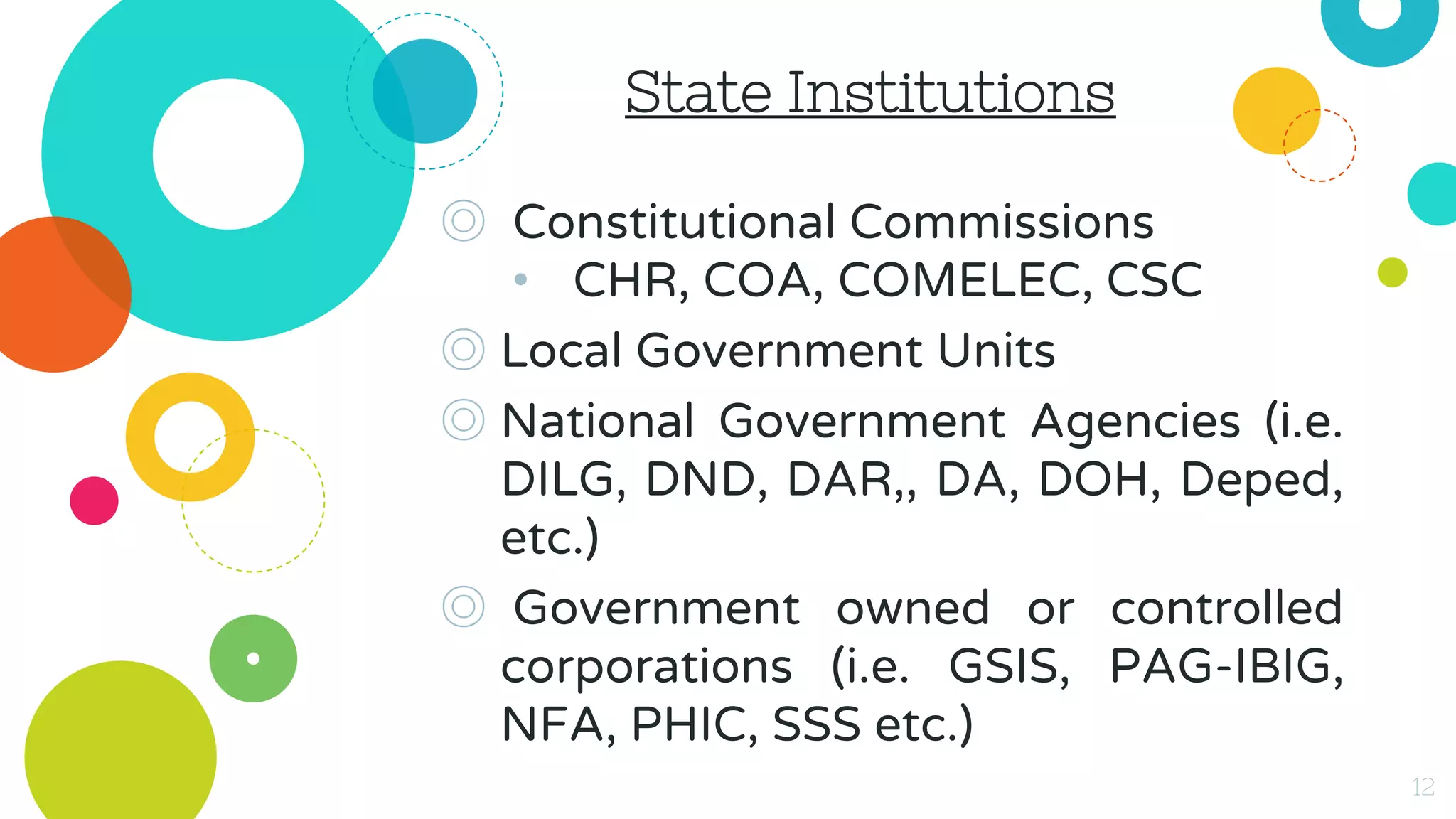
12.
State Institutions
◎ ConstitutionalCommissions
• CHR, COA, COMELEC, CSC
◎ Local Government Units
◎ National Government Agencies (i.e.
DILG, DND, DAR,, DA, DOH, Deped,
etc.)
◎ Government owned or controlled
corporations (i.e. GSIS, PAG-IBIG,
NFA, PHIC, SSS etc.)
12
13.
◎ “Non-State actors”
◎A group of people
or organization that
participates in
international affairs
and relations but is
not affiliated with
any state or nation.
13
Non-State
Institutions
o It isowned by a group of people but
has a separate legal identity
(the owners of a corporation are not
responsible for its own debts).
Corporations offer stocks (determines
level of ownership), as well as bonds
(allows one to earn interest). These
generate large amounts of capital,
which is needed for growth (Contreras
et al. 2016).
Corporation
17
oIt is anorganization composed of
workers or employees from
related fields, which aims to
represent the interests and
rights of its members, both in
the workplace and in the society.
Trade
Unions
20
o These aremade up of people with
common interest who agreed to
work together for easy, safe, and
affordable access to commodities,
loans, and other services. They are
created to help and empower one
another with a minimum help from
the government
Cooperatives
23
oThese are agenciesthat promote
progress by engaging in projects,
policymaking, and dialogue (Contreras
et al. 2016). Some countries with active
agencies in the Philippines are Japan
(JICA), Canada (CIDA), and U.S.A.
(USAID). Those providing financial
assistance include the Asian
Development Bank (ADB).
Development
Agencies
25
o These organizationsare created to
expose the conditions of the
marginalized sector of the society
by using mass media as its platform
as they raise critical
issues to the government. They
provide facts about the life’s various
realities to influence policy-making.
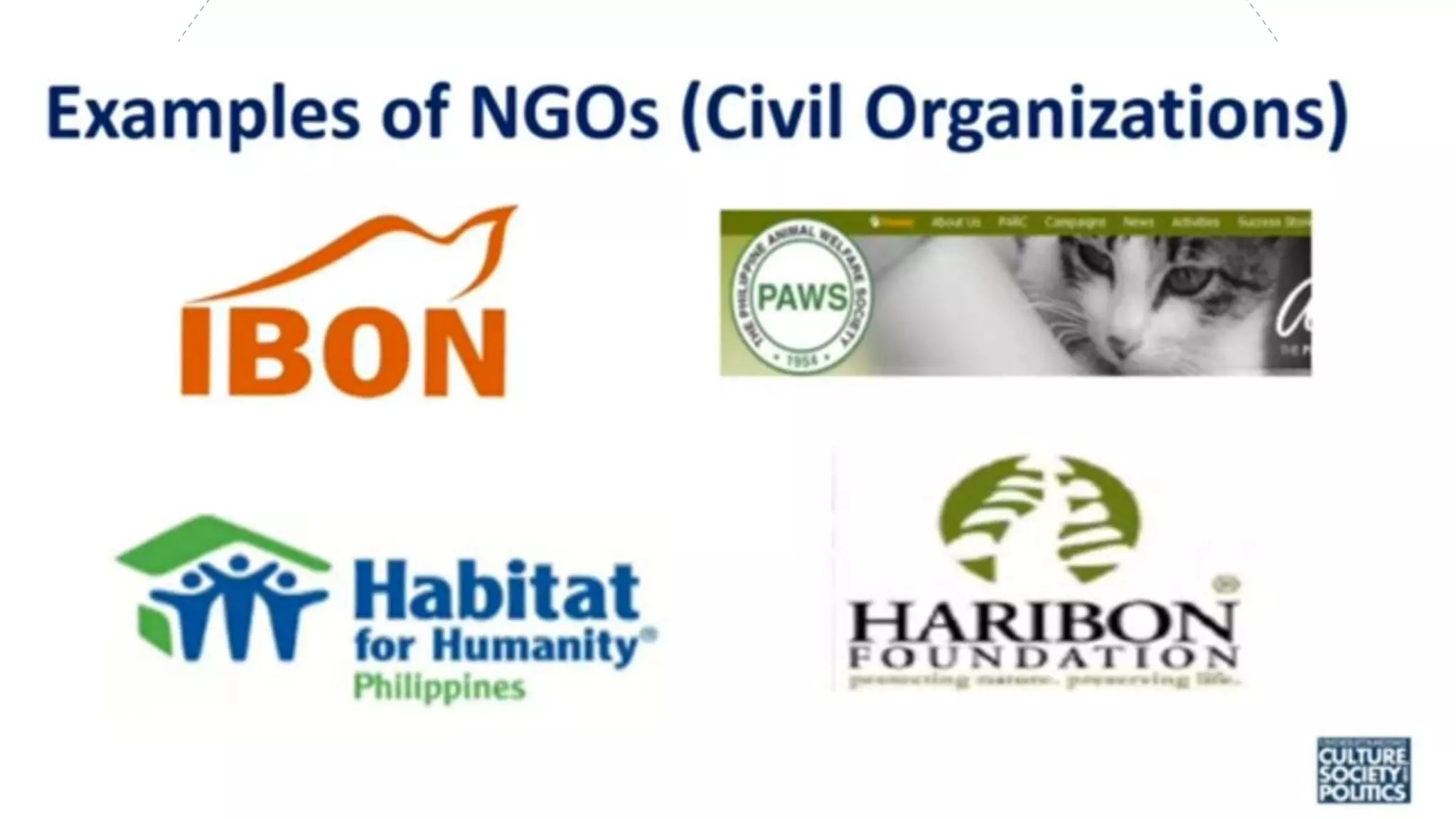
Civil
Organizations
27
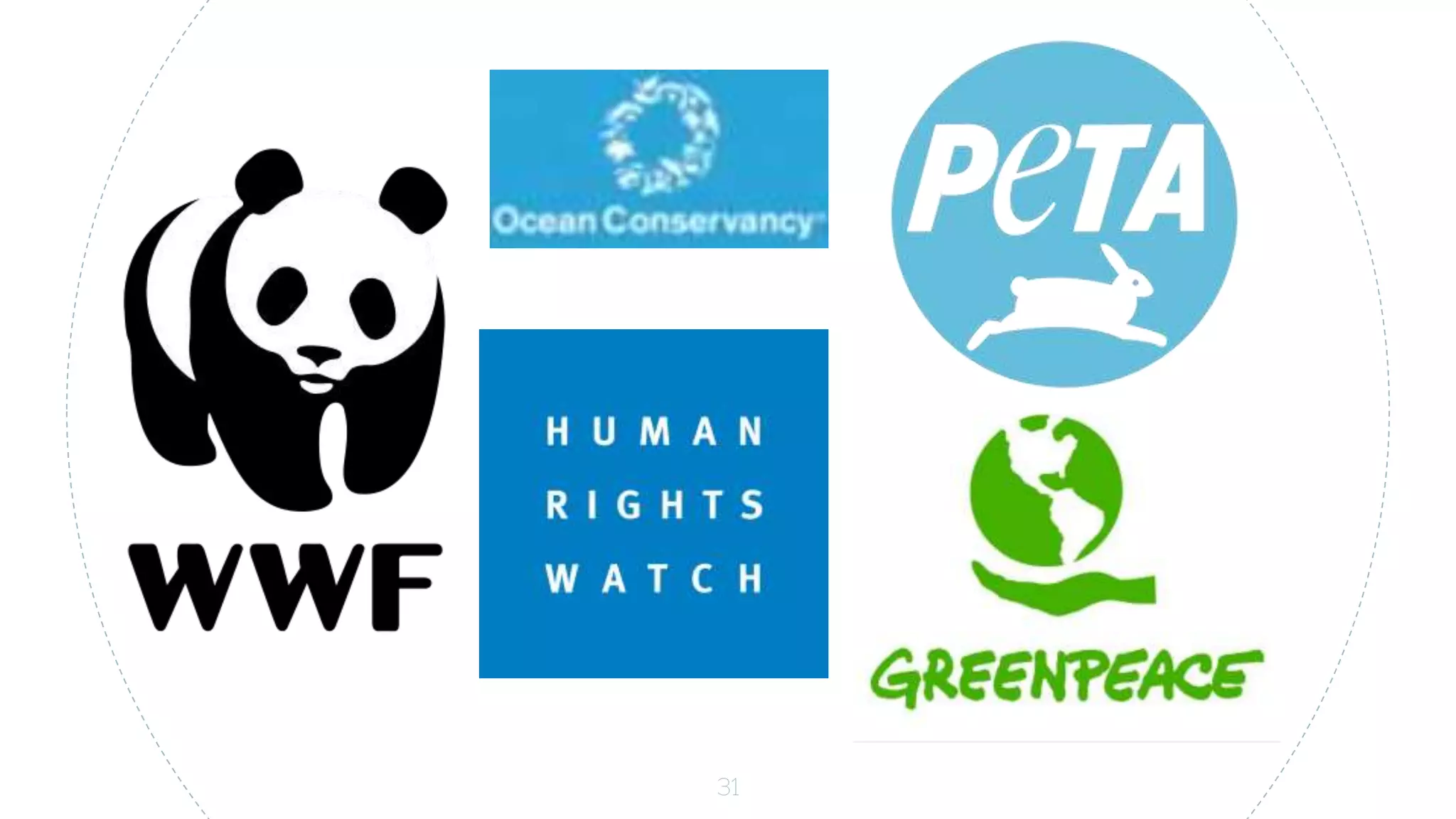
oIt influence thegovernment to take
action on matters commonly
neglected. A group maybe a national
or an international organization
that promotes and advocates
progress and development related
to particular issues of the society.
Transnational
Advocacy
Group
30
32
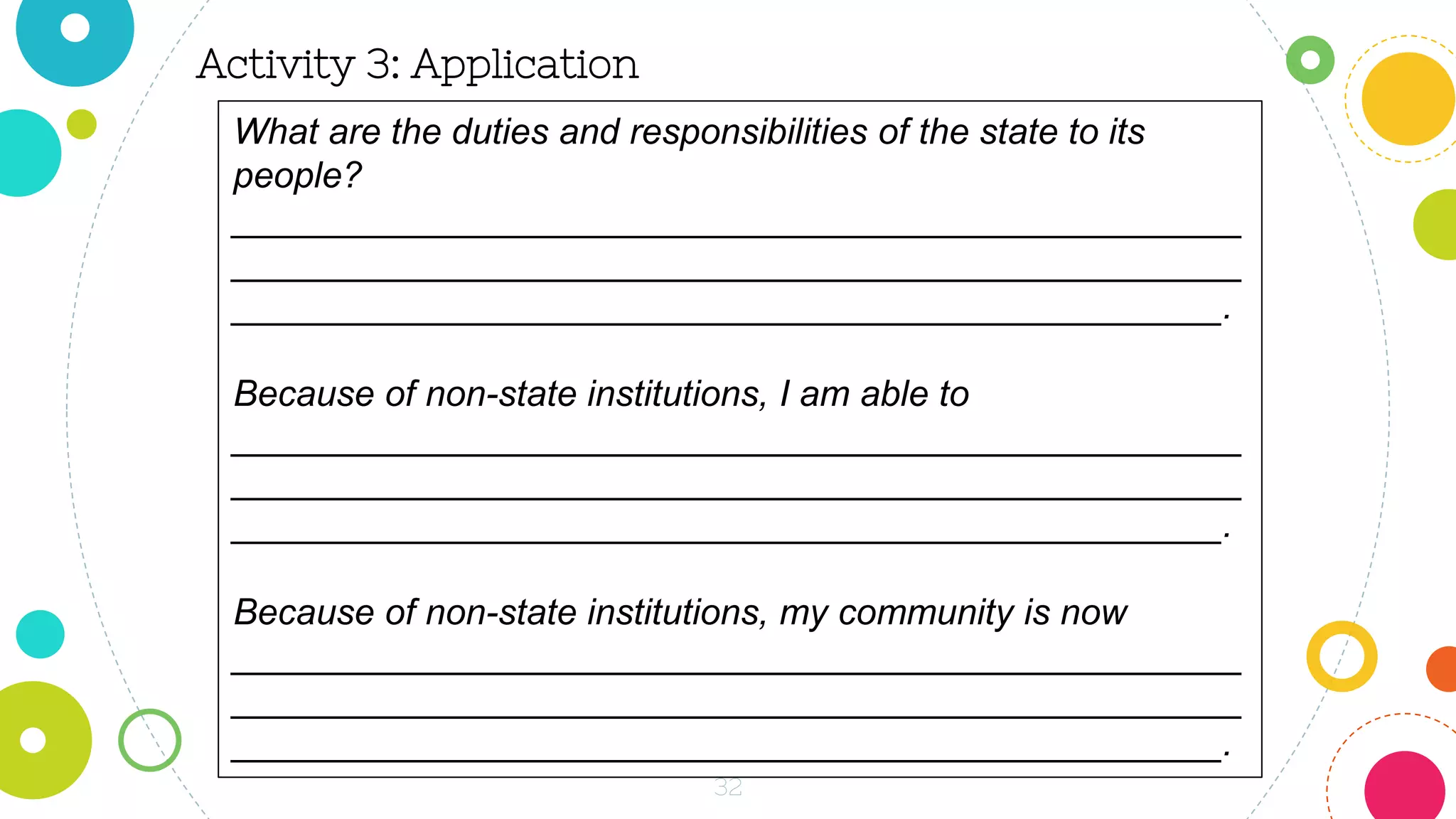
Activity 3: Application
Whatare the duties and responsibilities of the state to its
people?
__________________________________________________
__________________________________________________
_________________________________________________.
Because of non-state institutions, I am able to
__________________________________________________
__________________________________________________
_________________________________________________.
Because of non-state institutions, my community is now
__________________________________________________
__________________________________________________
_________________________________________________.
33.
33
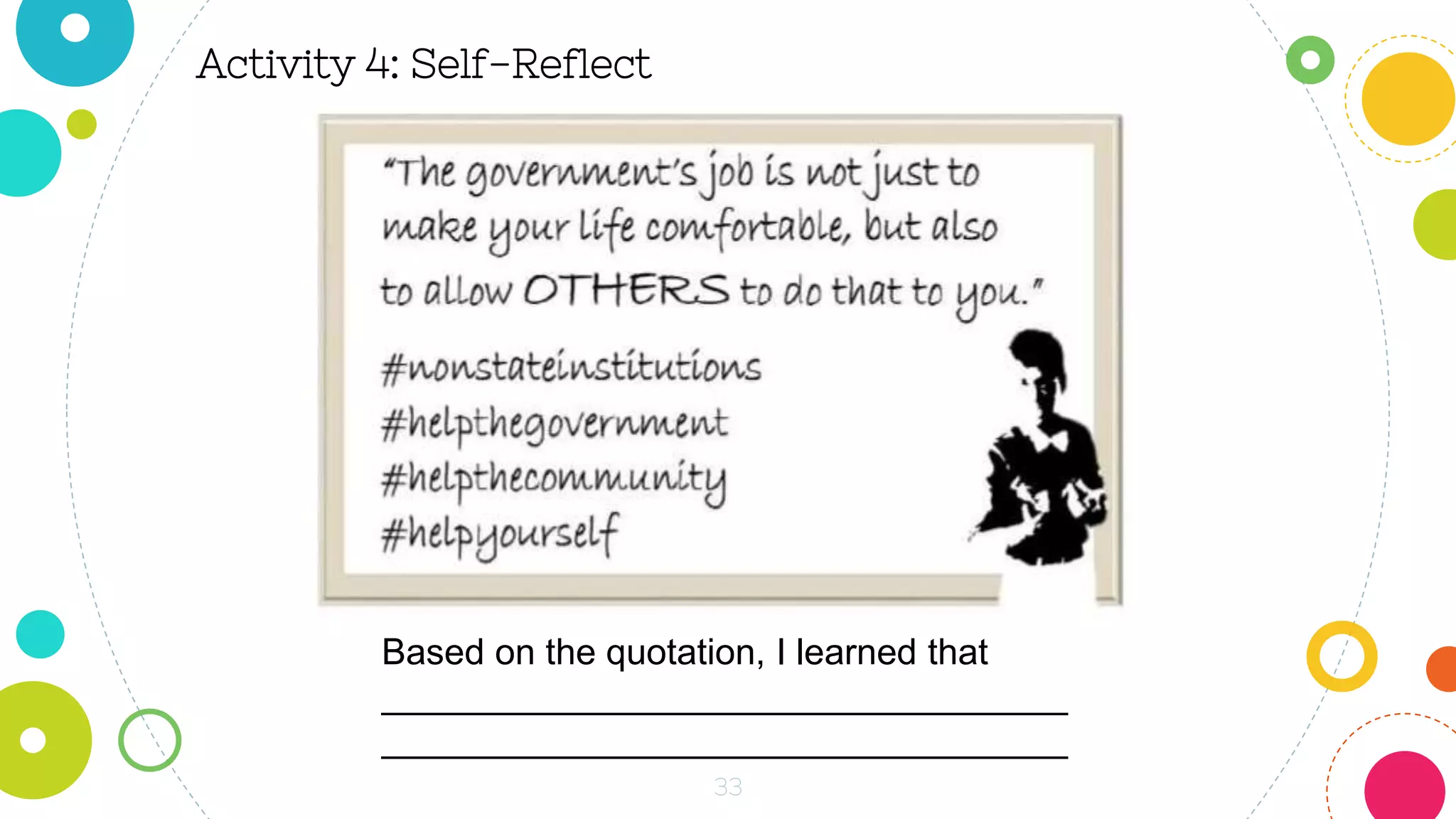
Activity 4: Self-Reflect
Basedon the quotation, I learned that
__________________________________
__________________________________










![[Lesson 1] UCSP: Some Key Observations](https://cdn.slidesharecdn.com/ss_thumbnails/lesson1ucspsomekeyobservations-191106031001-thumbnail.jpg?width=640&height=640&fit=bounds)


![UCSP- 2ND QUARTER LESSON FOR THE CO1 [Autosaved].pptx](https://cdn.slidesharecdn.com/ss_thumbnails/ucsp-2ndquarterlessonfortheco1autosaved-240108222729-da208d8b-thumbnail.jpg?width=640&height=640&fit=bounds)


