Sociological Foundations of
Education
What is
Sociology?
It is derived from the Latin word
“Socius” means “social or being with others”
and Greek word “logos” means “study”.
Sociology – study of social beings
Sociology
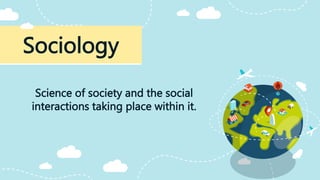
Science of society and the social
interactions taking place within it.
History of Sociology
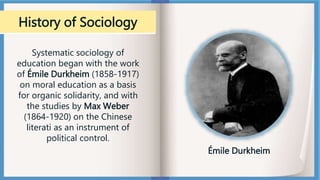
Systematic sociology of
education began with the work
of Émile Durkheim (1858-1917)
on moral education as a basis
for organic solidarity, and with
the studies by Max Weber
(1864-1920) on the Chinese
literati as an instrument of
political control.
Émile Durkheim
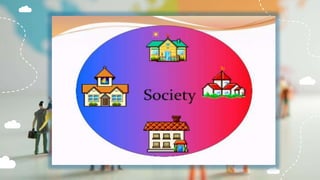
What is a Society?
It is a group of individuals involved in persistent
social interaction or a large social group sharing the same
spatial or social territory, typically subject to the same
political authority and dominant cultural expectations.
Socialization is the process whereby
an individual learns to appreciate
the meaning and values that exist in
in the culture at large and
eventually internalizes such beliefs
and values as guides for human
conduct.
Socialization
Institutional
Group Agencies
for
Education
What is an
Educational Agency?
- a specialized institution that
directly or indirectly exercises an
educational influence on the
child.
Characteristics of Educational Agencies:
Include both formal and informal social institution.
Exercise some educational influenece on individual.
Directly or indirectly concern with the education of youngsters.
Concerned with the transmission of cultural and social heritage.
Include both specialized/non-specialized institution.
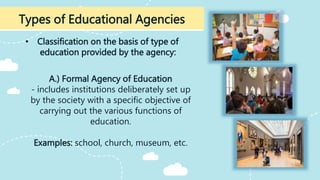
‱ Classification on the basis of type of
education provided by the agency:
Types of Educational Agencies
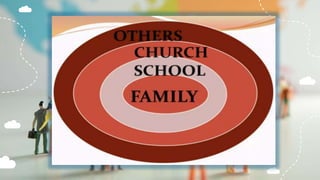
A.) Formal Agency of Education
- includes institutions deliberately set up
by the society with a specific objective of
carrying out the various functions of
education.
Examples: school, church, museum, etc.
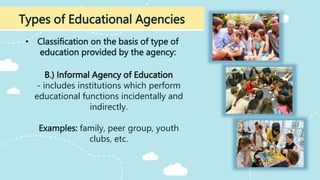
‱ Classification on the basis of type of
education provided by the agency:
Types of Educational Agencies
B.) Informal Agency of Education
- includes institutions which perform
educational functions incidentally and
indirectly.
Examples: family, peer group, youth
clubs, etc.
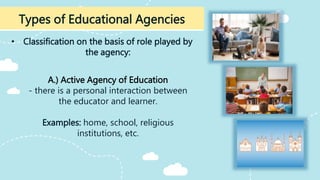
‱ Classification on the basis of role played by
the agency:
Types of Educational Agencies
A.) Active Agency of Education
- there is a personal interaction between
the educator and learner.
Examples: home, school, religious
institutions, etc.
‱ Classification on the basis of role played by
the agency:
Types of Educational Agencies
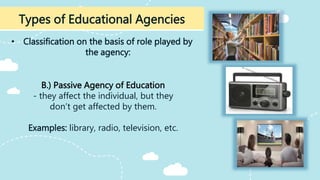
B.) Passive Agency of Education
- they affect the individual, but they
don’t get affected by them.
Examples: library, radio, television, etc.
‱ Classification on the basis of monitory
intention of the agency:
Types of Educational Agencies
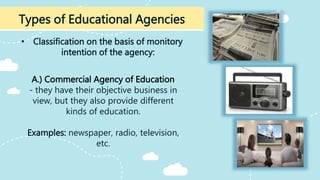
A.) Commercial Agency of Education
- they have their objective business in
view, but they also provide different
kinds of education.
Examples: newspaper, radio, television,
etc.
‱ Classification on the basis of monitory
intention of the agency:
Types of Educational Agencies
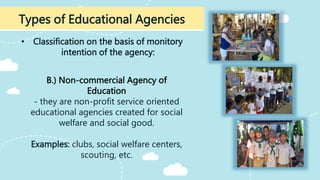
B.) Non-commercial Agency of
Education
- they are non-profit service oriented
educational agencies created for social
welfare and social good.
Examples: clubs, social welfare centers,
scouting, etc.
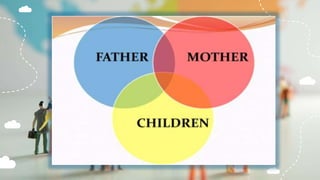
Family as an Agency of Education
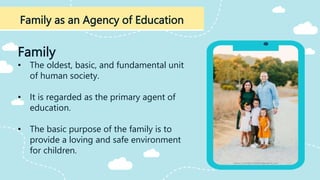
Family
‱ The oldest, basic, and fundamental unit
of human society.
‱ It is regarded as the primary agent of
education.
‱ The basic purpose of the family is to
provide a loving and safe environment
for children.
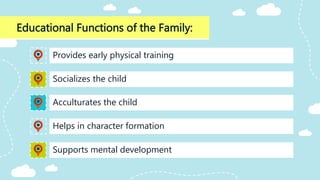
Educational Functions of the Family:
Acculturates the child
Provides early physical training
Socializes the child
Helps in character formation
Supports mental development
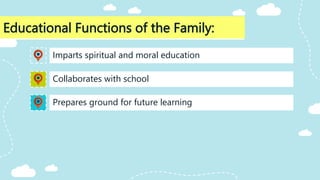
Educational Functions of the Family:
Prepares ground for future learning
Imparts spiritual and moral education
Collaborates with school
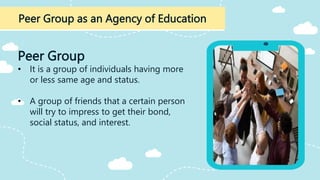
Peer Group as an Agency of Education
Peer Group
‱ It is a group of individuals having more
or less same age and status.
‱ A group of friends that a certain person
will try to impress to get their bond,
social status, and interest.
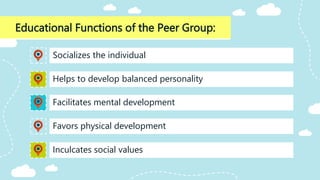
Educational Functions of the Peer Group:
Facilitates mental development
Socializes the individual
Helps to develop balanced personality
Favors physical development
Inculcates social values
Educational Functions of the Family:
Acculturates
Develops leadership qualities
Fosters talents and creative abilities
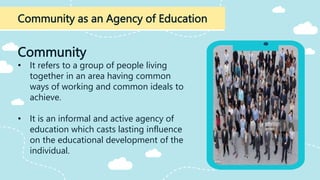
Community as an Agency of Education
Community
‱ It refers to a group of people living
together in an area having common
ways of working and common ideals to
achieve.
‱ It is an informal and active agency of
education which casts lasting influence
on the educational development of the
individual.
Educational Functions of the Community:
Helps for cultural development
Provides educational facilities to children through institutions
Formulate aims and objectives of education
Encourages the vocational development of the learner
Encourages and coordinates the educational efforts of various
parallel agencies
Helps for cultural development
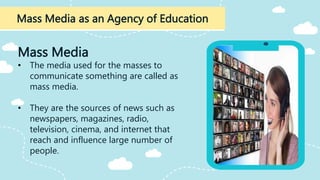
Mass Media as an Agency of Education
Mass Media
‱ The media used for the masses to
communicate something are called as
mass media.
‱ They are the sources of news such as
newspapers, magazines, radio,
television, cinema, and internet that
reach and influence large number of
people.
Educational Functions of the Mass Media:
Helps in intellectual, social, emotional, and aesthetic
development.
Television can serve as a powerful medium for imparting
education through educational broadcasting.
The world wide web makes interaction between the teacher
and the taught sitting in remote places.
Educational Functions of the Mass Media:
Helps to develop social and political values like feeling of
brotherhood, oneness, cooperation, democratic values, etc.
Helps children to enrich their imagination, ignites their
creativity, encourages them to think divergently.
Helps to transmitting cultural values from one generation to
another.
Educational Functions of the Mass Media:
Newspapers plays their educational function by providing
up-to-date information about many areas and also by
intimating information about the opportunities of
education.
Human Relations
and
Leadership
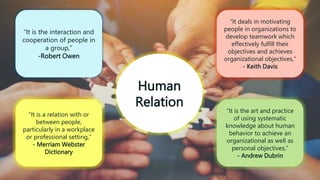
Human
Relation
“It is the interaction and
cooperation of people in
a group,”
-Robert Owen
“It is a relation with or
between people,
particularly in a workplace
or professional setting,”
- Merriam Webster
Dictionary
“It is the art and practice
of using systematic
knowledge about human
behavior to achieve an
organizational as well as
personal objectives,”
- Andrew Dubrin
“It deals in motivating
people in organizations to
develop teamwork which
effectively fulfill their
objectives and achieves
organizational objectives,”
- Keith Davis
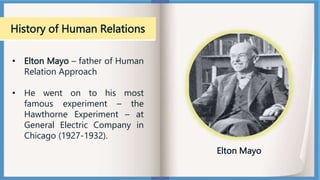
History of Human Relations
‱ Elton Mayo – father of Human
Relation Approach
‱ He went on to his most
famous experiment – the
Hawthorne Experiment – at
General Electric Company in
Chicago (1927-1932).
Elton Mayo
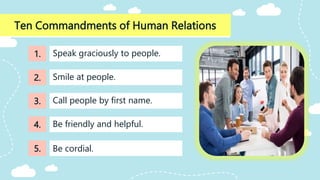
Ten Commandments of Human Relations
Call people by first name.
Speak graciously to people.
Smile at people.
Be friendly and helpful.
Be cordial.
1.
2.
3.
4.
5.
Ten Commandments of Human Relations
Be considerate of the feelings of others.
Be genuinely interested in people.
Be generous with praise, be cautious with criticism.
Be thoughtful of the opinion of others.
Be alert to give service.
6.
7.
8.
9.
10.
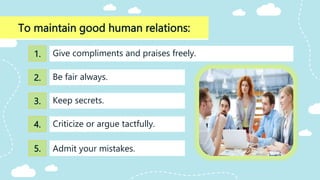
To maintain good human relations:
Keep secrets.
Give compliments and praises freely.
Be fair always.
Criticize or argue tactfully.
Admit your mistakes.
1.
2.
3.
4.
5.
To maintain good human relations:
Give credit to whom credit is due.
Recognize the merits of others’ opinions.
Be grateful always.
Be honest.
Maintain a moderate level of humility.
6.
7.
8.
9.
10.
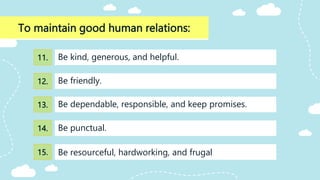
To maintain good human relations:
Be dependable, responsible, and keep promises.
Be kind, generous, and helpful.
Be friendly.
Be punctual.
Be resourceful, hardworking, and frugal
11.
12.
13.
14.
15.
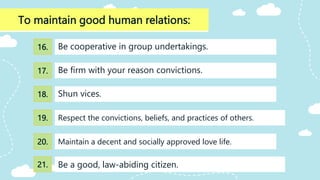
To maintain good human relations:
Shun vices.
Be cooperative in group undertakings.
Be firm with your reason convictions.
Respect the convictions, beliefs, and practices of others.
Maintain a decent and socially approved love life.
16.
17.
18.
19.
20.
Be a good, law-abiding citizen.
21.
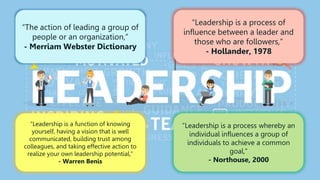
“The action of leading a group of
people or an organization,”
- Merriam Webster Dictionary
“Leadership is a function of knowing
yourself, having a vision that is well
communicated, building trust among
colleagues, and taking effective action to
realize your own leadership potential,”
- Warren Benis
“Leadership is a process whereby an
individual influences a group of
individuals to achieve a common
goal,”
- Northouse, 2000
“Leadership is a process of
influence between a leader and
those who are followers,”
- Hollander, 1978
LEADER
Someone who inspires
passion and motivation
in followers.
Someone who ensures
their team has support
and tools to achieve
their goals.
Someone with a vision
and the path to
realizing it.
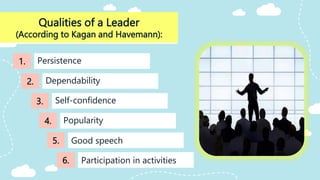
Qualities of a Leader
(According to Kagan and Havemann):
Self-confidence
Persistence
Dependability
1.
2.
3.
4.
5.
Participation in activities
6.
Popularity
Good speech
Qualities of a Leader
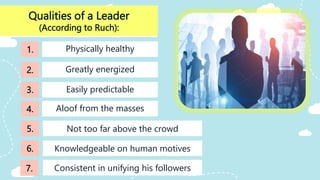
(According to Ruch):
Easily predictable
Physically healthy
Greatly energized
1.
2.
3.
4.
5.
Knowledgeable on human motives
6.
Aloof from the masses
Not too far above the crowd
Consistent in unifying his followers
7.
Filipino Leaders Advocate the Following
Qualities:
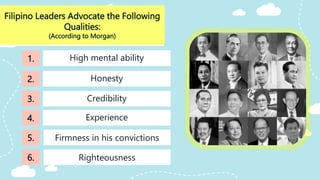
(According to Morgan)
Credibility
High mental ability
Honesty
1.
2.
3.
4.
5.
Righteousness
6.
Experience
Firmness in his convictions
Filipino Leaders Advocate the Following
Qualities:
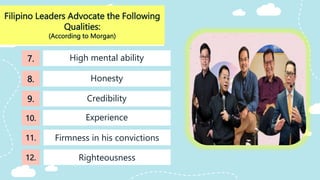
(According to Morgan)
Credibility
High mental ability
Honesty
7.
8.
9.
10.
11.
Righteousness
12.
Experience
Firmness in his convictions
Six Main Leadership
Theories
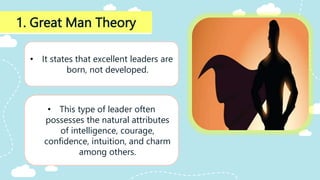
1. Great Man Theory
‱ It states that excellent leaders are
born, not developed.
‱ This type of leader often
possesses the natural attributes
of intelligence, courage,
confidence, intuition, and charm
among others.
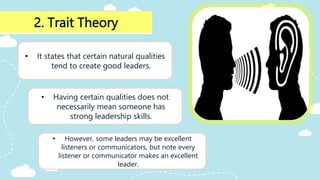
2. Trait Theory
‱ It states that certain natural qualities
tend to create good leaders.
‱ Having certain qualities does not
necessarily mean someone has
strong leadership skills.
‱ However, some leaders may be excellent
listeners or communicators, but note every
listener or communicator makes an excellent
leader.
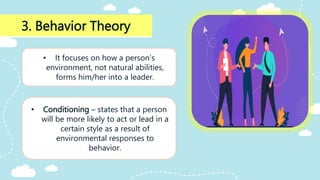
3. Behavior Theory
‱ It focuses on how a person’s
environment, not natural abilities,
forms him/her into a leader.
‱ Conditioning – states that a person
will be more likely to act or lead in a
certain style as a result of
environmental responses to
behavior.
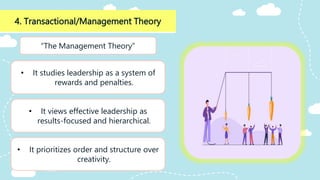
4. Transactional/Management Theory
“The Management Theory”
‱ It studies leadership as a system of
rewards and penalties.
‱ It views effective leadership as
results-focused and hierarchical.
‱ It prioritizes order and structure over
creativity.
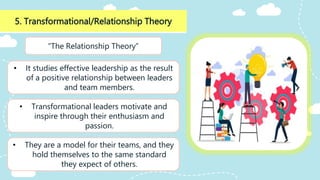
5. Transformational/Relationship Theory
“The Relationship Theory”
‱ It studies effective leadership as the result
of a positive relationship between leaders
and team members.
‱ Transformational leaders motivate and
inspire through their enthusiasm and
passion.
‱ They are a model for their teams, and they
hold themselves to the same standard
they expect of others.
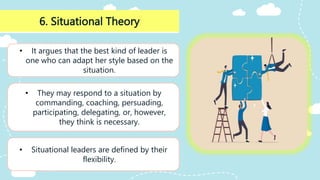
6. Situational Theory
‱ It argues that the best kind of leader is
one who can adapt her style based on the
situation.
‱ They may respond to a situation by
commanding, coaching, persuading,
participating, delegating, or, however,
they think is necessary.
‱ Situational leaders are defined by their
flexibility.
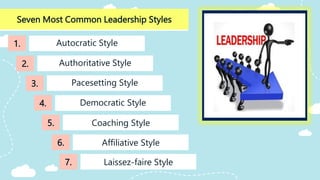
Seven Most Common Leadership Styles
Pacesetting Style
Autocratic Style
Authoritative Style
1.
2.
3.
4.
5.
Affiliative Style
6.
Democratic Style
Coaching Style
Laissez-faire Style
7.
Conclusion
Human relations and leadership are
significantly intertwined with each other. Therefore,
to achieve the organizational objectives, setting
directions–establishing a clear vision, using sense of
making to track progress, recognizing the
significance of human social factors and must take
decisions based on human considerations are
necessary to increase human efficiency at work.
Thank You
for
Listening!
References:
https://www.slideshare.net/JaseelCM/agencies-of-education-89267348
https://www.youtube.com/watch?time_continue=5&v=e22R2z-
NbG4&embeds_referring_euri=https%3A%2F%2Fwww.google.com%2Fsearch%3Fq%3Di
nstitutional%2Bgroup%2Bagencies%2Bfor%2Beducation%26sca_esv%3D562289703%26s
xsrf%3DAB5stBjDZC-O0H9fztBY1yreyB_Lk&source_ve_path=Mjg2NjY&feature=emb_logo
https://www.slideshare.net/titserRex/human-relation-and-leadership-by-alotencio-amp-
anonuevo
https://www.slideshare.net/mizrach/human-relations-and-leadership

Sociological-Foundations-of-Education.pptx

  • 1.
  • 4.
    What is Sociology? It isderived from the Latin word “Socius” means “social or being with others” and Greek word “logos” means “study”. Sociology – study of social beings
  • 5.
    Sociology Science of societyand the social interactions taking place within it.
  • 6.
    History of Sociology Systematicsociology of education began with the work of Émile Durkheim (1858-1917) on moral education as a basis for organic solidarity, and with the studies by Max Weber (1864-1920) on the Chinese literati as an instrument of political control. Émile Durkheim
  • 7.
    What is aSociety? It is a group of individuals involved in persistent social interaction or a large social group sharing the same spatial or social territory, typically subject to the same political authority and dominant cultural expectations.
  • 8.
    Socialization is theprocess whereby an individual learns to appreciate the meaning and values that exist in in the culture at large and eventually internalizes such beliefs and values as guides for human conduct. Socialization
  • 13.
  • 14.
    What is an EducationalAgency? - a specialized institution that directly or indirectly exercises an educational influence on the child.
  • 15.
    Characteristics of EducationalAgencies: Include both formal and informal social institution. Exercise some educational influenece on individual. Directly or indirectly concern with the education of youngsters. Concerned with the transmission of cultural and social heritage. Include both specialized/non-specialized institution.
  • 16.
    ‱ Classification onthe basis of type of education provided by the agency: Types of Educational Agencies A.) Formal Agency of Education - includes institutions deliberately set up by the society with a specific objective of carrying out the various functions of education. Examples: school, church, museum, etc.
  • 17.
    ‱ Classification onthe basis of type of education provided by the agency: Types of Educational Agencies B.) Informal Agency of Education - includes institutions which perform educational functions incidentally and indirectly. Examples: family, peer group, youth clubs, etc.
  • 18.
    ‱ Classification onthe basis of role played by the agency: Types of Educational Agencies A.) Active Agency of Education - there is a personal interaction between the educator and learner. Examples: home, school, religious institutions, etc.
  • 19.
    ‱ Classification onthe basis of role played by the agency: Types of Educational Agencies B.) Passive Agency of Education - they affect the individual, but they don’t get affected by them. Examples: library, radio, television, etc.
  • 20.
    ‱ Classification onthe basis of monitory intention of the agency: Types of Educational Agencies A.) Commercial Agency of Education - they have their objective business in view, but they also provide different kinds of education. Examples: newspaper, radio, television, etc.
  • 21.
    ‱ Classification onthe basis of monitory intention of the agency: Types of Educational Agencies B.) Non-commercial Agency of Education - they are non-profit service oriented educational agencies created for social welfare and social good. Examples: clubs, social welfare centers, scouting, etc.
  • 22.
    Family as anAgency of Education Family ‱ The oldest, basic, and fundamental unit of human society. ‱ It is regarded as the primary agent of education. ‱ The basic purpose of the family is to provide a loving and safe environment for children.
  • 23.
    Educational Functions ofthe Family: Acculturates the child Provides early physical training Socializes the child Helps in character formation Supports mental development
  • 24.
    Educational Functions ofthe Family: Prepares ground for future learning Imparts spiritual and moral education Collaborates with school
  • 25.
    Peer Group asan Agency of Education Peer Group ‱ It is a group of individuals having more or less same age and status. ‱ A group of friends that a certain person will try to impress to get their bond, social status, and interest.
  • 26.
    Educational Functions ofthe Peer Group: Facilitates mental development Socializes the individual Helps to develop balanced personality Favors physical development Inculcates social values
  • 27.
    Educational Functions ofthe Family: Acculturates Develops leadership qualities Fosters talents and creative abilities
  • 28.
    Community as anAgency of Education Community ‱ It refers to a group of people living together in an area having common ways of working and common ideals to achieve. ‱ It is an informal and active agency of education which casts lasting influence on the educational development of the individual.
  • 29.
    Educational Functions ofthe Community: Helps for cultural development Provides educational facilities to children through institutions Formulate aims and objectives of education Encourages the vocational development of the learner Encourages and coordinates the educational efforts of various parallel agencies Helps for cultural development
  • 30.
    Mass Media asan Agency of Education Mass Media ‱ The media used for the masses to communicate something are called as mass media. ‱ They are the sources of news such as newspapers, magazines, radio, television, cinema, and internet that reach and influence large number of people.
  • 31.
    Educational Functions ofthe Mass Media: Helps in intellectual, social, emotional, and aesthetic development. Television can serve as a powerful medium for imparting education through educational broadcasting. The world wide web makes interaction between the teacher and the taught sitting in remote places.
  • 32.
    Educational Functions ofthe Mass Media: Helps to develop social and political values like feeling of brotherhood, oneness, cooperation, democratic values, etc. Helps children to enrich their imagination, ignites their creativity, encourages them to think divergently. Helps to transmitting cultural values from one generation to another.
  • 33.
    Educational Functions ofthe Mass Media: Newspapers plays their educational function by providing up-to-date information about many areas and also by intimating information about the opportunities of education.
  • 34.
  • 35.
    Human Relation “It is theinteraction and cooperation of people in a group,” -Robert Owen “It is a relation with or between people, particularly in a workplace or professional setting,” - Merriam Webster Dictionary “It is the art and practice of using systematic knowledge about human behavior to achieve an organizational as well as personal objectives,” - Andrew Dubrin “It deals in motivating people in organizations to develop teamwork which effectively fulfill their objectives and achieves organizational objectives,” - Keith Davis
  • 36.
    History of HumanRelations ‱ Elton Mayo – father of Human Relation Approach ‱ He went on to his most famous experiment – the Hawthorne Experiment – at General Electric Company in Chicago (1927-1932). Elton Mayo
  • 37.
    Ten Commandments ofHuman Relations Call people by first name. Speak graciously to people. Smile at people. Be friendly and helpful. Be cordial. 1. 2. 3. 4. 5.
  • 38.
    Ten Commandments ofHuman Relations Be considerate of the feelings of others. Be genuinely interested in people. Be generous with praise, be cautious with criticism. Be thoughtful of the opinion of others. Be alert to give service. 6. 7. 8. 9. 10.
  • 39.
    To maintain goodhuman relations: Keep secrets. Give compliments and praises freely. Be fair always. Criticize or argue tactfully. Admit your mistakes. 1. 2. 3. 4. 5.
  • 40.
    To maintain goodhuman relations: Give credit to whom credit is due. Recognize the merits of others’ opinions. Be grateful always. Be honest. Maintain a moderate level of humility. 6. 7. 8. 9. 10.
  • 41.
    To maintain goodhuman relations: Be dependable, responsible, and keep promises. Be kind, generous, and helpful. Be friendly. Be punctual. Be resourceful, hardworking, and frugal 11. 12. 13. 14. 15.
  • 42.
    To maintain goodhuman relations: Shun vices. Be cooperative in group undertakings. Be firm with your reason convictions. Respect the convictions, beliefs, and practices of others. Maintain a decent and socially approved love life. 16. 17. 18. 19. 20. Be a good, law-abiding citizen. 21.
  • 43.
    “The action ofleading a group of people or an organization,” - Merriam Webster Dictionary “Leadership is a function of knowing yourself, having a vision that is well communicated, building trust among colleagues, and taking effective action to realize your own leadership potential,” - Warren Benis “Leadership is a process whereby an individual influences a group of individuals to achieve a common goal,” - Northouse, 2000 “Leadership is a process of influence between a leader and those who are followers,” - Hollander, 1978
  • 44.
    LEADER Someone who inspires passionand motivation in followers. Someone who ensures their team has support and tools to achieve their goals. Someone with a vision and the path to realizing it.
  • 45.
    Qualities of aLeader (According to Kagan and Havemann): Self-confidence Persistence Dependability 1. 2. 3. 4. 5. Participation in activities 6. Popularity Good speech
  • 46.
    Qualities of aLeader (According to Ruch): Easily predictable Physically healthy Greatly energized 1. 2. 3. 4. 5. Knowledgeable on human motives 6. Aloof from the masses Not too far above the crowd Consistent in unifying his followers 7.
  • 47.
    Filipino Leaders Advocatethe Following Qualities: (According to Morgan) Credibility High mental ability Honesty 1. 2. 3. 4. 5. Righteousness 6. Experience Firmness in his convictions
  • 48.
    Filipino Leaders Advocatethe Following Qualities: (According to Morgan) Credibility High mental ability Honesty 7. 8. 9. 10. 11. Righteousness 12. Experience Firmness in his convictions
  • 49.
  • 50.
    1. Great ManTheory ‱ It states that excellent leaders are born, not developed. ‱ This type of leader often possesses the natural attributes of intelligence, courage, confidence, intuition, and charm among others.
  • 51.
    2. Trait Theory ‱It states that certain natural qualities tend to create good leaders. ‱ Having certain qualities does not necessarily mean someone has strong leadership skills. ‱ However, some leaders may be excellent listeners or communicators, but note every listener or communicator makes an excellent leader.
  • 52.
    3. Behavior Theory ‱It focuses on how a person’s environment, not natural abilities, forms him/her into a leader. ‱ Conditioning – states that a person will be more likely to act or lead in a certain style as a result of environmental responses to behavior.
  • 53.
    4. Transactional/Management Theory “TheManagement Theory” ‱ It studies leadership as a system of rewards and penalties. ‱ It views effective leadership as results-focused and hierarchical. ‱ It prioritizes order and structure over creativity.

  • 54.
    5. Transformational/Relationship Theory “TheRelationship Theory” ‱ It studies effective leadership as the result of a positive relationship between leaders and team members. ‱ Transformational leaders motivate and inspire through their enthusiasm and passion. ‱ They are a model for their teams, and they hold themselves to the same standard they expect of others.
  • 55.
    6. Situational Theory ‱It argues that the best kind of leader is one who can adapt her style based on the situation. ‱ They may respond to a situation by commanding, coaching, persuading, participating, delegating, or, however, they think is necessary. ‱ Situational leaders are defined by their flexibility.
  • 56.
    Seven Most CommonLeadership Styles Pacesetting Style Autocratic Style Authoritative Style 1. 2. 3. 4. 5. Affiliative Style 6. Democratic Style Coaching Style Laissez-faire Style 7.
  • 57.
    Conclusion Human relations andleadership are significantly intertwined with each other. Therefore, to achieve the organizational objectives, setting directions–establishing a clear vision, using sense of making to track progress, recognizing the significance of human social factors and must take decisions based on human considerations are necessary to increase human efficiency at work.
  • 58.
  • 59.

Editor's Notes

  • #56 The leadership does not relate to a certain type of leader or claim that any one style is best.