

1
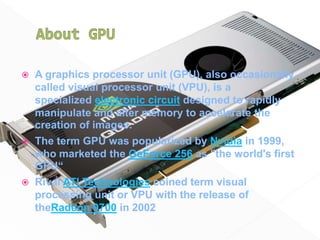
 A graphics processor unit (GPU), also occasionally
called visual processor unit (VPU), is a
specialized electronic circuit designed to rapidly
manipulate and alter memory to accelerate the
creation of images.
 The term GPU was popularized by Nvidia in 1999,
who marketed the GeForce 256 as "the world's first
GPU“
 Rival ATI Technologies coined term visual
processing unit or VPU with the release of
theRadeon 9700 in 2002
2
 1980
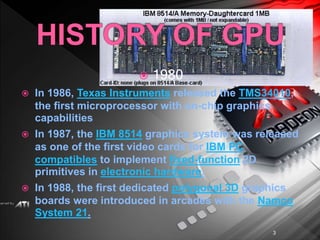
 In 1986, Texas Instruments released the TMS34010,
the first microprocessor with on-chip graphics
capabilities
 In 1987, the IBM 8514 graphics system was released
as one of the first video cards for IBM PC
compatibles to implement fixed-function 2D
primitives in electronic hardware.
 In 1988, the first dedicated polygonal 3D graphics
boards were introduced in arcades with the Namco
System 21.
3
 In 1991, S3 Graphics introduced the S3 86C911,
which its Designers named after the Porsche 911.
 come to support microsoft window 3.x.
 Improve hardware accelaration.
 Help in fast image processing
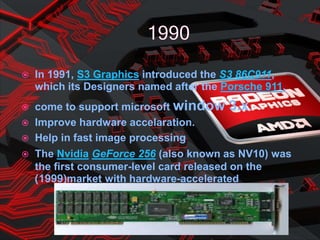
 The Nvidia GeForce 256 (also known as NV10) was
the first consumer-level card released on the
(1999)market with hardware-accelerated
4
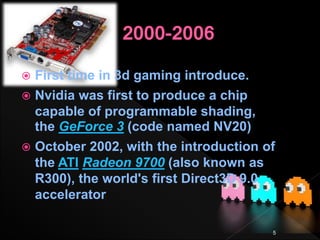
 First time in 3d gaming introduce.
 Nvidia was first to produce a chip
capable of programmable shading,
the GeForce 3 (code named NV20)
 October 2002, with the introduction of
the ATI Radeon 9700 (also known as
R300), the world's first Direct3D 9.0
accelerator
5
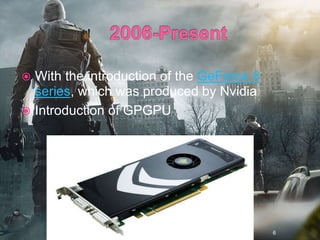
 With the introduction of the GeForce 8
series, which was produced by Nvidia
 Introduction of GPGPU
6
 Intel (27.8%)
 Nvidia (49.6%)
 AMD/ATI (20.6%)
 S3 Grahpics(Owned VIA Technology)
 MATROX
 ASUS
 GIGABYTE
7
 Nvidia Corporation is aAmerican
worldwide technology company based in
Santa Clara, California.
 . Nvidia manufactures graphics
processing units (GPUs), as well
as system on a chip units (SOCs) for
the mobile computing market.
 Nvidia established in 1990.
 World’s biggest manufacturer of GPU.
8
 ATI Founded in 1983 as Array Technology
Inc.
 Introduce First timevg and VGU
 Advanced Micro Devices (AMD) acquired
ATI in 2006
 Establisheed in ontario,canada.
 World’s Second biggest manufacturer of
GPU after beating intel graphic family
corporation.
9
 They were initially used to accelerate the memory-
intensive work of texture
mapping and rendering polygons.
 Accelerate geometric calculations such
astherotation and translation of vertices into
different coordinate systems.
10
 Dedicated graphic card
 Integrated graphics solutions
 Hybrid solutions
 Stream Processing and General
Purpose GPUs (GPGPU)
 External GPU (eGPU)
11
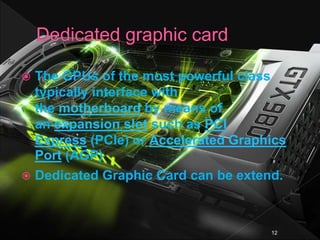
 The GPUs of the most powerful class
typically interface with
the motherboard by means of
an expansion slot such as PCI
Express (PCIe) or Accelerated Graphics
Port (AGP)
 Dedicated Graphic Card can be extend.
12
 Integrated graphic card utilise the portion of
system’ RAM
 IGPs can be integrated onto the
motherboard as part of the chipset, or within
the same die as CPU (like AMD APUor Intel
HD Graphics)
13
 This newer class of GPUs competes with
integrated graphics in the low-end
desktop and notebook markets.
 The most common implementations of
this are ATI's HyperMemory and
Nvidia's TurboCache.
 These share memory with the system and
have a small dedicated memory cache, to
make up for the high latency of the
system RAM.
14
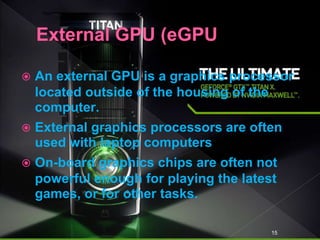
 An external GPU is a graphics processor
located outside of the housing of the
computer.
 External graphics processors are often
used with laptop computers
 On-board graphics chips are often not
powerful enough for playing the latest
games, or for other tasks.
15
 Nvidia Titan x
 Nvidia Pascal
 AMD/ATI R9 Fury X
16
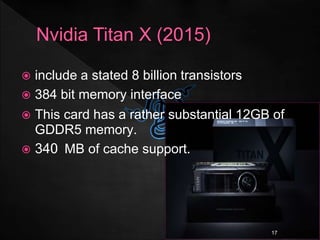
 include a stated 8 billion transistors
 384 bit memory interface
 This card has a rather substantial 12GB of
GDDR5 memory.
 340 MB of cache support.
17
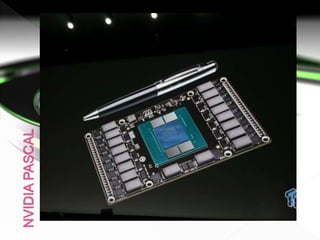
 The first GPU to use stacked, 3D chip
packaging and to incorporate a new PCI
Express-based interconnect technology
called NVLink.
 Pascal, named after the 17th century French
inventor and mathematician Blaise Pascal.
 IBM is the only partner in the hopper on
NVLink with Nvidia.
18
 Pascal gpu will be the successor of Maxwell
 Featuring the latest HBM 2 and 16nm
 Pascal feature 17 billion transistors creames
indside its core.
 Pascal will be in two edition (16/32 gb)
 Dominate the next High resolution 4k and 8k
gaming performance.
 Connected by 4 stacks 256 gb/s bandwidth
each totally we get 1 TB/s speed.
19
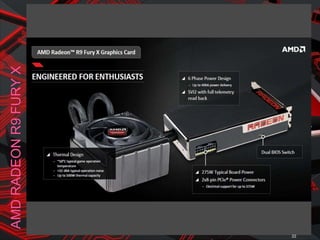
 The AMD Radeon R9 Fury X is the world's
first GPU with AMD-pioneered High-
Bandwidth Memory (HBM).
 focuses on driving performance in two areas
of gaming: 4K and VR
 it's an area the R9 Fury X is looking to beat
Nvidia.
 Comes with the power of 8.5 billion
transisitors.
20
21
22
23

GPU

  • 1.
  • 2.
     A graphicsprocessor unit (GPU), also occasionally called visual processor unit (VPU), is a specialized electronic circuit designed to rapidly manipulate and alter memory to accelerate the creation of images.  The term GPU was popularized by Nvidia in 1999, who marketed the GeForce 256 as "the world's first GPU“  Rival ATI Technologies coined term visual processing unit or VPU with the release of theRadeon 9700 in 2002 2
  • 3.
     1980  In1986, Texas Instruments released the TMS34010, the first microprocessor with on-chip graphics capabilities  In 1987, the IBM 8514 graphics system was released as one of the first video cards for IBM PC compatibles to implement fixed-function 2D primitives in electronic hardware.  In 1988, the first dedicated polygonal 3D graphics boards were introduced in arcades with the Namco System 21. 3
  • 4.
     In 1991,S3 Graphics introduced the S3 86C911, which its Designers named after the Porsche 911.  come to support microsoft window 3.x.  Improve hardware accelaration.  Help in fast image processing  The Nvidia GeForce 256 (also known as NV10) was the first consumer-level card released on the (1999)market with hardware-accelerated 4
  • 5.
     First timein 3d gaming introduce.  Nvidia was first to produce a chip capable of programmable shading, the GeForce 3 (code named NV20)  October 2002, with the introduction of the ATI Radeon 9700 (also known as R300), the world's first Direct3D 9.0 accelerator 5
  • 6.
     With theintroduction of the GeForce 8 series, which was produced by Nvidia  Introduction of GPGPU 6
  • 7.
     Intel (27.8%) Nvidia (49.6%)  AMD/ATI (20.6%)  S3 Grahpics(Owned VIA Technology)  MATROX  ASUS  GIGABYTE 7
  • 8.
     Nvidia Corporationis aAmerican worldwide technology company based in Santa Clara, California.  . Nvidia manufactures graphics processing units (GPUs), as well as system on a chip units (SOCs) for the mobile computing market.  Nvidia established in 1990.  World’s biggest manufacturer of GPU. 8
  • 9.
     ATI Foundedin 1983 as Array Technology Inc.  Introduce First timevg and VGU  Advanced Micro Devices (AMD) acquired ATI in 2006  Establisheed in ontario,canada.  World’s Second biggest manufacturer of GPU after beating intel graphic family corporation. 9
  • 10.
     They wereinitially used to accelerate the memory- intensive work of texture mapping and rendering polygons.  Accelerate geometric calculations such astherotation and translation of vertices into different coordinate systems. 10
  • 11.
     Dedicated graphiccard  Integrated graphics solutions  Hybrid solutions  Stream Processing and General Purpose GPUs (GPGPU)  External GPU (eGPU) 11
  • 12.
     The GPUsof the most powerful class typically interface with the motherboard by means of an expansion slot such as PCI Express (PCIe) or Accelerated Graphics Port (AGP)  Dedicated Graphic Card can be extend. 12
  • 13.
     Integrated graphiccard utilise the portion of system’ RAM  IGPs can be integrated onto the motherboard as part of the chipset, or within the same die as CPU (like AMD APUor Intel HD Graphics) 13
  • 14.
     This newerclass of GPUs competes with integrated graphics in the low-end desktop and notebook markets.  The most common implementations of this are ATI's HyperMemory and Nvidia's TurboCache.  These share memory with the system and have a small dedicated memory cache, to make up for the high latency of the system RAM. 14
  • 15.
     An externalGPU is a graphics processor located outside of the housing of the computer.  External graphics processors are often used with laptop computers  On-board graphics chips are often not powerful enough for playing the latest games, or for other tasks. 15
  • 16.
     Nvidia Titanx  Nvidia Pascal  AMD/ATI R9 Fury X 16
  • 17.
     include astated 8 billion transistors  384 bit memory interface  This card has a rather substantial 12GB of GDDR5 memory.  340 MB of cache support. 17
  • 18.
     The firstGPU to use stacked, 3D chip packaging and to incorporate a new PCI Express-based interconnect technology called NVLink.  Pascal, named after the 17th century French inventor and mathematician Blaise Pascal.  IBM is the only partner in the hopper on NVLink with Nvidia. 18
  • 19.
     Pascal gpuwill be the successor of Maxwell  Featuring the latest HBM 2 and 16nm  Pascal feature 17 billion transistors creames indside its core.  Pascal will be in two edition (16/32 gb)  Dominate the next High resolution 4k and 8k gaming performance.  Connected by 4 stacks 256 gb/s bandwidth each totally we get 1 TB/s speed. 19
  • 20.
     The AMDRadeon R9 Fury X is the world's first GPU with AMD-pioneered High- Bandwidth Memory (HBM).  focuses on driving performance in two areas of gaming: 4K and VR  it's an area the R9 Fury X is looking to beat Nvidia.  Comes with the power of 8.5 billion transisitors. 20
  • 21.
  • 22.
  • 23.