CALTECH PRIVATE LIMITED
Agenda
 Introduction
 Background
 WHY CALIBRATE???
 WHEN CALIBRATE???
 Benefits of Calibration
 On-site VS Lab calibration
 Inter-relationship between Quality, Productivity And Calibration
 Calibration for Pharmaceuticals
 Some facts about calibration
 Why Caltech???
 Queries
Introduction
 “A set of operations, performed in accordance with a definite
documented procedure, that compares measurements performed by an
instrument to those made by a more accurate instrument or standard,
for the purpose of detecting and reporting or eliminating by
adjustment, errors in the instruments tested.”:- ISO/IEC Guide 2
 “Operation that, under specified conditions, in a first step, establishes a
relation between the quantity values with measurement uncertainties
provided by measurement standards and corresponding indications
with associated measurement uncertainties and, in a second step, uses
this information to establish a relation for obtaining a measurement
result from an indication.”:- As per VIM
Background
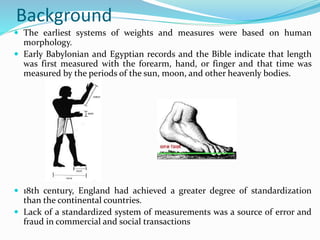
 The earliest systems of weights and measures were based on human
morphology.
 Early Babylonian and Egyptian records and the Bible indicate that length
was first measured with the forearm, hand, or finger and that time was
measured by the periods of the sun, moon, and other heavenly bodies.
 18th century, England had achieved a greater degree of standardization
than the continental countries.
 Lack of a standardized system of measurements was a source of error and
fraud in commercial and social transactions
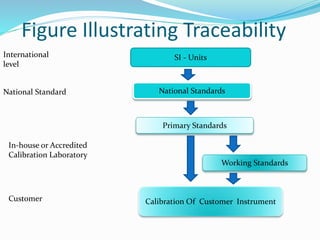
Figure Illustrating Traceability
SI - Units
National Standards
Primary Standards
Working Standards
Calibration Of Customer Instrument
International
level
National Standard
In-house or Accredited
Calibration Laboratory
Customer
Why calibrate???
Why calibrate???
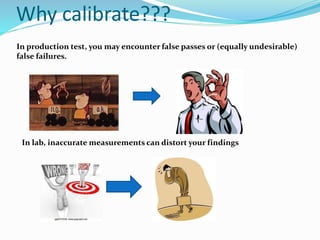
In production test, you may encounter false passes or (equally undesirable)
false failures.
In lab, inaccurate measurements can distort your findings
Why calibrate???
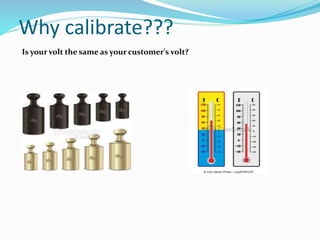
Is your volt the same as your customer's volt?
When Calibrate???
When Calibrate???
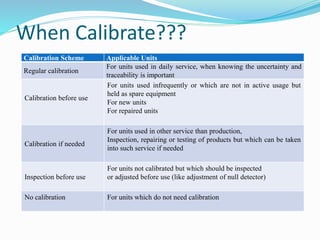
Calibration Scheme Applicable Units
Regular calibration
For units used in daily service, when knowing the uncertainty and
traceability is important
Calibration before use
For units used infrequently or which are not in active usage but
held as spare equipment
For new units
For repaired units
Calibration if needed
For units used in other service than production,
Inspection, repairing or testing of products but which can be taken
into such service if needed
Inspection before use
For units not calibrated but which should be inspected
or adjusted before use (like adjustment of null detector)
No calibration For units which do not need calibration
Lengthening or shortening calibration
interval
 Lengthening the Calibration Interval
 When the measurement equipment has stability surveillance long enough
 Before lengthening the calibration interval
 the user should ensure that the maximum calibration intervals were not
exceeded
 Shortening the Calibration Interval
 When measurement equipment has drifted more than its specifications allow
 procedures should be performed:
 In cases where the drift is caused by misuse or breakage, the cause and fault
should be corrected.
 In cases where the unit has drifted without a clear cause, the calibration interval
should be shortened to half of its original length.
Benefits
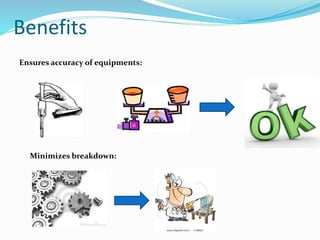
Ensures accuracy of equipments:
Minimizes breakdown:
Benefits
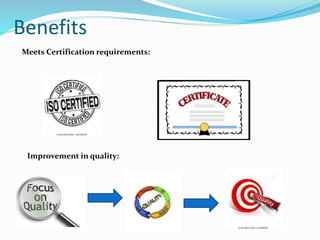
Meets Certification requirements:
Improvement in quality:
Benefits
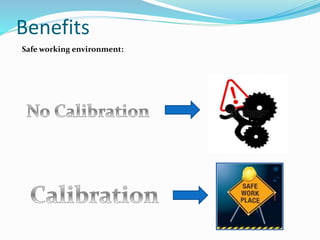
Safe working environment:
On-Site Vs Laboratory Calibration
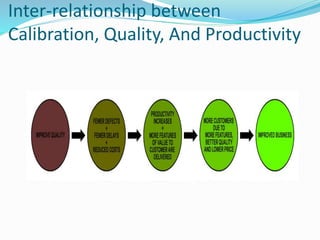
Inter-relationship between
Calibration, Quality, And Productivity
Inter-relationship between Quality,
Productivity and Calibration
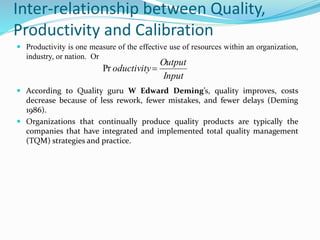
 Productivity is one measure of the effective use of resources within an organization,
industry, or nation. Or
 According to Quality guru W Edward Deming’s, quality improves, costs
decrease because of less rework, fewer mistakes, and fewer delays (Deming
1986).
 Organizations that continually produce quality products are typically the
companies that have integrated and implemented total quality management
(TQM) strategies and practice.
Input
Output
oductivityPr
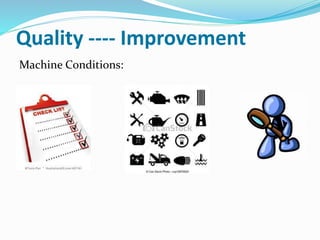
Quality ---- Improvement
Machine Conditions:
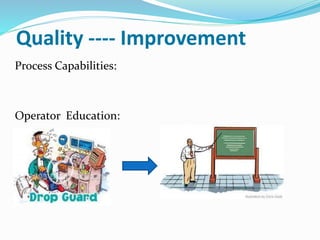
Quality ---- Improvement
Process Capabilities:
Operator Education:
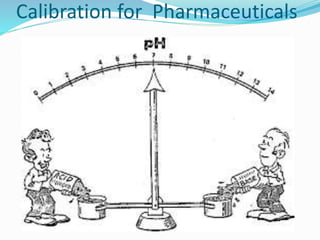
Calibration for Pharmaceuticals
Some Facts about calibration
 The words "calibrate" and "calibration" entered the English language as recent as
the American Civil War
 Term "calibration" was likely first associated with the precise division of linear
distance and angles using a dividing engine and the measurement of
gravitational mass using a weighing scale
 The calibration process begins with the design of the measuring instrument that
needs to be calibrated
 The selection of a standard or standards is the most visible part of the calibration
process.
 Quality management systems call for an effective metrology system which includes
formal, periodic, and documented calibration of all measuring instruments.
Why Caltech??????
 CALTECH is committed for quality calibration services.
 Our lab is well equipped with quality instruments.
 The master equipments include some of the world's best brands like YCT,
Racer, Radix, Rotronic, etc.
 CALTECH strictly follows the guidelines suggested by ISO 17025.
 The technical team of CALTECH consists of engineers and experienced
professionals in the field of metrology.
 Our standards are traceable to national and international standards.
 In a nutshell, quality is our motto, vision and mission
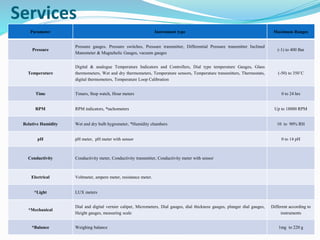
Services
Parameter Instrument type Maximum Ranges
Pressure
Pressure gauges. Pressure switches, Pressure transmitter, Differential Pressure transmitter Inclined
Manometer & Magnehelic Gauges, vacuum gauges
(-1) to 400 Bar
Temperature
Digital & analogue Temperature Indicators and Controllers, Dial type temperature Gauges, Glass
thermometers, Wet and dry thermometers, Temperature sensors, Temperature transmitters, Thermostats,
digital thermometers, Temperature Loop Calibration
(-50) to 350˚C
Time Timers, Stop watch, Hour meters 0 to 24 hrs
RPM RPM indicators, *tachometers Up to 18000 RPM
Relative Humidity Wet and dry bulb hygrometer, *Humidity chambers 10 to 90% RH
pH pH meter, pH meter with sensor 0 to 14 pH
Conductivity Conductivity meter, Conductivity transmitter, Conductivity meter with sensor
Electrical Voltmeter, ampere meter, resistance meter.
*Light LUX meters
*Mechanical
Dial and digital vernier caliper, Micrometers, Dial gauges, dial thickness gauges, plunger dial gauges,
Height gauges, measuring scale
Different according to
instruments
*Balance Weighing balance 1mg to 220 g
Queries and Suggestions
Thank You

Presentation for APPON

  • 1.
  • 2.
    Agenda  Introduction  Background WHY CALIBRATE???  WHEN CALIBRATE???  Benefits of Calibration  On-site VS Lab calibration  Inter-relationship between Quality, Productivity And Calibration  Calibration for Pharmaceuticals  Some facts about calibration  Why Caltech???  Queries
  • 3.
    Introduction  “A setof operations, performed in accordance with a definite documented procedure, that compares measurements performed by an instrument to those made by a more accurate instrument or standard, for the purpose of detecting and reporting or eliminating by adjustment, errors in the instruments tested.”:- ISO/IEC Guide 2  “Operation that, under specified conditions, in a first step, establishes a relation between the quantity values with measurement uncertainties provided by measurement standards and corresponding indications with associated measurement uncertainties and, in a second step, uses this information to establish a relation for obtaining a measurement result from an indication.”:- As per VIM
  • 4.
    Background  The earliestsystems of weights and measures were based on human morphology.  Early Babylonian and Egyptian records and the Bible indicate that length was first measured with the forearm, hand, or finger and that time was measured by the periods of the sun, moon, and other heavenly bodies.  18th century, England had achieved a greater degree of standardization than the continental countries.  Lack of a standardized system of measurements was a source of error and fraud in commercial and social transactions
  • 5.
    Figure Illustrating Traceability SI- Units National Standards Primary Standards Working Standards Calibration Of Customer Instrument International level National Standard In-house or Accredited Calibration Laboratory Customer
  • 6.
  • 7.
    Why calibrate??? In productiontest, you may encounter false passes or (equally undesirable) false failures. In lab, inaccurate measurements can distort your findings
  • 8.
    Why calibrate??? Is yourvolt the same as your customer's volt?
  • 10.
  • 11.
    When Calibrate??? Calibration SchemeApplicable Units Regular calibration For units used in daily service, when knowing the uncertainty and traceability is important Calibration before use For units used infrequently or which are not in active usage but held as spare equipment For new units For repaired units Calibration if needed For units used in other service than production, Inspection, repairing or testing of products but which can be taken into such service if needed Inspection before use For units not calibrated but which should be inspected or adjusted before use (like adjustment of null detector) No calibration For units which do not need calibration
  • 12.
    Lengthening or shorteningcalibration interval  Lengthening the Calibration Interval  When the measurement equipment has stability surveillance long enough  Before lengthening the calibration interval  the user should ensure that the maximum calibration intervals were not exceeded  Shortening the Calibration Interval  When measurement equipment has drifted more than its specifications allow  procedures should be performed:  In cases where the drift is caused by misuse or breakage, the cause and fault should be corrected.  In cases where the unit has drifted without a clear cause, the calibration interval should be shortened to half of its original length.
  • 13.
    Benefits Ensures accuracy ofequipments: Minimizes breakdown:
  • 14.
  • 15.
  • 16.
  • 17.
  • 18.
    Inter-relationship between Quality, Productivityand Calibration  Productivity is one measure of the effective use of resources within an organization, industry, or nation. Or  According to Quality guru W Edward Deming’s, quality improves, costs decrease because of less rework, fewer mistakes, and fewer delays (Deming 1986).  Organizations that continually produce quality products are typically the companies that have integrated and implemented total quality management (TQM) strategies and practice. Input Output oductivityPr
  • 19.
  • 20.
    Quality ---- Improvement ProcessCapabilities: Operator Education:
  • 21.
  • 22.
  • 23.
    Some Facts aboutcalibration  The words "calibrate" and "calibration" entered the English language as recent as the American Civil War  Term "calibration" was likely first associated with the precise division of linear distance and angles using a dividing engine and the measurement of gravitational mass using a weighing scale  The calibration process begins with the design of the measuring instrument that needs to be calibrated  The selection of a standard or standards is the most visible part of the calibration process.  Quality management systems call for an effective metrology system which includes formal, periodic, and documented calibration of all measuring instruments.
  • 24.
    Why Caltech??????  CALTECHis committed for quality calibration services.  Our lab is well equipped with quality instruments.  The master equipments include some of the world's best brands like YCT, Racer, Radix, Rotronic, etc.  CALTECH strictly follows the guidelines suggested by ISO 17025.  The technical team of CALTECH consists of engineers and experienced professionals in the field of metrology.  Our standards are traceable to national and international standards.  In a nutshell, quality is our motto, vision and mission
  • 25.
    Services Parameter Instrument typeMaximum Ranges Pressure Pressure gauges. Pressure switches, Pressure transmitter, Differential Pressure transmitter Inclined Manometer & Magnehelic Gauges, vacuum gauges (-1) to 400 Bar Temperature Digital & analogue Temperature Indicators and Controllers, Dial type temperature Gauges, Glass thermometers, Wet and dry thermometers, Temperature sensors, Temperature transmitters, Thermostats, digital thermometers, Temperature Loop Calibration (-50) to 350˚C Time Timers, Stop watch, Hour meters 0 to 24 hrs RPM RPM indicators, *tachometers Up to 18000 RPM Relative Humidity Wet and dry bulb hygrometer, *Humidity chambers 10 to 90% RH pH pH meter, pH meter with sensor 0 to 14 pH Conductivity Conductivity meter, Conductivity transmitter, Conductivity meter with sensor Electrical Voltmeter, ampere meter, resistance meter. *Light LUX meters *Mechanical Dial and digital vernier caliper, Micrometers, Dial gauges, dial thickness gauges, plunger dial gauges, Height gauges, measuring scale Different according to instruments *Balance Weighing balance 1mg to 220 g
  • 26.
  • 27.