A GxP-CompliantCalibration
Handling,storing,ortransportingtemperaturesensitivematerialsare
subjectto regulationsbygovernmentauthorities.Almosteveryregulatory
documentintheareas ofgoodmanufacturingpractices(GMP)andgood
distributionpractices(GDP)requires the calibrationoftemperature
sensors. This guide givesa compactoverviewon how
tocalibrateincompliance withtheseregulations,oftenreferredtoasGxP
requirements.
What is a calibration?
A calibration is a reliable, reproducible, and
documented comparison of a device under test
(data logger, sensor) with a traceable reference.
The reference is a high-precision instrument, which
is checked regularly by an accredited laboratory
(accreditation bodies for Switzerland: SAS/SCS;
USA: NIST; Germany: DAkkS; UK: UKAS). A
calibration is performed at one or several defined
measurement points. Toperform the calibration, a
device/machine is needed to keep a stable
environment:
For Temperature:
A calibration bath, block or fixed point (i.e. ice
water or liquid nitrogen) keeps a constant
temperature to let the two devices adjust to
the temperature point (e. g., for 30 minutes).
For Humidity:
A humidity generator or a reference solution
(salt water) generating a defined humidity at a
given temperature to let the two devices adjust
to the relative humidity (e.g., for 2 hours).
The two measurement rows (the device under
test and the reference device) are compared. If
the device under test measures within the
specification, the result is documented in a
calibration certificate.
Institutes (examples) for setting national
standards*
Switzerland METAS
Germany PTB
USA NIST
Singapore NMC A*STAR
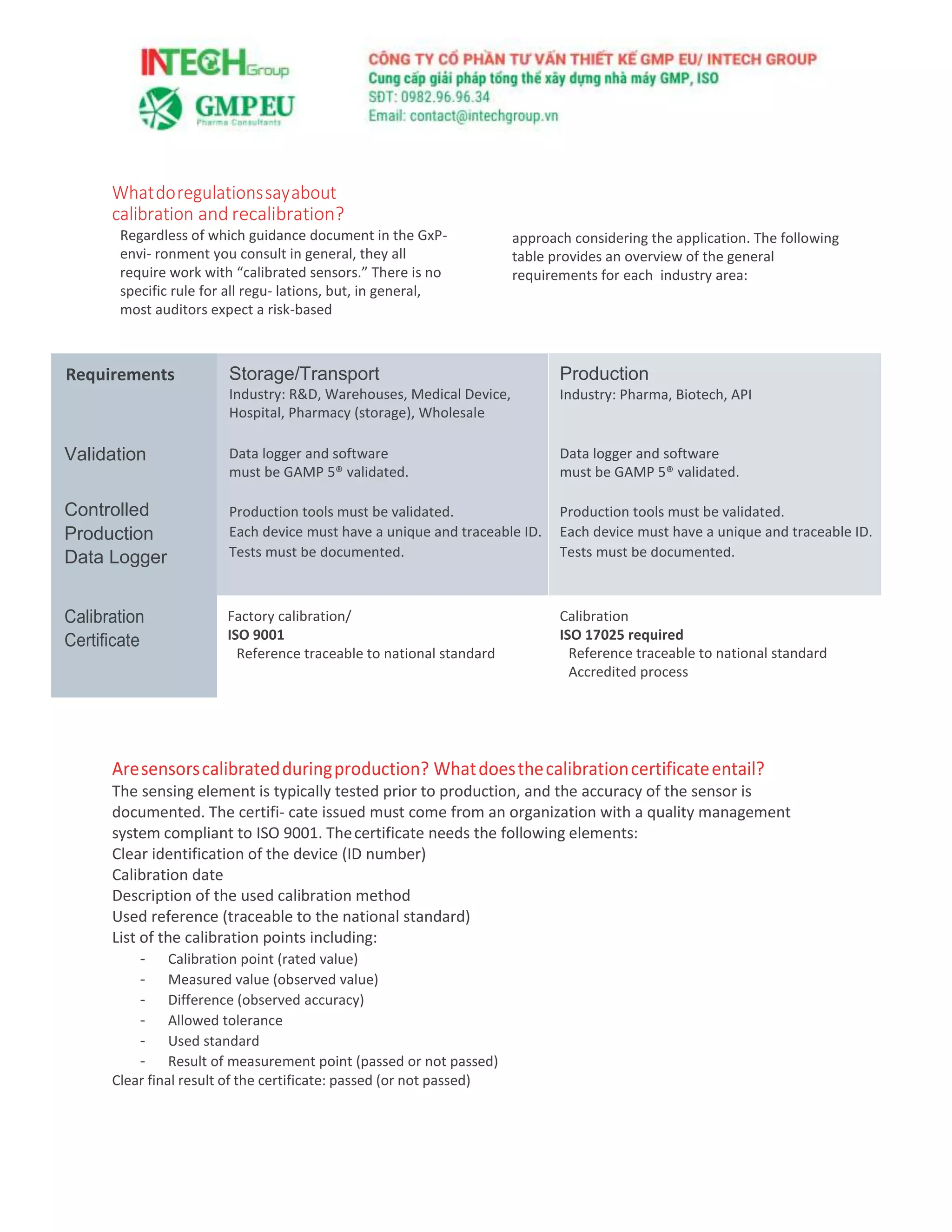
Whatdoregulationssayabout
calibration and recalibration?
Regardless of which guidance document in the GxP-
envi- ronment you consult in general, they all
require work with “calibrated sensors.” There is no
specific rule for all regu- lations, but, in general,
most auditors expect a risk-based
approach considering the application. The following
table provides an overview of the general
requirements for each industry area:
Aresensorscalibratedduringproduction? Whatdoesthecalibrationcertificateentail?
The sensing element is typically tested prior to production, and the accuracy of the sensor is
documented. The certifi- cate issued must come from an organization with a quality management
system compliant to ISO 9001. Thecertificate needs the following elements:
Clear identification of the device (ID number)
Calibration date
Description of the used calibration method
Used reference (traceable to the national standard)
List of the calibration points including:
- Calibration point (rated value)
- Measured value (observed value)
- Difference (observed accuracy)
- Allowed tolerance
- Used standard
- Result of measurement point (passed or not passed)
Clear final result of the certificate: passed (or not passed)
Requirements Storage/Transport
Industry: R&D, Warehouses, Medical Device,
Hospital, Pharmacy (storage), Wholesale
Production
Industry: Pharma, Biotech, API
Validation Data logger and software
must be GAMP 5® validated.
Data logger and software
must be GAMP 5® validated.
Controlled Production tools must be validated. Production tools must be validated.
Production Each device must have a unique and traceable ID. Each device must have a unique and traceable ID.
Data Logger Tests must be documented. Tests must be documented.
Calibration
Certificate
Factory calibration/
ISO 9001
Reference traceable to national standard
Calibration
ISO 17025 required
Reference traceable to national standard
Accredited process
HowcanIkeepmysystemincompliance
(recalibration)?
While the wording in some guidance documents
is more general (e.g.,“calibrated sensors must be
used”), others are more specific requesting
“regular calibration” or even “yearly calibration.”
When working with “one-year type” data
loggers, recalibration is not necessary since
“fresh” devices, including a production
calibration certificate, are purchased each year.
However, if working with a network monitoring
system or a cloud solution, there is a need for
regular recalibration. For such solutions, there
are two recommended options:
The first option is to replace the “old” sensor
with
a new sensor, which comes with a “fresh”
calibration certificate.
In the second option trained service technicians
perform the calibration on site using their
equipment (calibration bath or calibration block,
reference instrument).
Calibraton
sensor
Calibraton
Device
under test
2 000.00
How often do I need to recalibrate my sensor?
The risk-based approach should consider the risk of the application and the type of sensor (open vs. closed):
Potential Risks Circumstances with low risks Circumstances with high risks
Chemical damage Closed water-proof case (IP 67) Open sensor with external probe
Physical damage Fixed installation Loose installation (risk of fall or hit)
Transport (vibration)
Temperature range
of the application
+2 °C to +8 °C, +15 °C to +25 °C Extreme low temperatures (< -35 °C)
Extreme high temperatures (> +70 °C)
Risk approach Low risk sensor*
Production calibration installation
Recalibration 18 to 24 months after
installation
High risk sensor
Calibration after
installation
Recalibration 12 to 18
months after
production
*Whenpurchasinga“lowrisksensor”(waterproofcase,fixedinstallation,moderatetemperatureranges),itisacommon
bestpracticetowork with wireless temperature sensors in a closed case, which comes with a production calibration
certificate. Since the sensor is well protected from externalinfluencebeforeinstallation,itmakessensetostartthe
recalibrationintervalonlyaftertheinstallationofthesensorhashappened.
The risk of drift slightly increases during operative use
HowdoIreadanISO17025calibration certificate?
ISO 17025 is the international standard for calibrations with elevated requirements. The national
authority accredits the laboratory, the calibration process, and thecertificate.
Although ISO 17025 certificates do not result in higher accuracy, they are more expensive since the
documentation effort is much higher.
Inadditiontothefactorycalibration,ISO17025follows these standards:
Laboratory must be accredited.
Certificate must include the following information:
- Logo of national accreditation body
- Logo of ILAC (International Laboratory Accreditation Cooperation)
- Location of the calibration
- Environmental conditions during calibration
- Measurement uncertainty
- Name of person who performed the calibration
- Name of person who approved the calibration
- The final result (statement of conformity) justification

GxP - Compliant Calibration

  • 2.
    A GxP-CompliantCalibration Handling,storing,ortransportingtemperaturesensitivematerialsare subjectto regulationsbygovernmentauthorities.Almosteveryregulatory documentintheareasofgoodmanufacturingpractices(GMP)andgood distributionpractices(GDP)requires the calibrationoftemperature sensors. This guide givesa compactoverviewon how tocalibrateincompliance withtheseregulations,oftenreferredtoasGxP requirements. What is a calibration? A calibration is a reliable, reproducible, and documented comparison of a device under test (data logger, sensor) with a traceable reference. The reference is a high-precision instrument, which is checked regularly by an accredited laboratory (accreditation bodies for Switzerland: SAS/SCS; USA: NIST; Germany: DAkkS; UK: UKAS). A calibration is performed at one or several defined measurement points. Toperform the calibration, a device/machine is needed to keep a stable environment: For Temperature: A calibration bath, block or fixed point (i.e. ice water or liquid nitrogen) keeps a constant temperature to let the two devices adjust to the temperature point (e. g., for 30 minutes). For Humidity: A humidity generator or a reference solution (salt water) generating a defined humidity at a given temperature to let the two devices adjust to the relative humidity (e.g., for 2 hours). The two measurement rows (the device under test and the reference device) are compared. If the device under test measures within the specification, the result is documented in a calibration certificate. Institutes (examples) for setting national standards* Switzerland METAS Germany PTB USA NIST Singapore NMC A*STAR
  • 3.
    Whatdoregulationssayabout calibration and recalibration? Regardlessof which guidance document in the GxP- envi- ronment you consult in general, they all require work with “calibrated sensors.” There is no specific rule for all regu- lations, but, in general, most auditors expect a risk-based approach considering the application. The following table provides an overview of the general requirements for each industry area: Aresensorscalibratedduringproduction? Whatdoesthecalibrationcertificateentail? The sensing element is typically tested prior to production, and the accuracy of the sensor is documented. The certifi- cate issued must come from an organization with a quality management system compliant to ISO 9001. Thecertificate needs the following elements: Clear identification of the device (ID number) Calibration date Description of the used calibration method Used reference (traceable to the national standard) List of the calibration points including: - Calibration point (rated value) - Measured value (observed value) - Difference (observed accuracy) - Allowed tolerance - Used standard - Result of measurement point (passed or not passed) Clear final result of the certificate: passed (or not passed) Requirements Storage/Transport Industry: R&D, Warehouses, Medical Device, Hospital, Pharmacy (storage), Wholesale Production Industry: Pharma, Biotech, API Validation Data logger and software must be GAMP 5® validated. Data logger and software must be GAMP 5® validated. Controlled Production tools must be validated. Production tools must be validated. Production Each device must have a unique and traceable ID. Each device must have a unique and traceable ID. Data Logger Tests must be documented. Tests must be documented. Calibration Certificate Factory calibration/ ISO 9001 Reference traceable to national standard Calibration ISO 17025 required Reference traceable to national standard Accredited process
  • 4.
    HowcanIkeepmysystemincompliance (recalibration)? While the wordingin some guidance documents is more general (e.g.,“calibrated sensors must be used”), others are more specific requesting “regular calibration” or even “yearly calibration.” When working with “one-year type” data loggers, recalibration is not necessary since “fresh” devices, including a production calibration certificate, are purchased each year. However, if working with a network monitoring system or a cloud solution, there is a need for regular recalibration. For such solutions, there are two recommended options: The first option is to replace the “old” sensor with a new sensor, which comes with a “fresh” calibration certificate. In the second option trained service technicians perform the calibration on site using their equipment (calibration bath or calibration block, reference instrument). Calibraton sensor Calibraton Device under test 2 000.00
  • 5.
    How often doI need to recalibrate my sensor? The risk-based approach should consider the risk of the application and the type of sensor (open vs. closed): Potential Risks Circumstances with low risks Circumstances with high risks Chemical damage Closed water-proof case (IP 67) Open sensor with external probe Physical damage Fixed installation Loose installation (risk of fall or hit) Transport (vibration) Temperature range of the application +2 °C to +8 °C, +15 °C to +25 °C Extreme low temperatures (< -35 °C) Extreme high temperatures (> +70 °C) Risk approach Low risk sensor* Production calibration installation Recalibration 18 to 24 months after installation High risk sensor Calibration after installation Recalibration 12 to 18 months after production *Whenpurchasinga“lowrisksensor”(waterproofcase,fixedinstallation,moderatetemperatureranges),itisacommon bestpracticetowork with wireless temperature sensors in a closed case, which comes with a production calibration certificate. Since the sensor is well protected from externalinfluencebeforeinstallation,itmakessensetostartthe recalibrationintervalonlyaftertheinstallationofthesensorhashappened. The risk of drift slightly increases during operative use HowdoIreadanISO17025calibration certificate? ISO 17025 is the international standard for calibrations with elevated requirements. The national authority accredits the laboratory, the calibration process, and thecertificate. Although ISO 17025 certificates do not result in higher accuracy, they are more expensive since the documentation effort is much higher. Inadditiontothefactorycalibration,ISO17025follows these standards: Laboratory must be accredited. Certificate must include the following information: - Logo of national accreditation body - Logo of ILAC (International Laboratory Accreditation Cooperation) - Location of the calibration - Environmental conditions during calibration - Measurement uncertainty - Name of person who performed the calibration - Name of person who approved the calibration - The final result (statement of conformity) justification