Calibration of equipments
By: Shravan Kumar
What is Calibration ?
Calibration:
The demonstration that a particular
instrument or device produces results within
specified limits by comparison with those
produced by a reference or traceable
standard over an appropriate range of
measurements .
OR
Calibration is a comparison between measurements –
one of known magnitude or correctness made or set
with one device and another measurement made in
as similar a way as possible with a second device.
STANDARD DEVICE:
The device with the known or assigned correctness is called the
standard.
UNDER TEST DEVICE:
The second device is the unit under test, test instrument, or any of
several other names for the device being calibrated.
Requirement of Calibration
•Control of weighing
•Control of measuring
•Control of monitoring and
•Control test equipment
that is critical for assuring the quality of intermediates or
APIs should be calibrated according to written procedures and
an established schedule.
Procedure for Calibration !
1. Equipment calibrations should be performed using
standards traceable to certified standards, if existing.
2. Records of these calibrations should be maintained.
3. The current CALIBRATION status of critical EQUIPMENT
should be known and verifiable.
1. Instruments/equipments that do not meet calibration
criteria should not be used.
2. Deviations from approved standards of calibration on
critical instruments/equipments should be investigated
to determine if these could have had an impact on the
quality of the intermediate(s) or API(s) manufactured
using this equipment since the last successful calibration.
Here we are focusing only on equipment
(Volume) calibration procedures, like:
Reactors
Storage tanks
Vessels
Objective :
To develop a standard procedure for the
equipment (Volume) calibration (e. g.
Reactor, Receiver and Tank)used in
manufacturing.
Responsibility:
1. Production Chemist
2. Production Technician
Shall be responsible for the compliance of SOP.
Procedure For the Calibration :
1.Equipment should be empty & clean.
2.Bottom valve of the equipment should be closed.
3.A DI water flow meter and two clean hose pipe for the performing the
calibration activity.
4.DI water flow meter should be calibrated.
5.Connect the hose pipe with DI water point
6.Connect the DI water flow meter and
7.Than connect the second hose pipe.
8.The water flow meter should be tightly clamped.
9.Put the hose pipe in the equipment.
Types of Equipment Calibration
1. Reactor calibration
2.Tank or Receiver calibration
Reactor calibration
Instrument required for Reactor calibration
1.Calibrated DI water flow meter
2.Calibrated dip rod
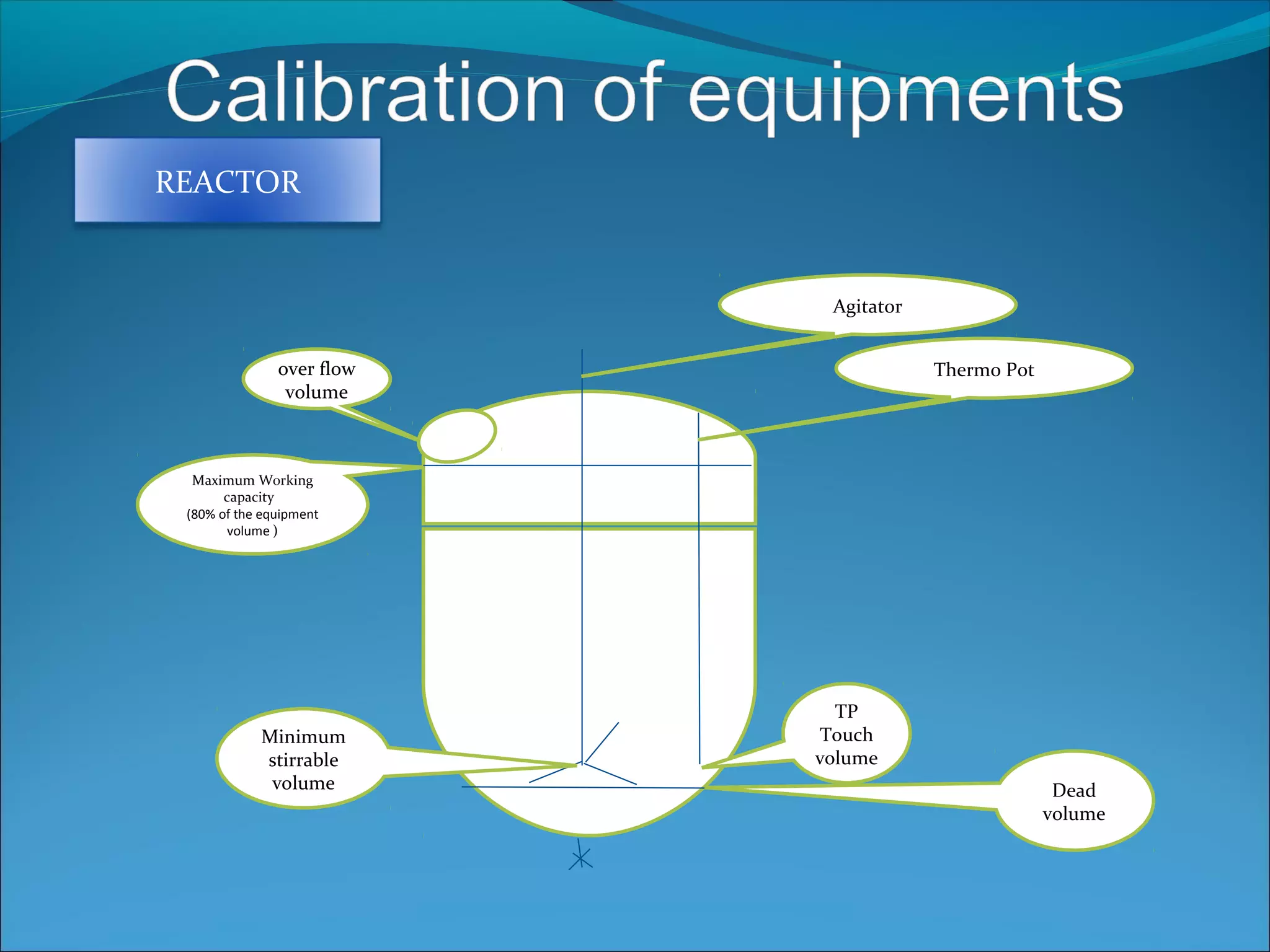
over flow
volume
TP
Touch
volume
Minimum
stirrable
volume
Maximum Working
capacity
(80% of the equipment
volume )
Dead
volume
Agitator
Thermo Pot
REACTOR
Calibration of equipment can be divide into three
parts
1. Dead volume :
2.Working capacity volume
3.Over flow volume
Dead volume:
A minimum volume of the equipment which is not
stirrable.
Working capacity volume:
Volume between the dead and overflow volume.
Over flow volume:
Volume after the dead and working capacity volume,
Or
the maximum volume after the working capacity, if we
add a single amount of water and the it become out
from the equipment
FOR REACTOR
Procedure for find the dead volume of reactor:
1. Put the hose pipe in the reactor and calibrated dip at the bottom
valve of the reactor.
2. Note the initial reading.
3. Paste a mark on the calibrated dip rod for the identification (where the
leaf of the agitator start)
4. Start the filling of water in the reactor carefully
5. Stop the filling of water as the level of water touch the leaf of the
agitator.
6. Note the second reading.
7. Find the difference between initial and final reading
8. The volume will be as dead volume of the reactor
Procedure for maximum working capacity of the reactor:
1. Put a mark on the dip rod for the dead volume.
2. And again put the second mark after a one centimeter on the dip
rod.
3. Put the dip rod in the reactor at the bottom valve.
4. Fill the DI water till the mark of one centimeter.
5. Note the initial and final reading and find the difference.
6. Than we will get LPCM ( Liter per centimeter)
7. Repeat the activity till the 80% of the equipment volume. (Working
capacity of the equipment)
8. Again fill the water till the neck of the equipment and note the
reading. (Maximum capacity of the equipment)
Procedure for over flow volume of the reactor:
1. After getting the maximum capacity of the equipment.
2. Note the initial reading.
3. Fill the water till the water come out from the manhole .
4. Note the final reading.
5. Find the difference
6. The amount of water will be the over flow volume of the
equipment.
Cross verification Procedure for volume calibration:
1. Note the initial reading.
2. Open the bottom valve and discard the water.
3. Note down the reading .
• For over flow volume.
• For working capacity.
• For LPCM
• For dead volume
Tanks & Vessels calibration
Instrument required for Tanks & Vessels calibration
Calibrated DI water flow meter
Line
indicator
Dead
volume
Visual
capacity
Over
flow
volume
Tanks & Vessels
FOR TANKS & VESSELS
Procedure for find the dead volume of tanks & vessels:
1. Put the hose pipe in the equipment.
2. Note the initial reading.
3. Start the filling of water into the equipment.
4. Stop the filling of water as the level of water shown in line
indicator (LI).
5. Note the second reading.
6. Find the difference between initial and final reading
7. The volume will be as dead volume of the equipment.
Procedure for maximum working capacity of the Tanks
and vessels:
1.After getting the dead volume of the equipment.
2.Note the initial reading
3.Fill the DI water till the level of line indicator reaches at one centimeter
in LI.
4.Note the final reading.
5.Find the difference for LPCM (LPCM-liter per centimeter).
6.Repeat the activity till the LI fill completely (working capacity of the equipment ).
Procedure for over flow volume of the Tanks & Vessels:
1. After getting the maximum capacity of the equipment.
2. Note the initial reading.
3. Fill the water till the water come out from the manhole .
4. Note the final reading.
5. Find the difference
6. The amount of water will be the over flow volume of the equipment.
THANK YOU !!!!

Equipment calibration PPT by Shravan Kumar

  • 1.
  • 2.
  • 3.
    Calibration: The demonstration thata particular instrument or device produces results within specified limits by comparison with those produced by a reference or traceable standard over an appropriate range of measurements .
  • 4.
    OR Calibration is acomparison between measurements – one of known magnitude or correctness made or set with one device and another measurement made in as similar a way as possible with a second device.
  • 5.
    STANDARD DEVICE: The devicewith the known or assigned correctness is called the standard. UNDER TEST DEVICE: The second device is the unit under test, test instrument, or any of several other names for the device being calibrated.
  • 6.
  • 7.
    •Control of weighing •Controlof measuring •Control of monitoring and •Control test equipment that is critical for assuring the quality of intermediates or APIs should be calibrated according to written procedures and an established schedule.
  • 8.
  • 9.
    1. Equipment calibrationsshould be performed using standards traceable to certified standards, if existing. 2. Records of these calibrations should be maintained. 3. The current CALIBRATION status of critical EQUIPMENT should be known and verifiable.
  • 10.
    1. Instruments/equipments thatdo not meet calibration criteria should not be used. 2. Deviations from approved standards of calibration on critical instruments/equipments should be investigated to determine if these could have had an impact on the quality of the intermediate(s) or API(s) manufactured using this equipment since the last successful calibration.
  • 11.
    Here we arefocusing only on equipment (Volume) calibration procedures, like: Reactors Storage tanks Vessels
  • 12.
    Objective : To developa standard procedure for the equipment (Volume) calibration (e. g. Reactor, Receiver and Tank)used in manufacturing. Responsibility: 1. Production Chemist 2. Production Technician Shall be responsible for the compliance of SOP.
  • 13.
    Procedure For theCalibration : 1.Equipment should be empty & clean. 2.Bottom valve of the equipment should be closed. 3.A DI water flow meter and two clean hose pipe for the performing the calibration activity. 4.DI water flow meter should be calibrated. 5.Connect the hose pipe with DI water point 6.Connect the DI water flow meter and 7.Than connect the second hose pipe. 8.The water flow meter should be tightly clamped. 9.Put the hose pipe in the equipment.
  • 14.
    Types of EquipmentCalibration 1. Reactor calibration 2.Tank or Receiver calibration
  • 15.
    Reactor calibration Instrument requiredfor Reactor calibration 1.Calibrated DI water flow meter 2.Calibrated dip rod
  • 16.
    over flow volume TP Touch volume Minimum stirrable volume Maximum Working capacity (80%of the equipment volume ) Dead volume Agitator Thermo Pot REACTOR
  • 17.
    Calibration of equipmentcan be divide into three parts 1. Dead volume : 2.Working capacity volume 3.Over flow volume
  • 18.
    Dead volume: A minimumvolume of the equipment which is not stirrable. Working capacity volume: Volume between the dead and overflow volume. Over flow volume: Volume after the dead and working capacity volume, Or the maximum volume after the working capacity, if we add a single amount of water and the it become out from the equipment
  • 19.
    FOR REACTOR Procedure forfind the dead volume of reactor: 1. Put the hose pipe in the reactor and calibrated dip at the bottom valve of the reactor. 2. Note the initial reading. 3. Paste a mark on the calibrated dip rod for the identification (where the leaf of the agitator start) 4. Start the filling of water in the reactor carefully 5. Stop the filling of water as the level of water touch the leaf of the agitator. 6. Note the second reading. 7. Find the difference between initial and final reading 8. The volume will be as dead volume of the reactor
  • 20.
    Procedure for maximumworking capacity of the reactor: 1. Put a mark on the dip rod for the dead volume. 2. And again put the second mark after a one centimeter on the dip rod. 3. Put the dip rod in the reactor at the bottom valve. 4. Fill the DI water till the mark of one centimeter. 5. Note the initial and final reading and find the difference. 6. Than we will get LPCM ( Liter per centimeter) 7. Repeat the activity till the 80% of the equipment volume. (Working capacity of the equipment) 8. Again fill the water till the neck of the equipment and note the reading. (Maximum capacity of the equipment)
  • 21.
    Procedure for overflow volume of the reactor: 1. After getting the maximum capacity of the equipment. 2. Note the initial reading. 3. Fill the water till the water come out from the manhole . 4. Note the final reading. 5. Find the difference 6. The amount of water will be the over flow volume of the equipment.
  • 22.
    Cross verification Procedurefor volume calibration: 1. Note the initial reading. 2. Open the bottom valve and discard the water. 3. Note down the reading . • For over flow volume. • For working capacity. • For LPCM • For dead volume
  • 23.
    Tanks & Vesselscalibration Instrument required for Tanks & Vessels calibration Calibrated DI water flow meter
  • 24.
  • 25.
    FOR TANKS &VESSELS Procedure for find the dead volume of tanks & vessels: 1. Put the hose pipe in the equipment. 2. Note the initial reading. 3. Start the filling of water into the equipment. 4. Stop the filling of water as the level of water shown in line indicator (LI). 5. Note the second reading. 6. Find the difference between initial and final reading 7. The volume will be as dead volume of the equipment.
  • 26.
    Procedure for maximumworking capacity of the Tanks and vessels: 1.After getting the dead volume of the equipment. 2.Note the initial reading 3.Fill the DI water till the level of line indicator reaches at one centimeter in LI. 4.Note the final reading. 5.Find the difference for LPCM (LPCM-liter per centimeter). 6.Repeat the activity till the LI fill completely (working capacity of the equipment ).
  • 27.
    Procedure for overflow volume of the Tanks & Vessels: 1. After getting the maximum capacity of the equipment. 2. Note the initial reading. 3. Fill the water till the water come out from the manhole . 4. Note the final reading. 5. Find the difference 6. The amount of water will be the over flow volume of the equipment.
  • 28.