Key developments in ICT in Norwegian Education Deputy Director General Øystein Johannessen Norwegian Ministry of Education and Research BECTA Visit Coventry 08112006
Digital Literacy and Curriculum Reform Strategic Activities Challenges Topics in my presentation
National Curriculum Reform Covers grades 1-13 and takes effect from school year 2006-2007. Heavy investments in teacher competencies. Hallmark 1: Less focus on normative methodology, clear competence goals Hallmark 2:  5 basic skills  as basis for learning and development to be embedded in all subjects at all levels. to be able to  express oneself orally  to be able to  read  to be able to  express oneself in writing  to be able to  do arithmetic  to be able to  use information and communication technology Basis digital skills: Need for diversity. Avoid mouse-trap  
Case I: Digital Skills in Norwegian Digital skills: Enabling the potential in reading and writing. Critical use of sources. Improve communication and presentation skills. 4th grade:  Search and retrieve texts by using ICT. Finding useful  material for essays etc. on the Internet 7th grade Use ICT in creating texts Explain IPR for texts from the Internet 10th grade Assess the value of texts and info from the Internet
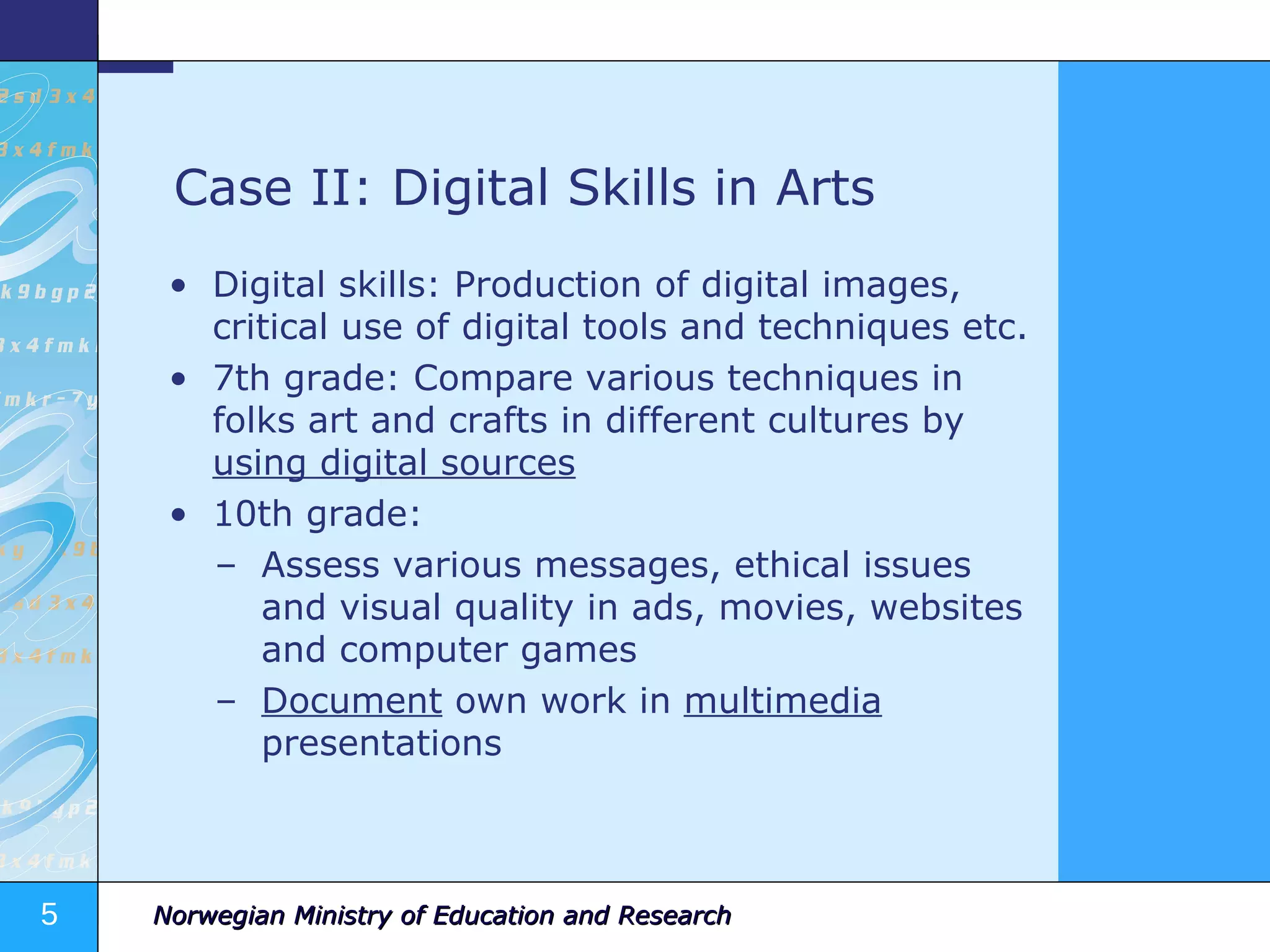
Case II: Digital Skills in Arts Digital skills: Production of digital images, critical use of digital tools and techniques etc. 7th grade: Compare various techniques in folks art and crafts in different cultures by  using digital sources 10th grade: Assess various messages, ethical issues and visual quality in ads, movies, websites and computer games Document  own work in  multimedia  presentations
The need for a coherent approach-> Identity Management Identity management (ID management) is a broad administrative area that deals with  identifying individuals  in a system (such as a country, a network, or an enterprise) and  controlling their access to resources  within that system by  associating user rights and restrictions with the established identity . IDM  -  within the educational sector (i.e. FEIDE) Building upon a policy for Federation  Based upon Open standards  Single Sign-On  One single username + password for access to multiple digital services Deployment step-by-step towards 2010
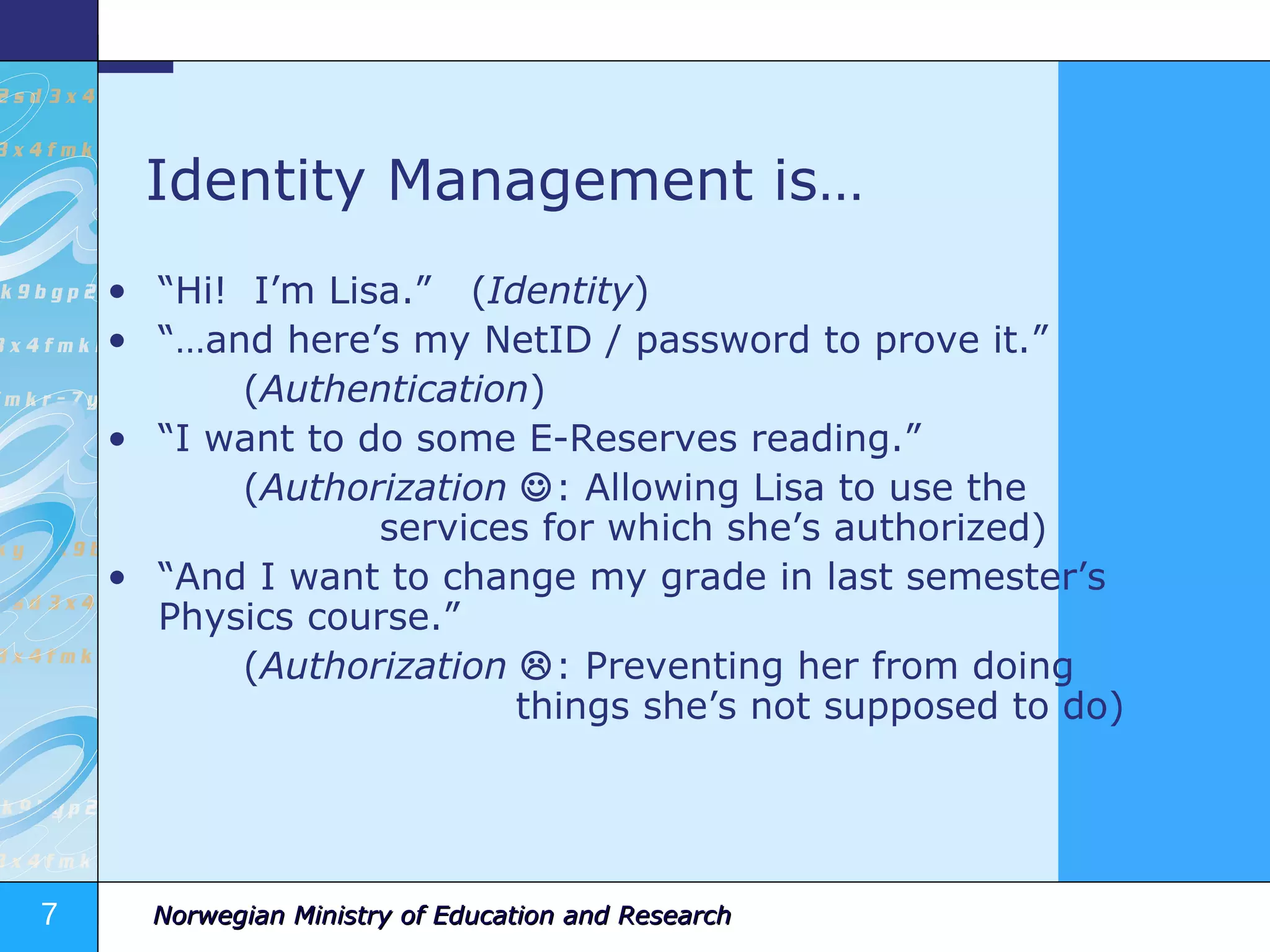
Identity Management is… “ Hi!  I’m Lisa.”  ( Identity ) “… and here’s my NetID / password to prove it.” ( Authentication ) “ I want to do some E-Reserves reading.” ( Authorization   : Allowing Lisa to use the services for which she’s authorized) “ And I want to change my grade in last semester’s Physics course.” ( Authorization   : Preventing her from doing  things she’s not supposed to do)
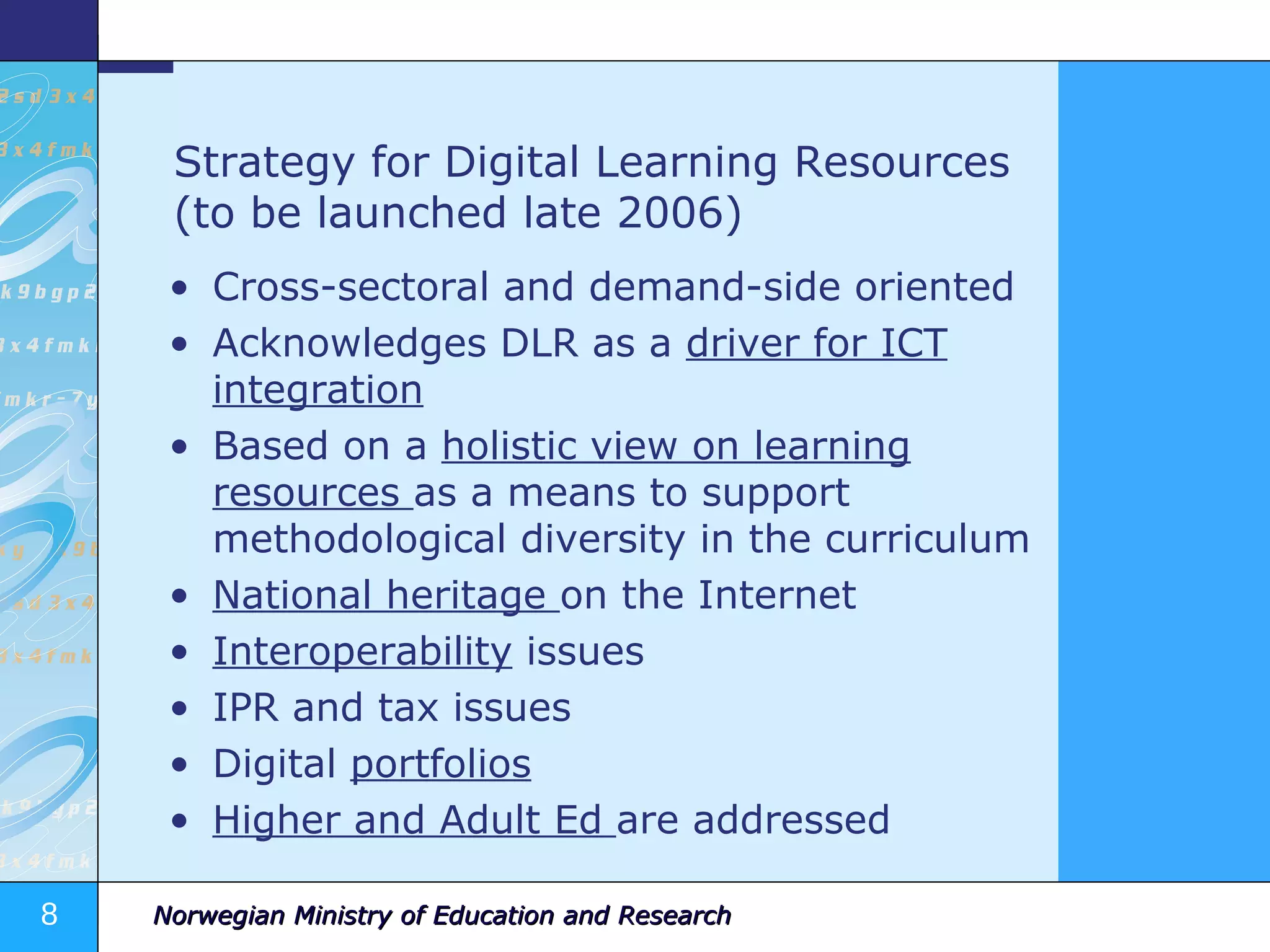
Strategy for Digital Learning Resources (to be launched late 2006) Cross-sectoral and demand-side oriented Acknowledges DLR as a  driver for ICT integration Based on a  holistic view on learning resources  as a means to support methodological diversity in the curriculum National heritage  on the Internet Interoperability  issues IPR and tax issues Digital  portfolios Higher and Adult Ed  are addressed
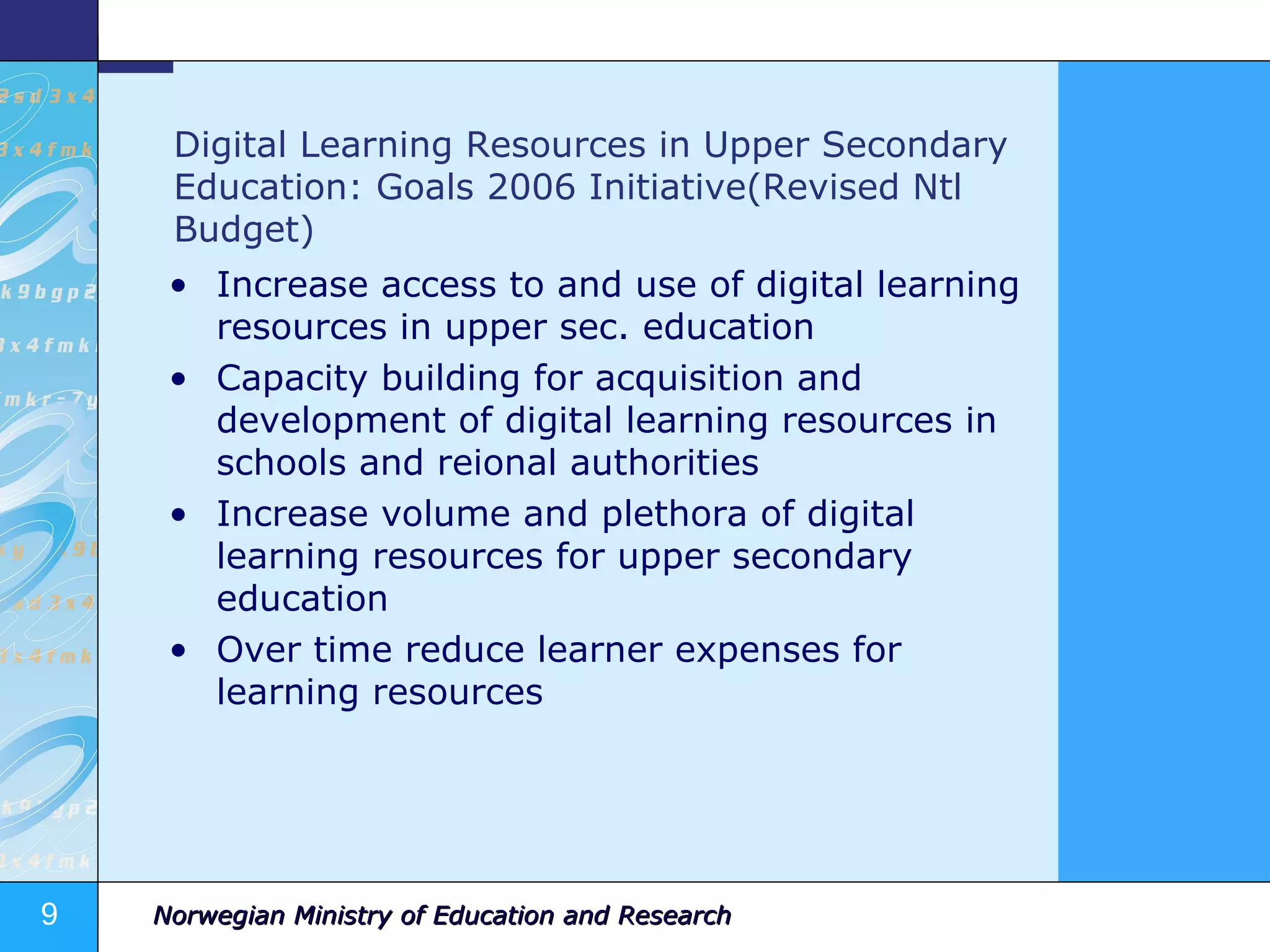
Digital Learning Resources in Upper Secondary Education: Goals 2006 Initiative(Revised Ntl Budget) Increase access to and use of digital learning resources in upper sec. education Capacity building for acquisition and development of digital learning resources in schools and reional authorities Increase volume and plethora of digital learning resources for upper secondary education Over time reduce learner expenses for learning resources
Challenge I: Towards….World 2.0     Web 2.0 and social software  give our students new tools for production, interaction and sharing online. -> Challenge to the educational system Computer games : Engages children in complex learning situations requiring the ability to master different set of modalities (J P Gee 2005) OECD 2006 (”New Millelium Learners”) and others: How will the  gap between home and school use  of ICT affect education? Risk of marginalisation? New learners are more  ICT-savvy  than before. We have to grasp this challenge
Challenge II: How long is the last mile…? Competence development does not seem to have  sufficient impact  (eLearning Nordic 2006) -> Need to revisit teacher and in-service training New curriculum:  Embedding of digital skills  is critical for embedding ICT in schools Sufficient  alignment of assessment  to new curriculum? Better knowledge base  is required Access issues: Broadband connectivity and PC access at home are still related to income and educational level of parents. Broadband connectivity in primary schools unevenly distributed Adults at risk ?: Insufficient basic skills -> Barriers to participation in Knowledge Society Higher Ed revisited? ICT Architecture, Open Source Software and Open Standards : White Paper on ICT Policy late 2006
Digital Competencies are necessary to navigate in difficult waters – even on a sunny day   Thank you for your attention [email_address]

Presentation BECTA 08112006

  • 1.
    Key developments inICT in Norwegian Education Deputy Director General Øystein Johannessen Norwegian Ministry of Education and Research BECTA Visit Coventry 08112006
  • 2.
    Digital Literacy andCurriculum Reform Strategic Activities Challenges Topics in my presentation
  • 3.
    National Curriculum ReformCovers grades 1-13 and takes effect from school year 2006-2007. Heavy investments in teacher competencies. Hallmark 1: Less focus on normative methodology, clear competence goals Hallmark 2: 5 basic skills as basis for learning and development to be embedded in all subjects at all levels. to be able to express oneself orally to be able to read to be able to express oneself in writing to be able to do arithmetic to be able to use information and communication technology Basis digital skills: Need for diversity. Avoid mouse-trap 
  • 4.
    Case I: DigitalSkills in Norwegian Digital skills: Enabling the potential in reading and writing. Critical use of sources. Improve communication and presentation skills. 4th grade: Search and retrieve texts by using ICT. Finding useful material for essays etc. on the Internet 7th grade Use ICT in creating texts Explain IPR for texts from the Internet 10th grade Assess the value of texts and info from the Internet
  • 5.
    Case II: DigitalSkills in Arts Digital skills: Production of digital images, critical use of digital tools and techniques etc. 7th grade: Compare various techniques in folks art and crafts in different cultures by using digital sources 10th grade: Assess various messages, ethical issues and visual quality in ads, movies, websites and computer games Document own work in multimedia presentations
  • 6.
    The need fora coherent approach-> Identity Management Identity management (ID management) is a broad administrative area that deals with identifying individuals in a system (such as a country, a network, or an enterprise) and controlling their access to resources within that system by associating user rights and restrictions with the established identity . IDM - within the educational sector (i.e. FEIDE) Building upon a policy for Federation Based upon Open standards Single Sign-On One single username + password for access to multiple digital services Deployment step-by-step towards 2010
  • 7.
    Identity Management is…“ Hi! I’m Lisa.” ( Identity ) “… and here’s my NetID / password to prove it.” ( Authentication ) “ I want to do some E-Reserves reading.” ( Authorization  : Allowing Lisa to use the services for which she’s authorized) “ And I want to change my grade in last semester’s Physics course.” ( Authorization  : Preventing her from doing things she’s not supposed to do)
  • 8.
    Strategy for DigitalLearning Resources (to be launched late 2006) Cross-sectoral and demand-side oriented Acknowledges DLR as a driver for ICT integration Based on a holistic view on learning resources as a means to support methodological diversity in the curriculum National heritage on the Internet Interoperability issues IPR and tax issues Digital portfolios Higher and Adult Ed are addressed
  • 9.
    Digital Learning Resourcesin Upper Secondary Education: Goals 2006 Initiative(Revised Ntl Budget) Increase access to and use of digital learning resources in upper sec. education Capacity building for acquisition and development of digital learning resources in schools and reional authorities Increase volume and plethora of digital learning resources for upper secondary education Over time reduce learner expenses for learning resources
  • 10.
    Challenge I: Towards….World2.0  Web 2.0 and social software give our students new tools for production, interaction and sharing online. -> Challenge to the educational system Computer games : Engages children in complex learning situations requiring the ability to master different set of modalities (J P Gee 2005) OECD 2006 (”New Millelium Learners”) and others: How will the gap between home and school use of ICT affect education? Risk of marginalisation? New learners are more ICT-savvy than before. We have to grasp this challenge
  • 11.
    Challenge II: Howlong is the last mile…? Competence development does not seem to have sufficient impact (eLearning Nordic 2006) -> Need to revisit teacher and in-service training New curriculum: Embedding of digital skills is critical for embedding ICT in schools Sufficient alignment of assessment to new curriculum? Better knowledge base is required Access issues: Broadband connectivity and PC access at home are still related to income and educational level of parents. Broadband connectivity in primary schools unevenly distributed Adults at risk ?: Insufficient basic skills -> Barriers to participation in Knowledge Society Higher Ed revisited? ICT Architecture, Open Source Software and Open Standards : White Paper on ICT Policy late 2006
  • 12.
    Digital Competencies arenecessary to navigate in difficult waters – even on a sunny day  Thank you for your attention [email_address]