



Digital Citizenship
A Burning Issue
in Educational Technology
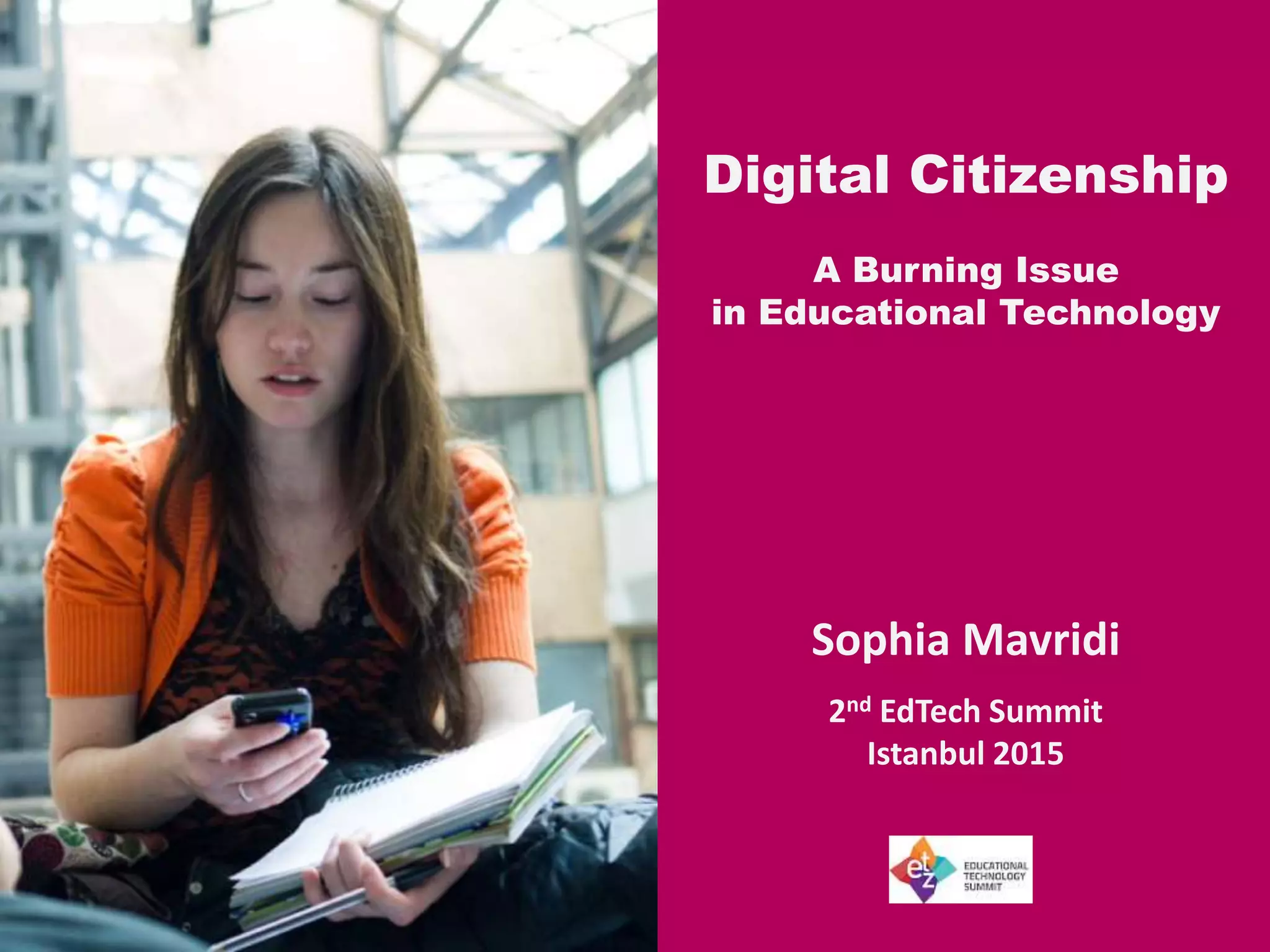
Sophia Mavridi
2nd EdTech Summit
Istanbul 2015
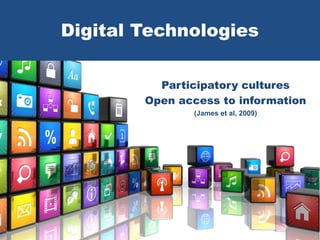
Digital Technologies
Participatory cultures
Open access to information
(James et al, 2009)
Risky opportunities
(Livingstone, 2008:1)
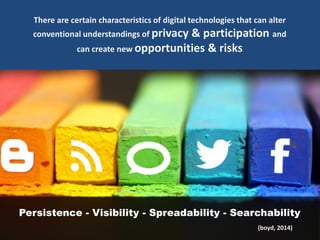
There are certain characteristics of digital technologies that can alter
conventional understandings of privacy & participation and
can create new opportunities & risks
Persistence - Visibility - Spreadability - Searchability
(boyd, 2014)
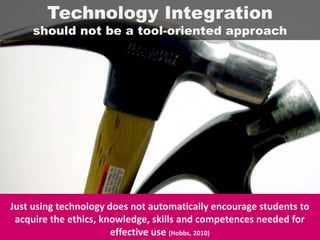
Just using technology does not automatically encourage students to
acquire the ethics, knowledge, skills and competences needed for
effective use (Hobbs, 2010)
Technology Integration
should not be a tool-oriented approach
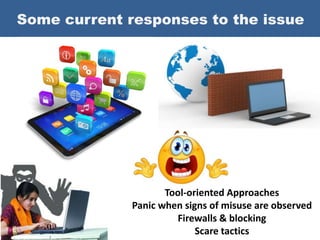
Some current responses to the issue
Tool-oriented Approaches
Panic when signs of misuse are observed
Firewalls & blocking
Scare tactics
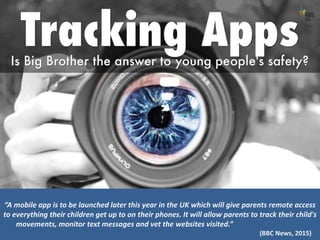
“A mobile app is to be launched later this year in the UK which will give parents remote access
to everything their children get up to on their phones. It will allow parents to track their child's
movements, monitor text messages and vet the websites visited.”
(BBC News, 2015)
“At a public swimming pool we have gates, put up signs,
have lifeguards and shallow ends…
but we also teach children how to swim”
Byron (2008: 2)
Digital Citizenship
A HOLISTIC APPROACH
Literacies, skills, competences and ethical thinking for
effective digital participation
What is Digital Citizenship
A digital citizen understands human, cultural, and societal
issues related to technology and advocates and practices safe, responsible
and ethical use of digital information and technology
(ISTE, 2007)
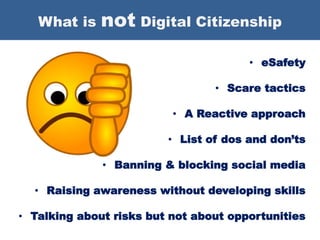
What is not Digital Citizenship
• eSafety
• Scare tactics
• A Reactive approach
• List of dos and don’ts
• Banning & blocking social media
• Raising awareness without developing skills
• Talking about risks but not about opportunities
What skills & competences
do we need to foster?
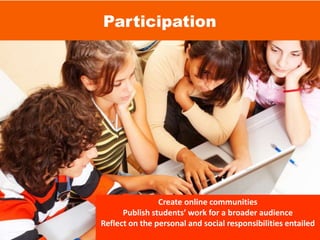
Participation
Create online communities
Publish students’ work for a broader audience
Reflect on the personal and social responsibilities entailed
Managing Privacy & Identity
Are young people creating a culture of disclosure?
(Woo, 2006)
Digital Citizens represent themselves in light of the properties of
Persistance, Searchability, Visibility and Spreadability
(James et al, 2009)
Safety
Critical thinking
Revisiting the role of strangers
Perceiving everything we do online as public
Evaluating the credibility of online information
• Critical thinking
• Fact checking
• Source comparison
• Who’s the author?
• What’s the purpose of this message?
• What opinions or ideas are missing?
Develop fair use skills
Teach paraphrasing and citation skills
Introduce students to Creative Commons Licenses
Encourage students to license their own work and publish it online
Teach students to synthesise information into their own original argument
Ownership & authorship
Digital Plagiarism and Copyright
Are digital technologies creating an
‘infringing culture’?
(Lessig, 2004)
Managing digital distractions & healthy computing
• Don’t ban the use of mobile
devices – Manage it
• Switch to plane mode when
needed
• Involve students in the creation
of class rules
• Have a technology-free day
• Provide a good role model
Healthy computing
• Right posture – RSI, eye strain,
back problems
• Take regular breaks.
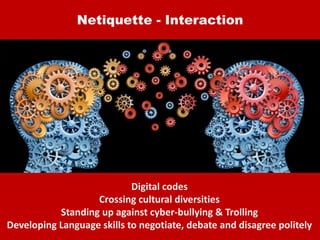
Netiquette - Interaction
Digital codes
Crossing cultural diversities
Standing up against cyber-bullying & Trolling
Developing Language skills to negotiate, debate and disagree politely
Digital security
Detecting Malware
Setting strong passwords
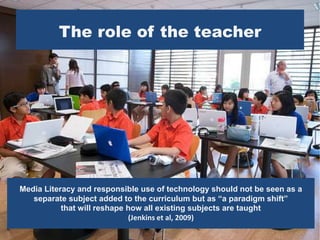
The role of the teacher
Media Literacy and responsible use of technology should not be seen as a
separate subject added to the curriculum but as “a paradigm shift”
that will reshape how all existing subjects are taught
(Jenkins et al, 2009)
The teachers involved in this study suggested that every discipline teacher
should assume responsibility to teach digital citizenship skills as more and more
technology is integrated into the classroom:
• a core component of students’ education (100%)
• These skills cannot be covered by the ICT teacher alone (88%)
• The way ICT is taught in their contexts does not include digital citizenship skills
but rather focuses on how digital tools work (53%)
• Teachers spend considerable amount of time with students and can be both
guards and mentors of their safe and ethical conduct (80%)
Further discipline-specific research is needed to explore the relevance of these skills
to different subjects of the school curriculum.
(Mavridi, 2014: 62, 79)
Limitations & Constraints
Lack of training
Teachers may need to find their own way
“I was not 100% sure about the materials but I still went ahead and I said
“OK you can do that”, but perhaps I was taking risks, right? But there was
nobody to guide me, tell me or train me. So I think we need some guidelines,
we need somebody to train us as well. “
“I’ve never heard of any course you can take on how to train students to use
technology properly. I think we have to learn by ourselves as this is
something that doesn’t exist.”
Data from EFL Teachers (Mavridi, 2014: 170, 168)
photo #ELTpics Dace Praulins
“I think with teachers but also with leaders and principals, part of their problem is
that they might not have a shared understanding of what it is to teach students to
use the Internet responsibly, and what it means for teaching and learning”
Data from DigCit expert (Mavridi, 2014: 126)
Other constraints identified
Time
Parents
Limited access to technology
A systematic approach
Not a once-and-for-all approach
Integrating Digital Citizenship
6 Action Steps
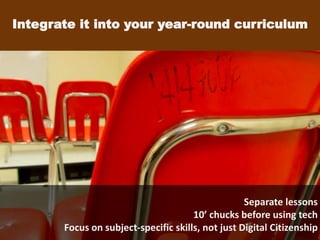
Separate lessons
10’ chucks before using tech
Focus on subject-specific skills, not just Digital Citizenship
Integrate it into your year-round curriculum
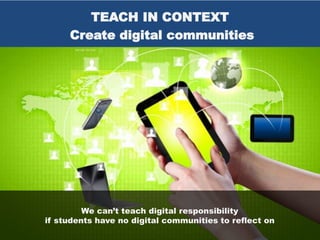
We can’t teach digital responsibility
if students have no digital communities to reflect on
TEACH IN CONTEXT
Create digital communities
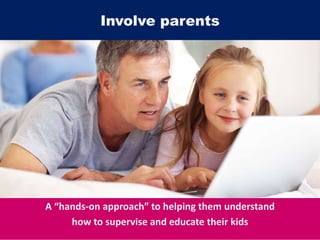
A “hands-on approach” to helping them understand
how to supervise and educate their kids
Involve parents
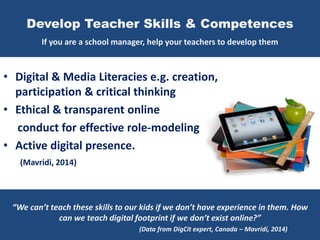
Develop Teacher Skills & Competences
If you are a school manager, help your teachers to develop them
• Digital & Media Literacies e.g. creation,
participation & critical thinking
• Ethical & transparent online
conduct for effective role-modeling
• Active digital presence.
(Mavridi, 2014)
“We can’t teach these skills to our kids if we don’t have experience in them. How
can we teach digital footprint if we don’t exist online?”
(Data from DigCit expert, Canada – Mavridi, 2014)
Digital Citizenship Resources
Lesson Plans – Videos - eBooks
Or design your own materials
Stay informed
#DigitalCitizenship
#DigCit
#DigLit
#eSafety
#DigitalIdentity
@SophiaMav
Email mav.sophia@gmail.com
Twitter @SophiaMav
Blog sophiamavridi.edublogs.org
Sophia Mavridi

Digital Citizenship: A Burning Issue in Educational Technology

  • 1.
    Digital Citizenship A BurningIssue in Educational Technology Sophia Mavridi 2nd EdTech Summit Istanbul 2015
  • 2.
    Digital Technologies Participatory cultures Openaccess to information (James et al, 2009)
  • 3.
  • 4.
    There are certaincharacteristics of digital technologies that can alter conventional understandings of privacy & participation and can create new opportunities & risks Persistence - Visibility - Spreadability - Searchability (boyd, 2014)
  • 5.
    Just using technologydoes not automatically encourage students to acquire the ethics, knowledge, skills and competences needed for effective use (Hobbs, 2010) Technology Integration should not be a tool-oriented approach
  • 6.
    Some current responsesto the issue Tool-oriented Approaches Panic when signs of misuse are observed Firewalls & blocking Scare tactics
  • 7.
    “A mobile appis to be launched later this year in the UK which will give parents remote access to everything their children get up to on their phones. It will allow parents to track their child's movements, monitor text messages and vet the websites visited.” (BBC News, 2015)
  • 8.
    “At a publicswimming pool we have gates, put up signs, have lifeguards and shallow ends… but we also teach children how to swim” Byron (2008: 2)
  • 9.
    Digital Citizenship A HOLISTICAPPROACH Literacies, skills, competences and ethical thinking for effective digital participation
  • 10.
    What is DigitalCitizenship A digital citizen understands human, cultural, and societal issues related to technology and advocates and practices safe, responsible and ethical use of digital information and technology (ISTE, 2007)
  • 11.
    What is notDigital Citizenship • eSafety • Scare tactics • A Reactive approach • List of dos and don’ts • Banning & blocking social media • Raising awareness without developing skills • Talking about risks but not about opportunities
  • 12.
    What skills &competences do we need to foster?
  • 13.
    Participation Create online communities Publishstudents’ work for a broader audience Reflect on the personal and social responsibilities entailed
  • 14.
    Managing Privacy &Identity Are young people creating a culture of disclosure? (Woo, 2006) Digital Citizens represent themselves in light of the properties of Persistance, Searchability, Visibility and Spreadability (James et al, 2009)
  • 15.
    Safety Critical thinking Revisiting therole of strangers Perceiving everything we do online as public
  • 16.
    Evaluating the credibilityof online information • Critical thinking • Fact checking • Source comparison • Who’s the author? • What’s the purpose of this message? • What opinions or ideas are missing?
  • 17.
    Develop fair useskills Teach paraphrasing and citation skills Introduce students to Creative Commons Licenses Encourage students to license their own work and publish it online Teach students to synthesise information into their own original argument Ownership & authorship Digital Plagiarism and Copyright Are digital technologies creating an ‘infringing culture’? (Lessig, 2004)
  • 18.
    Managing digital distractions& healthy computing • Don’t ban the use of mobile devices – Manage it • Switch to plane mode when needed • Involve students in the creation of class rules • Have a technology-free day • Provide a good role model Healthy computing • Right posture – RSI, eye strain, back problems • Take regular breaks.
  • 19.
    Netiquette - Interaction Digitalcodes Crossing cultural diversities Standing up against cyber-bullying & Trolling Developing Language skills to negotiate, debate and disagree politely
  • 20.
  • 21.
    The role ofthe teacher Media Literacy and responsible use of technology should not be seen as a separate subject added to the curriculum but as “a paradigm shift” that will reshape how all existing subjects are taught (Jenkins et al, 2009)
  • 22.
    The teachers involvedin this study suggested that every discipline teacher should assume responsibility to teach digital citizenship skills as more and more technology is integrated into the classroom: • a core component of students’ education (100%) • These skills cannot be covered by the ICT teacher alone (88%) • The way ICT is taught in their contexts does not include digital citizenship skills but rather focuses on how digital tools work (53%) • Teachers spend considerable amount of time with students and can be both guards and mentors of their safe and ethical conduct (80%) Further discipline-specific research is needed to explore the relevance of these skills to different subjects of the school curriculum. (Mavridi, 2014: 62, 79)
  • 23.
  • 24.
    Lack of training Teachersmay need to find their own way “I was not 100% sure about the materials but I still went ahead and I said “OK you can do that”, but perhaps I was taking risks, right? But there was nobody to guide me, tell me or train me. So I think we need some guidelines, we need somebody to train us as well. “ “I’ve never heard of any course you can take on how to train students to use technology properly. I think we have to learn by ourselves as this is something that doesn’t exist.” Data from EFL Teachers (Mavridi, 2014: 170, 168) photo #ELTpics Dace Praulins
  • 25.
    “I think withteachers but also with leaders and principals, part of their problem is that they might not have a shared understanding of what it is to teach students to use the Internet responsibly, and what it means for teaching and learning” Data from DigCit expert (Mavridi, 2014: 126)
  • 26.
  • 27.
    A systematic approach Nota once-and-for-all approach Integrating Digital Citizenship 6 Action Steps
  • 28.
    Separate lessons 10’ chucksbefore using tech Focus on subject-specific skills, not just Digital Citizenship Integrate it into your year-round curriculum
  • 29.
    We can’t teachdigital responsibility if students have no digital communities to reflect on TEACH IN CONTEXT Create digital communities
  • 30.
    A “hands-on approach”to helping them understand how to supervise and educate their kids Involve parents
  • 31.
    Develop Teacher Skills& Competences If you are a school manager, help your teachers to develop them • Digital & Media Literacies e.g. creation, participation & critical thinking • Ethical & transparent online conduct for effective role-modeling • Active digital presence. (Mavridi, 2014) “We can’t teach these skills to our kids if we don’t have experience in them. How can we teach digital footprint if we don’t exist online?” (Data from DigCit expert, Canada – Mavridi, 2014)
  • 32.
    Digital Citizenship Resources LessonPlans – Videos - eBooks Or design your own materials
  • 33.
  • 34.
    Email mav.sophia@gmail.com Twitter @SophiaMav Blogsophiamavridi.edublogs.org Sophia Mavridi