Open Educational Resources: Policy implications Deputy Director General Øystein Johannessen Norwegian Ministry of Education and Research OECD Expert Meeting Barcelona 26102006
Current situation in Norwegian (Higher) Education Strategies Policy implications Topics in my presentation
Some ICT trends in Norwegian Education Curriculum Reform (K-13): Digital Skills embedded in subject curricula from 2006-2007. Higher Ed Quality Reform in Higher Ed: Stronger emphasis on student-active learning High penetration of digital learning platforms in Higher Ed Good infrastructure (PC access, Internet, networks) Uneven use of digital learning resources (DLR). Scale and scope of OER activities have not been mapped. Lack of re-use of digital learning resources
Possible reasons for lack of re-use of DLR in Higher Ed Learning resources are context-bound. Inhibits re-use Lack of ICT competence in own organisation The ”My Way Syndrome”. Insufficient culture of sharing IPR issues
Portal strategy (2005-2008) Coordination Group for Educational Portals Advocates a Culture for Sharing Avvoid overlapping content and target groups Technology development and interoperability: Course Decscription Management (CDM) Technological Interoperability for digital learning resources Content sharing and dissemination projects
Strategy for Digital Learning Resources (to be launched late 2006) Cross-sectoral and demand-side oriented Acknowledges DLR as a  driver for ICT integration Based on a  holistic view on learning resources  as a means to support methodological diversity National heritage  on the Internet Interoperability  issues IPR and tax issues Digital  portfolios Higher and Adult Ed  are addressed
Towards….World 2.0     Web 2.0 and social software  give our students new tools for production, interaction and sharing online. -> Challenge to the educational system Computer games : Engages children in complex learning situations requiring the ability to master different set of modalities (J P Gee 2005) OECD 2006 (”New Millelium Learners”) and others: How will the  gap between home and school use  of ICT affect education? Risk of marginalisation? New students are more  ICT-savvy  than before. HEIs have to grasp this challenge
Policy implications: General issues Do we need a policy framework for OERs? Yes, but not only for Higher Ed OECD and EU should encourage OER policy discussions Government: Policy and infrastructure frameworks Legislation and licensing regimes Government should take its own medicine We are looking into the concept of the  Public Digital Domain  -> OER-policy must be mainstreamed Access Competencies Content
OER: Policy implications (I) Need to secure a  plethora of digital resources  for learning ->  Digital Public Domain Open Standards and OSS must be  included in governmental ICT policy  (Norway: White Paper late 2006) Coherent policy on incentives and funding is a big challenge Need to  strengthen the knowledge base  on digital learning resources (incl. OER)
OER Policy Implications (II) Technology Issues: Crossroads in terms of metatagging vs semantic search tecnologies Issues in Higher Ed ->Incentives and HE culture Pedagogical innovation  -> e.g. include Web 2.0 and social software in teaching and learning. Piece of cake? Business models for OER: Naivety? Important?
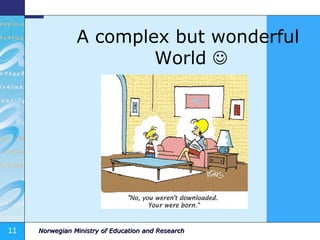
A complex but wonderful  World  

Open Educational Resources: Policy Implications

  • 1.
    Open Educational Resources:Policy implications Deputy Director General Øystein Johannessen Norwegian Ministry of Education and Research OECD Expert Meeting Barcelona 26102006
  • 2.
    Current situation inNorwegian (Higher) Education Strategies Policy implications Topics in my presentation
  • 3.
    Some ICT trendsin Norwegian Education Curriculum Reform (K-13): Digital Skills embedded in subject curricula from 2006-2007. Higher Ed Quality Reform in Higher Ed: Stronger emphasis on student-active learning High penetration of digital learning platforms in Higher Ed Good infrastructure (PC access, Internet, networks) Uneven use of digital learning resources (DLR). Scale and scope of OER activities have not been mapped. Lack of re-use of digital learning resources
  • 4.
    Possible reasons forlack of re-use of DLR in Higher Ed Learning resources are context-bound. Inhibits re-use Lack of ICT competence in own organisation The ”My Way Syndrome”. Insufficient culture of sharing IPR issues
  • 5.
    Portal strategy (2005-2008)Coordination Group for Educational Portals Advocates a Culture for Sharing Avvoid overlapping content and target groups Technology development and interoperability: Course Decscription Management (CDM) Technological Interoperability for digital learning resources Content sharing and dissemination projects
  • 6.
    Strategy for DigitalLearning Resources (to be launched late 2006) Cross-sectoral and demand-side oriented Acknowledges DLR as a driver for ICT integration Based on a holistic view on learning resources as a means to support methodological diversity National heritage on the Internet Interoperability issues IPR and tax issues Digital portfolios Higher and Adult Ed are addressed
  • 7.
    Towards….World 2.0  Web 2.0 and social software give our students new tools for production, interaction and sharing online. -> Challenge to the educational system Computer games : Engages children in complex learning situations requiring the ability to master different set of modalities (J P Gee 2005) OECD 2006 (”New Millelium Learners”) and others: How will the gap between home and school use of ICT affect education? Risk of marginalisation? New students are more ICT-savvy than before. HEIs have to grasp this challenge
  • 8.
    Policy implications: Generalissues Do we need a policy framework for OERs? Yes, but not only for Higher Ed OECD and EU should encourage OER policy discussions Government: Policy and infrastructure frameworks Legislation and licensing regimes Government should take its own medicine We are looking into the concept of the Public Digital Domain -> OER-policy must be mainstreamed Access Competencies Content
  • 9.
    OER: Policy implications(I) Need to secure a plethora of digital resources for learning -> Digital Public Domain Open Standards and OSS must be included in governmental ICT policy (Norway: White Paper late 2006) Coherent policy on incentives and funding is a big challenge Need to strengthen the knowledge base on digital learning resources (incl. OER)
  • 10.
    OER Policy Implications(II) Technology Issues: Crossroads in terms of metatagging vs semantic search tecnologies Issues in Higher Ed ->Incentives and HE culture Pedagogical innovation -> e.g. include Web 2.0 and social software in teaching and learning. Piece of cake? Business models for OER: Naivety? Important?
  • 11.
    A complex butwonderful World 