Presentation
By: Jagadish Mali
E&TC 6th Sem.
INTRODUCTION
In today’s life, everyone gives importance to
time. Time does not wait for anybody. Everything
should be performed in time & accurately. Now a
day’s school/college bells are manually operated.
Hence there is a big question of accuracy. Also
there is necessity of manpower and money. Hence
here we should use automatic control system, which
saves our manpower and money & also highest
accuracy. Hence we have selected the project.
What is our system?
In market there many digital clocks available with
bells but rings only at specific time. For e.g. Alarm
Clock and some bells that ring after some time intervals
and that cannot stop after specific time. For e.g. Musical
Clock But all these limitation have been removed by our
project. It rings only according to our college time table.
[Convention Bell] [Manually Operated College Bell]
Automatic College Bell
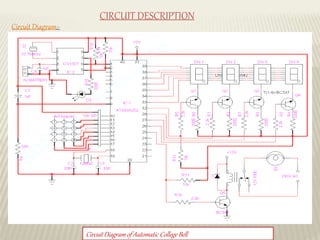
CIRCUIT DESCRIPTION
Circuit Diagram:-
Circuit Diagramof Automatic College Bell
Operations
 Switch ON the power
 In Display the real time will display.
 It has an Inbuilt Real Time Clock (DS1307/DS 12c
12c887) which tracks over the Real Time. When this
time equals to the Bell Ringing time, then the Relay for
the Bell is switched on.
 If one want to change the belling time. Input the desire
time from the keypad provided
 For changing the input time press * followed by #
on the keypad and set the belling time.
 One can set many ringing time at a time.
• The input time must be set with respect of RTC
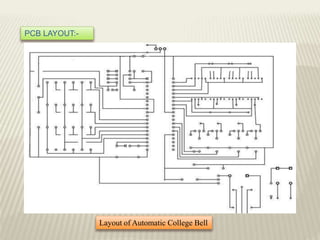
PCB LAYOUT:-
Layout of Automatic College Bell
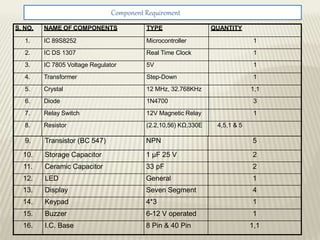
Component Requirement
S. NO. NAME OF COMPONENTS TYPE QUANTITY
1. IC 89S8252 Microcontroller 1
2. IC DS 1307 Real Time Clock 1
3. IC 7805 Voltage Regulator 5V 1
4. Transformer Step-Down 1
5. Crystal 12 MHz, 32.768KHz 1,1
6. Diode 1N4700 3
7. Relay Switch 12V Magnetic Relay 1
8. Resistor (2.2,10,56) KΩ,330E 4,5,1 & 5
9. Transistor (BC 547) NPN 5
10. Storage Capacitor 1 µF 25 V 2
11. Ceramic Capacitor 33 pF 2
12. LED General 1
13. Display Seven Segment 4
14. Keypad 4*3 1
15. Buzzer 6-12 V operated 1
16. I.C. Base 8 Pin & 40 Pin 1,1
Component Description
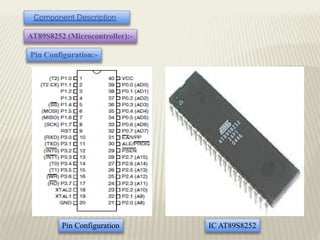
AT89S8252 (Microcontroller):-
Pin Configuration:-
Pin Configuration IC AT89S8252
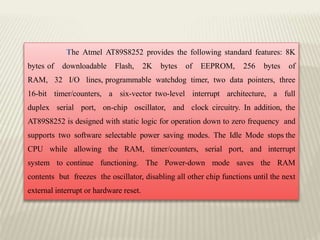
The Atmel AT89S8252 provides the following standard features: 8K
bytes of downloadable Flash, 2K bytes of EEPROM, 256 bytes of
RAM, 32 I/O lines, programmable watchdog timer, two data pointers, three
16-bit timer/counters, a six-vector two-level interrupt architecture, a full
duplex serial port, on-chip oscillator, and clock circuitry. In addition, the
AT89S8252 is designed with static logic for operation down to zero frequency and
supports two software selectable power saving modes. The Idle Mode stops the
CPU while allowing the RAM, timer/counters, serial port, and interrupt
system to continue functioning. The Power-down mode saves the RAM
contents but freezes the oscillator, disabling all other chip functions until the next
external interrupt or hardware reset.
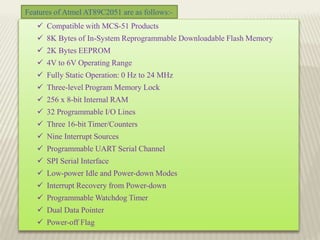
Features of Atmel AT89C2051 are as follows:-
 Compatible with MCS-51 Products
 8K Bytes of In-System Reprogrammable Downloadable Flash Memory
 2K Bytes EEPROM
 4V to 6V Operating Range
 Fully Static Operation: 0 Hz to 24 MHz
 Three-level Program Memory Lock
 256 x 8-bit Internal RAM
 32 Programmable I/O Lines
 Three 16-bit Timer/Counters
 Nine Interrupt Sources
 Programmable UART Serial Channel
 SPI Serial Interface
 Low-power Idle and Power-down Modes
 Interrupt Recovery from Power-down
 Programmable Watchdog Timer
 Dual Data Pointer
 Power-off Flag
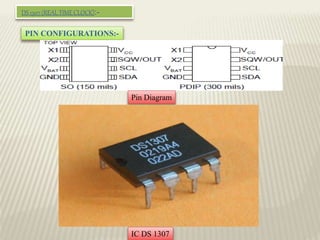
DS1307(REALTIMECLOCK):-
PIN CONFIGURATIONS:-
Pin Diagram
IC DS 1307
The DS1307 serial real-time clock (RTC) is a low power, full binary-
coded decimal (BCD) clock/calendar plus 56 bytes of NV SRAM. Address
and data are transferred serially through an I2C, bidirectional bus. The
clock/calendar provides seconds, minutes, hours, day, date, month, and year
information. The end of the month date is automatically adjusted for
months with fewer than 31 days, including corrections for leap year. The
clock operates in either the 24-hour or 12-hour format with AM/PM
indicator. The DS1307 has a built-in power-sense circuit that detects power
failures and automatically switches to the backup supply. Timekeeping
operation continues while the part operates from the backup supply.
Feature of IC DS1307 are as follows:
 Real-Time Clock (RTC) Counts Seconds
 Minutes, Hours, Date of the Month, Month, Day of the week, and Year with Leap-
Year
 Compensation Valid Up to 2100
 56-Byte, Battery-Backed, General-Purpose RAM with Unlimited Writes
 Programmable Square-Wave Output Signal
 Automatic Power-Fail Detect and Switch Circuitry
 Consumes Less than 500nA in Battery-Backup
 Mode with Oscillator Running
 Optional Industrial Temperature Range: - 40°C to +85°C
LM7805 VOLTAGE REGULATOR
The 78xx (also sometimes known as LM78xx) series of devices is a family of
self-contained fixed linear voltage regulator integrated circuits. The 78xx family is a
very popular choice for many electronic circuits which require a regulated power supply,
due to their ease of use and relative cheapness. When specifying individual ICs within
this family, the xx is replaced with a two-digit number, which indicates the output
voltage the particular device is designed to provide (for example, the 7805 has a 5 volt
output, while the 7812 produces 12 volts). The 78xx lines a re positive voltage
regulators, meaning that they are designed to produce a voltage that is positive relative to
a common ground. There is a related line of 79xx devices which are complementary
negative voltage regulators. 78xx and 79xx ICs can be used in combination to provide
both positive and negative supply voltages in the same circuit, if necessary.
78xx Ics have three terminals and are most commonly found in the TO220 form
factor, although smaller surface-mount and larger TO3 packages are also available from
some manufacturers. These devices typically support an input voltage which can be
anywhere from a couple of volts over the intended output voltage, up to a maximum
of 35 or 40 volts, and can typically provide up to around 1 or 1.5 amps of current
(though smaller or larger packages may have a lower or higher current rating).
[IC 7805]
TRANSFORMER
Definition
The transformer is a static electro-magnetic device that transforms one alternating
voltage (current) into another voltage (current). However, power remains the some
during the transformation. Transformers play a major role in the transmission and
distribution of AC power.
Principle
Transformer works on the principle of mutual induction. A transformer consists of
laminated magnetic core forming the magnetic frame. Primary and secondary coils are
wound upon the two cores of the magnetic frame, linked by the common magnetic flux.
When an alternating voltage is applied across the primary coil, a current flows in the
primary coil producing magnetic flux in the transformer core. This flux induces voltage in
secondary coil.
[Step-Up Transformer]
[Step-Down Transformer]
CRYSTAL
A piezoelectric crystal is an electronic circuit that uses the mechanical resonance of a
vibrating crystal of piezoelectric material to create an electrical signal with a very precise
frequency. This frequency is commonly used to keep track of time (as in quartz
wristwatches), to provide a stable clock signal for digital integrated circuits, and to
stabilize frequencies for radio transmitters and receivers. The most common type of
piezoelectric resonator used is the quartz crystal, so oscillator circuits designed around
them were called "crystal oscillators".
[Crystal]
DIODE
[Diode Symbol]
[Diode]
RELAY
[Relay]
In this circuit a 12V magnetic relay is used. In magnetic relay, insulated copper
wire coil is used to magnetize and attract the plunger. The plunger is normally
connected to N/C terminal. A spring is connected to attract the plunger upper side.
When output is received by relay, the plunger is attracted and the bulb glows.
RESISTORS
A Resistor is a heat-dissipating element and in the electronic circuits it is mostly used
for either controlling the current in the circuit or developing a voltage drop across it, which
could be utilized for many applications. There are various types of resistors, which can be
classified according to a number of factors depending upon:
 Material used for fabrication
 Wattage and physical size
 Intended application
 Ambient temperature rating
 Cost
[Resistor]
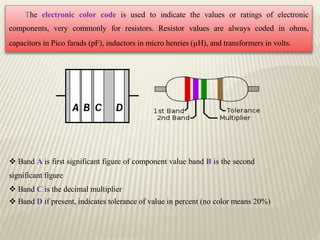
The electronic color code is used to indicate the values or ratings of electronic
components, very commonly for resistors. Resistor values are always coded in ohms,
capacitors in Pico farads (pF), inductors in micro henries (µH), and transformers in volts.
 Band A is first significant figure of component value band B is the second
significant figure
 Band C is the decimal multiplier
 Band D if present, indicates tolerance of value in percent (no color means 20%)
TRANSISTOR
A Transistor consists of two junctions formed by sandwiching either p-type or n-
type semiconductor between a pair of opposite types. Accordingly, there are two types
of transistors namely: -
(1) n-p-n transistor (2) p-n-p transistor
[Transistors] [Transistor (BC 547)]
CAPACITORS
The fundamental relation for the capacitance between two flat plates separated
by a dielectric material is given by: -
C=0.08854KA/D
Where: -
C= capacitance in pf.
K= dielectric constant
A=Area per plate in square cm.
D=Distance between two plates in cm
[Capacitor]
LED (LIGHT EMITTING DIODE)
[Light Emitting Diode]
SEVEN SEGMENT DISPLAY
[Seven Segment Display]
A seven segment display, as its name indicates, is composed of seven elements.
Individually on or off, they can be combined to produce simplified representations of the
Arabic numerals. Often the seven segments are arranged in an oblique (slanted) which aids
readability. Each of the numbers 0, 6,7and 9 may be represented by different glyphs on
seven-segment displays.
KEYPAD (4*3)
[Keypad 4*3]
A simple 4x3 keyboard that allows data entry into bus based systems. Flow code
macros for driving this E-block are available.
APPLICATIONS & ADVANTAGES
1.It can be used in the college, school for belling purpose.
2.The components used for the assembling of this circuit are very cheap and are
easily available in the market. Hence the initial cost of setting up the circuit is
minimal.
3.It can be used in the any type of examination for belling because we can set
the ringing time.
4.Automatic scheduling of college bell is possible.
5.Compact in size so takes less space.
6.This project is much suitable college, schools, institutions etc.
7.Time editable facility is available.
FUTURE SCOPE
Automatic college bell system using Lab
VIEW can be extended for further development
as there can be many departments in a university
at a distance in the same campus and want to
synchronize all department bells.
CONCLUSION
 Present day ringing the bell in colleges or schools
are carried out manually.
 The main disadvantage of this is that one person
has to be alert for this.
 To overcome from this, we have decided to prepare
the circuit which will be operated automatically and
the ringing of bell will start by its given time.
Presentation

Presentation

  • 1.
  • 2.
    INTRODUCTION In today’s life,everyone gives importance to time. Time does not wait for anybody. Everything should be performed in time & accurately. Now a day’s school/college bells are manually operated. Hence there is a big question of accuracy. Also there is necessity of manpower and money. Hence here we should use automatic control system, which saves our manpower and money & also highest accuracy. Hence we have selected the project.
  • 3.
    What is oursystem? In market there many digital clocks available with bells but rings only at specific time. For e.g. Alarm Clock and some bells that ring after some time intervals and that cannot stop after specific time. For e.g. Musical Clock But all these limitation have been removed by our project. It rings only according to our college time table.
  • 4.
    [Convention Bell] [ManuallyOperated College Bell] Automatic College Bell
  • 5.
    CIRCUIT DESCRIPTION Circuit Diagram:- CircuitDiagramof Automatic College Bell
  • 6.
    Operations  Switch ONthe power  In Display the real time will display.  It has an Inbuilt Real Time Clock (DS1307/DS 12c 12c887) which tracks over the Real Time. When this time equals to the Bell Ringing time, then the Relay for the Bell is switched on.  If one want to change the belling time. Input the desire time from the keypad provided
  • 7.
     For changingthe input time press * followed by # on the keypad and set the belling time.  One can set many ringing time at a time. • The input time must be set with respect of RTC
  • 8.
    PCB LAYOUT:- Layout ofAutomatic College Bell
  • 9.
    Component Requirement S. NO.NAME OF COMPONENTS TYPE QUANTITY 1. IC 89S8252 Microcontroller 1 2. IC DS 1307 Real Time Clock 1 3. IC 7805 Voltage Regulator 5V 1 4. Transformer Step-Down 1 5. Crystal 12 MHz, 32.768KHz 1,1 6. Diode 1N4700 3 7. Relay Switch 12V Magnetic Relay 1 8. Resistor (2.2,10,56) KΩ,330E 4,5,1 & 5 9. Transistor (BC 547) NPN 5 10. Storage Capacitor 1 µF 25 V 2 11. Ceramic Capacitor 33 pF 2 12. LED General 1 13. Display Seven Segment 4 14. Keypad 4*3 1 15. Buzzer 6-12 V operated 1 16. I.C. Base 8 Pin & 40 Pin 1,1
  • 10.
    Component Description AT89S8252 (Microcontroller):- PinConfiguration:- Pin Configuration IC AT89S8252
  • 11.
    The Atmel AT89S8252provides the following standard features: 8K bytes of downloadable Flash, 2K bytes of EEPROM, 256 bytes of RAM, 32 I/O lines, programmable watchdog timer, two data pointers, three 16-bit timer/counters, a six-vector two-level interrupt architecture, a full duplex serial port, on-chip oscillator, and clock circuitry. In addition, the AT89S8252 is designed with static logic for operation down to zero frequency and supports two software selectable power saving modes. The Idle Mode stops the CPU while allowing the RAM, timer/counters, serial port, and interrupt system to continue functioning. The Power-down mode saves the RAM contents but freezes the oscillator, disabling all other chip functions until the next external interrupt or hardware reset.
  • 12.
    Features of AtmelAT89C2051 are as follows:-  Compatible with MCS-51 Products  8K Bytes of In-System Reprogrammable Downloadable Flash Memory  2K Bytes EEPROM  4V to 6V Operating Range  Fully Static Operation: 0 Hz to 24 MHz  Three-level Program Memory Lock  256 x 8-bit Internal RAM  32 Programmable I/O Lines  Three 16-bit Timer/Counters  Nine Interrupt Sources  Programmable UART Serial Channel  SPI Serial Interface  Low-power Idle and Power-down Modes  Interrupt Recovery from Power-down  Programmable Watchdog Timer  Dual Data Pointer  Power-off Flag
  • 13.
  • 14.
    The DS1307 serialreal-time clock (RTC) is a low power, full binary- coded decimal (BCD) clock/calendar plus 56 bytes of NV SRAM. Address and data are transferred serially through an I2C, bidirectional bus. The clock/calendar provides seconds, minutes, hours, day, date, month, and year information. The end of the month date is automatically adjusted for months with fewer than 31 days, including corrections for leap year. The clock operates in either the 24-hour or 12-hour format with AM/PM indicator. The DS1307 has a built-in power-sense circuit that detects power failures and automatically switches to the backup supply. Timekeeping operation continues while the part operates from the backup supply.
  • 15.
    Feature of ICDS1307 are as follows:  Real-Time Clock (RTC) Counts Seconds  Minutes, Hours, Date of the Month, Month, Day of the week, and Year with Leap- Year  Compensation Valid Up to 2100  56-Byte, Battery-Backed, General-Purpose RAM with Unlimited Writes  Programmable Square-Wave Output Signal  Automatic Power-Fail Detect and Switch Circuitry  Consumes Less than 500nA in Battery-Backup  Mode with Oscillator Running  Optional Industrial Temperature Range: - 40°C to +85°C
  • 16.
    LM7805 VOLTAGE REGULATOR The78xx (also sometimes known as LM78xx) series of devices is a family of self-contained fixed linear voltage regulator integrated circuits. The 78xx family is a very popular choice for many electronic circuits which require a regulated power supply, due to their ease of use and relative cheapness. When specifying individual ICs within this family, the xx is replaced with a two-digit number, which indicates the output voltage the particular device is designed to provide (for example, the 7805 has a 5 volt output, while the 7812 produces 12 volts). The 78xx lines a re positive voltage regulators, meaning that they are designed to produce a voltage that is positive relative to a common ground. There is a related line of 79xx devices which are complementary negative voltage regulators. 78xx and 79xx ICs can be used in combination to provide both positive and negative supply voltages in the same circuit, if necessary.
  • 17.
    78xx Ics havethree terminals and are most commonly found in the TO220 form factor, although smaller surface-mount and larger TO3 packages are also available from some manufacturers. These devices typically support an input voltage which can be anywhere from a couple of volts over the intended output voltage, up to a maximum of 35 or 40 volts, and can typically provide up to around 1 or 1.5 amps of current (though smaller or larger packages may have a lower or higher current rating). [IC 7805]
  • 18.
    TRANSFORMER Definition The transformer isa static electro-magnetic device that transforms one alternating voltage (current) into another voltage (current). However, power remains the some during the transformation. Transformers play a major role in the transmission and distribution of AC power. Principle Transformer works on the principle of mutual induction. A transformer consists of laminated magnetic core forming the magnetic frame. Primary and secondary coils are wound upon the two cores of the magnetic frame, linked by the common magnetic flux. When an alternating voltage is applied across the primary coil, a current flows in the primary coil producing magnetic flux in the transformer core. This flux induces voltage in secondary coil.
  • 19.
  • 20.
    CRYSTAL A piezoelectric crystalis an electronic circuit that uses the mechanical resonance of a vibrating crystal of piezoelectric material to create an electrical signal with a very precise frequency. This frequency is commonly used to keep track of time (as in quartz wristwatches), to provide a stable clock signal for digital integrated circuits, and to stabilize frequencies for radio transmitters and receivers. The most common type of piezoelectric resonator used is the quartz crystal, so oscillator circuits designed around them were called "crystal oscillators". [Crystal]
  • 21.
  • 22.
  • 23.
    RELAY [Relay] In this circuita 12V magnetic relay is used. In magnetic relay, insulated copper wire coil is used to magnetize and attract the plunger. The plunger is normally connected to N/C terminal. A spring is connected to attract the plunger upper side. When output is received by relay, the plunger is attracted and the bulb glows.
  • 24.
    RESISTORS A Resistor isa heat-dissipating element and in the electronic circuits it is mostly used for either controlling the current in the circuit or developing a voltage drop across it, which could be utilized for many applications. There are various types of resistors, which can be classified according to a number of factors depending upon:  Material used for fabrication  Wattage and physical size  Intended application  Ambient temperature rating  Cost [Resistor]
  • 25.
    The electronic colorcode is used to indicate the values or ratings of electronic components, very commonly for resistors. Resistor values are always coded in ohms, capacitors in Pico farads (pF), inductors in micro henries (µH), and transformers in volts.  Band A is first significant figure of component value band B is the second significant figure  Band C is the decimal multiplier  Band D if present, indicates tolerance of value in percent (no color means 20%)
  • 26.
    TRANSISTOR A Transistor consistsof two junctions formed by sandwiching either p-type or n- type semiconductor between a pair of opposite types. Accordingly, there are two types of transistors namely: - (1) n-p-n transistor (2) p-n-p transistor [Transistors] [Transistor (BC 547)]
  • 27.
    CAPACITORS The fundamental relationfor the capacitance between two flat plates separated by a dielectric material is given by: - C=0.08854KA/D Where: - C= capacitance in pf. K= dielectric constant A=Area per plate in square cm. D=Distance between two plates in cm [Capacitor]
  • 28.
    LED (LIGHT EMITTINGDIODE) [Light Emitting Diode]
  • 29.
    SEVEN SEGMENT DISPLAY [SevenSegment Display] A seven segment display, as its name indicates, is composed of seven elements. Individually on or off, they can be combined to produce simplified representations of the Arabic numerals. Often the seven segments are arranged in an oblique (slanted) which aids readability. Each of the numbers 0, 6,7and 9 may be represented by different glyphs on seven-segment displays.
  • 30.
    KEYPAD (4*3) [Keypad 4*3] Asimple 4x3 keyboard that allows data entry into bus based systems. Flow code macros for driving this E-block are available.
  • 31.
    APPLICATIONS & ADVANTAGES 1.Itcan be used in the college, school for belling purpose. 2.The components used for the assembling of this circuit are very cheap and are easily available in the market. Hence the initial cost of setting up the circuit is minimal. 3.It can be used in the any type of examination for belling because we can set the ringing time. 4.Automatic scheduling of college bell is possible. 5.Compact in size so takes less space. 6.This project is much suitable college, schools, institutions etc. 7.Time editable facility is available.
  • 32.
    FUTURE SCOPE Automatic collegebell system using Lab VIEW can be extended for further development as there can be many departments in a university at a distance in the same campus and want to synchronize all department bells.
  • 33.
    CONCLUSION  Present dayringing the bell in colleges or schools are carried out manually.  The main disadvantage of this is that one person has to be alert for this.  To overcome from this, we have decided to prepare the circuit which will be operated automatically and the ringing of bell will start by its given time.