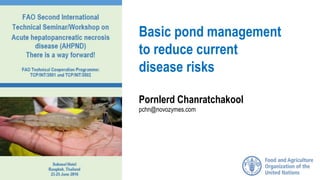
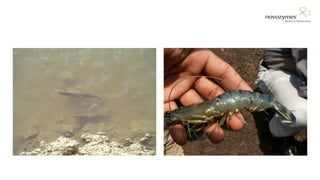
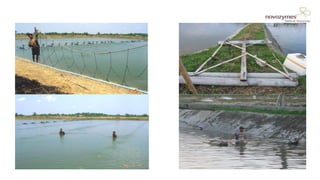
Basic pond management
to reduce current
disease risks
Pornlerd Chanratchakool
pchn@novozymes.com
NOVOZYMES PRESENTATION
22/06/20162
Concept
The importance
of a healthy pond
and shrimp
Environment
PathogensHost
D
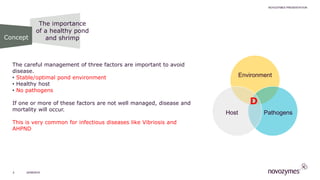
The careful management of three factors are important to avoid
disease.
• Stable/optimal pond environment
• Healthy host
• No pathogens
If one or more of these factors are not well managed, disease and
mortality will occur.
This is very common for infectious diseases like Vibriosis and
AHPND
NOVOZYMES PRESENTATION22/06/2016
Preventing/Reducing Disease by maintain better pond
environment
Clean Environment
Optimal parameters
• Maintain stable water quality
• Preventing waste accumulation (From : Feed? and Plankton?)
• Prevent/Eliminate toxic substances
NOVOZYMES PRESENTATION22/06/20164
Control pathogen
Less Pathogens
• control/eliminate pathogen
in the system/shrimp
• reduce pathogenicity of pathogen
• and improving shrimp health
NOVOZYMES PRESENTATION22/06/20165
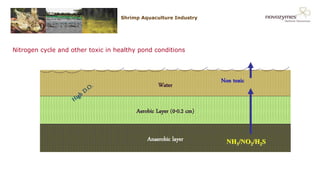
Water
Nitrogen cycle and other toxic in healthy pond conditions
Shrimp Aquaculture Industry
Aerobic Layer (0-0.2 cm)
Anaerobic layer NH3/NO2/H2S
Non toxic
NOVOZYMES PRESENTATION22/06/20166
NOVOZYMES PRESENTATION22/06/20167
NOVOZYMES PRESENTATION22/06/20168
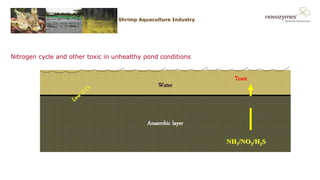
Water
Nitrogen cycle and other toxic in unhealthy pond conditions
Shrimp Aquaculture Industry
Technical Challenges
Aerobic Layer (0-2 cm)
Anaerobic layer
NH3/NO2/H2S
Toxic
NOVOZYMES PRESENTATION22/06/20169
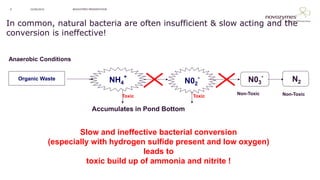
Anaerobic Conditions
Organic Waste NH4
+
N02
-
N03
-
N2
Non-Toxic Non-Toxic
Accumulates in Pond Bottom
In common, natural bacteria are often insufficient & slow acting and the
conversion is ineffective!
Slow and ineffective bacterial conversion
(especially with hydrogen sulfide present and low oxygen)
leads to
toxic build up of ammonia and nitrite !
Toxic Toxic
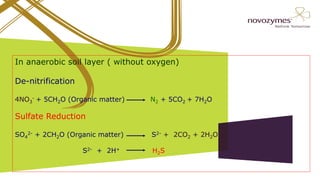
In anaerobic soil layer ( without oxygen)
De-nitrification
4NO3
- + 5CH2O (Organic matter) N2 + 5CO2 + 7H2O
Sulfate Reduction
SO4
2- + 2CH2O (Organic matter) S2- + 2CO2 + 2H2O
S2- + 2H+ H2S
NOVOZYMES PRESENTATION22/06/201611
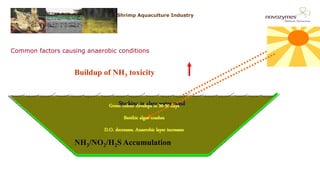
Common factors causing anaerobic conditions
Shrimp Aquaculture Industry
Technical Challenges
Benthic Algae develops
Stocking in clear water pondGreen colour develops in 20-30 days
Benthic algae crashes
Buildup of NH3 toxicity
D.O. decreases. Anaerobic layer increases
NH3/NO2/H2S Accumulation
NOVOZYMES PRESENTATION22/06/201612
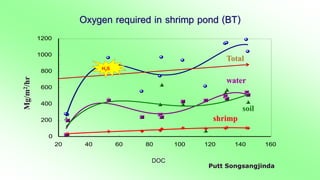
20 40 60 80 100 120 140 160
0
200
400
600
800
1000
1200
DOC
Mg/m2/hr
Oxygen required in shrimp pond (BT)
Total
soil
water
shrimp
H2S
Putt Songsangjinda
NOVOZYMES PRESENTATION22/06/201613
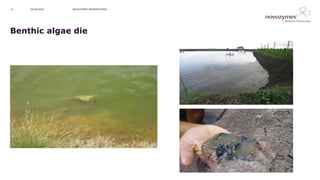
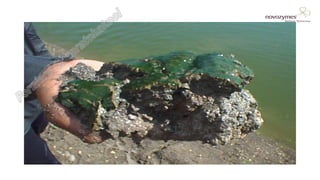
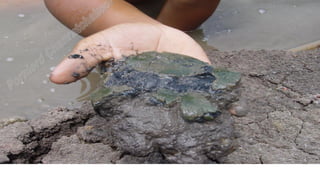
Benthic algae die
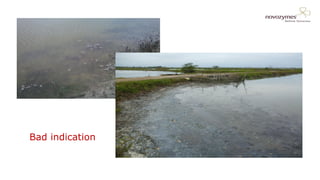
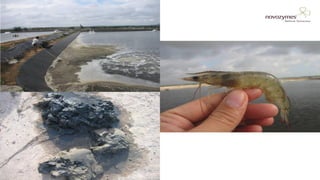
Bad indication
NOVOZYMES PRESENTATION22/06/201619
NOVOZYMES PRESENTATION22/06/201620
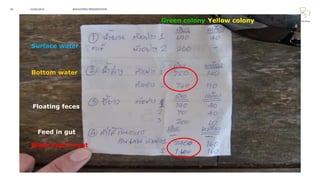
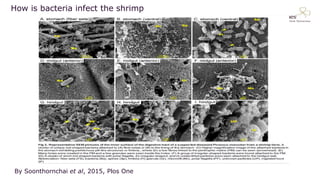
Surface water
Bottom water
Floating feces
Feed in gut
Black mud in gut
Green colony Yellow colony
How is bacteria infect the shrimp
By Soonthornchai et al, 2015, Plos One
NOVOZYMES PRESENTATION22/06/201622
NOVOZYMES PRESENTATION22/06/201623
www.themegallery.com
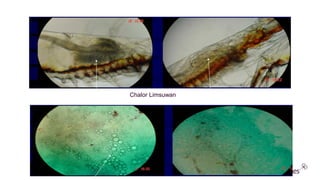
Chalor Limsuwan
NOVOZYMES PRESENTATION22/06/201626
Preventing diseases by better
management
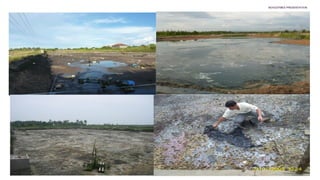
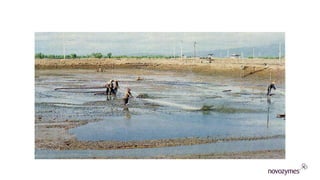
• Cleaning pond soil
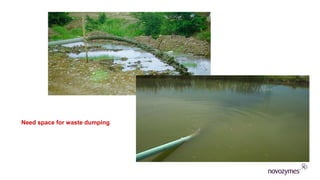
• Removing sludge
• Changing pond soil
• Lining
• Preparing clean water
• Filtering
• Disinfection
• Green water
• Bio-floc
• Etc..
NOVOZYMES PRESENTATION
22/06/201628
Need space for waste dumping
NOVOZYMES PRESENTATION
22/06/201631
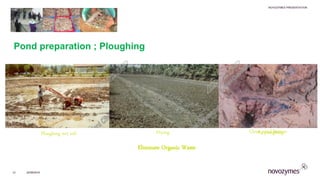
Proper Pond Preparation
Ploughing wet soil Drying Re-ploughingClean pond bottom
Eliminate Organic Waste
Pond preparation ; Ploughing
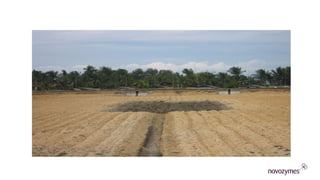
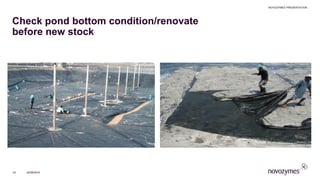
Check pond bottom condition/renovate
before new stock
NOVOZYMES PRESENTATION
22/06/201633
Stock the pond with SPF post larva only
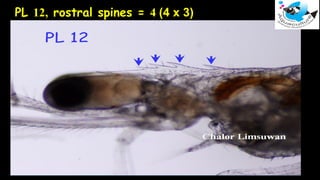
PL 12, rostral spines = 4 (4 x 3)
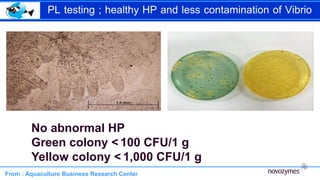
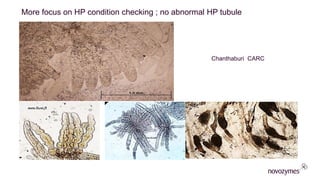
กา PL testing ; healthy HP and less contamination of Vibrio
From : Aquaculture Business Research Center
No abnormal HP
Green colony < 100 CFU/1 g
Yellow colony < 1,000 CFU/1 g
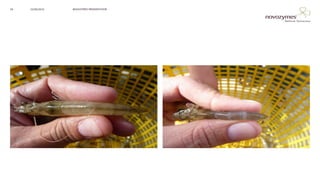
More focus on HP condition checking ; no abnormal HP tubule
Chanthaburi CARC
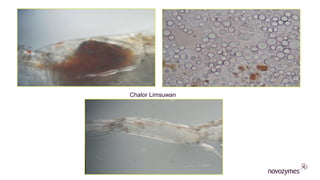
Chalor Limsuwan
Chalor Limsuwan
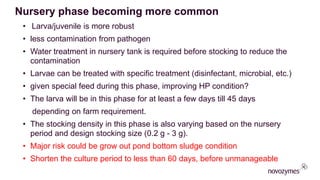
• Larva/juvenile is more robust
• less contamination from pathogen
• Water treatment in nursery tank is required before stocking to reduce the
contamination
• Larvae can be treated with specific treatment (disinfectant, microbial, etc.)
• given special feed during this phase, improving HP condition?
• The larva will be in this phase for at least a few days till 45 days
depending on farm requirement.
• The stocking density in this phase is also varying based on the nursery
period and design stocking size (0.2 g - 3 g).
• Major risk could be grow out pond bottom sludge condition
• Shorten the culture period to less than 60 days, before unmanageable
Nursery phase becoming more common
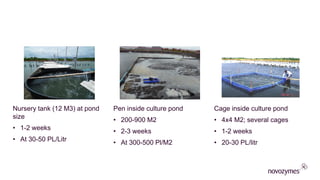
​Nursery tank (12 M3) at pond
size
• 1-2 weeks
• At 30-50 PL/Litr
​Pen inside culture pond
• 200-900 M2
• 2-3 weeks
• At 300-500 Pl/M2
​Cage inside culture pond
• 4x4 M2; several cages
• 1-2 weeks
• 20-30 PL/litr
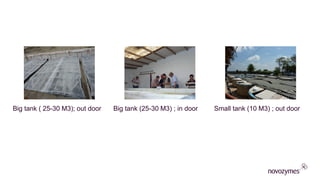
​Big tank ( 25-30 M3); out door ​Big tank (25-30 M3) ; in door ​Small tank (10 M3) ; out door
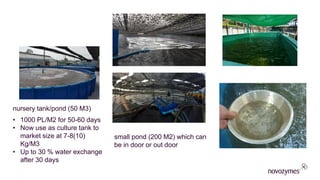
​nursery tank/pond (50 M3)
• 1000 PL/M2 for 50-60 days
• Now use as culture tank to
market size at 7-8(10)
Kg/M3
• Up to 30 % water exchange
after 30 days
​small pond (200 M2) which can
be in door or out door
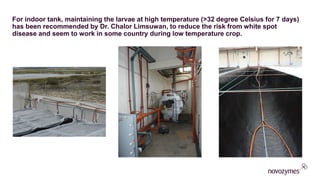
For indoor tank, maintaining the larvae at high temperature (>32 degree Celsius for 7 days)
has been recommended by Dr. Chalor Limsuwan, to reduce the risk from white spot
disease and seem to work in some country during low temperature crop.
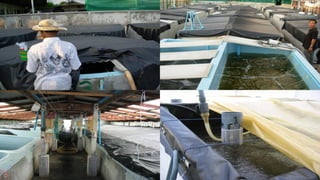
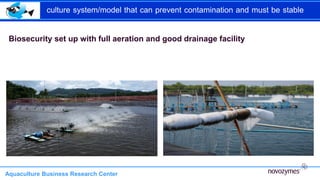
culture system/model that can prevent contamination and must be stable
Aquaculture Business Research Center
Biosecurity set up with full aeration and good drainage facility
NOVOZYMES PRESENTATION22/06/201647
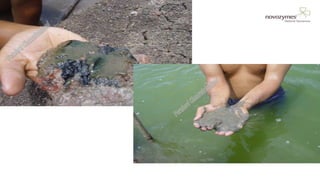
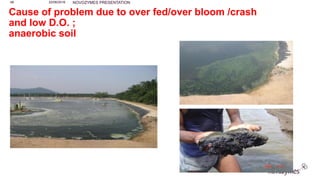
Cause of problem due to over fed/over bloom /crash
and low D.O. ;
anaerobic soil
NOVOZYMES PRESENTATION22/06/201648
NOVOZYMES PRESENTATION
22/06/201650
0
5
10
15
20
25
30
35
40
45
0 10 20 30 40 50 60 70 80 90 100
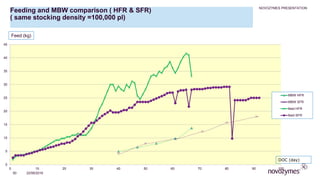
MBW HFR
MBW SFR
feed HFR
feed SFR
DOC (day)
Feeding and MBW comparison ( HFR & SFR)
( same stocking density =100,000 pl)
Feed (kg)
0
10
20
30
40
50
60
1 3 5 7 9 11 13 15 17 19 21 23 25 27 29 31 33 35 37 39 41 43 45 47 49 51 53 55 57 59 61 63 65 67 69 71 73 75 77 79 81 83 85 87 89 91 93 95 97 99
feed(kg)/shrimpweight(gram)
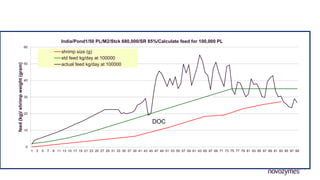
India/Pond1/50 PL/M2/Stck 680,000/SR 85%/Calculate feed for 100,000 PL
shrimp size (g)
std feed kg/day at 100000
actual feed kg/day at 100000
DOC
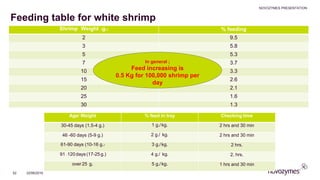
Feeding table for white shrimp
Shrimp Weight (g.) % feeding
2 9.5
3 5.8
5 5.3
7 3.7
10 3.3
15 2.6
20 2.1
25 1.6
30 1.3
NOVOZYMES PRESENTATION
22/06/201652
Age/ Weight % feed in tray Checking time
30-45 days (1.5-4 g.) 1 g./ kg. 2 hrs and 30 min
46 -60 days (5-9 g.) 2 g./ kg. 2 hrs and 30 min
61-90 days (10-16 g.) 3 g./ kg. 2 hrs.
91 -120 days (17-25g.) 4 g./ kg. 2. hrs.
over 25 g. 5 g./ kg. 1 hrs and 30 min
In general ;
Feed increasing is
0.5 Kg for 100,000 shrimp per
day
Different culture models have been
successfully proven but need to be
selected by farmers, base on area,
budget, experience etc..
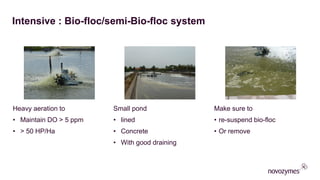
Intensive : Bio-floc/semi-Bio-floc system
​Heavy aeration to
• Maintain DO > 5 ppm
• > 50 HP/Ha
​Small pond
• lined
• Concrete
• With good draining
​Make sure to
• re-suspend bio-floc
• Or remove
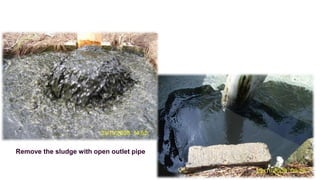
Remove the sludge with open outlet pipe
NOVOZYMES PRESENTATION
22/06/2016
56
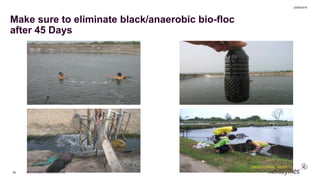
Make sure to eliminate black/anaerobic bio-floc
after 45 Days
NOVOZYMES PRESENTATION22/06/201657
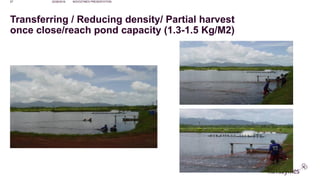
Transferring / Reducing density/ Partial harvest
once close/reach pond capacity (1.3-1.5 Kg/M2)
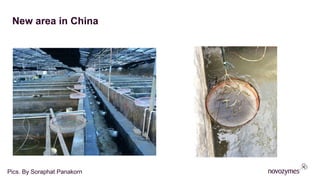
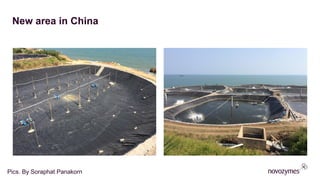
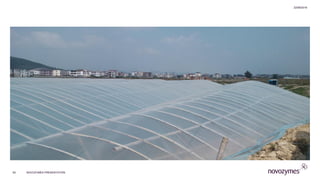
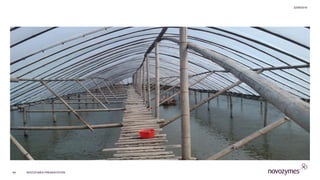
New area in China
Pics. By Soraphat Panakorn
New area in China
Pics. By Soraphat Panakorn
NOVOZYMES PRESENTATION
22/06/2016
63
NOVOZYMES PRESENTATION
22/06/2016
64
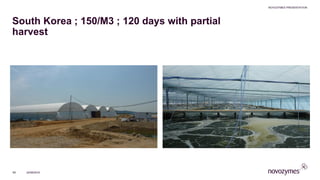
South Korea ; 150/M3 ; 120 days with partial
harvest
NOVOZYMES PRESENTATION
22/06/201665
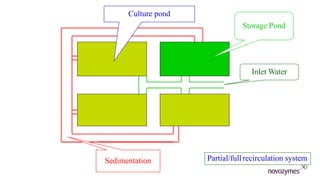
Sedimentation
Culture pond
Storage Pond
Inlet Water
Partial/fullrecirculation system
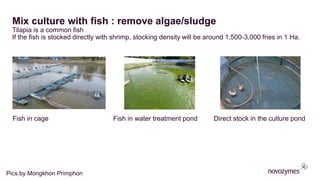
Mix culture with fish : remove algae/sludge
Tilapia is a common fish
If the fish is stocked directly with shrimp, stocking density will be around 1,500-3,000 fries in 1 Ha.
​Fish in cage ​Fish in water treatment pond ​Direct stock in the culture pond
Pics.by Mongkhon Primphon
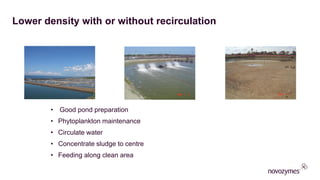
Lower density with or without recirculation
• Good pond preparation
• Phytoplankton maintenance
• Circulate water
• Concentrate sludge to centre
• Feeding along clean area
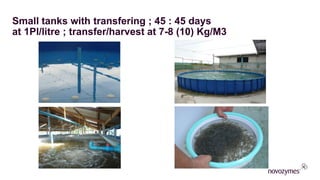
Small tanks with transfering ; 45 : 45 days
at 1Pl/litre ; transfer/harvest at 7-8 (10) Kg/M3
Key points to reduce risk from diseases/mortality
​Well prepare the pond
​Remove sludge or completely dry/check and repair liner if damaged
​Biosecurity set up especially in outbreak/risky area
​Prepare reservoir/ disinfect water well before get the bloom
• Not only treat viral carrier
• Need to treat bacteria also
​Select good SPF PL ; > PL 10 (gill completely developed and HP quality check
• Salinity stress test (Optional ; 0 ppt; 30 mins then 30 ppt. 30 mins ; survival > 95 %)
• Vibrios count (<1,000 CFU/G Total: <100 CFU/G green)
​May be better to stock PL from different good/reliable hatchery in each stocking time
​Set up tank/cage or pen for nursery to reduce risks
​Stocking density <120 Pl/M2 (WS)or base on pond potential
• < 1.3-1.5 Kg/M2 in standard pond without partial harvest (WS) : depending on system
• < 0.6-0.8 Kg/M2 for BT
NOVOZYMES PRESENTATION
22/06/201670
Key point cont.
​For standard feeding program during first month should be individual adjust; base on actual growth,
check the growth at DoC 20
​Control feed well, 12 Kg/100,000 at DoC 30, ABW at 2.0-2.5 g
​accumulate feed at 30 days should not > 250 kg.
​However, if the shrimp growing faster; calculate base on specific growth in each pond
​Reduced feed when temp. lower than 26 C
​Add salt at 50 g/kg of feed during low salinity/heavy rain
​Maximum feed increment/day/100,000 shrimp is 500 g.
​Maintain D.O. > 3/4 ppm. near the edge of sludge : 1HP = 400-500 Kg
​Or >6 ppm. for super intensive
​Prevent toxic H2S, ammonia and nitrite
​Partially harvest/harvest if production close to maximum capacity
​Shrimp feed less, slow growth, low D.O. etc..
NOVOZYMES PRESENTATION
22/06/201671
Presentation 1.1 Basic pond management to reduce current disease risks (Dr Pornlerd Chanratchakool)

Presentation 1.1 Basic pond management to reduce current disease risks (Dr Pornlerd Chanratchakool)

  • 1.
    Basic pond management toreduce current disease risks Pornlerd Chanratchakool pchn@novozymes.com
  • 2.
    NOVOZYMES PRESENTATION 22/06/20162 Concept The importance ofa healthy pond and shrimp Environment PathogensHost D The careful management of three factors are important to avoid disease. • Stable/optimal pond environment • Healthy host • No pathogens If one or more of these factors are not well managed, disease and mortality will occur. This is very common for infectious diseases like Vibriosis and AHPND
  • 3.
    NOVOZYMES PRESENTATION22/06/2016 Preventing/Reducing Diseaseby maintain better pond environment Clean Environment Optimal parameters • Maintain stable water quality • Preventing waste accumulation (From : Feed? and Plankton?) • Prevent/Eliminate toxic substances
  • 4.
    NOVOZYMES PRESENTATION22/06/20164 Control pathogen LessPathogens • control/eliminate pathogen in the system/shrimp • reduce pathogenicity of pathogen • and improving shrimp health
  • 5.
    NOVOZYMES PRESENTATION22/06/20165 Water Nitrogen cycleand other toxic in healthy pond conditions Shrimp Aquaculture Industry Aerobic Layer (0-0.2 cm) Anaerobic layer NH3/NO2/H2S Non toxic
  • 6.
  • 7.
  • 8.
    NOVOZYMES PRESENTATION22/06/20168 Water Nitrogen cycleand other toxic in unhealthy pond conditions Shrimp Aquaculture Industry Technical Challenges Aerobic Layer (0-2 cm) Anaerobic layer NH3/NO2/H2S Toxic
  • 9.
    NOVOZYMES PRESENTATION22/06/20169 Anaerobic Conditions OrganicWaste NH4 + N02 - N03 - N2 Non-Toxic Non-Toxic Accumulates in Pond Bottom In common, natural bacteria are often insufficient & slow acting and the conversion is ineffective! Slow and ineffective bacterial conversion (especially with hydrogen sulfide present and low oxygen) leads to toxic build up of ammonia and nitrite ! Toxic Toxic
  • 10.
    In anaerobic soillayer ( without oxygen) De-nitrification 4NO3 - + 5CH2O (Organic matter) N2 + 5CO2 + 7H2O Sulfate Reduction SO4 2- + 2CH2O (Organic matter) S2- + 2CO2 + 2H2O S2- + 2H+ H2S
  • 11.
    NOVOZYMES PRESENTATION22/06/201611 Common factorscausing anaerobic conditions Shrimp Aquaculture Industry Technical Challenges Benthic Algae develops Stocking in clear water pondGreen colour develops in 20-30 days Benthic algae crashes Buildup of NH3 toxicity D.O. decreases. Anaerobic layer increases NH3/NO2/H2S Accumulation
  • 12.
    NOVOZYMES PRESENTATION22/06/201612 20 4060 80 100 120 140 160 0 200 400 600 800 1000 1200 DOC Mg/m2/hr Oxygen required in shrimp pond (BT) Total soil water shrimp H2S Putt Songsangjinda
  • 13.
  • 14.
  • 19.
  • 20.
    NOVOZYMES PRESENTATION22/06/201620 Surface water Bottomwater Floating feces Feed in gut Black mud in gut Green colony Yellow colony
  • 21.
    How is bacteriainfect the shrimp By Soonthornchai et al, 2015, Plos One
  • 22.
  • 23.
  • 24.
  • 26.
  • 27.
    Preventing diseases bybetter management • Cleaning pond soil • Removing sludge • Changing pond soil • Lining • Preparing clean water • Filtering • Disinfection • Green water • Bio-floc • Etc..
  • 28.
  • 30.
    Need space forwaste dumping
  • 31.
    NOVOZYMES PRESENTATION 22/06/201631 Proper PondPreparation Ploughing wet soil Drying Re-ploughingClean pond bottom Eliminate Organic Waste Pond preparation ; Ploughing
  • 33.
    Check pond bottomcondition/renovate before new stock NOVOZYMES PRESENTATION 22/06/201633
  • 34.
    Stock the pondwith SPF post larva only
  • 35.
    PL 12, rostralspines = 4 (4 x 3)
  • 36.
    กา PL testing; healthy HP and less contamination of Vibrio From : Aquaculture Business Research Center No abnormal HP Green colony < 100 CFU/1 g Yellow colony < 1,000 CFU/1 g
  • 37.
    More focus onHP condition checking ; no abnormal HP tubule Chanthaburi CARC
  • 38.
  • 39.
  • 41.
    • Larva/juvenile ismore robust • less contamination from pathogen • Water treatment in nursery tank is required before stocking to reduce the contamination • Larvae can be treated with specific treatment (disinfectant, microbial, etc.) • given special feed during this phase, improving HP condition? • The larva will be in this phase for at least a few days till 45 days depending on farm requirement. • The stocking density in this phase is also varying based on the nursery period and design stocking size (0.2 g - 3 g). • Major risk could be grow out pond bottom sludge condition • Shorten the culture period to less than 60 days, before unmanageable Nursery phase becoming more common
  • 42.
    ​Nursery tank (12M3) at pond size • 1-2 weeks • At 30-50 PL/Litr ​Pen inside culture pond • 200-900 M2 • 2-3 weeks • At 300-500 Pl/M2 ​Cage inside culture pond • 4x4 M2; several cages • 1-2 weeks • 20-30 PL/litr
  • 43.
    ​Big tank (25-30 M3); out door ​Big tank (25-30 M3) ; in door ​Small tank (10 M3) ; out door
  • 44.
    ​nursery tank/pond (50M3) • 1000 PL/M2 for 50-60 days • Now use as culture tank to market size at 7-8(10) Kg/M3 • Up to 30 % water exchange after 30 days ​small pond (200 M2) which can be in door or out door
  • 45.
    For indoor tank,maintaining the larvae at high temperature (>32 degree Celsius for 7 days) has been recommended by Dr. Chalor Limsuwan, to reduce the risk from white spot disease and seem to work in some country during low temperature crop.
  • 46.
    culture system/model thatcan prevent contamination and must be stable Aquaculture Business Research Center Biosecurity set up with full aeration and good drainage facility
  • 47.
  • 48.
    Cause of problemdue to over fed/over bloom /crash and low D.O. ; anaerobic soil NOVOZYMES PRESENTATION22/06/201648
  • 50.
    NOVOZYMES PRESENTATION 22/06/201650 0 5 10 15 20 25 30 35 40 45 0 1020 30 40 50 60 70 80 90 100 MBW HFR MBW SFR feed HFR feed SFR DOC (day) Feeding and MBW comparison ( HFR & SFR) ( same stocking density =100,000 pl) Feed (kg)
  • 51.
    0 10 20 30 40 50 60 1 3 57 9 11 13 15 17 19 21 23 25 27 29 31 33 35 37 39 41 43 45 47 49 51 53 55 57 59 61 63 65 67 69 71 73 75 77 79 81 83 85 87 89 91 93 95 97 99 feed(kg)/shrimpweight(gram) India/Pond1/50 PL/M2/Stck 680,000/SR 85%/Calculate feed for 100,000 PL shrimp size (g) std feed kg/day at 100000 actual feed kg/day at 100000 DOC
  • 52.
    Feeding table forwhite shrimp Shrimp Weight (g.) % feeding 2 9.5 3 5.8 5 5.3 7 3.7 10 3.3 15 2.6 20 2.1 25 1.6 30 1.3 NOVOZYMES PRESENTATION 22/06/201652 Age/ Weight % feed in tray Checking time 30-45 days (1.5-4 g.) 1 g./ kg. 2 hrs and 30 min 46 -60 days (5-9 g.) 2 g./ kg. 2 hrs and 30 min 61-90 days (10-16 g.) 3 g./ kg. 2 hrs. 91 -120 days (17-25g.) 4 g./ kg. 2. hrs. over 25 g. 5 g./ kg. 1 hrs and 30 min In general ; Feed increasing is 0.5 Kg for 100,000 shrimp per day
  • 53.
    Different culture modelshave been successfully proven but need to be selected by farmers, base on area, budget, experience etc..
  • 54.
    Intensive : Bio-floc/semi-Bio-flocsystem ​Heavy aeration to • Maintain DO > 5 ppm • > 50 HP/Ha ​Small pond • lined • Concrete • With good draining ​Make sure to • re-suspend bio-floc • Or remove
  • 55.
    Remove the sludgewith open outlet pipe
  • 56.
    NOVOZYMES PRESENTATION 22/06/2016 56 Make sureto eliminate black/anaerobic bio-floc after 45 Days
  • 57.
    NOVOZYMES PRESENTATION22/06/201657 Transferring /Reducing density/ Partial harvest once close/reach pond capacity (1.3-1.5 Kg/M2)
  • 61.
    New area inChina Pics. By Soraphat Panakorn
  • 62.
    New area inChina Pics. By Soraphat Panakorn
  • 63.
  • 64.
  • 65.
    South Korea ;150/M3 ; 120 days with partial harvest NOVOZYMES PRESENTATION 22/06/201665
  • 66.
    Sedimentation Culture pond Storage Pond InletWater Partial/fullrecirculation system
  • 67.
    Mix culture withfish : remove algae/sludge Tilapia is a common fish If the fish is stocked directly with shrimp, stocking density will be around 1,500-3,000 fries in 1 Ha. ​Fish in cage ​Fish in water treatment pond ​Direct stock in the culture pond Pics.by Mongkhon Primphon
  • 68.
    Lower density withor without recirculation • Good pond preparation • Phytoplankton maintenance • Circulate water • Concentrate sludge to centre • Feeding along clean area
  • 69.
    Small tanks withtransfering ; 45 : 45 days at 1Pl/litre ; transfer/harvest at 7-8 (10) Kg/M3
  • 70.
    Key points toreduce risk from diseases/mortality ​Well prepare the pond ​Remove sludge or completely dry/check and repair liner if damaged ​Biosecurity set up especially in outbreak/risky area ​Prepare reservoir/ disinfect water well before get the bloom • Not only treat viral carrier • Need to treat bacteria also ​Select good SPF PL ; > PL 10 (gill completely developed and HP quality check • Salinity stress test (Optional ; 0 ppt; 30 mins then 30 ppt. 30 mins ; survival > 95 %) • Vibrios count (<1,000 CFU/G Total: <100 CFU/G green) ​May be better to stock PL from different good/reliable hatchery in each stocking time ​Set up tank/cage or pen for nursery to reduce risks ​Stocking density <120 Pl/M2 (WS)or base on pond potential • < 1.3-1.5 Kg/M2 in standard pond without partial harvest (WS) : depending on system • < 0.6-0.8 Kg/M2 for BT NOVOZYMES PRESENTATION 22/06/201670
  • 71.
    Key point cont. ​Forstandard feeding program during first month should be individual adjust; base on actual growth, check the growth at DoC 20 ​Control feed well, 12 Kg/100,000 at DoC 30, ABW at 2.0-2.5 g ​accumulate feed at 30 days should not > 250 kg. ​However, if the shrimp growing faster; calculate base on specific growth in each pond ​Reduced feed when temp. lower than 26 C ​Add salt at 50 g/kg of feed during low salinity/heavy rain ​Maximum feed increment/day/100,000 shrimp is 500 g. ​Maintain D.O. > 3/4 ppm. near the edge of sludge : 1HP = 400-500 Kg ​Or >6 ppm. for super intensive ​Prevent toxic H2S, ammonia and nitrite ​Partially harvest/harvest if production close to maximum capacity ​Shrimp feed less, slow growth, low D.O. etc.. NOVOZYMES PRESENTATION 22/06/201671