Aquaculture Consultants
Freshwater, Brackishwater & Marine Farming


                  Khalid A. Memon
                  CEO, Aquaculture Technologies
                  www.aquatechpk.com
Sustainable Marine & Brackishwater
             Aquaculture
      Shrimp & Finfish Farming

• Costal Shrimp Culture
• Coastal Land Based & Cage Finfish Culture
• Inland Low Salinity Shrimp & Finfish Culture
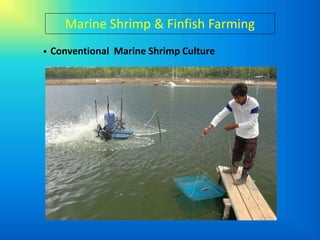
Marine Shrimp & Finfish Farming
   Conventional Marine Shrimp Culture
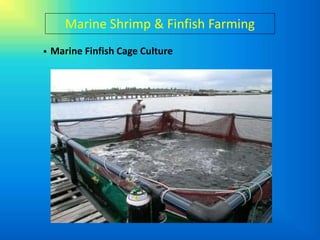
Marine Shrimp & Finfish Farming
   Marine Finfish Cage Culture
Old Ideas
  Proven Developments in Aquaculture

 Biofloc Technology in Shrimp Culture
   • Open Lined / Cemented Ponds
   • Indoor Tanks / Covered Ponds

 Inland Low Salinity Groundwater Aquaculture
   • Open Ponds
   • Indoor Tanks
Cultured & Experimental Species

• Pacific White Shrimp - Litopenaeus vannamei
• Gilthead sea bream - Sparus aurata
• Florida pompano (Trachinotus carolinus)
• Nile Tilapia (Oreochromis niloticus)
• Red Drum (Sciaenops ocellatus)
• Cobia (Rachycentron canadum)
• Rainbow trout (Oncorhynchus mykiss)
• Black Tiger Shrimp and Banana (monodon & merguiensis)
Biofloc Technology Simplified
Conventional Intensified Culture Systems:
• Intensive farming requires more supplementary protein feed
  resulting in environmental pollution
• This pollution is caused by dead algae, excessive uneaten feeds, fish
  and shrimp excreta and other organic matter
• Deteriorates water quality
• Increases risk of disease outbreaks
• Contributes to nitrogen pollution in the culture system released in
  the form of ammonia and nitrite
• Ammonia and nitrite are toxic to cultured animals
• High levels of ammonia effect growth and moulting in shellfish
• High oxygen consumption results in fish shrimp mortalities
• Intensive farming requires frequent water exchanges
Biofloc Technology Simplified
Biofloc Technology Systems (BFT):
• BFT helps in solving culture water and feed problems.
• When carbon is added, nitrogen compounds combine with it to
  produce flocs of protein molecules.
• These molecules form a floating mass called bioflocs which are
  dominated by bacteria.
• The production of microbial biomass, are used by the culture
  species as additional high protein source.
• The bacteria take up ammonium from the water to produce
  microbial protein.
• BFT removes ammonia-nitrogen from the water.
• BFT creates additional feed for the shrimp thus reducing feed
  inputs but increasing production due to higher rate of stocking.
Biofloc Technology Basics

1. SPF Post larvae
2. HDPE lined ponds
3. Sludge removal (requires less water)
4. Control inlet & discharge gates (no leakages)
5. Clean pond & equipment
6. Screen & treat water
7. Correct aeration system & Paddle wheel position in ponds
8. High aeration –28 to 32 HP/ha PWAs
9. Grain (pellet)
10. Molasses
11. Crab Fence & Bird scare lines
12. Control workers , visitors & their movement
Benefits of Biofloc Culture System

• Limited or zero water exchange
• Higher bio-security
• Environmentally friendly system
• Reduction of nutrient rich effluent discharge
• Protein reuse (Higher efficiency up to 45%)
• Cost-effective ( Grain based pellet feeds)
• Full control of toxic nitrogen compound such as ammonia
 and nitrites
• High Production 6 – 12 MT /acre/crop
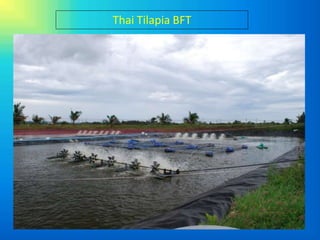
Thai Tilapia BFT
Inland Low Salinity Groundwater Aquaculture

Advantages of inland saline aquaculture include:
• Use of unproductive land without sweet water source
• Use of high volume unexploited saline groundwater that
  is presently considered a waste stream
• Potential for commercial production of a highly
  marketable product
• Faster fish growth due to constant elevated water
  temperatures
• Improved feed management and food conversion
  efficiencies
• Biosecure water supply and ability to manage
  environmental impacts (such as water and nutrients)
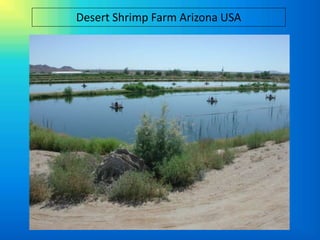
Desert Shrimp Farm Arizona USA
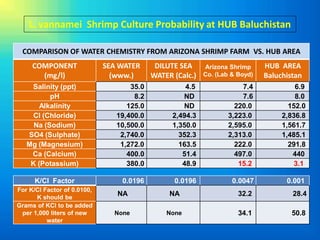
L. vannamei Shrimp Culture Probability at HUB Baluchistan

 COMPARISON OF WATER CHEMISTRY FROM ARIZONA SHRIMP FARM VS. HUB AREA
     COMPONENT               SEA WATER      DILUTE SEA     Arizona Shrimp     HUB AREA
       (mg/l)                  (www.)      WATER (Calc.)   Co. (Lab & Boyd)   Baluchistan
    Salinity (ppt)                  35.0             4.5               7.4             6.9
          pH                         8.2            ND                 7.6             8.0
       Alkalinity                  125.0            ND               220.0           152.0
    Cl (Chloride)               19,400.0         2,494.3           3,223.0         2,836.8
     Na (Sodium)                10,500.0         1,350.0           2,595.0         1,561.7
   SO4 (Sulphate)                2,740.0           352.3           2,313.0         1,485.1
   Mg (Magnesium)                1,272.0           163.5             222.0           291.8
    Ca (Calcium)                   400.0            51.4             497.0            440
    K (Potassium)                  380.0            48.9              15.2             3.1

      K/Cl Factor                0.0196          0.0196             0.0047          0.001
For K/Cl Factor of 0.0100,
      K should be
                                NA              NA                    32.2            28.4
Grams of KCl to be added
 per 1,000 liters of new       None            None                   34.1            50.8
          water
Limitations Overcome
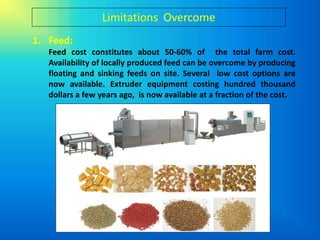
1. Feed:
   Feed cost constitutes about 50-60% of the total farm cost.
   Availability of locally produced feed can be overcome by producing
   floating and sinking feeds on site. Several low cost options are
   now available. Extruder equipment costing hundred thousand
   dollars a few years ago, is now available at a fraction of the cost.
Limitations Overcome

2. Seed: Farms around the world are switching over to culturing
    the Pacific White Shrimp L vannamei and trials conducted in
    Sindh have been successful and acceptable by local processors.

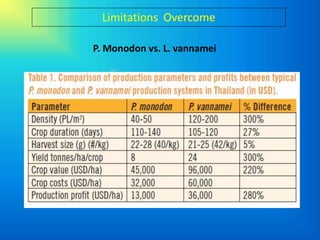
• Slow growth syndrome – emerging problem in Penaeus monodon

• Availability of vannamei shrimp Specific Pathogen Free SPF & CPF
• High tolerance to salinity levels 1 – 40 ppt
• Stocking rates of up to 150 m²
• Grows as fast as tiger shrimp
• Vannamei is easier to breed and has excellent qualities
• Better survival rates as against monodon and indicus
• Market acceptability is very good.
Limitations Overcome

P. Monodon vs. L. vannamei
Limitations

3. Government Assistance
•   Governmental and fisheries agencies to allocate suitable
    land for shrimp farming.
•   Fisheries Department to provide shrimp seed including
    vannamei
•   Governmental and fisheries agencies should offer incentives
    to farmers and potential investors
•   Lease of land at reasonable rates under a Land Grant Policy
•   Soft Loans, income and profit tax rebates
•   Assistance with collective infrastructure such as roads,
    electricity, water channels, bunds and drainage.
THANK YOU


   Khalid A. Memon
   CEO, Aquaculture Technologies
   www.aquatechpk.com

Aquaculture Technologies Consultants

  • 1.
    Aquaculture Consultants Freshwater, Brackishwater& Marine Farming Khalid A. Memon CEO, Aquaculture Technologies www.aquatechpk.com
  • 2.
    Sustainable Marine &Brackishwater Aquaculture Shrimp & Finfish Farming • Costal Shrimp Culture • Coastal Land Based & Cage Finfish Culture • Inland Low Salinity Shrimp & Finfish Culture
  • 3.
    Marine Shrimp &Finfish Farming  Conventional Marine Shrimp Culture
  • 4.
    Marine Shrimp &Finfish Farming  Marine Finfish Cage Culture
  • 5.
    Old Ideas Proven Developments in Aquaculture  Biofloc Technology in Shrimp Culture • Open Lined / Cemented Ponds • Indoor Tanks / Covered Ponds  Inland Low Salinity Groundwater Aquaculture • Open Ponds • Indoor Tanks
  • 6.
    Cultured & ExperimentalSpecies • Pacific White Shrimp - Litopenaeus vannamei • Gilthead sea bream - Sparus aurata • Florida pompano (Trachinotus carolinus) • Nile Tilapia (Oreochromis niloticus) • Red Drum (Sciaenops ocellatus) • Cobia (Rachycentron canadum) • Rainbow trout (Oncorhynchus mykiss) • Black Tiger Shrimp and Banana (monodon & merguiensis)
  • 7.
    Biofloc Technology Simplified ConventionalIntensified Culture Systems: • Intensive farming requires more supplementary protein feed resulting in environmental pollution • This pollution is caused by dead algae, excessive uneaten feeds, fish and shrimp excreta and other organic matter • Deteriorates water quality • Increases risk of disease outbreaks • Contributes to nitrogen pollution in the culture system released in the form of ammonia and nitrite • Ammonia and nitrite are toxic to cultured animals • High levels of ammonia effect growth and moulting in shellfish • High oxygen consumption results in fish shrimp mortalities • Intensive farming requires frequent water exchanges
  • 8.
    Biofloc Technology Simplified BioflocTechnology Systems (BFT): • BFT helps in solving culture water and feed problems. • When carbon is added, nitrogen compounds combine with it to produce flocs of protein molecules. • These molecules form a floating mass called bioflocs which are dominated by bacteria. • The production of microbial biomass, are used by the culture species as additional high protein source. • The bacteria take up ammonium from the water to produce microbial protein. • BFT removes ammonia-nitrogen from the water. • BFT creates additional feed for the shrimp thus reducing feed inputs but increasing production due to higher rate of stocking.
  • 9.
    Biofloc Technology Basics 1.SPF Post larvae 2. HDPE lined ponds 3. Sludge removal (requires less water) 4. Control inlet & discharge gates (no leakages) 5. Clean pond & equipment 6. Screen & treat water 7. Correct aeration system & Paddle wheel position in ponds 8. High aeration –28 to 32 HP/ha PWAs 9. Grain (pellet) 10. Molasses 11. Crab Fence & Bird scare lines 12. Control workers , visitors & their movement
  • 10.
    Benefits of BioflocCulture System • Limited or zero water exchange • Higher bio-security • Environmentally friendly system • Reduction of nutrient rich effluent discharge • Protein reuse (Higher efficiency up to 45%) • Cost-effective ( Grain based pellet feeds) • Full control of toxic nitrogen compound such as ammonia and nitrites • High Production 6 – 12 MT /acre/crop
  • 11.
  • 12.
    Inland Low SalinityGroundwater Aquaculture Advantages of inland saline aquaculture include: • Use of unproductive land without sweet water source • Use of high volume unexploited saline groundwater that is presently considered a waste stream • Potential for commercial production of a highly marketable product • Faster fish growth due to constant elevated water temperatures • Improved feed management and food conversion efficiencies • Biosecure water supply and ability to manage environmental impacts (such as water and nutrients)
  • 13.
    Desert Shrimp FarmArizona USA
  • 14.
    L. vannamei ShrimpCulture Probability at HUB Baluchistan COMPARISON OF WATER CHEMISTRY FROM ARIZONA SHRIMP FARM VS. HUB AREA COMPONENT SEA WATER DILUTE SEA Arizona Shrimp HUB AREA (mg/l) (www.) WATER (Calc.) Co. (Lab & Boyd) Baluchistan Salinity (ppt) 35.0 4.5 7.4 6.9 pH 8.2 ND 7.6 8.0 Alkalinity 125.0 ND 220.0 152.0 Cl (Chloride) 19,400.0 2,494.3 3,223.0 2,836.8 Na (Sodium) 10,500.0 1,350.0 2,595.0 1,561.7 SO4 (Sulphate) 2,740.0 352.3 2,313.0 1,485.1 Mg (Magnesium) 1,272.0 163.5 222.0 291.8 Ca (Calcium) 400.0 51.4 497.0 440 K (Potassium) 380.0 48.9 15.2 3.1 K/Cl Factor 0.0196 0.0196 0.0047 0.001 For K/Cl Factor of 0.0100, K should be NA NA 32.2 28.4 Grams of KCl to be added per 1,000 liters of new None None 34.1 50.8 water
  • 15.
    Limitations Overcome 1. Feed: Feed cost constitutes about 50-60% of the total farm cost. Availability of locally produced feed can be overcome by producing floating and sinking feeds on site. Several low cost options are now available. Extruder equipment costing hundred thousand dollars a few years ago, is now available at a fraction of the cost.
  • 16.
    Limitations Overcome 2. Seed:Farms around the world are switching over to culturing the Pacific White Shrimp L vannamei and trials conducted in Sindh have been successful and acceptable by local processors. • Slow growth syndrome – emerging problem in Penaeus monodon • Availability of vannamei shrimp Specific Pathogen Free SPF & CPF • High tolerance to salinity levels 1 – 40 ppt • Stocking rates of up to 150 m² • Grows as fast as tiger shrimp • Vannamei is easier to breed and has excellent qualities • Better survival rates as against monodon and indicus • Market acceptability is very good.
  • 17.
  • 18.
    Limitations 3. Government Assistance • Governmental and fisheries agencies to allocate suitable land for shrimp farming. • Fisheries Department to provide shrimp seed including vannamei • Governmental and fisheries agencies should offer incentives to farmers and potential investors • Lease of land at reasonable rates under a Land Grant Policy • Soft Loans, income and profit tax rebates • Assistance with collective infrastructure such as roads, electricity, water channels, bunds and drainage.
  • 19.
    THANK YOU Khalid A. Memon CEO, Aquaculture Technologies www.aquatechpk.com