Gender Blind Development,
Gender Mainstreaming &
Equality
By
Muhammad Arshad
(Master’s in IRD, Lincoln University, New
Zealand)
Training & Coordination Officer, PARD
(January 04, 2012)
GENDER BLIND
 Ignoring or non-recognition of the existence of gender
and gender differences.
 Not recognising that men and women are
POSITIONED differently, they have different
EXPERIENCES, different NEEDS, different
STRENGTHS and SKILLS and these need to be
considered while planning projects.
GENDER AWARE
 Recognising or being aware of the existence of
gender and gender differences in society;
recognising that men and women are
POSITIONED differently, they have different
EXPERIENCES, different NEEDS, different
STRENGTHS and SKILLS and these need to be
considered while planning projects.
 However awareness may not lead to any action
towards gender equality. We can be aware and yet
not act.
GENDER SENSITIVE
 Being gender sensitive means being AWARE PLUS
TAKING ACTION against existing gender
discrimination and inequalities.
 It means looking at the world through women’s eyes
and doing everything with a gender perspective in order
to transform gender relations and make them more
equal and just.
Some Examples of Gender Blind
Development
 Rural farming women were displaced by agriculture
technology. The result was a loss of income for the
women, and a lost opportunity to learn a new skill
(since the assumption was that women cannot deal
with technology).
 Aga Khan Education Service (AKES) in the Northern
Areas invested in female schools because government
schools for boys existed in the area. The result was
because of better quality of teaching; the girls who
graduated from those schools had a markedly high
standard of education compared to boys. One of the
undesirable outcomes was a difficulty in finding
appropriate marriage proposals for these girls.
Contd…
 Sindh’s education policy for rural areas requires that the land for the
schools be contributed by the community. More often than not, those
who are in a position to donate the land are relatively better off, and
whose off springs probably go to private schools. The land which is
donated by them is generally is least valuable, and most often
located far away from the village and therefore inaccessible and
unsafe for young girls. Such schools consequently have little impact
on the increase in enrollment, and therefore female literacy rates, for
obvious reasons.
 A rice research project in Punjab resulted in new varieties that were
fast growing and early producers. Plant breeders did not explore
other uses of the rice plant. The husbands were given the proceeds
from the rice crop. Previously, women had made place mats and
other crafts from the rice husks and stalk. With the new varieties,
this residue – disregarded by the researchers – was no longer useful
for crafts, resulting in less off-season income for the women in the
family. While the family may have had more rice and the husbands
(or other male household head) may have had more income, net
family income was not necessarily greater, and women’s direct
control over her income was affected.
Engendering Development Means
Recognizing….
 Women and men often have different needs
and priorities due to their different status and
roles in society
 Development interventions have to be based
on an understanding of gender roles
 Women and their needs and priorities have to
be given as much importance as those of men
 Only then is humane, just and sustainable
development possible
What are Gender issues?
Invisibility of either gender
Unequal burdens of work
Unequal access to resources
Unequal benefits and or control of resources
We Must Not Assume
 That either gender (especially women) will
automatically benefit from a proposed
project or program. Rather, it is consciously
thinking about how this will happen.
What Needs to be Ensured While
Preparing Projects
 Are the needs of both women and men reflected in
the goals, objectives and strategies of the Project?
 Is there a clear policy for mainstreaming women?
 Has appropriate budget been allocated for the
development of both men and women?
 Does the project consider men’s and women’s
practical and strategic gender needs?
Some important points
◊ The objectives of prosperity and development could not be
achieved without educating the women in the rural and urban
areas.
◊ Women should use their potential for addressing and resolving
the problems of their community especially in the areas of
education, health and economy.
◊ We need to provide a safe and conducive climate in which
women could freely express their creative capabilities and
work for the betterment of country
Government Initiatives
 During the MTDF (2005-10), the
Government focused on the following two
objectives using a rights-based approach
towards gender justice and equality.
- Steps towards meeting women’s basic minimum
needs, including, inter alia, nutrition through
enhanced food security measures, renewable
energy, basic and reproductive health care,
primary education and infrastructure, such as
housing, water, rural road and transport;
- Steps towards poverty reduction and economic
empowerment.
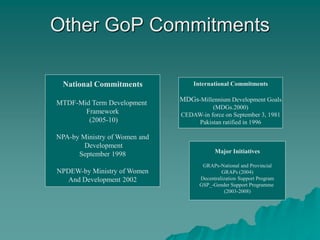
Other GoP Commitments
National Commitments
MTDF-Mid Term Development
Framework
(2005-10)
NPA-by Ministry of Women and
Development
September 1998
NPDEW-by Ministry of Women
And Development 2002
International Commitments
MDGs-Millennium Development Goals
(MDGs.2000)
CEDAW-in force on September 3, 1981
Pakistan ratified in 1996
Major Initiatives
GRAPs-National and Provincial
GRAPs (2004)
Decentralization Support Program
GSP_-Gender Support Programme
(2003-2008)
What is Gender Mainstreaming?
Gender Mainstreaming is a key strategy to reduce inequalities
between women and men.
The United Nations defines it as:
“…the process of assessing the implications for women and men
of any planned action, including legislation, policies, or
programmes, in all areas and at all levels. It is a strategy for
making women’s as well as men’s concerns and experiences a
dimension of the design, implementation, monitoring and
evaluation of policies and programmes in all political, economic,
and societal spheres so that women and men benefit equally
and inequality is not perpetuated”.
Source:
The Economic & Social Council Report for 1997, UN, 1997
Gender Mainstreaming in Policies,
Programs and Projects
Policies, programs and projects impact
differently on women and men due to
their gender based roles and life
situations. Developing institutional
capacity for gender mainstreaming thus
requires that the needs of both women
and men are reflected from beginning to
end of the policy, programs and projects.
Gender Equity
 Gender equity is concerned with the
promotion of personal, social, cultural,
political, and economic equality for all. The
term emerged out of a growing
recognition in society of pervasive gender
inequalities.
 In the short term, gender emphasis in the
gender equity initiatives is paced on
improving conditions and attitudes as they
affect girls and women. In the long term
these initiatives will also improve the
situation for boys and men.
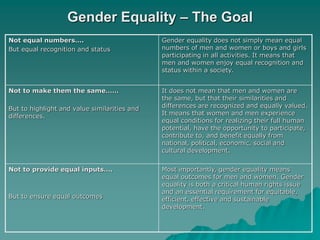
Gender Equality – The Goal
Not equal numbers….
But equal recognition and status
Gender equality does not simply mean equal
numbers of men and women or boys and girls
participating in all activities. It means that
men and women enjoy equal recognition and
status within a society.
Not to make them the same……
But to highlight and value similarities and
differences.
It does not mean that men and women are
the same, but that their similarities and
differences are recognized and equally valued.
It means that women and men experience
equal conditions for realizing their full human
potential, have the opportunity to participate,
contribute to, and benefit equally from
national, political, economic, social and
cultural development.
Not to provide equal inputs….
But to ensure equal outcomes
Most importantly, gender equality means
equal outcomes for men and women. Gender
equality is both a critical human rights issue
and an essential requirement for equitable,
efficient, effective and sustainable
development.
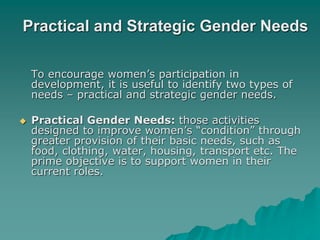
Practical and Strategic Gender Needs
To encourage women’s participation in
development, it is useful to identify two types of
needs – practical and strategic gender needs.
 Practical Gender Needs: those activities
designed to improve women’s “condition” through
greater provision of their basic needs, such as
food, clothing, water, housing, transport etc. The
prime objective is to support women in their
current roles.
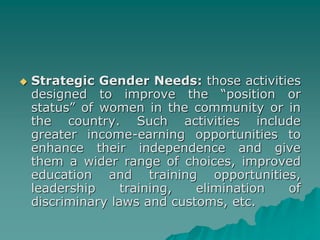
 Strategic Gender Needs: those activities
designed to improve the “position or
status” of women in the community or in
the country. Such activities include
greater income-earning opportunities to
enhance their independence and give
them a wider range of choices, improved
education and training opportunities,
leadership training, elimination of
discriminary laws and customs, etc.

Gender Blind Development, Mainstreaming & Equality.ppt

  • 2.
    Gender Blind Development, GenderMainstreaming & Equality By Muhammad Arshad (Master’s in IRD, Lincoln University, New Zealand) Training & Coordination Officer, PARD (January 04, 2012)
  • 3.
    GENDER BLIND  Ignoringor non-recognition of the existence of gender and gender differences.  Not recognising that men and women are POSITIONED differently, they have different EXPERIENCES, different NEEDS, different STRENGTHS and SKILLS and these need to be considered while planning projects.
  • 4.
    GENDER AWARE  Recognisingor being aware of the existence of gender and gender differences in society; recognising that men and women are POSITIONED differently, they have different EXPERIENCES, different NEEDS, different STRENGTHS and SKILLS and these need to be considered while planning projects.  However awareness may not lead to any action towards gender equality. We can be aware and yet not act.
  • 5.
    GENDER SENSITIVE  Beinggender sensitive means being AWARE PLUS TAKING ACTION against existing gender discrimination and inequalities.  It means looking at the world through women’s eyes and doing everything with a gender perspective in order to transform gender relations and make them more equal and just.
  • 6.
    Some Examples ofGender Blind Development  Rural farming women were displaced by agriculture technology. The result was a loss of income for the women, and a lost opportunity to learn a new skill (since the assumption was that women cannot deal with technology).  Aga Khan Education Service (AKES) in the Northern Areas invested in female schools because government schools for boys existed in the area. The result was because of better quality of teaching; the girls who graduated from those schools had a markedly high standard of education compared to boys. One of the undesirable outcomes was a difficulty in finding appropriate marriage proposals for these girls.
  • 7.
    Contd…  Sindh’s educationpolicy for rural areas requires that the land for the schools be contributed by the community. More often than not, those who are in a position to donate the land are relatively better off, and whose off springs probably go to private schools. The land which is donated by them is generally is least valuable, and most often located far away from the village and therefore inaccessible and unsafe for young girls. Such schools consequently have little impact on the increase in enrollment, and therefore female literacy rates, for obvious reasons.  A rice research project in Punjab resulted in new varieties that were fast growing and early producers. Plant breeders did not explore other uses of the rice plant. The husbands were given the proceeds from the rice crop. Previously, women had made place mats and other crafts from the rice husks and stalk. With the new varieties, this residue – disregarded by the researchers – was no longer useful for crafts, resulting in less off-season income for the women in the family. While the family may have had more rice and the husbands (or other male household head) may have had more income, net family income was not necessarily greater, and women’s direct control over her income was affected.
  • 8.
    Engendering Development Means Recognizing…. Women and men often have different needs and priorities due to their different status and roles in society  Development interventions have to be based on an understanding of gender roles  Women and their needs and priorities have to be given as much importance as those of men  Only then is humane, just and sustainable development possible
  • 9.
    What are Genderissues? Invisibility of either gender Unequal burdens of work Unequal access to resources Unequal benefits and or control of resources
  • 10.
    We Must NotAssume  That either gender (especially women) will automatically benefit from a proposed project or program. Rather, it is consciously thinking about how this will happen.
  • 11.
    What Needs tobe Ensured While Preparing Projects  Are the needs of both women and men reflected in the goals, objectives and strategies of the Project?  Is there a clear policy for mainstreaming women?  Has appropriate budget been allocated for the development of both men and women?  Does the project consider men’s and women’s practical and strategic gender needs?
  • 12.
    Some important points ◊The objectives of prosperity and development could not be achieved without educating the women in the rural and urban areas. ◊ Women should use their potential for addressing and resolving the problems of their community especially in the areas of education, health and economy. ◊ We need to provide a safe and conducive climate in which women could freely express their creative capabilities and work for the betterment of country
  • 13.
    Government Initiatives  Duringthe MTDF (2005-10), the Government focused on the following two objectives using a rights-based approach towards gender justice and equality. - Steps towards meeting women’s basic minimum needs, including, inter alia, nutrition through enhanced food security measures, renewable energy, basic and reproductive health care, primary education and infrastructure, such as housing, water, rural road and transport; - Steps towards poverty reduction and economic empowerment.
  • 14.
    Other GoP Commitments NationalCommitments MTDF-Mid Term Development Framework (2005-10) NPA-by Ministry of Women and Development September 1998 NPDEW-by Ministry of Women And Development 2002 International Commitments MDGs-Millennium Development Goals (MDGs.2000) CEDAW-in force on September 3, 1981 Pakistan ratified in 1996 Major Initiatives GRAPs-National and Provincial GRAPs (2004) Decentralization Support Program GSP_-Gender Support Programme (2003-2008)
  • 15.
    What is GenderMainstreaming? Gender Mainstreaming is a key strategy to reduce inequalities between women and men. The United Nations defines it as: “…the process of assessing the implications for women and men of any planned action, including legislation, policies, or programmes, in all areas and at all levels. It is a strategy for making women’s as well as men’s concerns and experiences a dimension of the design, implementation, monitoring and evaluation of policies and programmes in all political, economic, and societal spheres so that women and men benefit equally and inequality is not perpetuated”. Source: The Economic & Social Council Report for 1997, UN, 1997
  • 16.
    Gender Mainstreaming inPolicies, Programs and Projects Policies, programs and projects impact differently on women and men due to their gender based roles and life situations. Developing institutional capacity for gender mainstreaming thus requires that the needs of both women and men are reflected from beginning to end of the policy, programs and projects.
  • 17.
    Gender Equity  Genderequity is concerned with the promotion of personal, social, cultural, political, and economic equality for all. The term emerged out of a growing recognition in society of pervasive gender inequalities.  In the short term, gender emphasis in the gender equity initiatives is paced on improving conditions and attitudes as they affect girls and women. In the long term these initiatives will also improve the situation for boys and men.
  • 18.
    Gender Equality –The Goal Not equal numbers…. But equal recognition and status Gender equality does not simply mean equal numbers of men and women or boys and girls participating in all activities. It means that men and women enjoy equal recognition and status within a society. Not to make them the same…… But to highlight and value similarities and differences. It does not mean that men and women are the same, but that their similarities and differences are recognized and equally valued. It means that women and men experience equal conditions for realizing their full human potential, have the opportunity to participate, contribute to, and benefit equally from national, political, economic, social and cultural development. Not to provide equal inputs…. But to ensure equal outcomes Most importantly, gender equality means equal outcomes for men and women. Gender equality is both a critical human rights issue and an essential requirement for equitable, efficient, effective and sustainable development.
  • 19.
    Practical and StrategicGender Needs To encourage women’s participation in development, it is useful to identify two types of needs – practical and strategic gender needs.  Practical Gender Needs: those activities designed to improve women’s “condition” through greater provision of their basic needs, such as food, clothing, water, housing, transport etc. The prime objective is to support women in their current roles.
  • 20.
     Strategic GenderNeeds: those activities designed to improve the “position or status” of women in the community or in the country. Such activities include greater income-earning opportunities to enhance their independence and give them a wider range of choices, improved education and training opportunities, leadership training, elimination of discriminary laws and customs, etc.