THE SIMPLE PRESENTTHE SIMPLE PRESENT
Uses of The SimpleUses of The Simple
PresentPresent
1. The Simple Present can be used1. The Simple Present can be used
to refer to actions which occur atto refer to actions which occur at
regular intervalsregular intervals..
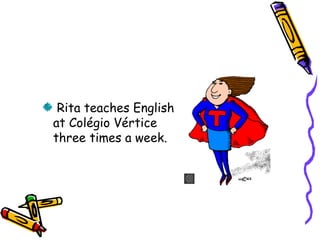
Rita teaches English
at Colégio Vértice
three times a week.
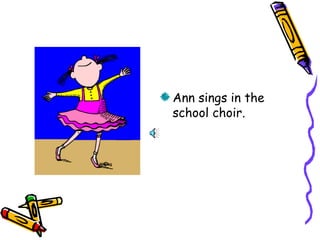
Ann sings in the
school choir.
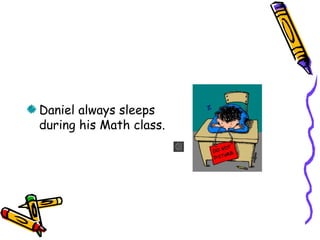
Daniel always sleeps
during his Math class.
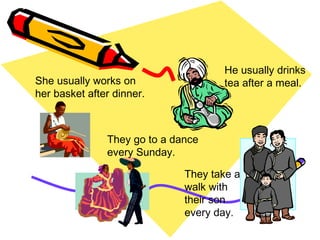
She usually works on
her basket after dinner.
He usually drinks
tea after a meal.
They go to a dance
every Sunday.
They take a
walk with
their son
every day.
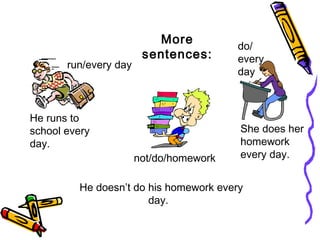
run/every day
do/
every
day
not/do/homework
More
sentences:
He runs to
school every
day.
She does her
homework
every day.
He doesn’t do his homework every
day.
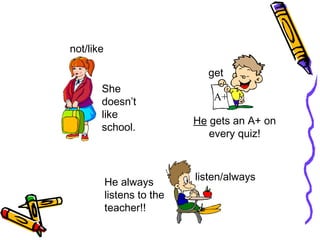
not/like
get
A+
listen/always
She
doesn’t
like
school.
He gets an A+ on
every quiz!
He always
listens to the
teacher!!
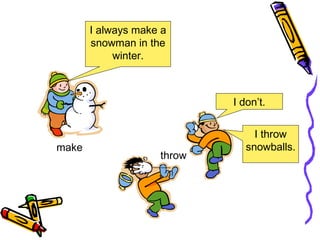
make
throw
I don’t.
I always make a
snowman in the
winter.
I throw
snowballs.
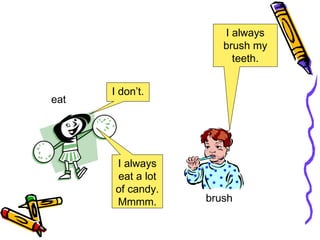
brush
I don’t.
I always
brush my
teeth.
I always
eat a lot
of candy.
Mmmm.
eat
2. The Simple Present is also used2. The Simple Present is also used
in stating general truths.in stating general truths.
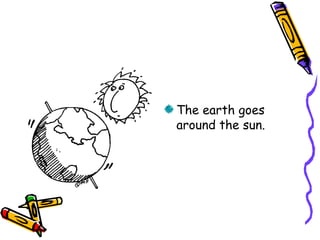
The earth goes
around the sun.
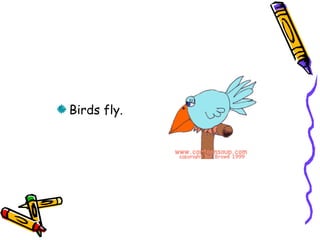
Birds fly.
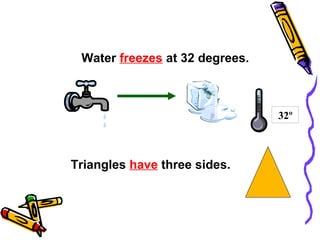
Water freezes at 32 degrees.
32º
Triangles have three sides.
3. Occasionally, the Simple Present3. Occasionally, the Simple Present
is used to express actionsis used to express actions
occurring in the future.occurring in the future.
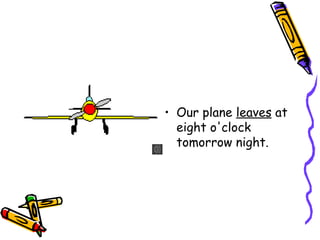
• Our plane leaves at
eight o'clock
tomorrow night.
4. In addition, the Simple Present4. In addition, the Simple Present
is used when referring to printedis used when referring to printed
material, and when describingmaterial, and when describing
events portrayed in a book, film, orevents portrayed in a book, film, or
other work of art.other work of art.
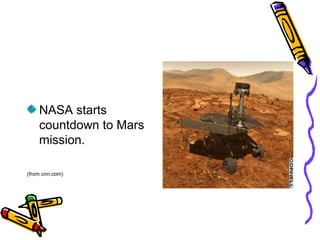
NASA starts
countdown to Mars
mission.
(from cnn.com)
Formation of the simpleFormation of the simple
presentpresent
The simple present is formed fromThe simple present is formed from
thethe bare infinitivebare infinitive of the verb. Asof the verb. As
shown in the following examples, theshown in the following examples, the
bare infinitive of a verb consists ofbare infinitive of a verb consists of
the infinitive without the wordthe infinitive without the word toto..
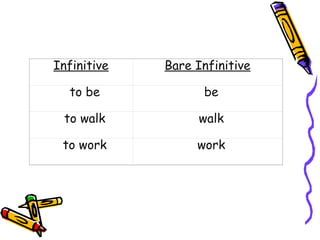
Infinitive Bare Infinitive
  to be   be
  to walk   walk
  to work   work
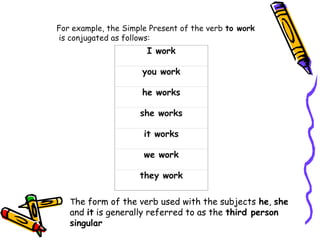
For example, the Simple Present of the verb to work
is conjugated as follows:
I work
you work
he works
she works
it works
we work
they work
The form of the verb used with the subjects he, she
and it is generally referred to as the third person
singular
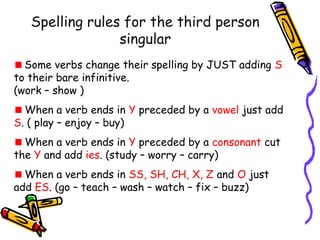
Spelling rules for the third person
singular
Some verbs change their spelling by JUST adding S
to their bare infinitive.
(work – show )
When a verb ends in Y preceded by a vowel just add
S. ( play – enjoy – buy)
When a verb ends in Y preceded by a consonant cut
the Y and add ies. (study – worry – carry)
When a verb ends in SS, SH, CH, X, Z and O just
add ES. (go – teach – wash – watch – fix – buzz)
The auxiliariesThe auxiliaries
DO and DOESDO and DOES
The auxiliaries DO and Does areThe auxiliaries DO and Does are
used to make the Interrogativeused to make the Interrogative
and Negative forms.and Negative forms.
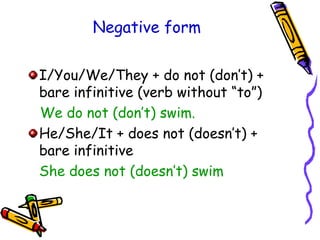
Negative form
I/You/We/They + do not (don’t) +
bare infinitive (verb without “to”)
We do not (don’t) swim.
He/She/It + does not (doesn’t) +
bare infinitive
She does not (doesn’t) swim
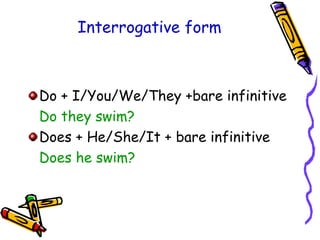
Interrogative form
Do + I/You/We/They +bare infinitive
Do they swim?
Does + He/She/It + bare infinitive
Does he swim?
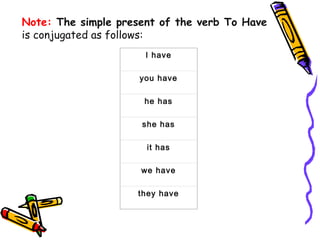
Note: The simple present of the verb To Have
is conjugated as follows:
I have
you have
he has
she has
it has
we have
they have
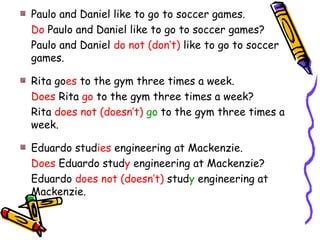
Paulo and Daniel like to go to soccer games.
Do Paulo and Daniel like to go to soccer games?
Paulo and Daniel do not (don’t) like to go to soccer
games.
Rita goes to the gym three times a week.
Does Rita go to the gym three times a week?
Rita does not (doesn’t) go to the gym three times a
week.
Eduardo studies engineering at Mackenzie.
Does Eduardo study engineering at Mackenzie?
Eduardo does not (doesn’t) study engineering at
Mackenzie.
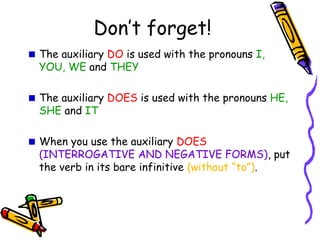
Don’t forget!
The auxiliary DO is used with the pronouns I,
YOU, WE and THEY
The auxiliary DOES is used with the pronouns HE,
SHE and IT
When you use the auxiliary DOES
(INTERROGATIVE AND NEGATIVE FORMS),
put the verb in its bare infinitive (without “to”).
That’s all for now folks!That’s all for now folks!
Thanks!Thanks!
Teacher RitaTeacher Rita

The simple present tense

  • 1.
    THE SIMPLE PRESENTTHESIMPLE PRESENT
  • 2.
    Uses of TheSimpleUses of The Simple PresentPresent 1. The Simple Present can be used1. The Simple Present can be used to refer to actions which occur atto refer to actions which occur at regular intervalsregular intervals..
  • 3.
    Rita teaches English atColégio Vértice three times a week.
  • 4.
    Ann sings inthe school choir.
  • 5.
  • 6.
    She usually workson her basket after dinner. He usually drinks tea after a meal. They go to a dance every Sunday. They take a walk with their son every day.
  • 7.
    run/every day do/ every day not/do/homework More sentences: He runsto school every day. She does her homework every day. He doesn’t do his homework every day.
  • 8.
    not/like get A+ listen/always She doesn’t like school. He gets anA+ on every quiz! He always listens to the teacher!!
  • 9.
    make throw I don’t. I alwaysmake a snowman in the winter. I throw snowballs.
  • 10.
    brush I don’t. I always brushmy teeth. I always eat a lot of candy. Mmmm. eat
  • 11.
    2. The SimplePresent is also used2. The Simple Present is also used in stating general truths.in stating general truths.
  • 12.
  • 13.
  • 14.
    Water freezes at32 degrees. 32º Triangles have three sides.
  • 15.
    3. Occasionally, theSimple Present3. Occasionally, the Simple Present is used to express actionsis used to express actions occurring in the future.occurring in the future.
  • 16.
    • Our planeleaves at eight o'clock tomorrow night.
  • 17.
    4. In addition,the Simple Present4. In addition, the Simple Present is used when referring to printedis used when referring to printed material, and when describingmaterial, and when describing events portrayed in a book, film, orevents portrayed in a book, film, or other work of art.other work of art.
  • 18.
    NASA starts countdown toMars mission. (from cnn.com)
  • 19.
    Formation of thesimpleFormation of the simple presentpresent The simple present is formed fromThe simple present is formed from thethe bare infinitivebare infinitive of the verb. Asof the verb. As shown in the following examples, theshown in the following examples, the bare infinitive of a verb consists ofbare infinitive of a verb consists of the infinitive without the wordthe infinitive without the word toto..
  • 20.
    Infinitive Bare Infinitive  to be   be   to walk   walk   to work   work
  • 21.
    For example, theSimple Present of the verb to work is conjugated as follows: I work you work he works she works it works we work they work The form of the verb used with the subjects he, she and it is generally referred to as the third person singular
  • 22.
    Spelling rules forthe third person singular Some verbs change their spelling by JUST adding S to their bare infinitive. (work – show ) When a verb ends in Y preceded by a vowel just add S. ( play – enjoy – buy) When a verb ends in Y preceded by a consonant cut the Y and add ies. (study – worry – carry) When a verb ends in SS, SH, CH, X, Z and O just add ES. (go – teach – wash – watch – fix – buzz)
  • 23.
    The auxiliariesThe auxiliaries DOand DOESDO and DOES The auxiliaries DO and Does areThe auxiliaries DO and Does are used to make the Interrogativeused to make the Interrogative and Negative forms.and Negative forms.
  • 24.
    Negative form I/You/We/They +do not (don’t) + bare infinitive (verb without “to”) We do not (don’t) swim. He/She/It + does not (doesn’t) + bare infinitive She does not (doesn’t) swim
  • 25.
    Interrogative form Do +I/You/We/They +bare infinitive Do they swim? Does + He/She/It + bare infinitive Does he swim?
  • 26.
    Note: The simplepresent of the verb To Have is conjugated as follows: I have you have he has she has it has we have they have
  • 27.
    Paulo and Daniellike to go to soccer games. Do Paulo and Daniel like to go to soccer games? Paulo and Daniel do not (don’t) like to go to soccer games. Rita goes to the gym three times a week. Does Rita go to the gym three times a week? Rita does not (doesn’t) go to the gym three times a week. Eduardo studies engineering at Mackenzie. Does Eduardo study engineering at Mackenzie? Eduardo does not (doesn’t) study engineering at Mackenzie.
  • 28.
    Don’t forget! The auxiliaryDO is used with the pronouns I, YOU, WE and THEY The auxiliary DOES is used with the pronouns HE, SHE and IT When you use the auxiliary DOES (INTERROGATIVE AND NEGATIVE FORMS), put the verb in its bare infinitive (without “to”).
  • 29.
    That’s all fornow folks!That’s all for now folks! Thanks!Thanks! Teacher RitaTeacher Rita