
12 Tenses, Recognition,
Production
Lecture No. 9, 10
Zafar Ullah, lecturer in English zafarullah76@gmail.com
Tense
• Tense Meaning: time
• 12 tenses
• 4 Present,
• 4 Past,
• 4 Future
2
Names of Tenses
• Simple= Indefinite
• Progressive= Continuous
• Perfect Progressive= Perfect Continuous
3
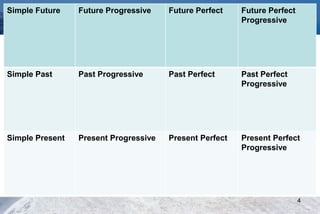
Simple Future Future Progressive Future Perfect Future Perfect
Progressive
Simple Past Past Progressive Past Perfect Past Perfect
Progressive
Simple Present Present Progressive Present Perfect Present Perfect
Progressive
4
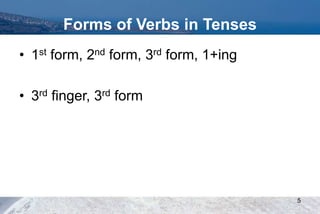
Forms of Verbs in Tenses
• 1st form, 2nd form, 3rd form, 1+ing
• 3rd finger, 3rd form
5
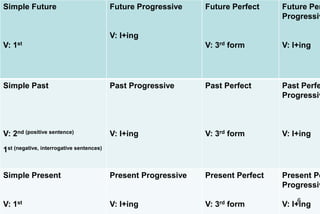
Forms of Tenses
Simple Future
V: 1st
Future Progressive
V: I+ing
Future Perfect
V: 3rd form
Future Per
Progressiv
V: I+ing
Simple Past
V: 2nd (positive sentence)
1st (negative, interrogative sentences)
Past Progressive
V: I+ing
Past Perfect
V: 3rd form
Past Perfe
Progressiv
V: I+ing
Simple Present
V: 1st
Present Progressive
V: I+ing
Present Perfect
V: 3rd form
Present Pe
Progressiv
V: I+ing
6
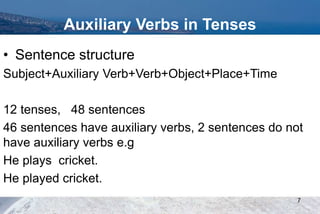
Auxiliary Verbs in Tenses
• Sentence structure
Subject+Auxiliary Verb+Verb+Object+Place+Time
12 tenses, 48 sentences
46 sentences have auxiliary verbs, 2 sentences do not
have auxiliary verbs e.g
He plays cricket.
He played cricket.
7
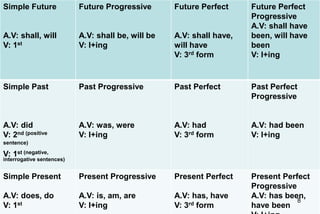
Forms of Tenses
Simple Future
A.V: shall, will
V: 1st
Future Progressive
A.V: shall be, will be
V: I+ing
Future Perfect
A.V: shall have,
will have
V: 3rd form
Future Perfect
Progressive
A.V: shall have
been, will have
been
V: I+ing
Simple Past
A.V: did
V: 2nd (positive
sentence)
V: 1st (negative,
interrogative sentences)
Past Progressive
A.V: was, were
V: I+ing
Past Perfect
A.V: had
V: 3rd form
Past Perfect
Progressive
A.V: had been
V: I+ing
Simple Present
A.V: does, do
V: 1st
Present Progressive
A.V: is, am, are
V: I+ing
Present Perfect
A.V: has, have
V: 3rd form
Present Perfect
Progressive
A.V: has been,
have been
8
Pronoun and Auxiliary Verb
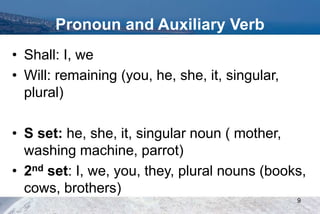
• Shall: I, we
• Will: remaining (you, he, she, it, singular,
plural)
• S set: he, she, it, singular noun ( mother,
washing machine, parrot)
• 2nd set: I, we, you, they, plural nouns (books,
cows, brothers)
9
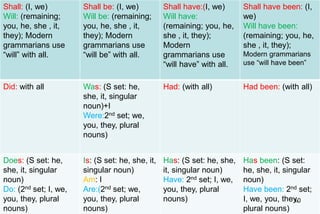
Shall: (I, we)
Will: (remaining;
you, he, she , it,
they); Modern
grammarians use
“will” with all.
Shall be: (I, we)
Will be: (remaining;
you, he, she , it,
they); Modern
grammarians use
“will be” with all.
Shall have:(I, we)
Will have:
(remaining; you, he,
she , it, they);
Modern
grammarians use
“will have” with all.
Shall have been: (I,
we)
Will have been:
(remaining; you, he,
she , it, they);
Modern grammarians
use “will have been”
Did: with all Was: (S set: he,
she, it, singular
noun)+I
Were:2nd set; we,
you, they, plural
nouns)
Had: (with all) Had been: (with all)
Does: (S set: he,
she, it, singular
noun)
Do: (2nd set; I, we,
you, they, plural
nouns)
Is: (S set: he, she, it,
singular noun)
Am: I
Are:(2nd set; we,
you, they, plural
nouns)
Has: (S set: he, she,
it, singular noun)
Have: 2nd set; I, we,
you, they, plural
nouns)
Has been: (S set:
he, she, it, singular
noun)
Have been: 2nd set;
I, we, you, they,
plural nouns)
10
Recognition in Urdu
• Grammar Translation Method
• Benefits in Urdu to English translation
• Support of mother tongue
11
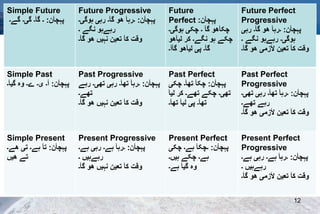
Simple Future
‫پہچأن‬:‫گے۔‬ ‫گی۔‬ ‫گأ۔‬ ‫۔‬
Future Progressive
‫پہچأن‬:‫ہوگی۔‬ ‫رہی‬ ‫گأ۔‬ ‫ھو‬ ‫۔رہأ‬
‫۔‬ ‫نگے‬ ‫رہےہو‬
‫گأ۔‬ ‫ھو‬ ‫نہیں‬ ‫تعین‬ ‫کأ‬ ‫وقت‬
Future
Perfect ‫پہچأن‬:
‫ہوگی۔‬ ‫چکی‬ ‫۔‬ ‫گأ‬ ‫چکأھو‬
‫لیأھو‬ ‫کر‬ ‫نگے۔‬ ‫ہو‬ ‫چکے‬
‫گأأ۔‬ ‫لیأھو‬ ‫پی‬ ‫گأ۔‬
Future Perfect
Progressive
‫پہچأن‬:‫رہی‬ ‫گأ۔‬ ‫ھو‬ ‫۔رہأ‬
‫۔‬ ‫نگے‬ ‫رہےہو‬ ‫ہوگی۔‬
‫گأ۔‬ ‫ھو‬ ‫ألزمی‬ ‫تعین‬ ‫کأ‬ ‫وقت‬
Simple Past
‫پہچأن‬:‫گیأ۔‬ ‫وہ‬ ‫ے۔‬ ‫ی۔‬ ‫أ۔‬
Past Progressive
‫پہچأن‬:‫رہے‬ ‫تھی۔‬ ‫رہی‬ ‫تھأ۔‬ ‫۔رہأ‬
‫تھے۔‬
‫گأ۔‬ ‫ھو‬ ‫نہیں‬ ‫تعین‬ ‫کأ‬ ‫وقت‬
Past Perfect
‫پہچأن‬:‫چکی‬ ‫تھأ۔‬ ‫چکأ‬
‫لیأ‬ ‫کر‬ ‫تھے۔‬ ‫چکے‬ ‫تھی۔‬
‫تھأ۔‬ ‫لیأ‬ ‫پی‬ ‫تھأ۔‬
Past Perfect
Progressive
‫پہچأن‬:‫تھی۔‬ ‫رہی‬ ‫تھأ۔‬ ‫۔رہأ‬
‫تھے۔‬ ‫رہے‬
‫گأ۔‬ ‫ھو‬ ‫ألزمی‬ ‫تعین‬ ‫کأ‬ ‫وقت‬
Simple Present
‫پہچأن‬:‫ھے۔‬ ‫تی‬ ‫ہے۔‬ ‫تأ‬
‫ھیں‬ ‫تے‬
Present Progressive
‫پہچأن‬:‫ہے۔‬ ‫رہی‬ ‫ہے۔‬ ‫۔رہأ‬
‫۔‬ ‫رہےہیں‬
‫گأ۔‬ ‫ھو‬ ‫نہیں‬ ‫تعین‬ ‫کأ‬ ‫وقت‬
Present Perfect
‫پہچأن‬:‫چکی‬ ‫ہے۔‬ ‫۔چکأ‬
‫ہیں۔‬ ‫چکے‬ ‫ہے۔‬
‫ہے۔‬ ‫گیأ‬ ‫وہ‬
Present Perfect
Progressive
‫پہچأن‬:‫ہے۔‬ ‫رہی‬ ‫ہے۔‬ ‫۔رہأ‬
‫۔‬ ‫رہےہیں‬
‫گأ۔‬ ‫ھو‬ ‫ألزمی‬ ‫تعین‬ ‫کأ‬ ‫وقت‬
12
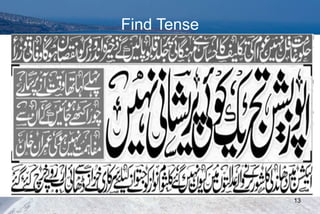
Find Tense
13
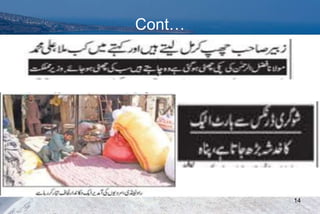
Cont…
14
Recognition in English
• Direct method
• Convert your ideas into English
15
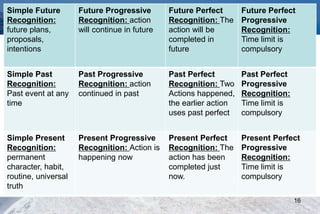
Simple Future
Recognition:
future plans,
proposals,
intentions
Future Progressive
Recognition: action
will continue in future
Future Perfect
Recognition: The
action will be
completed in
future
Future Perfect
Progressive
Recognition:
Time limit is
compulsory
Simple Past
Recognition:
Past event at any
time
Past Progressive
Recognition: action
continued in past
Past Perfect
Recognition: Two
Actions happened,
the earlier action
uses past perfect
Past Perfect
Progressive
Recognition:
Time limit is
compulsory
Simple Present
Recognition:
permanent
character, habit,
routine, universal
truth
Present Progressive
Recognition: Action is
happening now
Present Perfect
Recognition: The
action has been
completed just
now.
Present Perfect
Progressive
Recognition:
Time limit is
compulsory
16
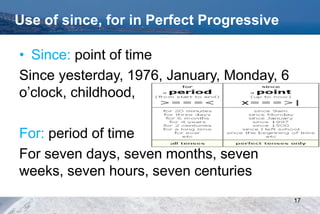
Use of since, for in Perfect Progressive
• Since: point of time
Since yesterday, 1976, January, Monday, 6
o’clock, childhood,
For: period of time
For seven days, seven months, seven
weeks, seven hours, seven centuries
17
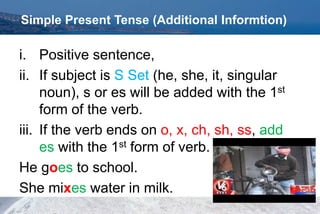
Simple Present Tense (Additional Informtion)
i. Positive sentence,
ii. If subject is S Set (he, she, it, singular
noun), s or es will be added with the 1st
form of the verb.
iii. If the verb ends on o, x, ch, sh, ss, add
es with the 1st form of verb.
He goes to school.
She mixes water in milk.
18
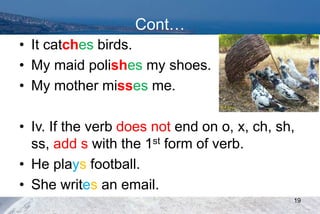
Cont…
• It catches birds.
• My maid polishes my shoes.
• My mother misses me.
• Iv. If the verb does not end on o, x, ch, sh,
ss, add s with the 1st form of verb.
• He plays football.
• She writes an email.
19
Cont…
• If the subject is 2nd set (I, we, you, they,
plural nouns), do not add s or es.
• Never use addition of s or es in
interrogative or negative sentences.
20
Make 48 Sentences
• Make 12 boxes
• Use 2 pages
• Write all separated features ( forms,
Auxiliary verbs, recognition) of one tense
in one box on your copy.
• Convert 1 sentence into 48 sentences
21
Thanks
22
Question Answers
23

9. 10. tenses

  • 1.
    12 Tenses, Recognition, Production LectureNo. 9, 10 Zafar Ullah, lecturer in English zafarullah76@gmail.com
  • 2.
    Tense • Tense Meaning:time • 12 tenses • 4 Present, • 4 Past, • 4 Future 2
  • 3.
    Names of Tenses •Simple= Indefinite • Progressive= Continuous • Perfect Progressive= Perfect Continuous 3
  • 4.
    Simple Future FutureProgressive Future Perfect Future Perfect Progressive Simple Past Past Progressive Past Perfect Past Perfect Progressive Simple Present Present Progressive Present Perfect Present Perfect Progressive 4
  • 5.
    Forms of Verbsin Tenses • 1st form, 2nd form, 3rd form, 1+ing • 3rd finger, 3rd form 5
  • 6.
    Forms of Tenses SimpleFuture V: 1st Future Progressive V: I+ing Future Perfect V: 3rd form Future Per Progressiv V: I+ing Simple Past V: 2nd (positive sentence) 1st (negative, interrogative sentences) Past Progressive V: I+ing Past Perfect V: 3rd form Past Perfe Progressiv V: I+ing Simple Present V: 1st Present Progressive V: I+ing Present Perfect V: 3rd form Present Pe Progressiv V: I+ing 6
  • 7.
    Auxiliary Verbs inTenses • Sentence structure Subject+Auxiliary Verb+Verb+Object+Place+Time 12 tenses, 48 sentences 46 sentences have auxiliary verbs, 2 sentences do not have auxiliary verbs e.g He plays cricket. He played cricket. 7
  • 8.
    Forms of Tenses SimpleFuture A.V: shall, will V: 1st Future Progressive A.V: shall be, will be V: I+ing Future Perfect A.V: shall have, will have V: 3rd form Future Perfect Progressive A.V: shall have been, will have been V: I+ing Simple Past A.V: did V: 2nd (positive sentence) V: 1st (negative, interrogative sentences) Past Progressive A.V: was, were V: I+ing Past Perfect A.V: had V: 3rd form Past Perfect Progressive A.V: had been V: I+ing Simple Present A.V: does, do V: 1st Present Progressive A.V: is, am, are V: I+ing Present Perfect A.V: has, have V: 3rd form Present Perfect Progressive A.V: has been, have been 8
  • 9.
    Pronoun and AuxiliaryVerb • Shall: I, we • Will: remaining (you, he, she, it, singular, plural) • S set: he, she, it, singular noun ( mother, washing machine, parrot) • 2nd set: I, we, you, they, plural nouns (books, cows, brothers) 9
  • 10.
    Shall: (I, we) Will:(remaining; you, he, she , it, they); Modern grammarians use “will” with all. Shall be: (I, we) Will be: (remaining; you, he, she , it, they); Modern grammarians use “will be” with all. Shall have:(I, we) Will have: (remaining; you, he, she , it, they); Modern grammarians use “will have” with all. Shall have been: (I, we) Will have been: (remaining; you, he, she , it, they); Modern grammarians use “will have been” Did: with all Was: (S set: he, she, it, singular noun)+I Were:2nd set; we, you, they, plural nouns) Had: (with all) Had been: (with all) Does: (S set: he, she, it, singular noun) Do: (2nd set; I, we, you, they, plural nouns) Is: (S set: he, she, it, singular noun) Am: I Are:(2nd set; we, you, they, plural nouns) Has: (S set: he, she, it, singular noun) Have: 2nd set; I, we, you, they, plural nouns) Has been: (S set: he, she, it, singular noun) Have been: 2nd set; I, we, you, they, plural nouns) 10
  • 11.
    Recognition in Urdu •Grammar Translation Method • Benefits in Urdu to English translation • Support of mother tongue 11
  • 12.
    Simple Future ‫پہچأن‬:‫گے۔‬ ‫گی۔‬‫گأ۔‬ ‫۔‬ Future Progressive ‫پہچأن‬:‫ہوگی۔‬ ‫رہی‬ ‫گأ۔‬ ‫ھو‬ ‫۔رہأ‬ ‫۔‬ ‫نگے‬ ‫رہےہو‬ ‫گأ۔‬ ‫ھو‬ ‫نہیں‬ ‫تعین‬ ‫کأ‬ ‫وقت‬ Future Perfect ‫پہچأن‬: ‫ہوگی۔‬ ‫چکی‬ ‫۔‬ ‫گأ‬ ‫چکأھو‬ ‫لیأھو‬ ‫کر‬ ‫نگے۔‬ ‫ہو‬ ‫چکے‬ ‫گأأ۔‬ ‫لیأھو‬ ‫پی‬ ‫گأ۔‬ Future Perfect Progressive ‫پہچأن‬:‫رہی‬ ‫گأ۔‬ ‫ھو‬ ‫۔رہأ‬ ‫۔‬ ‫نگے‬ ‫رہےہو‬ ‫ہوگی۔‬ ‫گأ۔‬ ‫ھو‬ ‫ألزمی‬ ‫تعین‬ ‫کأ‬ ‫وقت‬ Simple Past ‫پہچأن‬:‫گیأ۔‬ ‫وہ‬ ‫ے۔‬ ‫ی۔‬ ‫أ۔‬ Past Progressive ‫پہچأن‬:‫رہے‬ ‫تھی۔‬ ‫رہی‬ ‫تھأ۔‬ ‫۔رہأ‬ ‫تھے۔‬ ‫گأ۔‬ ‫ھو‬ ‫نہیں‬ ‫تعین‬ ‫کأ‬ ‫وقت‬ Past Perfect ‫پہچأن‬:‫چکی‬ ‫تھأ۔‬ ‫چکأ‬ ‫لیأ‬ ‫کر‬ ‫تھے۔‬ ‫چکے‬ ‫تھی۔‬ ‫تھأ۔‬ ‫لیأ‬ ‫پی‬ ‫تھأ۔‬ Past Perfect Progressive ‫پہچأن‬:‫تھی۔‬ ‫رہی‬ ‫تھأ۔‬ ‫۔رہأ‬ ‫تھے۔‬ ‫رہے‬ ‫گأ۔‬ ‫ھو‬ ‫ألزمی‬ ‫تعین‬ ‫کأ‬ ‫وقت‬ Simple Present ‫پہچأن‬:‫ھے۔‬ ‫تی‬ ‫ہے۔‬ ‫تأ‬ ‫ھیں‬ ‫تے‬ Present Progressive ‫پہچأن‬:‫ہے۔‬ ‫رہی‬ ‫ہے۔‬ ‫۔رہأ‬ ‫۔‬ ‫رہےہیں‬ ‫گأ۔‬ ‫ھو‬ ‫نہیں‬ ‫تعین‬ ‫کأ‬ ‫وقت‬ Present Perfect ‫پہچأن‬:‫چکی‬ ‫ہے۔‬ ‫۔چکأ‬ ‫ہیں۔‬ ‫چکے‬ ‫ہے۔‬ ‫ہے۔‬ ‫گیأ‬ ‫وہ‬ Present Perfect Progressive ‫پہچأن‬:‫ہے۔‬ ‫رہی‬ ‫ہے۔‬ ‫۔رہأ‬ ‫۔‬ ‫رہےہیں‬ ‫گأ۔‬ ‫ھو‬ ‫ألزمی‬ ‫تعین‬ ‫کأ‬ ‫وقت‬ 12
  • 13.
  • 14.
  • 15.
    Recognition in English •Direct method • Convert your ideas into English 15
  • 16.
    Simple Future Recognition: future plans, proposals, intentions FutureProgressive Recognition: action will continue in future Future Perfect Recognition: The action will be completed in future Future Perfect Progressive Recognition: Time limit is compulsory Simple Past Recognition: Past event at any time Past Progressive Recognition: action continued in past Past Perfect Recognition: Two Actions happened, the earlier action uses past perfect Past Perfect Progressive Recognition: Time limit is compulsory Simple Present Recognition: permanent character, habit, routine, universal truth Present Progressive Recognition: Action is happening now Present Perfect Recognition: The action has been completed just now. Present Perfect Progressive Recognition: Time limit is compulsory 16
  • 17.
    Use of since,for in Perfect Progressive • Since: point of time Since yesterday, 1976, January, Monday, 6 o’clock, childhood, For: period of time For seven days, seven months, seven weeks, seven hours, seven centuries 17
  • 18.
    Simple Present Tense(Additional Informtion) i. Positive sentence, ii. If subject is S Set (he, she, it, singular noun), s or es will be added with the 1st form of the verb. iii. If the verb ends on o, x, ch, sh, ss, add es with the 1st form of verb. He goes to school. She mixes water in milk. 18
  • 19.
    Cont… • It catchesbirds. • My maid polishes my shoes. • My mother misses me. • Iv. If the verb does not end on o, x, ch, sh, ss, add s with the 1st form of verb. • He plays football. • She writes an email. 19
  • 20.
    Cont… • If thesubject is 2nd set (I, we, you, they, plural nouns), do not add s or es. • Never use addition of s or es in interrogative or negative sentences. 20
  • 21.
    Make 48 Sentences •Make 12 boxes • Use 2 pages • Write all separated features ( forms, Auxiliary verbs, recognition) of one tense in one box on your copy. • Convert 1 sentence into 48 sentences 21
  • 22.
  • 23.