PRESENT SIMPLE
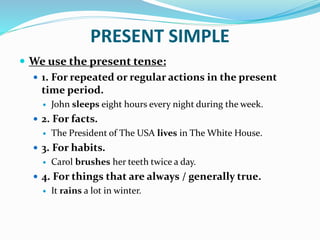
 We use the present tense:
 1. For repeated or regular actions in the present
time period.
 John sleeps eight hours every night during the week.
 2. For facts.
 The President of The USA lives in The White House.
 3. For habits.
 Carol brushes her teeth twice a day.
 4. For things that are always / generally true.
 It rains a lot in winter.
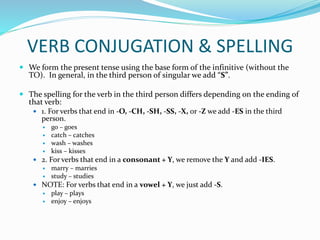
VERB CONJUGATION & SPELLING
 We form the present tense using the base form of the infinitive (without the
TO). In general, in the third person of singular we add “S”.
 The spelling for the verb in the third person differs depending on the ending of
that verb:
 1. For verbs that end in -O, -CH, -SH, -SS, -X, or -Z we add -ES in the third
person.
 go – goes
 catch – catches
 wash – washes
 kiss – kisses
 2. For verbs that end in a consonant + Y, we remove the Y and add -IES.
 marry – marries
 study – studies
 NOTE: For verbs that end in a vowel + Y, we just add -S.
 play – plays
 enjoy – enjoys
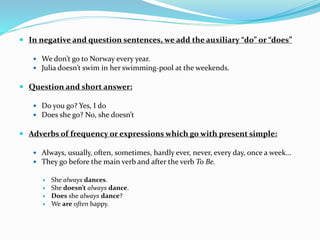
 In negative and question sentences, we add the auxiliary “do” or “does”
 We don’t go to Norway every year.
 Julia doesn’t swim in her swimming-pool at the weekends.
 Question and short answer:
 Do you go? Yes, I do
 Does she go? No, she doesn’t
 Adverbs of frequency or expressions which go with present simple:
 Always, usually, often, sometimes, hardly ever, never, every day, once a week…
 They go before the main verb and after the verb To Be.
 She always dances.
 She doesn’t always dance.
 Does she always dance?
 We are often happy.
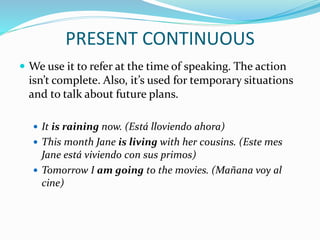
PRESENT CONTINUOUS
 We use it to refer at the time of speaking. The action
isn’t complete. Also, it’s used for temporary situations
and to talk about future plans.
 It is raining now. (Está lloviendo ahora)
 This month Jane is living with her cousins. (Este mes
Jane está viviendo con sus primos)
 Tomorrow I am going to the movies. (Mañana voy al
cine)
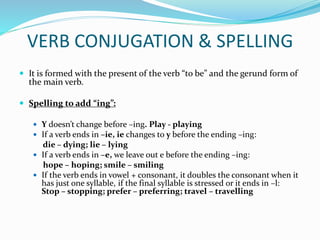
VERB CONJUGATION & SPELLING
 It is formed with the present of the verb “to be” and the gerund form of
the main verb.
 Spelling to add “ing”:
 Y doesn’t change before –ing. Play - playing
 If a verb ends in –ie, ie changes to y before the ending –ing:
die – dying; lie – lying
 If a verb ends in –e, we leave out e before the ending –ing:
hope – hoping; smile – smiling
 If the verb ends in vowel + consonant, it doubles the consonant when it
has just one syllable, if the final syllable is stressed or it ends in –l:
Stop – stopping; prefer – preferring; travel – travelling
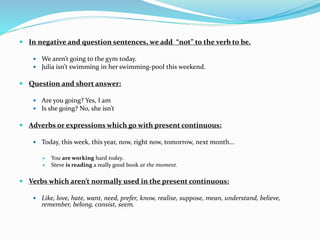
 In negative and question sentences, we add “not” to the verb to be.
 We aren’t going to the gym today.
 Julia isn’t swimming in her swimming-pool this weekend.
 Question and short answer:
 Are you going? Yes, I am
 Is she going? No, she isn’t
 Adverbs or expressions which go with present continuous:
 Today, this week, this year, now, right now, tomorrow, next month…
 You are working hard today.
 Steve is reading a really good book at the moment.
 Verbs which aren’t normally used in the present continuous:
 Like, love, hate, want, need, prefer, know, realise, suppose, mean, understand, believe,
remember, belong, consist, seem.
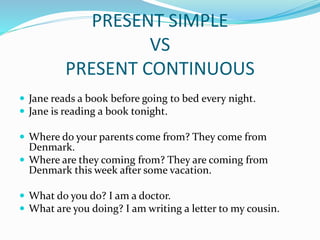
PRESENT SIMPLE
VS
PRESENT CONTINUOUS
 Jane reads a book before going to bed every night.
 Jane is reading a book tonight.
 Where do your parents come from? They come from
Denmark.
 Where are they coming from? They are coming from
Denmark this week after some vacation.
 What do you do? I am a doctor.
 What are you doing? I am writing a letter to my cousin.
VIDEOS
 http://www.youtube.com/watch?v=SzL6Ww7xUWc&
hd=1
 http://www.youtube.com/watch?v=GjqdToylBDg&hd=
1
 http://www.youtube.com/watch?v=DcyyKtmFMiQ&h
d=1 (Present Simple, cartoon)
 http://www.youtube.com/watch?v=5RYdMEDfRdU&h
d=1 (Present Continuous, “The Simpsons”)

Present simple versus present continuous

  • 2.
    PRESENT SIMPLE  Weuse the present tense:  1. For repeated or regular actions in the present time period.  John sleeps eight hours every night during the week.  2. For facts.  The President of The USA lives in The White House.  3. For habits.  Carol brushes her teeth twice a day.  4. For things that are always / generally true.  It rains a lot in winter.
  • 3.
    VERB CONJUGATION &SPELLING  We form the present tense using the base form of the infinitive (without the TO). In general, in the third person of singular we add “S”.  The spelling for the verb in the third person differs depending on the ending of that verb:  1. For verbs that end in -O, -CH, -SH, -SS, -X, or -Z we add -ES in the third person.  go – goes  catch – catches  wash – washes  kiss – kisses  2. For verbs that end in a consonant + Y, we remove the Y and add -IES.  marry – marries  study – studies  NOTE: For verbs that end in a vowel + Y, we just add -S.  play – plays  enjoy – enjoys
  • 4.
     In negativeand question sentences, we add the auxiliary “do” or “does”  We don’t go to Norway every year.  Julia doesn’t swim in her swimming-pool at the weekends.  Question and short answer:  Do you go? Yes, I do  Does she go? No, she doesn’t  Adverbs of frequency or expressions which go with present simple:  Always, usually, often, sometimes, hardly ever, never, every day, once a week…  They go before the main verb and after the verb To Be.  She always dances.  She doesn’t always dance.  Does she always dance?  We are often happy.
  • 5.
    PRESENT CONTINUOUS  Weuse it to refer at the time of speaking. The action isn’t complete. Also, it’s used for temporary situations and to talk about future plans.  It is raining now. (Está lloviendo ahora)  This month Jane is living with her cousins. (Este mes Jane está viviendo con sus primos)  Tomorrow I am going to the movies. (Mañana voy al cine)
  • 6.
    VERB CONJUGATION &SPELLING  It is formed with the present of the verb “to be” and the gerund form of the main verb.  Spelling to add “ing”:  Y doesn’t change before –ing. Play - playing  If a verb ends in –ie, ie changes to y before the ending –ing: die – dying; lie – lying  If a verb ends in –e, we leave out e before the ending –ing: hope – hoping; smile – smiling  If the verb ends in vowel + consonant, it doubles the consonant when it has just one syllable, if the final syllable is stressed or it ends in –l: Stop – stopping; prefer – preferring; travel – travelling
  • 7.
     In negativeand question sentences, we add “not” to the verb to be.  We aren’t going to the gym today.  Julia isn’t swimming in her swimming-pool this weekend.  Question and short answer:  Are you going? Yes, I am  Is she going? No, she isn’t  Adverbs or expressions which go with present continuous:  Today, this week, this year, now, right now, tomorrow, next month…  You are working hard today.  Steve is reading a really good book at the moment.  Verbs which aren’t normally used in the present continuous:  Like, love, hate, want, need, prefer, know, realise, suppose, mean, understand, believe, remember, belong, consist, seem.
  • 8.
    PRESENT SIMPLE VS PRESENT CONTINUOUS Jane reads a book before going to bed every night.  Jane is reading a book tonight.  Where do your parents come from? They come from Denmark.  Where are they coming from? They are coming from Denmark this week after some vacation.  What do you do? I am a doctor.  What are you doing? I am writing a letter to my cousin.
  • 9.
    VIDEOS  http://www.youtube.com/watch?v=SzL6Ww7xUWc& hd=1  http://www.youtube.com/watch?v=GjqdToylBDg&hd= 1 http://www.youtube.com/watch?v=DcyyKtmFMiQ&h d=1 (Present Simple, cartoon)  http://www.youtube.com/watch?v=5RYdMEDfRdU&h d=1 (Present Continuous, “The Simpsons”)