Presentation about
Present and Past tense
Student: Karen Cuaran
Grade: 11-2
Teacher: Eulices Cifuentes
1
PRESENT SIMPLE
We use the present simple:
 To talk about something that is true at present.
 I work as a teacher.
 He lives in Bogota with his family now.
 To talk about something that happens regularly.
 I go bird watching at the weekends.
 He goes to cinema every Sunday.
 To talk about something that is always true.
 The earth goes around the Sun.
 The human body contains 32 teeth.
2
PRESENT SIMPLE
Spelling rules for 3rd person (he, she and it)
We add –s to the verb to form the third person
singular.
 I drink – he drinks
 I run – he runs
 We add –es to verbs that end in
-ss, -sh, -ch, -x, -o.
Guesses, Finishes, Watches,
Fixes, Does
 With verbs ending in consonant + y,
we change the –y to –ies.
 I cry – he cries, I try – he cries
 With verbs ending in vowel + y,
we just add –s as usual.
 I play – he plays
 I enjoy – he enjoys
Positive Sentences
 We live across the street.
 They watch a terrific movie once a week.
 He feeds his dog with leftovers.
 She borrows money from her friends.
3
PRESENT SIMPLE
Negative Sentences
 I don’t like soap operas.
 You don’t listen anyone but yourself.
 He doesn’t lend his car to anyone.
 She doesn’t focus on important details.
Auxiliary:
We use them for negative and
question sentences.
Do – Don’t
I, you, we, they
Does – Doesn’t
She, he, it
4
PRESENT SIMPLE
Question Sentences
 Do you always argue with your parents?
 Do we live in Manchester now?
 Does he like skating?
 Does the cat chase the cats?
 What do you do in your free time?
 Why do you go to the park?
5
PRESENT CONTINUOUS
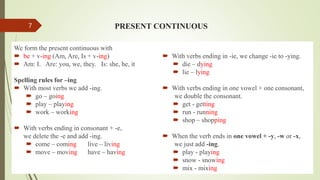
We use the present continuous:
 To talk about things that are happening at the moment we
speak.
 A: What are you doing?
 B: I´m writing an e-mail.
 To talk about things that are happening now, but not
exactly at the moment we speak.
 My brother is looking for a job at the moment.
 You are spending a lot of money these days.
 To talk about something is planned to do in the future.
 We´re visiting our grandparents next weekend.
 My sister is starting a new job next Monday.
6
PRESENT CONTINUOUS
We form the present continuous with
 be + v-ing (Am, Are, Is + v-ing)
 Am: I. Are: you, we, they. Is: she, he, it
Spelling rules for –ing
 With most verbs we add -ing.
 go – going
 play – playing
 work – working
 With verbs ending in consonant + -e,
we delete the -e and add -ing.
 come – coming live – living
 move – moving have – having
 With verbs ending in -ie, we change -ie to -ying.
 die – dying
 lie – lying
 With verbs ending in one vowel + one consonant,
we double the consonant.
 get - getting
 run - running
 shop – shopping
 When the verb ends in one vowel + -y, -w or -x,
we just add -ing.
 play - playing
 snow - snowing
 mix - mixing
7
Positive Sentences
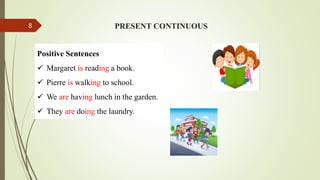
 Margaret is reading a book.
 Pierre is walking to school.
 We are having lunch in the garden.
 They are doing the laundry.
PRESENT CONTINUOUS
8
Negative Sentences
 Margaret is not reading a book.
 Pierre is not walking to school.
 We are not having lunch in the garden.
 They are not doing the laundry.
PRESENT CONTINUOUS
Negative form
Verb to be + not + V-ing
9
Question Sentences
 Is she reading a comic?
 Are they climbing a tree?
 Is he wearing red pants?
 Are you cooking the dinner?
PRESENT CONTINUOUS
10
PRESENT PERFECT
We use the present perfect:
 To describe unfinished time.
 We have lived in the capital since 2001.
 I’ve finished all my work today.
 To refer to indefinite time.
 I have broken my leg two weeks ago.
 I haven’t seen him for years.
 To express experience or result.
 She has lost her keys.
 She has gone to the shop and she has bought bread.
11
PRESENT PERFECT
We form the present perfect with
Subject + verb to have + verb (past participle)
Positive Sentences
 I have worked as a teacher since 2011.
 We have lived in Japan since 1995.
 She has watched this movie three times.
 He has worked in the Eiffel Tower for four year.
Auxiliary:
We use the verb to have
with this tense.
Have – haven’t
I, you, we, they
Has – hasn’t
She, he, it
12
PRESENT PERFECT
Negative Sentences
 He has not watched this movie before.
 I have not studied for my English exam.
 We have not talked by telephone with my mom this month.
 I have not looked for a job before.
13
PRESENT PERFECT
Question Sentences
 Have they cared these dogs for six years?
 Have you played soccer since 1997?
 Have you phoned him this day?
 Have you watched this film before?
14
PRESENT PERFECT CONTINUOUS
We use the present perfect continuous:
 to show that an action started in the past and has continued up to the present moment.
 You have been waiting here for two hours.
 She has been working at that company for three years.
 The tense has a more general meaning of lately. We often use the words lately or
recently to emphasize this meaning.
 Recently, I have been feeling really tired.
 She has been watching too much television lately.
Present perfect continuous usually emphasizes duration, or the amount of time that an
action has been taking place.
15
PRESENT PERFECT CONTINUOUS
We form the present perfect continuous with
Subject + verb to have + been + verb-ing
Positive Sentences
 They have been talking for the last hour.
 James has been teaching at the university since June.
 You have been doing this for the last 30 minutes.
 Nancy has been taking her medicine for the last three days.
Auxiliary:
We use the verb to have
plus been with this tense.
Have been – haven’t been
I, you, we, they
Has been – hasn’t been
She, he, it
16
PRESENT PERFECT CONTINUOUS
Negative Sentences
 He has not been doing his work.
 I have not been exercising lately.
 Mary has not been feeling a little depressed.
 Lisa has not been practicing her English.
17
PRESENT PERFECT CONTINUOUS
Question Sentences
 Have you been smoking lately?
 Has Lisa been practicing her English?
 Have they been playing tennis every Sunday?
 Has she been running recently?
18
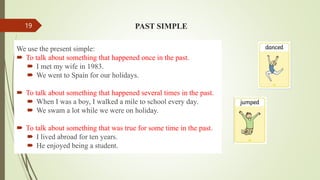
PAST SIMPLE
We use the present simple:
 To talk about something that happened once in the past.
 I met my wife in 1983.
 We went to Spain for our holidays.
 To talk about something that happened several times in the past.
 When I was a boy, I walked a mile to school every day.
 We swam a lot while we were on holiday.
 To talk about something that was true for some time in the past.
 I lived abroad for ten years.
 He enjoyed being a student.
19
PAST SIMPLE
Spelling rules of –ed (Regular verbs)
We normally add –ed to the verb to make
the past simple.
 I worked – he worked
 I rest – he rested
 We add –d to verbs that end in –e.
 admire – admired
 change – changed
 bake – baked
 With verbs ending in consonant + y,
we change the –y to –ied.
apply – applied, copy – copied
 With verbs ending in vowel + y,
we just add –s as usual.
 enjoy –enjoyed
 stay – stayed
 destroy - destroyed
 With verbs ending in one vowel and one
consonant, we double the consonant.
 chat – chatted
 drop – dropped
 clap - clapped
20
PAST SIMPLE
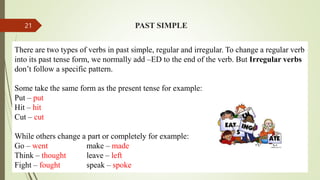
There are two types of verbs in past simple, regular and irregular. To change a regular verb
into its past tense form, we normally add –ED to the end of the verb. But Irregular verbs
don’t follow a specific pattern.
Some take the same form as the present tense for example:
Put – put
Hit – hit
Cut – cut
While others change a part or completely for example:
Go – went make – made
Think – thought leave – left
Fight – fought speak – spoke
21
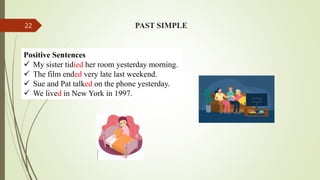
Positive Sentences
 My sister tidied her room yesterday morning.
 The film ended very late last weekend.
 Sue and Pat talked on the phone yesterday.
 We lived in New York in 1997.
PAST SIMPLE
22
Negative Sentences
 He didn’t phone a friend an hour ago.
 The girls didn’t wear skirts to the party.
 They didn’t go to bed at midnight.
 I didn’t get up at seven last Sunday.
PAST SIMPLE
Auxiliary:
We use them in negative
and question sentences for
all pronouns.
Did – Didn’t
I, you, we, they, she, he, it
23
Question Sentences
 Did She go to school on foot yesterday?
 Did Paul eat 2 sandwiches and an apple?
 Did They find 50 euros in the street?
 Did We swim in the Mediterranean sea?
 Did Joe write a letter to Mary 2 days ago?
 Did The children break the window?
PAST SIMPLE
24
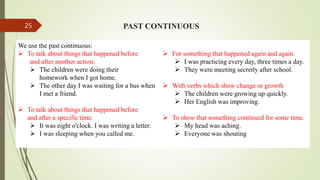
PAST CONTINUOUS
We use the past continuous:
 To talk about things that happened before
and after another action.
 The children were doing their
homework when I got home.
 The other day I was waiting for a bus when
I met a friend.
 To talk about things that happened before
and after a specific time.
 It was eight o'clock. I was writing a letter.
 I was sleeping when you called me.
 For something that happened again and again.
 I was practicing every day, three times a day.
 They were meeting secretly after school.
 With verbs which show change or growth
 The children were growing up quickly.
 Her English was improving.
 To show that something continued for some time.
 My head was aching.
 Everyone was shouting
25
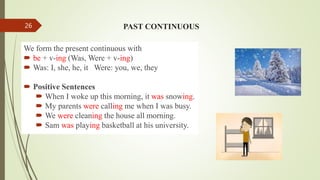
We form the present continuous with
 be + v-ing (Was, Were + v-ing)
 Was: I, she, he, it Were: you, we, they
 Positive Sentences
 When I woke up this morning, it was snowing.
 My parents were calling me when I was busy.
 We were cleaning the house all morning.
 Sam was playing basketball at his university.
PAST CONTINUOUS
26
PAST CONTINUOUS
Negative Sentences
 She wasn’t working during the party.
 Three years ago, we weren’t living in my home town.
 I tried to give him some advice, but he wasn't listening.
 They weren’t studying at 8 pm.
Negative form
Verb to be + not + V-ing
27
PAST CONTINUOUS
Question Sentences
 Were they sleeping peacefully until the alarm rang?
 Was he working as a cashier in October?
 Was she trying to impress her crush?
 Were the players training all year for this match?
28
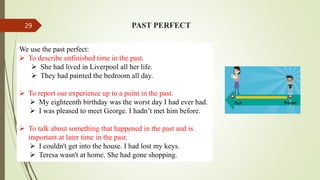
PAST PERFECT
We use the past perfect:
 To describe unfinished time in the past.
 She had lived in Liverpool all her life.
 They had painted the bedroom all day.
 To report our experience up to a point in the past.
 My eighteenth birthday was the worst day I had ever had.
 I was pleased to meet George. I hadn’t met him before.
 To talk about something that happened in the past and is
important at later time in the past.
 I couldn't get into the house. I had lost my keys.
 Teresa wasn't at home. She had gone shopping.
29
PAST PERFECT
We form the past perfect with
Subject + had + verb (past participle)
Positive Sentences
 I had worked there for a year.
 It had rained for hours.
 He had played the guitar since he was a teenager.
 He had printed three books this week.
Auxiliary:
We use the past form of the
verb to have with all pronouns.
Had – hadn’t
I, you, we, they, she, he, it
30
PAST PERFECT
Negative Sentences
 I hadn’t worked there for ten years.
 We hadn’t missed any episode of this program.
 They hadn’t finished the project by March.
 He hadn’t painted the house because he forgot to buy the paint.
31
PAST PERFECT
Question Sentences
 Had they booked the hotel in advance?
 Had she published her first poem?
 Had my sister arrived when you called yesterday?
 Had The thief had escaped when the police arrived?
32
PAST PERFECT CONTINUOUS
We use the past perfect continuous:
 To show that an action started in the past and has continued up until another time
in the past.
 He had been drinking milk the carton when Mom walked into the kitchen.
 We had been working at the company for five years when we got the
promotion.
 As with the present perfect continuous, we are more interested in the process.
 We had been trying to open the door for five minutes when Jane found the key.
 It had been raining hard for several hours and the streets were very wet.
33
PAST PERFECT CONTINUOUS
We form the past perfect continuous with
Subject + had + been + verb-ing
Positive Sentences
 She had been working at that company for three years.
 he had been standing all day at work.
 James had been teaching for more than a year.
 I had been studying Portuguese very long.
Auxiliary:
We use the past form of the
verb to have plus been with
all pronouns.
Had been – hadn’t been
I, you, we, they, she, he, it.
34
PAST PERFECT CONTINUOUS
Negative Sentences
 She hadn’t been attending class this month.
 He hadn’t been exercising so hard in the gym.
 Jones hadn’t been preparing the dinner in the fantastic restaurant.
 She hadn’t been traveling continuously for three days.
35
PAST PERFECT CONTINUOUS
Question Sentences
 Had Sofia been working at the
hospital for over two years?
 Had Solangie been singing for an
hour before her mom arrived.?
 Had you been standing there to
meet the manager?
 Had They been living in Guatape
for four years ?
36
THANK YOU
FOR YOUR ATTENTION
37

Presentation about Present and Past Tenses.pptx

  • 1.
    Presentation about Present andPast tense Student: Karen Cuaran Grade: 11-2 Teacher: Eulices Cifuentes 1
  • 2.
    PRESENT SIMPLE We usethe present simple:  To talk about something that is true at present.  I work as a teacher.  He lives in Bogota with his family now.  To talk about something that happens regularly.  I go bird watching at the weekends.  He goes to cinema every Sunday.  To talk about something that is always true.  The earth goes around the Sun.  The human body contains 32 teeth. 2
  • 3.
    PRESENT SIMPLE Spelling rulesfor 3rd person (he, she and it) We add –s to the verb to form the third person singular.  I drink – he drinks  I run – he runs  We add –es to verbs that end in -ss, -sh, -ch, -x, -o. Guesses, Finishes, Watches, Fixes, Does  With verbs ending in consonant + y, we change the –y to –ies.  I cry – he cries, I try – he cries  With verbs ending in vowel + y, we just add –s as usual.  I play – he plays  I enjoy – he enjoys Positive Sentences  We live across the street.  They watch a terrific movie once a week.  He feeds his dog with leftovers.  She borrows money from her friends. 3
  • 4.
    PRESENT SIMPLE Negative Sentences I don’t like soap operas.  You don’t listen anyone but yourself.  He doesn’t lend his car to anyone.  She doesn’t focus on important details. Auxiliary: We use them for negative and question sentences. Do – Don’t I, you, we, they Does – Doesn’t She, he, it 4
  • 5.
    PRESENT SIMPLE Question Sentences Do you always argue with your parents?  Do we live in Manchester now?  Does he like skating?  Does the cat chase the cats?  What do you do in your free time?  Why do you go to the park? 5
  • 6.
    PRESENT CONTINUOUS We usethe present continuous:  To talk about things that are happening at the moment we speak.  A: What are you doing?  B: I´m writing an e-mail.  To talk about things that are happening now, but not exactly at the moment we speak.  My brother is looking for a job at the moment.  You are spending a lot of money these days.  To talk about something is planned to do in the future.  We´re visiting our grandparents next weekend.  My sister is starting a new job next Monday. 6
  • 7.
    PRESENT CONTINUOUS We formthe present continuous with  be + v-ing (Am, Are, Is + v-ing)  Am: I. Are: you, we, they. Is: she, he, it Spelling rules for –ing  With most verbs we add -ing.  go – going  play – playing  work – working  With verbs ending in consonant + -e, we delete the -e and add -ing.  come – coming live – living  move – moving have – having  With verbs ending in -ie, we change -ie to -ying.  die – dying  lie – lying  With verbs ending in one vowel + one consonant, we double the consonant.  get - getting  run - running  shop – shopping  When the verb ends in one vowel + -y, -w or -x, we just add -ing.  play - playing  snow - snowing  mix - mixing 7
  • 8.
    Positive Sentences  Margaretis reading a book.  Pierre is walking to school.  We are having lunch in the garden.  They are doing the laundry. PRESENT CONTINUOUS 8
  • 9.
    Negative Sentences  Margaretis not reading a book.  Pierre is not walking to school.  We are not having lunch in the garden.  They are not doing the laundry. PRESENT CONTINUOUS Negative form Verb to be + not + V-ing 9
  • 10.
    Question Sentences  Isshe reading a comic?  Are they climbing a tree?  Is he wearing red pants?  Are you cooking the dinner? PRESENT CONTINUOUS 10
  • 11.
    PRESENT PERFECT We usethe present perfect:  To describe unfinished time.  We have lived in the capital since 2001.  I’ve finished all my work today.  To refer to indefinite time.  I have broken my leg two weeks ago.  I haven’t seen him for years.  To express experience or result.  She has lost her keys.  She has gone to the shop and she has bought bread. 11
  • 12.
    PRESENT PERFECT We formthe present perfect with Subject + verb to have + verb (past participle) Positive Sentences  I have worked as a teacher since 2011.  We have lived in Japan since 1995.  She has watched this movie three times.  He has worked in the Eiffel Tower for four year. Auxiliary: We use the verb to have with this tense. Have – haven’t I, you, we, they Has – hasn’t She, he, it 12
  • 13.
    PRESENT PERFECT Negative Sentences He has not watched this movie before.  I have not studied for my English exam.  We have not talked by telephone with my mom this month.  I have not looked for a job before. 13
  • 14.
    PRESENT PERFECT Question Sentences Have they cared these dogs for six years?  Have you played soccer since 1997?  Have you phoned him this day?  Have you watched this film before? 14
  • 15.
    PRESENT PERFECT CONTINUOUS Weuse the present perfect continuous:  to show that an action started in the past and has continued up to the present moment.  You have been waiting here for two hours.  She has been working at that company for three years.  The tense has a more general meaning of lately. We often use the words lately or recently to emphasize this meaning.  Recently, I have been feeling really tired.  She has been watching too much television lately. Present perfect continuous usually emphasizes duration, or the amount of time that an action has been taking place. 15
  • 16.
    PRESENT PERFECT CONTINUOUS Weform the present perfect continuous with Subject + verb to have + been + verb-ing Positive Sentences  They have been talking for the last hour.  James has been teaching at the university since June.  You have been doing this for the last 30 minutes.  Nancy has been taking her medicine for the last three days. Auxiliary: We use the verb to have plus been with this tense. Have been – haven’t been I, you, we, they Has been – hasn’t been She, he, it 16
  • 17.
    PRESENT PERFECT CONTINUOUS NegativeSentences  He has not been doing his work.  I have not been exercising lately.  Mary has not been feeling a little depressed.  Lisa has not been practicing her English. 17
  • 18.
    PRESENT PERFECT CONTINUOUS QuestionSentences  Have you been smoking lately?  Has Lisa been practicing her English?  Have they been playing tennis every Sunday?  Has she been running recently? 18
  • 19.
    PAST SIMPLE We usethe present simple:  To talk about something that happened once in the past.  I met my wife in 1983.  We went to Spain for our holidays.  To talk about something that happened several times in the past.  When I was a boy, I walked a mile to school every day.  We swam a lot while we were on holiday.  To talk about something that was true for some time in the past.  I lived abroad for ten years.  He enjoyed being a student. 19
  • 20.
    PAST SIMPLE Spelling rulesof –ed (Regular verbs) We normally add –ed to the verb to make the past simple.  I worked – he worked  I rest – he rested  We add –d to verbs that end in –e.  admire – admired  change – changed  bake – baked  With verbs ending in consonant + y, we change the –y to –ied. apply – applied, copy – copied  With verbs ending in vowel + y, we just add –s as usual.  enjoy –enjoyed  stay – stayed  destroy - destroyed  With verbs ending in one vowel and one consonant, we double the consonant.  chat – chatted  drop – dropped  clap - clapped 20
  • 21.
    PAST SIMPLE There aretwo types of verbs in past simple, regular and irregular. To change a regular verb into its past tense form, we normally add –ED to the end of the verb. But Irregular verbs don’t follow a specific pattern. Some take the same form as the present tense for example: Put – put Hit – hit Cut – cut While others change a part or completely for example: Go – went make – made Think – thought leave – left Fight – fought speak – spoke 21
  • 22.
    Positive Sentences  Mysister tidied her room yesterday morning.  The film ended very late last weekend.  Sue and Pat talked on the phone yesterday.  We lived in New York in 1997. PAST SIMPLE 22
  • 23.
    Negative Sentences  Hedidn’t phone a friend an hour ago.  The girls didn’t wear skirts to the party.  They didn’t go to bed at midnight.  I didn’t get up at seven last Sunday. PAST SIMPLE Auxiliary: We use them in negative and question sentences for all pronouns. Did – Didn’t I, you, we, they, she, he, it 23
  • 24.
    Question Sentences  DidShe go to school on foot yesterday?  Did Paul eat 2 sandwiches and an apple?  Did They find 50 euros in the street?  Did We swim in the Mediterranean sea?  Did Joe write a letter to Mary 2 days ago?  Did The children break the window? PAST SIMPLE 24
  • 25.
    PAST CONTINUOUS We usethe past continuous:  To talk about things that happened before and after another action.  The children were doing their homework when I got home.  The other day I was waiting for a bus when I met a friend.  To talk about things that happened before and after a specific time.  It was eight o'clock. I was writing a letter.  I was sleeping when you called me.  For something that happened again and again.  I was practicing every day, three times a day.  They were meeting secretly after school.  With verbs which show change or growth  The children were growing up quickly.  Her English was improving.  To show that something continued for some time.  My head was aching.  Everyone was shouting 25
  • 26.
    We form thepresent continuous with  be + v-ing (Was, Were + v-ing)  Was: I, she, he, it Were: you, we, they  Positive Sentences  When I woke up this morning, it was snowing.  My parents were calling me when I was busy.  We were cleaning the house all morning.  Sam was playing basketball at his university. PAST CONTINUOUS 26
  • 27.
    PAST CONTINUOUS Negative Sentences She wasn’t working during the party.  Three years ago, we weren’t living in my home town.  I tried to give him some advice, but he wasn't listening.  They weren’t studying at 8 pm. Negative form Verb to be + not + V-ing 27
  • 28.
    PAST CONTINUOUS Question Sentences Were they sleeping peacefully until the alarm rang?  Was he working as a cashier in October?  Was she trying to impress her crush?  Were the players training all year for this match? 28
  • 29.
    PAST PERFECT We usethe past perfect:  To describe unfinished time in the past.  She had lived in Liverpool all her life.  They had painted the bedroom all day.  To report our experience up to a point in the past.  My eighteenth birthday was the worst day I had ever had.  I was pleased to meet George. I hadn’t met him before.  To talk about something that happened in the past and is important at later time in the past.  I couldn't get into the house. I had lost my keys.  Teresa wasn't at home. She had gone shopping. 29
  • 30.
    PAST PERFECT We formthe past perfect with Subject + had + verb (past participle) Positive Sentences  I had worked there for a year.  It had rained for hours.  He had played the guitar since he was a teenager.  He had printed three books this week. Auxiliary: We use the past form of the verb to have with all pronouns. Had – hadn’t I, you, we, they, she, he, it 30
  • 31.
    PAST PERFECT Negative Sentences I hadn’t worked there for ten years.  We hadn’t missed any episode of this program.  They hadn’t finished the project by March.  He hadn’t painted the house because he forgot to buy the paint. 31
  • 32.
    PAST PERFECT Question Sentences Had they booked the hotel in advance?  Had she published her first poem?  Had my sister arrived when you called yesterday?  Had The thief had escaped when the police arrived? 32
  • 33.
    PAST PERFECT CONTINUOUS Weuse the past perfect continuous:  To show that an action started in the past and has continued up until another time in the past.  He had been drinking milk the carton when Mom walked into the kitchen.  We had been working at the company for five years when we got the promotion.  As with the present perfect continuous, we are more interested in the process.  We had been trying to open the door for five minutes when Jane found the key.  It had been raining hard for several hours and the streets were very wet. 33
  • 34.
    PAST PERFECT CONTINUOUS Weform the past perfect continuous with Subject + had + been + verb-ing Positive Sentences  She had been working at that company for three years.  he had been standing all day at work.  James had been teaching for more than a year.  I had been studying Portuguese very long. Auxiliary: We use the past form of the verb to have plus been with all pronouns. Had been – hadn’t been I, you, we, they, she, he, it. 34
  • 35.
    PAST PERFECT CONTINUOUS NegativeSentences  She hadn’t been attending class this month.  He hadn’t been exercising so hard in the gym.  Jones hadn’t been preparing the dinner in the fantastic restaurant.  She hadn’t been traveling continuously for three days. 35
  • 36.
    PAST PERFECT CONTINUOUS QuestionSentences  Had Sofia been working at the hospital for over two years?  Had Solangie been singing for an hour before her mom arrived.?  Had you been standing there to meet the manager?  Had They been living in Guatape for four years ? 36
  • 37.
    THANK YOU FOR YOURATTENTION 37