What is R.A. 
8980 ?
R.A. 8980 is an act 
promulgating a comprehensive 
policy and a National System for 
Early Childhood Care and 
Development (ECCD), providing 
funds therefore and for other 
purposes.
• RA 8980 defines it as full range of health, 
nutrition, early education and social services 
programs that provide for the holistic needs of 
children 0-6 years.
It is full range of services: 
To support the rights of children which are 
indivisible: survival (name and identity), 
development, (cognitive and emotional), 
protection and participation (respect for their 
views).
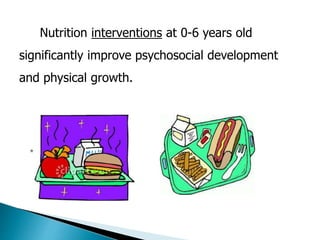
Nutrition interventions at 0-6 years old 
significantly improve psychosocial development 
and physical growth. 
*
Combined interventions to improve 
both physical and psychological 
development have greater impact 
than either or alone.
It requires the consolidated efforts from different 
sectors: 
- health, nutrition, early education, child 
protection, local governance, communication, etc.
Section 1. Short title-this 
act shall be known 
as the “ECCD Act”
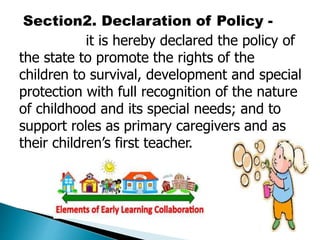
Section2. Declaration of Policy - 
it is hereby declared the policy of 
the state to promote the rights of the 
children to survival, development and special 
protection with full recognition of the nature 
of childhood and its special needs; and to 
support roles as primary caregivers and as 
their children’s first teacher.
 Section 3 Objectives-The objectives of the 
National ECCD System are: 
(a) To achieve improved infant and child 
survival rates by ensuring that adequate 
health and nutrition are accessible to young 
children and their mothers from the prenatal 
period throughout the early childhood years;
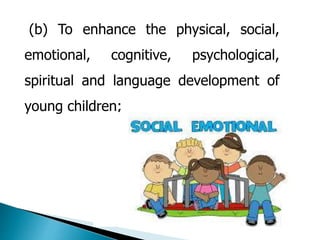
(b) To enhance the physical, social, 
emotional, cognitive, psychological, 
spiritual and language development of 
young children;
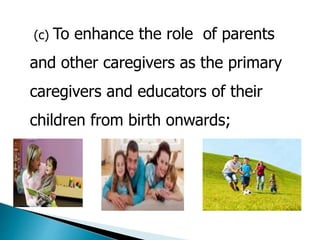
(c) To enhance the role of parents 
and other caregivers as the primary 
caregivers and educators of their 
children from birth onwards;
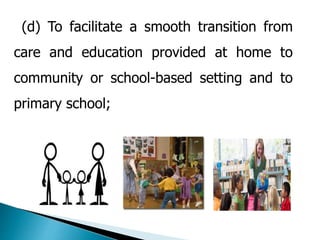
(d) To facilitate a smooth transition from 
care and education provided at home to 
community or school-based setting and to 
primary school;
(e) To enhance the capabilities of 
service provided and their 
supervisors to comply with quality 
standards for various ECCD 
programs;
(f) To enhance and sustain the 
efforts of the communities to promote 
ECCD programs and ensure that special 
support is provided for poor and 
disadvantaged communities;
(g) To ensure that young 
children are adequately 
prepared for the formal 
learning system that the 
both public and private 
schools are responsive to 
the development needs of 
these children;
(h) To established an efficient system for early 
identification, prevention, referral and intervention for 
the development disorders and disabilities in early 
childhood; and 
(i) To improve the quality standards of public and 
private ECCD programs through, but not limited to, a 
registration and credential system for ECCD service 
providers.
Section 4. Definitions. - For purposes of this Act: 
 (a) Early Childhood Care and Development (ECCD) 
System refers to the full range of health, nutrition, 
early education and social services programs that 
provide for the basic holistic needs of young children 
from birth to age six (6), to promote their optimum 
growth and 
development.
These programs include: 
 (1) Center-based programs, such as the day care service 
established under Republic Act No. 6972, public and 
private pre-schools, kindergarten or school-based 
programs, community or church-based early childhood 
education programs initiated by nongovernment 
organizations or people's organizations, workplace-related 
child care and education programs, child-minding centers, 
health centers and stations; and
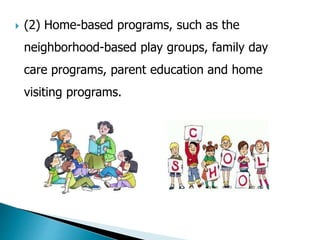
 (2) Home-based programs, such as the 
neighborhood-based play groups, family day 
care programs, parent education and home 
visiting programs.
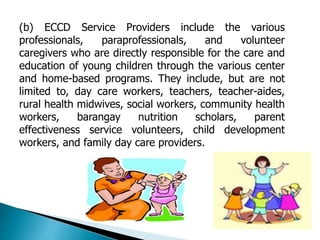
(b) ECCD Service Providers include the various 
professionals, paraprofessionals, and volunteer 
caregivers who are directly responsible for the care and 
education of young children through the various center 
and home-based programs. They include, but are not 
limited to, day care workers, teachers, teacher-aides, 
rural health midwives, social workers, community health 
workers, barangay nutrition scholars, parent 
effectiveness service volunteers, child development 
workers, and family day care providers.
 (c) ECCD Curriculum refers to the age-appropriate 
and developmentally appropriate educational 
objectives, program of activities, organized learning 
experiences and recommended learning materials 
for children that are implemented by service 
providers through center and home-based 
programs. It shall consist of national program goals 
and guidelines, instructional objectives, and content 
outlines integrating local learning experiences and 
indigenous learning materials.
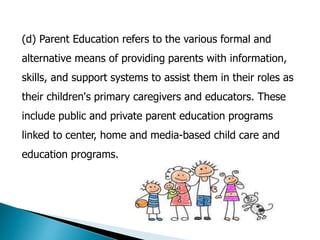
(d) Parent Education refers to the various formal and 
alternative means of providing parents with information, 
skills, and support systems to assist them in their roles as 
their children's primary caregivers and educators. These 
include public and private parent education programs 
linked to center, home and media-based child care and 
education programs.
 Section 5. System Framework and 
Components. - The ECCD System 
shall include the following 
components: 
(a) ECCD Curriculum - which focuses on 
children's total development according to 
their individual needs and socio-cultural 
background. It shall promote the delivery 
of complementary and integrative services 
for health care, nutrition, early childhood 
education, sanitation, and cultural 
activities. It shall use the child's first 
language as the medium of instruction.
 (b) Parent Education and Involvement, Advocacy, 
and Mobilization of Communities - which harness 
and develop parents' strengths as providers of 
ECCD at home, active partners or other 
stakeholders, advocates for community concerns 
that affect children, and pillars of support for local 
and national ECCD programs through community 
organization efforts.
(c) Human Resource Development Program – 
which establishes mechanisms for the systematic 
professionalization of ECCD service providers, through 
enrolment in educational programs in site-based or 
distance educational modes, through pre-service or in-service 
training including continuing education 
programs, whereby a registration and credential system 
shall be developed in the ECCD System.
 (d) ECCD Management - which focuses on a 
continuing process of planning, 
implementation, supervision, financial 
management, monitoring, evaluation and 
reporting
It shall encourage the active 
involvement and build the 
capabilities of service providers, 
parents, and local government 
officials to sustain the program, and 
it shall be guided by the principles of 
decentralization as stipulated in the 
Local Government Code of 1991.
(e) Quality Standards and Accreditation - which 
ensures that each component in the ECCD 
System complies with national quality 
standards, to be established by the National 
ECCD Coordinating Council as provided for 
under Section 8 of this Act, linked to an 
accreditation process.
Reporters : 
Julieta D. Cabiles 
and 
Blessie J. Dacillo

Republic Act 8980

  • 3.
    What is R.A. 8980 ?
  • 4.
    R.A. 8980 isan act promulgating a comprehensive policy and a National System for Early Childhood Care and Development (ECCD), providing funds therefore and for other purposes.
  • 5.
    • RA 8980defines it as full range of health, nutrition, early education and social services programs that provide for the holistic needs of children 0-6 years.
  • 6.
    It is fullrange of services: To support the rights of children which are indivisible: survival (name and identity), development, (cognitive and emotional), protection and participation (respect for their views).
  • 7.
    Nutrition interventions at0-6 years old significantly improve psychosocial development and physical growth. *
  • 8.
    Combined interventions toimprove both physical and psychological development have greater impact than either or alone.
  • 9.
    It requires theconsolidated efforts from different sectors: - health, nutrition, early education, child protection, local governance, communication, etc.
  • 11.
    Section 1. Shorttitle-this act shall be known as the “ECCD Act”
  • 12.
    Section2. Declaration ofPolicy - it is hereby declared the policy of the state to promote the rights of the children to survival, development and special protection with full recognition of the nature of childhood and its special needs; and to support roles as primary caregivers and as their children’s first teacher.
  • 13.
     Section 3Objectives-The objectives of the National ECCD System are: (a) To achieve improved infant and child survival rates by ensuring that adequate health and nutrition are accessible to young children and their mothers from the prenatal period throughout the early childhood years;
  • 14.
    (b) To enhancethe physical, social, emotional, cognitive, psychological, spiritual and language development of young children;
  • 15.
    (c) To enhancethe role of parents and other caregivers as the primary caregivers and educators of their children from birth onwards;
  • 16.
    (d) To facilitatea smooth transition from care and education provided at home to community or school-based setting and to primary school;
  • 17.
    (e) To enhancethe capabilities of service provided and their supervisors to comply with quality standards for various ECCD programs;
  • 18.
    (f) To enhanceand sustain the efforts of the communities to promote ECCD programs and ensure that special support is provided for poor and disadvantaged communities;
  • 19.
    (g) To ensurethat young children are adequately prepared for the formal learning system that the both public and private schools are responsive to the development needs of these children;
  • 20.
    (h) To establishedan efficient system for early identification, prevention, referral and intervention for the development disorders and disabilities in early childhood; and (i) To improve the quality standards of public and private ECCD programs through, but not limited to, a registration and credential system for ECCD service providers.
  • 21.
    Section 4. Definitions.- For purposes of this Act:  (a) Early Childhood Care and Development (ECCD) System refers to the full range of health, nutrition, early education and social services programs that provide for the basic holistic needs of young children from birth to age six (6), to promote their optimum growth and development.
  • 22.
    These programs include:  (1) Center-based programs, such as the day care service established under Republic Act No. 6972, public and private pre-schools, kindergarten or school-based programs, community or church-based early childhood education programs initiated by nongovernment organizations or people's organizations, workplace-related child care and education programs, child-minding centers, health centers and stations; and
  • 23.
     (2) Home-basedprograms, such as the neighborhood-based play groups, family day care programs, parent education and home visiting programs.
  • 24.
    (b) ECCD ServiceProviders include the various professionals, paraprofessionals, and volunteer caregivers who are directly responsible for the care and education of young children through the various center and home-based programs. They include, but are not limited to, day care workers, teachers, teacher-aides, rural health midwives, social workers, community health workers, barangay nutrition scholars, parent effectiveness service volunteers, child development workers, and family day care providers.
  • 25.
     (c) ECCDCurriculum refers to the age-appropriate and developmentally appropriate educational objectives, program of activities, organized learning experiences and recommended learning materials for children that are implemented by service providers through center and home-based programs. It shall consist of national program goals and guidelines, instructional objectives, and content outlines integrating local learning experiences and indigenous learning materials.
  • 26.
    (d) Parent Educationrefers to the various formal and alternative means of providing parents with information, skills, and support systems to assist them in their roles as their children's primary caregivers and educators. These include public and private parent education programs linked to center, home and media-based child care and education programs.
  • 27.
     Section 5.System Framework and Components. - The ECCD System shall include the following components: (a) ECCD Curriculum - which focuses on children's total development according to their individual needs and socio-cultural background. It shall promote the delivery of complementary and integrative services for health care, nutrition, early childhood education, sanitation, and cultural activities. It shall use the child's first language as the medium of instruction.
  • 28.
     (b) ParentEducation and Involvement, Advocacy, and Mobilization of Communities - which harness and develop parents' strengths as providers of ECCD at home, active partners or other stakeholders, advocates for community concerns that affect children, and pillars of support for local and national ECCD programs through community organization efforts.
  • 29.
    (c) Human ResourceDevelopment Program – which establishes mechanisms for the systematic professionalization of ECCD service providers, through enrolment in educational programs in site-based or distance educational modes, through pre-service or in-service training including continuing education programs, whereby a registration and credential system shall be developed in the ECCD System.
  • 30.
     (d) ECCDManagement - which focuses on a continuing process of planning, implementation, supervision, financial management, monitoring, evaluation and reporting
  • 31.
    It shall encouragethe active involvement and build the capabilities of service providers, parents, and local government officials to sustain the program, and it shall be guided by the principles of decentralization as stipulated in the Local Government Code of 1991.
  • 32.
    (e) Quality Standardsand Accreditation - which ensures that each component in the ECCD System complies with national quality standards, to be established by the National ECCD Coordinating Council as provided for under Section 8 of this Act, linked to an accreditation process.
  • 34.
    Reporters : JulietaD. Cabiles and Blessie J. Dacillo