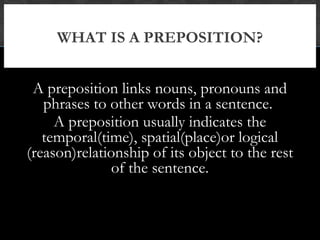
WHAT IS A PREPOSITION?


 A preposition links nouns, pronouns and
   phrases to other words in a sentence.
     A preposition usually indicates the
   temporal(time), spatial(place)or logical
(reason)relationship of its object to the rest
               of the sentence.
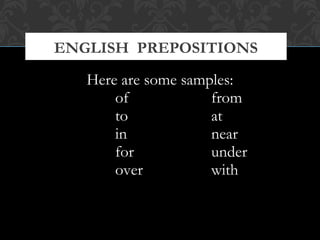
ENGLISH PREPOSITIONS
   Here are some samples:
       of            from
       to            at
       in            near
       for           under
       over          with
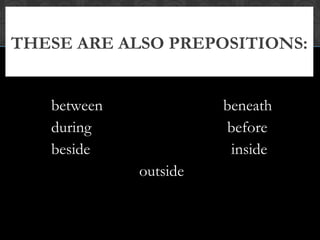
THESE ARE ALSO PREPOSITIONS:


   between             beneath
   during              before
   beside               inside
             outside
LOTS OF PREPOCITIONS EN ESPAÑOL
           HAVE “DE” :

      después de--after
          antes de--before
        debajo de—under
            cerca de--near
        al lado de--beside
          dentro de--inside
             fuera de--outside
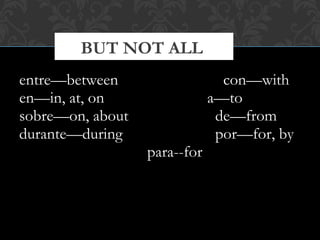
BUT NOT ALL
entre—between                   con—with
en—in, at, on                 a—to
sobre—on, about                de—from
durante—during                 por—for, by
                  para--for
EN INGLÉS

direct object pronouns (d.o.p), indirect
      object pronouns (i.o.p), and
prepositional pronouns (p.p.) are all the
                 same:
D.O.P   I.O.P    P.P.

 me           us
 you          y’all
 him, her, it them

Juan sees me.(DOP: who/what)
Juan gave me the rose.(IOP. To
       whom/for whom)
       Juan lives near me.
EN ESPAÑOL WE HAVE 3 SETS:


direct                indirect

  me          nos        me        nos
   te           os        te        os
lo, la           los,     le       les
las            ¡Ojo! are the differences
         These
PREPOSITIONAL


      mí           nosotros
       ti          vosotros
él, ella, Ud.   ellos, ellas, Uds.
PRONOMBRES PREPOSICIONALES.


    Prepositional pronouns are pronouns that
   follow a preposition. They have the same
   forms as subject pronouns, except the first-
person singular mí, and the second-person singular
                          ti.
The preposition con has special forms for the
       first and the second-persons singular:
              conmigo y contigo.
             (with me and with you)
In addition to the direct or indirect object pronoun, a
                 phrase consistin
            a + prepositional pronoun
     is often used for emphasis or clarification.
 For example with verbs like: gustar, encantar,
 chocar, molestar, importar, interesar, quedar.
  A ti te queda muy bien la camisa de cuadros.
       A mí me gustan las sandalias de tacones.
    A ella le chocan los jeans acampanados.
       A nosotros no nos encantan los guantes.
ALGUNAS PREPOSICIONES


    Voy a casa
Bebes café con ella.
 Son de Chicago.
 Canta desde niña.
   Es para papá.
   Está por allí.
 Ganó sin mentir.
Está sobre la mesa
   Están en WI.
Escribe la forma correcta del pronombre
preposicional:
1.Para____        4. Por ____(me)   8. Después
(he)                                de___
2. Con ___        5. En _______     (they [Masc.])
(you)             (it F)
3. De ___(y’all                     9.
in Spain)         6. Cerca de __    Behind__(Him)
                  (you[formal])
                                    10. For
                  7. Sin___(us)     ____(Her)

Prepos.pronombres

  • 1.
    WHAT IS APREPOSITION? A preposition links nouns, pronouns and phrases to other words in a sentence. A preposition usually indicates the temporal(time), spatial(place)or logical (reason)relationship of its object to the rest of the sentence.
  • 2.
    ENGLISH PREPOSITIONS Here are some samples: of from to at in near for under over with
  • 3.
    THESE ARE ALSOPREPOSITIONS: between beneath during before beside inside outside
  • 4.
    LOTS OF PREPOCITIONSEN ESPAÑOL HAVE “DE” : después de--after antes de--before debajo de—under cerca de--near al lado de--beside dentro de--inside fuera de--outside
  • 5.
    BUT NOT ALL entre—between con—with en—in, at, on a—to sobre—on, about de—from durante—during por—for, by para--for
  • 6.
    EN INGLÉS direct objectpronouns (d.o.p), indirect object pronouns (i.o.p), and prepositional pronouns (p.p.) are all the same:
  • 7.
    D.O.P I.O.P P.P. me us you y’all him, her, it them Juan sees me.(DOP: who/what) Juan gave me the rose.(IOP. To whom/for whom) Juan lives near me.
  • 8.
    EN ESPAÑOL WEHAVE 3 SETS: direct indirect me nos me nos te os te os lo, la los, le les las ¡Ojo! are the differences These
  • 9.
    PREPOSITIONAL mí nosotros ti vosotros él, ella, Ud. ellos, ellas, Uds.
  • 10.
    PRONOMBRES PREPOSICIONALES. Prepositional pronouns are pronouns that follow a preposition. They have the same forms as subject pronouns, except the first- person singular mí, and the second-person singular ti. The preposition con has special forms for the first and the second-persons singular: conmigo y contigo. (with me and with you)
  • 11.
    In addition tothe direct or indirect object pronoun, a phrase consistin a + prepositional pronoun is often used for emphasis or clarification. For example with verbs like: gustar, encantar, chocar, molestar, importar, interesar, quedar. A ti te queda muy bien la camisa de cuadros. A mí me gustan las sandalias de tacones. A ella le chocan los jeans acampanados. A nosotros no nos encantan los guantes.
  • 12.
    ALGUNAS PREPOSICIONES Voy a casa Bebes café con ella. Son de Chicago. Canta desde niña. Es para papá. Está por allí. Ganó sin mentir. Está sobre la mesa Están en WI.
  • 14.
    Escribe la formacorrecta del pronombre preposicional: 1.Para____ 4. Por ____(me) 8. Después (he) de___ 2. Con ___ 5. En _______ (they [Masc.]) (you) (it F) 3. De ___(y’all 9. in Spain) 6. Cerca de __ Behind__(Him) (you[formal]) 10. For 7. Sin___(us) ____(Her)