ENTER 2015 Research Track Slide Number 1
Online Learning and MOOCs: A
Framework Proposal
Jamie Murphya
, Nadzeya Kalbaska , Laurel Horton-ᵇ
Tognazzini and Lorenzo Cantoniᵃ ᵇ
a
Australian School of Management, Australia
jamie.perth@gmail.com, laurelhorton@me.com
ᵇThe Faculty of Communication Sciences,
Università della Svizzera italiana, Switzerland
nadzeya.kalbaska@usi.ch, lorenzo.cantoni@usi.ch
ENTER 2015 Research Track Slide Number 2
ENTER 2015 Research Track Slide Number 3
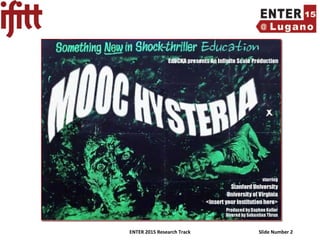
• INDUSTRY: “In talking about MOOCs and online courses
as interchangeable and equivalent entities Brooks is
doing a disservice to both. He is demonstrating a
shocking ignorance about the work that many of us have
been involved in for many years to help design and teach
small online courses . . .” (Kim, 2012).
• ACADEMIA: Few specifics, ambiguity, difficult to
classify, misunderstandings, improper generalisations,
(Cantoni et al, 2009; Negash & Wilcox, 2008; Baker &
Surrey, 2013)
Online Learning Confusion
ENTER 2015 Research Track Slide Number 4
Overview
• Evolution of Distance Learning
• Online Learning Trends
• Proposed Framework
• Online Learning Variables
• Conclusions, Limitations and Future
Research
ENTER 2015 Research Track Slide Number 5
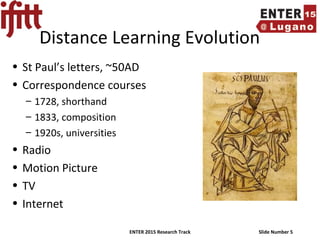
Distance Learning Evolution
• St Paul’s letters, ~50AD
• Correspondence courses
– 1728, shorthand
– 1833, composition
– 1920s, universities
• Radio
• Motion Picture
• TV
• Internet
ENTER 2015 Research Track Slide Number 6
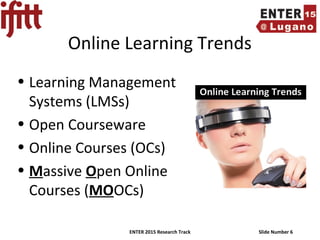
Online Learning Trends
• Learning Management
Systems (LMSs)
• Open Courseware
• Online Courses (OCs)
• Massive Open Online
Courses (MOOCs)
ENTER 2015 Research Track Slide Number 7
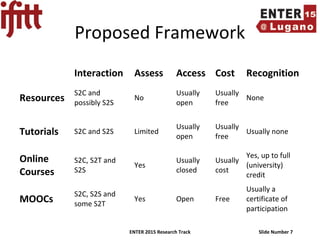
Proposed Framework
Interaction Assess Access Cost Recognition
Resources
S2C and
possibly S2S
No
Usually
open
Usually
free
None
Tutorials S2C and S2S Limited
Usually
open
Usually
free
Usually none
Online
Courses
S2C, S2T and
S2S
Yes
Usually
closed
Usually
cost
Yes, up to full
(university)
credit
MOOCs
S2C, S2S and
some S2T
Yes Open Free
Usually a
certificate of
participation
ENTER 2015 Research Track Slide Number 8
Framework Examples
• Resources: YouTube’s Educational Channel;
TED, IFITT Resources (eTourism Curriculum,
Digital Library, Wiki)
• Tutorials: Open Course Ware, Google’s
Digital Marketing Course, NTOs such as
Australia and Switzerland
• Online Courses: U of Phoenix, Arizona
State, thousands more
• MOOCs: Cornell, UCF, Floofl.com, U of
Girona, thousands more
ENTER 2015 Research Track Slide Number 9
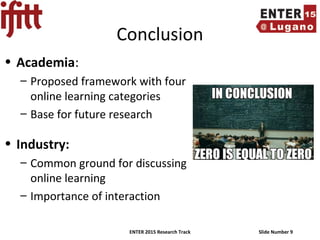
Conclusion
• Academia:
– Proposed framework with four
online learning categories
– Base for future research
• Industry:
– Common ground for discussing
online learning
– Importance of interaction
ENTER 2015 Research Track Slide Number 10
Limitations and Future Research
• Working proposal based on Lit Review
• Dynamic concept
• Need for validation
• Incorporate additional variables
– Presence
– Synchrocity
– Openness
– MOOC types, i.e. cMOOC vs xMOOC
ENTER 2015 Research Track Slide Number 11
Thank You
Q & A Session

Online Learning and MOOCs: A Framework Proposal

  • 1.
    ENTER 2015 ResearchTrack Slide Number 1 Online Learning and MOOCs: A Framework Proposal Jamie Murphya , Nadzeya Kalbaska , Laurel Horton-ᵇ Tognazzini and Lorenzo Cantoniᵃ ᵇ a Australian School of Management, Australia jamie.perth@gmail.com, laurelhorton@me.com ᵇThe Faculty of Communication Sciences, Università della Svizzera italiana, Switzerland nadzeya.kalbaska@usi.ch, lorenzo.cantoni@usi.ch
  • 2.
    ENTER 2015 ResearchTrack Slide Number 2
  • 3.
    ENTER 2015 ResearchTrack Slide Number 3 • INDUSTRY: “In talking about MOOCs and online courses as interchangeable and equivalent entities Brooks is doing a disservice to both. He is demonstrating a shocking ignorance about the work that many of us have been involved in for many years to help design and teach small online courses . . .” (Kim, 2012). • ACADEMIA: Few specifics, ambiguity, difficult to classify, misunderstandings, improper generalisations, (Cantoni et al, 2009; Negash & Wilcox, 2008; Baker & Surrey, 2013) Online Learning Confusion
  • 4.
    ENTER 2015 ResearchTrack Slide Number 4 Overview • Evolution of Distance Learning • Online Learning Trends • Proposed Framework • Online Learning Variables • Conclusions, Limitations and Future Research
  • 5.
    ENTER 2015 ResearchTrack Slide Number 5 Distance Learning Evolution • St Paul’s letters, ~50AD • Correspondence courses – 1728, shorthand – 1833, composition – 1920s, universities • Radio • Motion Picture • TV • Internet
  • 6.
    ENTER 2015 ResearchTrack Slide Number 6 Online Learning Trends • Learning Management Systems (LMSs) • Open Courseware • Online Courses (OCs) • Massive Open Online Courses (MOOCs)
  • 7.
    ENTER 2015 ResearchTrack Slide Number 7 Proposed Framework Interaction Assess Access Cost Recognition Resources S2C and possibly S2S No Usually open Usually free None Tutorials S2C and S2S Limited Usually open Usually free Usually none Online Courses S2C, S2T and S2S Yes Usually closed Usually cost Yes, up to full (university) credit MOOCs S2C, S2S and some S2T Yes Open Free Usually a certificate of participation
  • 8.
    ENTER 2015 ResearchTrack Slide Number 8 Framework Examples • Resources: YouTube’s Educational Channel; TED, IFITT Resources (eTourism Curriculum, Digital Library, Wiki) • Tutorials: Open Course Ware, Google’s Digital Marketing Course, NTOs such as Australia and Switzerland • Online Courses: U of Phoenix, Arizona State, thousands more • MOOCs: Cornell, UCF, Floofl.com, U of Girona, thousands more
  • 9.
    ENTER 2015 ResearchTrack Slide Number 9 Conclusion • Academia: – Proposed framework with four online learning categories – Base for future research • Industry: – Common ground for discussing online learning – Importance of interaction
  • 10.
    ENTER 2015 ResearchTrack Slide Number 10 Limitations and Future Research • Working proposal based on Lit Review • Dynamic concept • Need for validation • Incorporate additional variables – Presence – Synchrocity – Openness – MOOC types, i.e. cMOOC vs xMOOC
  • 11.
    ENTER 2015 ResearchTrack Slide Number 11 Thank You Q & A Session