OINTMENT
BY:LIPANJALI BADHEI
D. Pharm 1st Year
PHARMACEUTICS
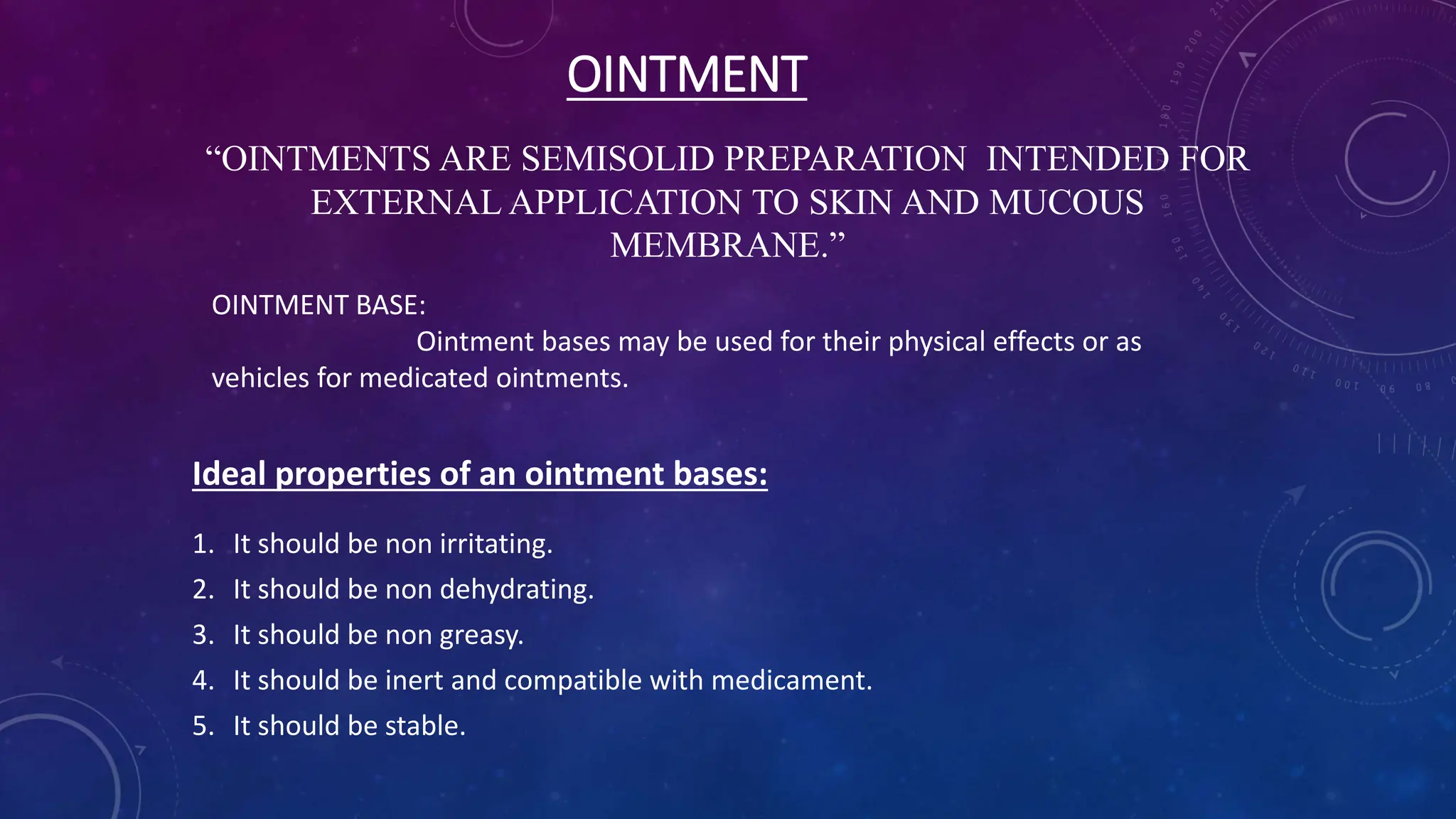
OINTMENT
“OINTMENTS ARE SEMISOLID PREPARATION INTENDED FOR
EXTERNAL APPLICATION TO SKIN AND MUCOUS
MEMBRANE.”
Ideal properties of an ointment bases:
1. It should be non irritating.
2. It should be non dehydrating.
3. It should be non greasy.
4. It should be inert and compatible with medicament.
5. It should be stable.
OINTMENT BASE:
Ointment bases may be used for their physical effects or as
vehicles for medicated ointments.
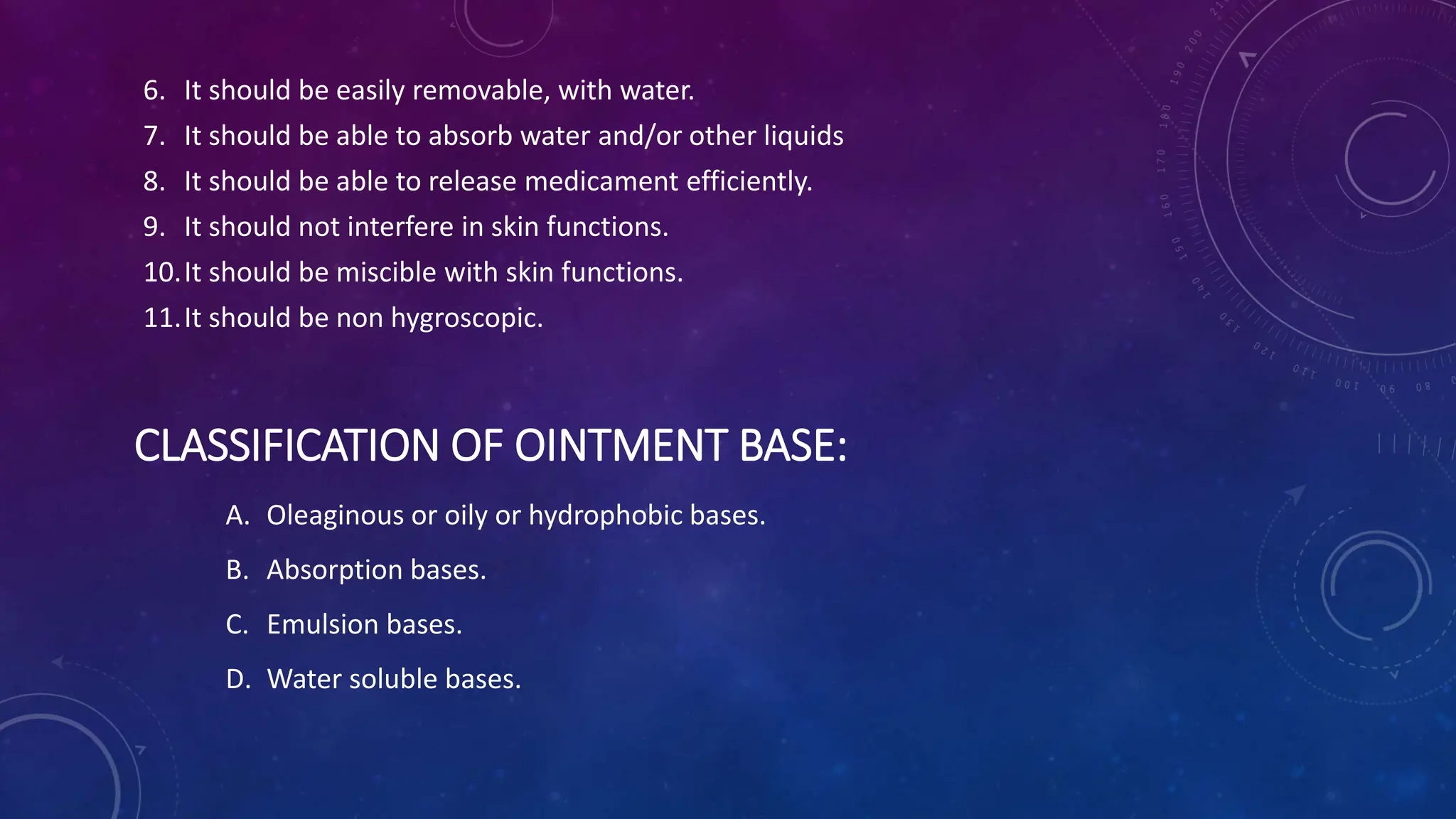
CLASSIFICATION OF OINTMENT BASE:
6. It should be easily removable, with water.
7. It should be able to absorb water and/or other liquids
8. It should be able to release medicament efficiently.
9. It should not interfere in skin functions.
10.It should be miscible with skin functions.
11.It should be non hygroscopic.
A. Oleaginous or oily or hydrophobic bases.
B. Absorption bases.
C. Emulsion bases.
D. Water soluble bases.
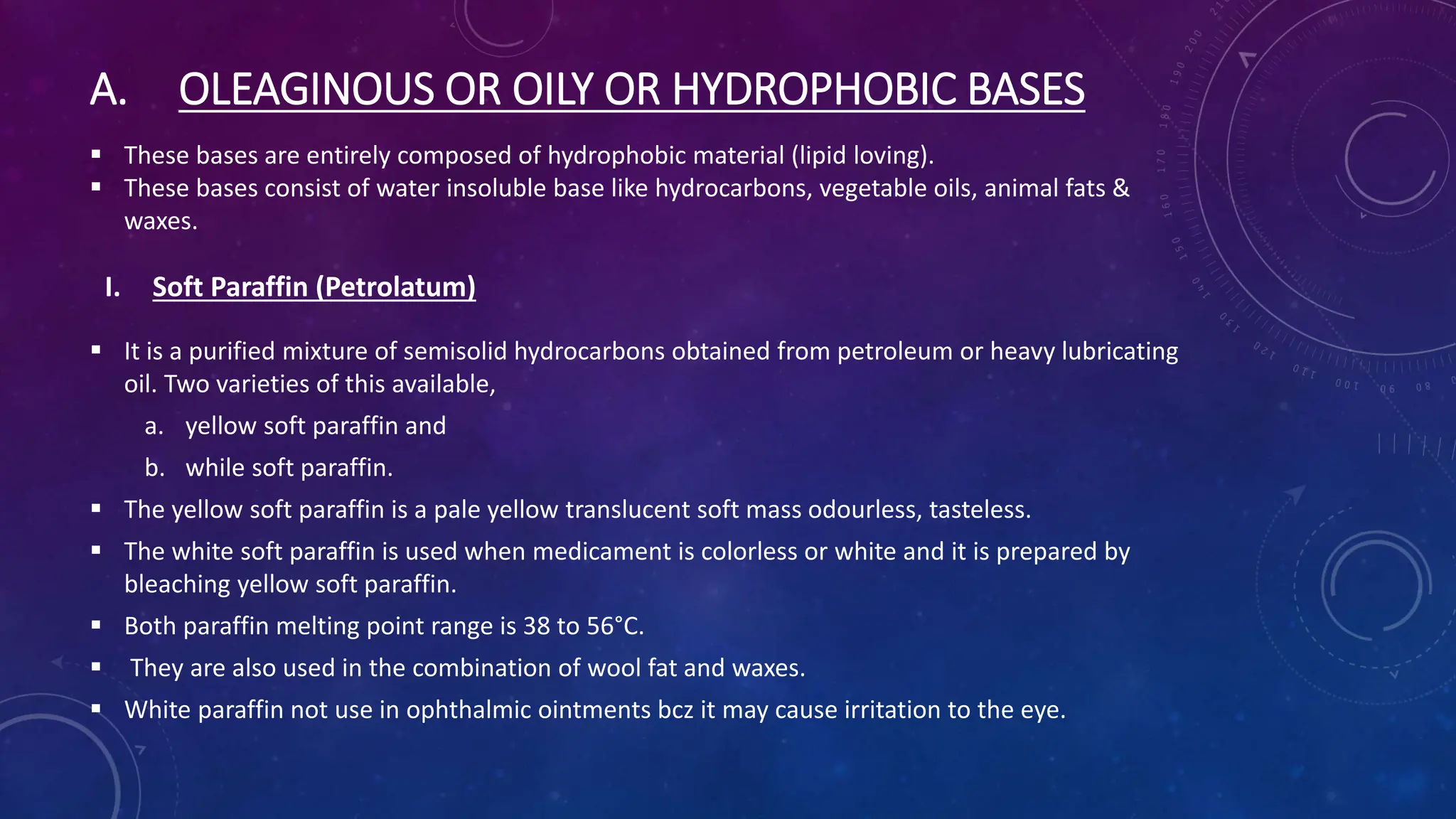
A. OLEAGINOUS OR OILY OR HYDROPHOBIC BASES
 These bases are entirely composed of hydrophobic material (lipid loving).
 These bases consist of water insoluble base like hydrocarbons, vegetable oils, animal fats &
waxes.
I. Soft Paraffin (Petrolatum)
 It is a purified mixture of semisolid hydrocarbons obtained from petroleum or heavy lubricating
oil. Two varieties of this available,
a. yellow soft paraffin and
b. while soft paraffin.
 The yellow soft paraffin is a pale yellow translucent soft mass odourless, tasteless.
 The white soft paraffin is used when medicament is colorless or white and it is prepared by
bleaching yellow soft paraffin.
 Both paraffin melting point range is 38 to 56°C.
 They are also used in the combination of wool fat and waxes.
 White paraffin not use in ophthalmic ointments bcz it may cause irritation to the eye.
 It is obtained by distillation from petrolatum.
 It is colourless or white, odourless, translucent
and wax like substances.
 Its melting point range is between 50-60°C.
 It is used to harden or stiffen the ointment
bases.
IV. Vvegetable oils and Animal Fats
II. Hard Paraffin
 It is also called as liquid petrolatum or white mineral oil.
 It is a mixture of liquid hydrocarbon obtained by distillation of petroleum and a variety depends on
the source of petroleum.
 It is colorless, odourless, test-less, & transparent oily liquid.
 It is insoluble in alcohol and water but soluble in chloroform and ether.
 It is used along with soft and hard paraffin to get a desired consistency of the ointment base.
III. Liquid Paraffin
 These includes almond oils, clove oil,
coconut oil, peanut oil, seasome oil,
beeswax, lanolin, sparmaceti wax.
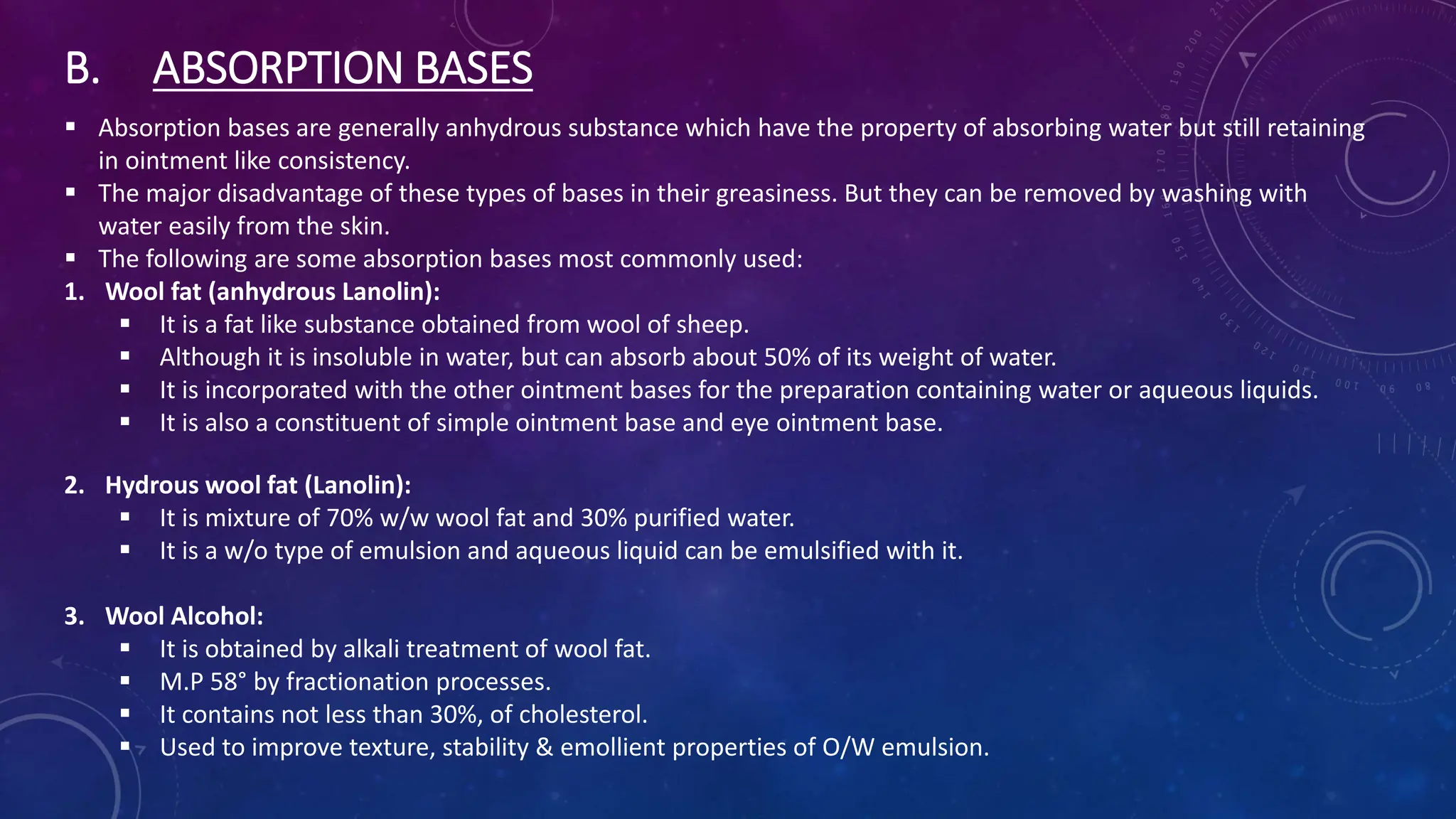
B. ABSORPTION BASES
 Absorption bases are generally anhydrous substance which have the property of absorbing water but still retaining
in ointment like consistency.
 The major disadvantage of these types of bases in their greasiness. But they can be removed by washing with
water easily from the skin.
 The following are some absorption bases most commonly used:
1. Wool fat (anhydrous Lanolin):
 It is a fat like substance obtained from wool of sheep.
 Although it is insoluble in water, but can absorb about 50% of its weight of water.
 It is incorporated with the other ointment bases for the preparation containing water or aqueous liquids.
 It is also a constituent of simple ointment base and eye ointment base.
2. Hydrous wool fat (Lanolin):
 It is mixture of 70% w/w wool fat and 30% purified water.
 It is a w/o type of emulsion and aqueous liquid can be emulsified with it.
3. Wool Alcohol:
 It is obtained by alkali treatment of wool fat.
 M.P 58° by fractionation processes.
 It contains not less than 30%, of cholesterol.
 Used to improve texture, stability & emollient properties of O/W emulsion.
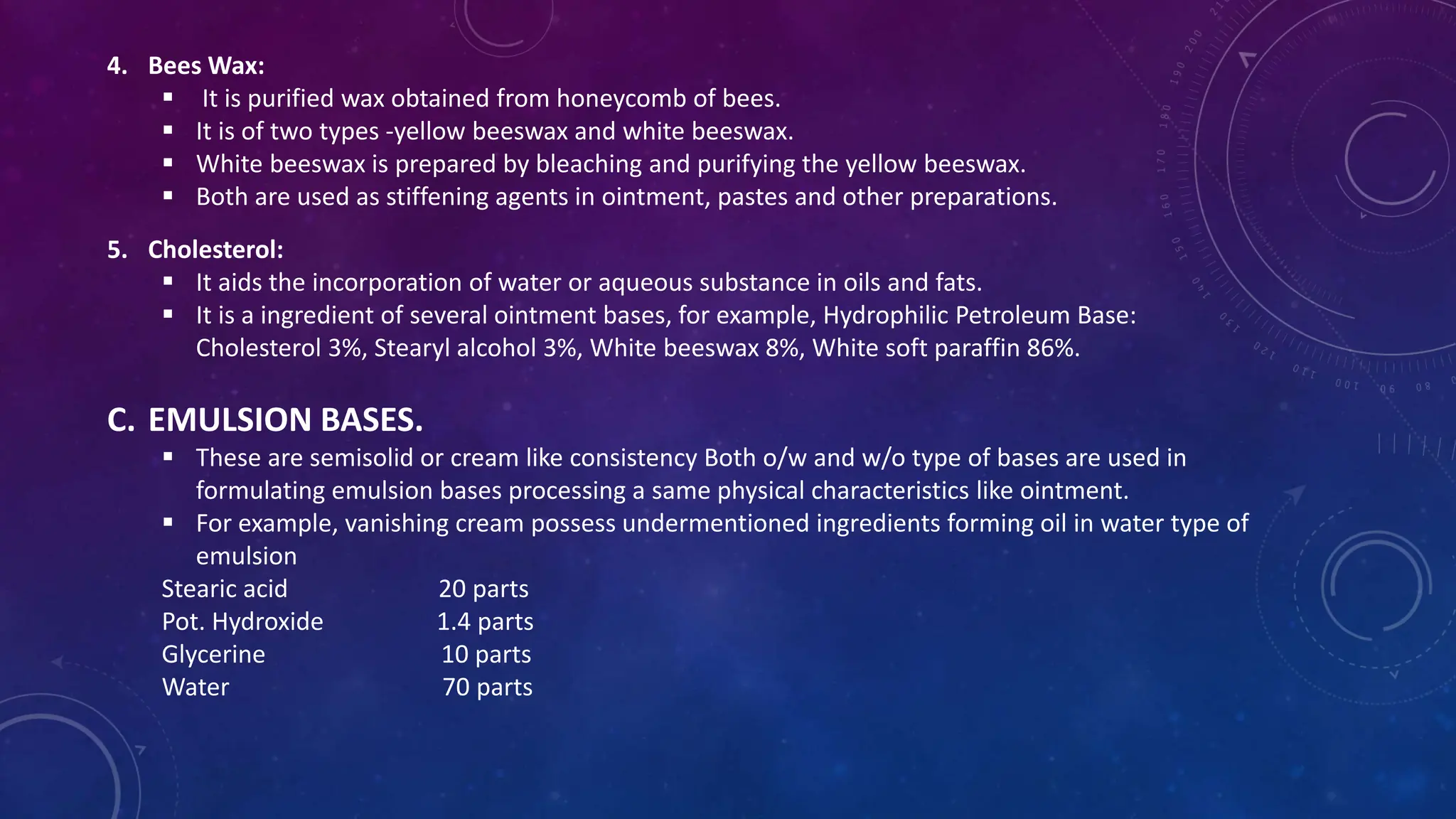
4. Bees Wax:
 It is purified wax obtained from honeycomb of bees.
 It is of two types -yellow beeswax and white beeswax.
 White beeswax is prepared by bleaching and purifying the yellow beeswax.
 Both are used as stiffening agents in ointment, pastes and other preparations.
5. Cholesterol:
 It aids the incorporation of water or aqueous substance in oils and fats.
 It is a ingredient of several ointment bases, for example, Hydrophilic Petroleum Base:
Cholesterol 3%, Stearyl alcohol 3%, White beeswax 8%, White soft paraffin 86%.
C. EMULSION BASES.
 These are semisolid or cream like consistency Both o/w and w/o type of bases are used in
formulating emulsion bases processing a same physical characteristics like ointment.
 For example, vanishing cream possess undermentioned ingredients forming oil in water type of
emulsion
Stearic acid 20 parts
Pot. Hydroxide 1.4 parts
Glycerine 10 parts
Water 70 parts
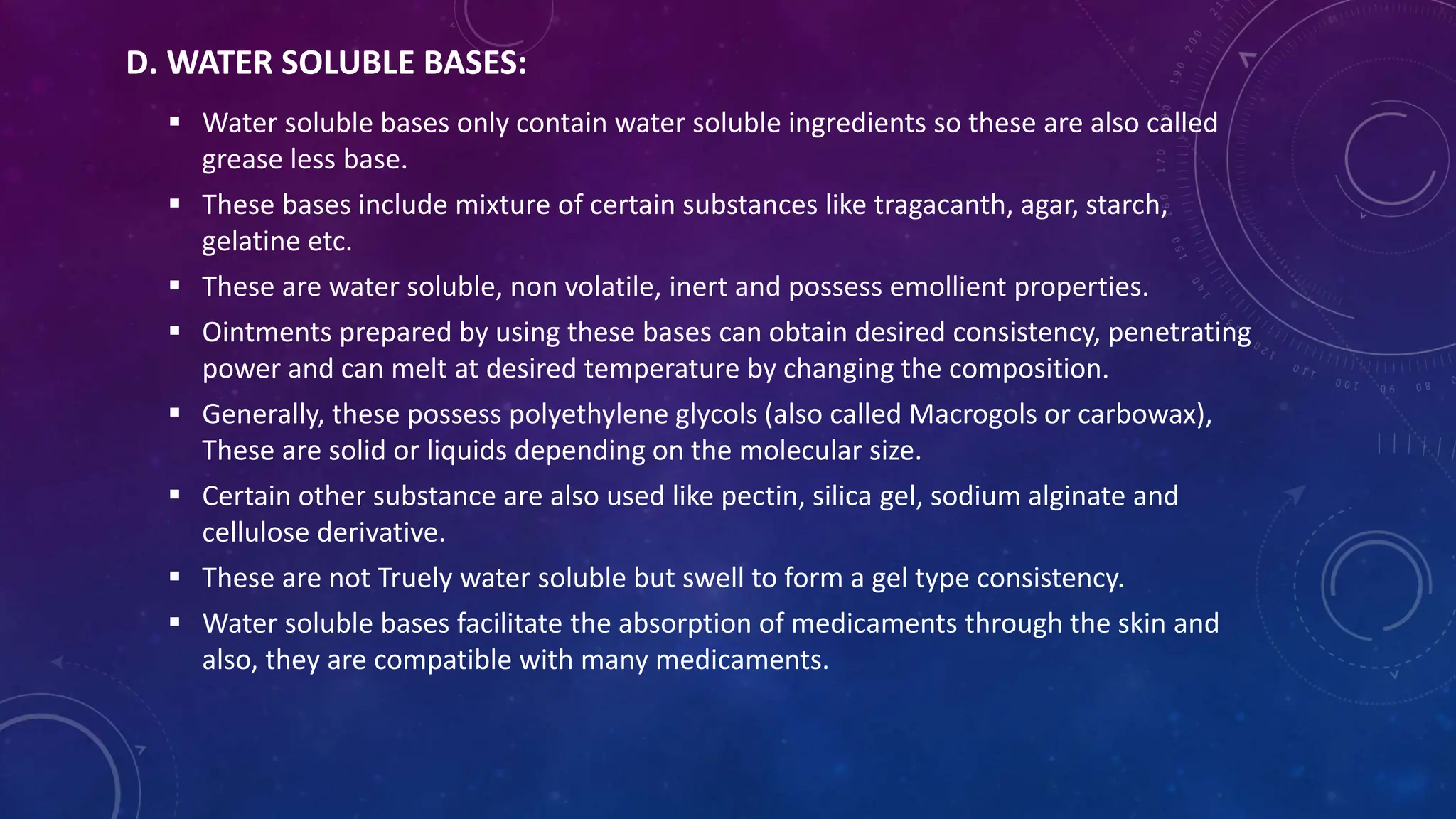
 Water soluble bases only contain water soluble ingredients so these are also called
grease less base.
 These bases include mixture of certain substances like tragacanth, agar, starch,
gelatine etc.
 These are water soluble, non volatile, inert and possess emollient properties.
 Ointments prepared by using these bases can obtain desired consistency, penetrating
power and can melt at desired temperature by changing the composition.
 Generally, these possess polyethylene glycols (also called Macrogols or carbowax),
These are solid or liquids depending on the molecular size.
 Certain other substance are also used like pectin, silica gel, sodium alginate and
cellulose derivative.
 These are not Truely water soluble but swell to form a gel type consistency.
 Water soluble bases facilitate the absorption of medicaments through the skin and
also, they are compatible with many medicaments.
D. WATER SOLUBLE BASES:
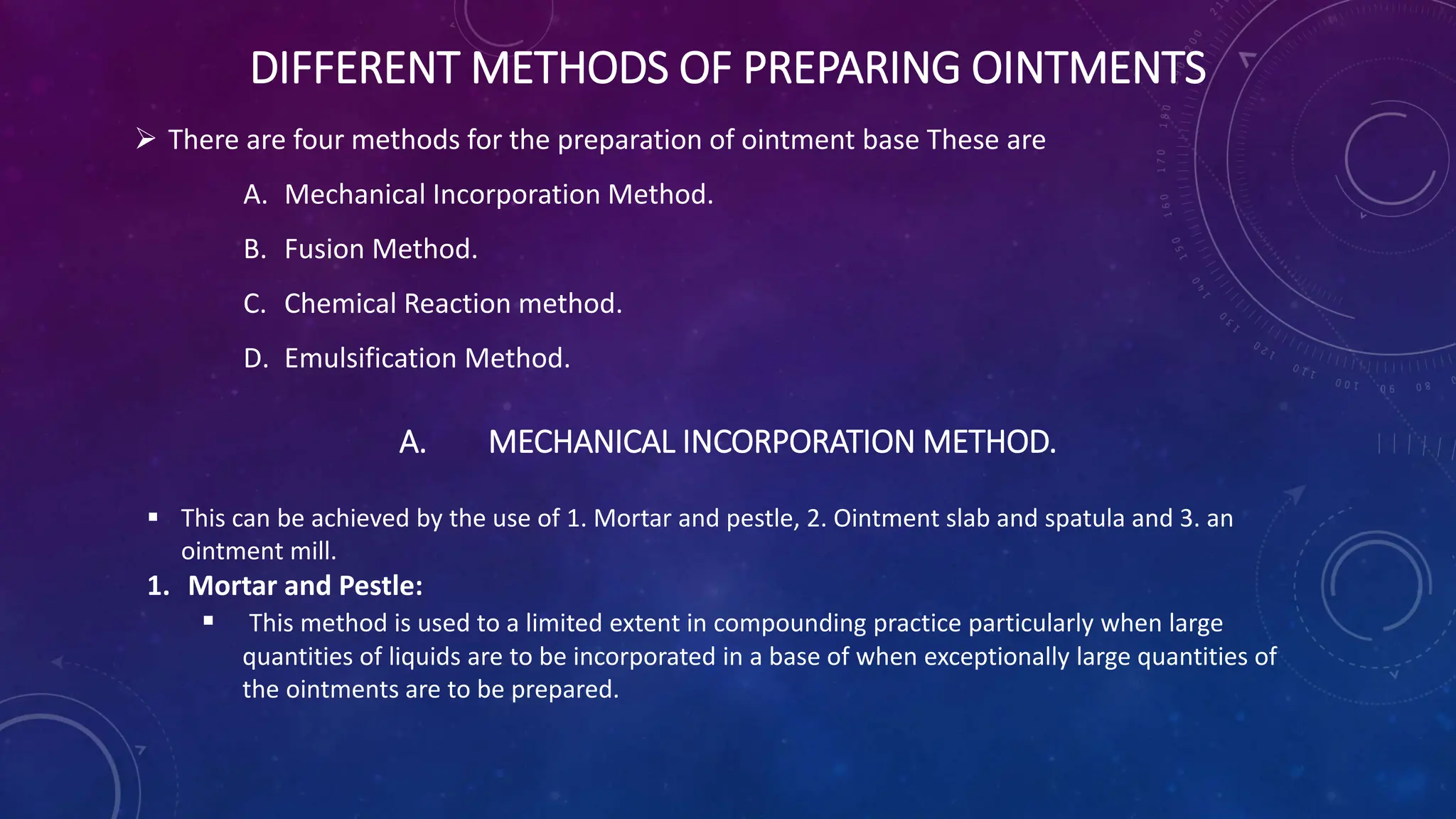
DIFFERENT METHODS OF PREPARING OINTMENTS
 There are four methods for the preparation of ointment base These are
A. Mechanical Incorporation Method.
B. Fusion Method.
C. Chemical Reaction method.
D. Emulsification Method.
A. MECHANICAL INCORPORATION METHOD.
 This can be achieved by the use of 1. Mortar and pestle, 2. Ointment slab and spatula and 3. an
ointment mill.
1. Mortar and Pestle:
 This method is used to a limited extent in compounding practice particularly when large
quantities of liquids are to be incorporated in a base of when exceptionally large quantities of
the ointments are to be prepared.
2. Trituration Method/ Slab & Spatula Method:
 The power is first rubbed with a small quantity of the base of form a concentrated
ointment base containing a finely divided principles formly distributed in it.
 The concentrated ointment is then gradually diluted with remaining quantity of the base
by rubbing with a spatula.
 A small quantity of an oil or oil soluble substance can be used as a levigating agent large
amount of levigating agents may cause undue softening of the finished product.
 The spatula should be of stainless steel with a long broad flexible blad.
 This method is also known as slabs and spatula method as the medicament is triturated
with a small amount of base on an ointment slab with the help of spatula.
 This is the most common method used for the preparation of ointment in laboratory.
For example:
Rx
Calamine finely sifted 15g
White soft paraffine 85g
Procedure:
 Pass the calamine through a very fine sieve to geta fine powder.
 Triturate the calamine with portion of white soft paraffin on an ointment slab with
spatula until smooth.
 Gradually add the remainder of white soft paraffin with continuous trituration until a
uniform ointment is obtained.
 Pack the ointment in a wide mouth container.
 The label bear the direction "For external use only'.
3. Ointment Mills:
 These are particularly suitable for large scale manufactured of ointment.
B. FUSION METHOD:
 When an ointment base contain a number of solid ingredients such as while bees wax, cetyl alcohol, stearyl
alcohol, stearic acid. hard paraffin etc. is necessary to melt them.
 The melting of the substance should be done in the decreasing order of their meting points, i.e., the substance
with highest M.P should be method first, then the substance with next M.P and so on, this will avoid the
overheating of substances having low M.P.
 The medicament is then added in the melted base and stirred thoroughly until the mass cools down and
homogenous product is termed.
For example: The Antiseptic Cream
Rx
Cetrimide 1.0 g
Ceto-stearyl alcohol 10 g
White soft paraffin 10 g
Liquid paraffin 29 g
Purified water 50 g
Procedure: Melt Ceto-stearyl alcohol, white soft paraffin and liquid paraffin together. Separately dissolve
cetrimide in purified water and warm it to almost same temp. (about 60°C) as that of the melted
substances. Add the warmed aqueous liquid to the melted mixture and stir thoroughly until cold Transfer
in a suitable container followed by labelling and dispensing.
OINTMENT.pptx D. Pharm 1st Year (Pharmaceutics)

OINTMENT.pptx D. Pharm 1st Year (Pharmaceutics)

  • 1.
  • 2.
    OINTMENT “OINTMENTS ARE SEMISOLIDPREPARATION INTENDED FOR EXTERNAL APPLICATION TO SKIN AND MUCOUS MEMBRANE.” Ideal properties of an ointment bases: 1. It should be non irritating. 2. It should be non dehydrating. 3. It should be non greasy. 4. It should be inert and compatible with medicament. 5. It should be stable. OINTMENT BASE: Ointment bases may be used for their physical effects or as vehicles for medicated ointments.
  • 3.
    CLASSIFICATION OF OINTMENTBASE: 6. It should be easily removable, with water. 7. It should be able to absorb water and/or other liquids 8. It should be able to release medicament efficiently. 9. It should not interfere in skin functions. 10.It should be miscible with skin functions. 11.It should be non hygroscopic. A. Oleaginous or oily or hydrophobic bases. B. Absorption bases. C. Emulsion bases. D. Water soluble bases.
  • 4.
    A. OLEAGINOUS OROILY OR HYDROPHOBIC BASES  These bases are entirely composed of hydrophobic material (lipid loving).  These bases consist of water insoluble base like hydrocarbons, vegetable oils, animal fats & waxes. I. Soft Paraffin (Petrolatum)  It is a purified mixture of semisolid hydrocarbons obtained from petroleum or heavy lubricating oil. Two varieties of this available, a. yellow soft paraffin and b. while soft paraffin.  The yellow soft paraffin is a pale yellow translucent soft mass odourless, tasteless.  The white soft paraffin is used when medicament is colorless or white and it is prepared by bleaching yellow soft paraffin.  Both paraffin melting point range is 38 to 56°C.  They are also used in the combination of wool fat and waxes.  White paraffin not use in ophthalmic ointments bcz it may cause irritation to the eye.
  • 5.
     It isobtained by distillation from petrolatum.  It is colourless or white, odourless, translucent and wax like substances.  Its melting point range is between 50-60°C.  It is used to harden or stiffen the ointment bases. IV. Vvegetable oils and Animal Fats II. Hard Paraffin  It is also called as liquid petrolatum or white mineral oil.  It is a mixture of liquid hydrocarbon obtained by distillation of petroleum and a variety depends on the source of petroleum.  It is colorless, odourless, test-less, & transparent oily liquid.  It is insoluble in alcohol and water but soluble in chloroform and ether.  It is used along with soft and hard paraffin to get a desired consistency of the ointment base. III. Liquid Paraffin  These includes almond oils, clove oil, coconut oil, peanut oil, seasome oil, beeswax, lanolin, sparmaceti wax.
  • 6.
    B. ABSORPTION BASES Absorption bases are generally anhydrous substance which have the property of absorbing water but still retaining in ointment like consistency.  The major disadvantage of these types of bases in their greasiness. But they can be removed by washing with water easily from the skin.  The following are some absorption bases most commonly used: 1. Wool fat (anhydrous Lanolin):  It is a fat like substance obtained from wool of sheep.  Although it is insoluble in water, but can absorb about 50% of its weight of water.  It is incorporated with the other ointment bases for the preparation containing water or aqueous liquids.  It is also a constituent of simple ointment base and eye ointment base. 2. Hydrous wool fat (Lanolin):  It is mixture of 70% w/w wool fat and 30% purified water.  It is a w/o type of emulsion and aqueous liquid can be emulsified with it. 3. Wool Alcohol:  It is obtained by alkali treatment of wool fat.  M.P 58° by fractionation processes.  It contains not less than 30%, of cholesterol.  Used to improve texture, stability & emollient properties of O/W emulsion.
  • 7.
    4. Bees Wax: It is purified wax obtained from honeycomb of bees.  It is of two types -yellow beeswax and white beeswax.  White beeswax is prepared by bleaching and purifying the yellow beeswax.  Both are used as stiffening agents in ointment, pastes and other preparations. 5. Cholesterol:  It aids the incorporation of water or aqueous substance in oils and fats.  It is a ingredient of several ointment bases, for example, Hydrophilic Petroleum Base: Cholesterol 3%, Stearyl alcohol 3%, White beeswax 8%, White soft paraffin 86%. C. EMULSION BASES.  These are semisolid or cream like consistency Both o/w and w/o type of bases are used in formulating emulsion bases processing a same physical characteristics like ointment.  For example, vanishing cream possess undermentioned ingredients forming oil in water type of emulsion Stearic acid 20 parts Pot. Hydroxide 1.4 parts Glycerine 10 parts Water 70 parts
  • 8.
     Water solublebases only contain water soluble ingredients so these are also called grease less base.  These bases include mixture of certain substances like tragacanth, agar, starch, gelatine etc.  These are water soluble, non volatile, inert and possess emollient properties.  Ointments prepared by using these bases can obtain desired consistency, penetrating power and can melt at desired temperature by changing the composition.  Generally, these possess polyethylene glycols (also called Macrogols or carbowax), These are solid or liquids depending on the molecular size.  Certain other substance are also used like pectin, silica gel, sodium alginate and cellulose derivative.  These are not Truely water soluble but swell to form a gel type consistency.  Water soluble bases facilitate the absorption of medicaments through the skin and also, they are compatible with many medicaments. D. WATER SOLUBLE BASES:
  • 9.
    DIFFERENT METHODS OFPREPARING OINTMENTS  There are four methods for the preparation of ointment base These are A. Mechanical Incorporation Method. B. Fusion Method. C. Chemical Reaction method. D. Emulsification Method. A. MECHANICAL INCORPORATION METHOD.  This can be achieved by the use of 1. Mortar and pestle, 2. Ointment slab and spatula and 3. an ointment mill. 1. Mortar and Pestle:  This method is used to a limited extent in compounding practice particularly when large quantities of liquids are to be incorporated in a base of when exceptionally large quantities of the ointments are to be prepared.
  • 10.
    2. Trituration Method/Slab & Spatula Method:  The power is first rubbed with a small quantity of the base of form a concentrated ointment base containing a finely divided principles formly distributed in it.  The concentrated ointment is then gradually diluted with remaining quantity of the base by rubbing with a spatula.  A small quantity of an oil or oil soluble substance can be used as a levigating agent large amount of levigating agents may cause undue softening of the finished product.  The spatula should be of stainless steel with a long broad flexible blad.  This method is also known as slabs and spatula method as the medicament is triturated with a small amount of base on an ointment slab with the help of spatula.  This is the most common method used for the preparation of ointment in laboratory.
  • 11.
    For example: Rx Calamine finelysifted 15g White soft paraffine 85g Procedure:  Pass the calamine through a very fine sieve to geta fine powder.  Triturate the calamine with portion of white soft paraffin on an ointment slab with spatula until smooth.  Gradually add the remainder of white soft paraffin with continuous trituration until a uniform ointment is obtained.  Pack the ointment in a wide mouth container.  The label bear the direction "For external use only'. 3. Ointment Mills:  These are particularly suitable for large scale manufactured of ointment.
  • 12.
    B. FUSION METHOD: When an ointment base contain a number of solid ingredients such as while bees wax, cetyl alcohol, stearyl alcohol, stearic acid. hard paraffin etc. is necessary to melt them.  The melting of the substance should be done in the decreasing order of their meting points, i.e., the substance with highest M.P should be method first, then the substance with next M.P and so on, this will avoid the overheating of substances having low M.P.  The medicament is then added in the melted base and stirred thoroughly until the mass cools down and homogenous product is termed. For example: The Antiseptic Cream Rx Cetrimide 1.0 g Ceto-stearyl alcohol 10 g White soft paraffin 10 g Liquid paraffin 29 g Purified water 50 g Procedure: Melt Ceto-stearyl alcohol, white soft paraffin and liquid paraffin together. Separately dissolve cetrimide in purified water and warm it to almost same temp. (about 60°C) as that of the melted substances. Add the warmed aqueous liquid to the melted mixture and stir thoroughly until cold Transfer in a suitable container followed by labelling and dispensing.