NUR HAZIERAH
MUHAMMAD SYAZWAN
SUPERVISOR: MR. KUMAR
DR CHE AHMAD MUTTAQIN
OUR AIMS
(1) identify the
patient's medical
problems
(2) determine if
further information
is needed to
characterize the
patient's medical
status
(3) establish if the
patient is medically
optimized
(4) confirm the
appropriateness of
the planned
procedure
Correct
abnormalities
Informed
consent
Details of
Preparations
Lab
Investigations
Cross-match
blood
Physiotherapy
Breathing
Exercise
DVT
Prophylaxis
Anaesthetic
Premedications
Principles of
Preoperative
Preparation
The
Assessments
Full History
Examination
Lab Test
Radiographs
ECG
Appropriate
Procedure
Risk factors associated with increased
perioperative mortality and morbidity
 Age > 60 years
 Arterial and pulmonary hypertension
 Body mass index of <20 kg/m2 or >35 kg/m2
 Congestive cardiac failure
 Peripheral vascular disease
 Diabetes mellitus
 Renal insufficiency
 Acute coronary syndromes
 Chronic pulmonary disease
 Neurological disease
 Previous cardiac surgery
General Problems in Surgical Patients
• Extreme age
• Limits: cardiac, repiratory, renal reserve
• Smaller doses of narcotics, sedatives &
analgesics
Age
• Affects wound healing
• High incidence of respiratory problems
• DVT & Pulmonary embolism are common
• Bedsores
Obesity
• Reduced response to trauma & infection
• Causes: Immunosuppressive drugs,
uremia. Malnutrition or liver disease
Compromised
Host
General Problems (cont.)
• Sensitivity to sedatives, anaesthetic, antibiotic drugs or
dressing
• Unexpected reaction might occur
• Severe cases -> Anaphylactic shock
Allergies
• Diabetics might need to change to sliding scale
• Patient on steroids may need additional cover during
major surgery
• Adjustment anticoagulant therapy
• Warfarin -> Heparin (perioperatively)
• Clopidogrel contraindicated in regional anaesthesia
(causing epidural hematoma)
• Acetylcholine & ATH Inhibitor (Antithrombin + Heparin
inhibitor) should stop 24hours before surgery to prevent
severe & refractory hypotension
Drugs
COMORBIDDISEASE
CARDIOVASCULAR DISEASE
RESPIRATORY DISEASE &
SMOKING
MALNUTRITION, ADHESION AND
JAUNDICE
RENAL DISEASE
HEMATOLOGICAL DISEASE
OBESITY
DIABETES MELLITUS
ASA Physical Status Classification System
1
• A normal healthy patient
2
• A patient with mild/moderate systemic disease
3
• A patient with severe systemic disease which limits
activities
4
• A patient with severe systemic disease that is a constant
threat to life
5
• A moribund patient who is not expected to survive without
the operation
6
• A declared brain-dead patient whose organs are being
removed for donor purposes
Routine testsBiochemistry
• Electrolytes
(Na+, K+),
urea,
creatinine
• Glucose
(RBS/CBS)
• Liver
function
tests
Haematology
• FBC
• Coag.
studies
(PT,
APTT, INR)
Imaging/Others
• CXR
• Resting ECG
• Pulmonary
function
tests
(spirometry)
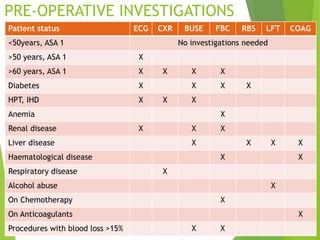
PRE-OPERATIVE INVESTIGATIONS
Patient status ECG CXR BUSE FBC RBS LFT COAG
<50years, ASA 1 No investigations needed
>50 years, ASA 1 X
>60 years, ASA 1 X X X X
Diabetes X X X X
HPT, IHD X X X
Anemia X
Renal disease X X X
Liver disease X X X X
Haematological disease X X
Respiratory disease X
Alcohol abuse X
On Chemotherapy X
On Anticoagulants X
Procedures with blood loss >15% X X
PROPHYLACTIC MEASURES AGAINST COMMON
POST OPERATIVE COMPLICATONS
• Antibiotics before op such as IV
Rocephine and Flagyl
Surgical infections
• Chemical – Heparin
• Mechanical –compression stokings
DVT
• Adequate renal perfusion
• Adequate oxygenation
Renal failure
REASONS FOR ANESTHETIC REFERRAL
Allergy or intolerance to certain substances, drugs or classes of
drugs
 Documented allergy to anesthetic drugs, analgesics, local
anesthetics or muscle relaxants
Instability or immobility of the cervical spine
 Rheumatoid arthritis, Down’s syndrome, Ankylosing spondylitis
 Previous instrumentation of the cervical spine
Known or potential difficult airway
 Limited jaw opening (temperomandibular joint arthritis, trismus
related to oral or submental sepsis, previously wired teeth, facial
radiotherapy or burns, previous reconstructive surgery to
mandible, tongue or mouth).
 Small mandible
 Large tongue (acromegaly, morbid obesity)
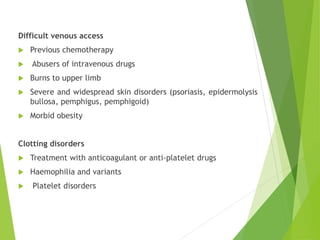
Difficult venous access
 Previous chemotherapy
 Abusers of intravenous drugs
 Burns to upper limb
 Severe and widespread skin disorders (psoriasis, epidermolysis
bullosa, pemphigus, pemphigoid)
 Morbid obesity
Clotting disorders
 Treatment with anticoagulant or anti-platelet drugs
 Haemophilia and variants
 Platelet disorders
ASSESSMENT OF THE LIKELY IMMEDIATE
POST-OP COURSE & THUS THE NEED FOR
HDU/ICU SUPPORT
Circumstance in which patients requiring ICU care
postoperatively:-
 When an operation causes major physiological disturbances
requiring close monitoring and /or organ support (e.g. major
surgery)
 When an unexpected major medical or surgical complication
occurs during surgery, threatening organ dysfunction (e.g.
intraoperative haemorrhage and myocardial infarction)
 When previous intercurrent disease compromises physiological
reserve (e.g. patient with severe COPD undergoes major
abdominal surgery)
PART II: SURGICAL
CONSENT
 Informed consent serves to identify and respect a
patient’s best interest by giving each patient the
opportunity to decide autonomously what his/her
best interest are in light of the planned
procedure.
SURGICAL CONSENT
CONSENT
 Important because:
i) Rights of the patient
ii) Patient education
iii) Prevent misunderstanding
iv) Prevent medico-legal cases
INFORMED CONSENT
INFORMING THE
PATIENT
IN GENERAL
 Should presented clearly as possible
 Include discussion of the diagnosis
 Should include explanation of the procedure
 Explanation of risks
 Benefits
 Potential consequences of the procedure
 Treatment options
 Alternatives to treatment (including nonsurgical management or non
intervention)
 The consent process can technically be done
without satisfying any of the essential elements of
the “informed” component
 Permissible for actual signature to be obtained by
resident, physician assistants after surgeon
properly informed the patients.
 the actual informed consent documents need to
fullfill a number of criteria (table 2)
OBTAINING CONSENT
FROM THE PATIENTS
Essential Components of
Documenting Consent
What is Legally Effective
Informed Consent
Under ordinary circumstances, legally effective
informed consent is obtained by reviewing the
approved informed consent with the subject,
answering any questions, and getting the subject’s
signature.
Subject Unable to Consent
• What if the subject
• Lacks capacity
• Has diminished decisional capacity
• Is a minor
• Is unconscious
Who is a Legally
Authorized Representative
• Legal Guardians
• Healthcare Surrogates
• Proxies
• Attorneys-in-fact
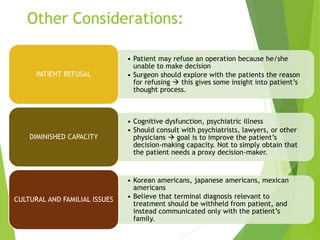
Other Considerations:
• Patient may refuse an operation because he/she
unable to make decision
• Surgeon should explore with the patients the reason
for refusing  this gives some insight into patient’s
thought process.
PATIENT REFUSAL
• Cognitive dysfunction, psychiatric illness
• Should consult with psychiatrists, lawyers, or other
physicians  goal is to improve the patient’s
decision-making capacity. Not to simply obtain that
the patient needs a proxy decision-maker.
DIMINISHED CAPACITY
• Korean americans, japanese americans, mexican
americans
• Believe that terminal diagnosis relevant to
treatment should be withheld from patient, and
instead communicated only with the patient’s
family.
CULTURAL AND FAMILIAL ISSUES
Preop & consent

Preop & consent

  • 1.
    NUR HAZIERAH MUHAMMAD SYAZWAN SUPERVISOR:MR. KUMAR DR CHE AHMAD MUTTAQIN
  • 3.
    OUR AIMS (1) identifythe patient's medical problems (2) determine if further information is needed to characterize the patient's medical status (3) establish if the patient is medically optimized (4) confirm the appropriateness of the planned procedure
  • 4.
  • 5.
  • 6.
    Risk factors associatedwith increased perioperative mortality and morbidity  Age > 60 years  Arterial and pulmonary hypertension  Body mass index of <20 kg/m2 or >35 kg/m2  Congestive cardiac failure  Peripheral vascular disease  Diabetes mellitus  Renal insufficiency  Acute coronary syndromes  Chronic pulmonary disease  Neurological disease  Previous cardiac surgery
  • 7.
    General Problems inSurgical Patients • Extreme age • Limits: cardiac, repiratory, renal reserve • Smaller doses of narcotics, sedatives & analgesics Age • Affects wound healing • High incidence of respiratory problems • DVT & Pulmonary embolism are common • Bedsores Obesity • Reduced response to trauma & infection • Causes: Immunosuppressive drugs, uremia. Malnutrition or liver disease Compromised Host
  • 8.
    General Problems (cont.) •Sensitivity to sedatives, anaesthetic, antibiotic drugs or dressing • Unexpected reaction might occur • Severe cases -> Anaphylactic shock Allergies • Diabetics might need to change to sliding scale • Patient on steroids may need additional cover during major surgery • Adjustment anticoagulant therapy • Warfarin -> Heparin (perioperatively) • Clopidogrel contraindicated in regional anaesthesia (causing epidural hematoma) • Acetylcholine & ATH Inhibitor (Antithrombin + Heparin inhibitor) should stop 24hours before surgery to prevent severe & refractory hypotension Drugs
  • 9.
    COMORBIDDISEASE CARDIOVASCULAR DISEASE RESPIRATORY DISEASE& SMOKING MALNUTRITION, ADHESION AND JAUNDICE RENAL DISEASE HEMATOLOGICAL DISEASE OBESITY DIABETES MELLITUS
  • 10.
    ASA Physical StatusClassification System 1 • A normal healthy patient 2 • A patient with mild/moderate systemic disease 3 • A patient with severe systemic disease which limits activities 4 • A patient with severe systemic disease that is a constant threat to life 5 • A moribund patient who is not expected to survive without the operation 6 • A declared brain-dead patient whose organs are being removed for donor purposes
  • 11.
    Routine testsBiochemistry • Electrolytes (Na+,K+), urea, creatinine • Glucose (RBS/CBS) • Liver function tests Haematology • FBC • Coag. studies (PT, APTT, INR) Imaging/Others • CXR • Resting ECG • Pulmonary function tests (spirometry)
  • 12.
    PRE-OPERATIVE INVESTIGATIONS Patient statusECG CXR BUSE FBC RBS LFT COAG <50years, ASA 1 No investigations needed >50 years, ASA 1 X >60 years, ASA 1 X X X X Diabetes X X X X HPT, IHD X X X Anemia X Renal disease X X X Liver disease X X X X Haematological disease X X Respiratory disease X Alcohol abuse X On Chemotherapy X On Anticoagulants X Procedures with blood loss >15% X X
  • 13.
    PROPHYLACTIC MEASURES AGAINSTCOMMON POST OPERATIVE COMPLICATONS • Antibiotics before op such as IV Rocephine and Flagyl Surgical infections • Chemical – Heparin • Mechanical –compression stokings DVT • Adequate renal perfusion • Adequate oxygenation Renal failure
  • 14.
    REASONS FOR ANESTHETICREFERRAL Allergy or intolerance to certain substances, drugs or classes of drugs  Documented allergy to anesthetic drugs, analgesics, local anesthetics or muscle relaxants Instability or immobility of the cervical spine  Rheumatoid arthritis, Down’s syndrome, Ankylosing spondylitis  Previous instrumentation of the cervical spine Known or potential difficult airway  Limited jaw opening (temperomandibular joint arthritis, trismus related to oral or submental sepsis, previously wired teeth, facial radiotherapy or burns, previous reconstructive surgery to mandible, tongue or mouth).  Small mandible  Large tongue (acromegaly, morbid obesity)
  • 15.
    Difficult venous access Previous chemotherapy  Abusers of intravenous drugs  Burns to upper limb  Severe and widespread skin disorders (psoriasis, epidermolysis bullosa, pemphigus, pemphigoid)  Morbid obesity Clotting disorders  Treatment with anticoagulant or anti-platelet drugs  Haemophilia and variants  Platelet disorders
  • 16.
    ASSESSMENT OF THELIKELY IMMEDIATE POST-OP COURSE & THUS THE NEED FOR HDU/ICU SUPPORT Circumstance in which patients requiring ICU care postoperatively:-  When an operation causes major physiological disturbances requiring close monitoring and /or organ support (e.g. major surgery)  When an unexpected major medical or surgical complication occurs during surgery, threatening organ dysfunction (e.g. intraoperative haemorrhage and myocardial infarction)  When previous intercurrent disease compromises physiological reserve (e.g. patient with severe COPD undergoes major abdominal surgery)
  • 17.
  • 18.
     Informed consentserves to identify and respect a patient’s best interest by giving each patient the opportunity to decide autonomously what his/her best interest are in light of the planned procedure. SURGICAL CONSENT
  • 19.
    CONSENT  Important because: i)Rights of the patient ii) Patient education iii) Prevent misunderstanding iv) Prevent medico-legal cases
  • 21.
  • 22.
  • 23.
    IN GENERAL  Shouldpresented clearly as possible  Include discussion of the diagnosis  Should include explanation of the procedure  Explanation of risks  Benefits  Potential consequences of the procedure  Treatment options  Alternatives to treatment (including nonsurgical management or non intervention)
  • 24.
     The consentprocess can technically be done without satisfying any of the essential elements of the “informed” component  Permissible for actual signature to be obtained by resident, physician assistants after surgeon properly informed the patients.  the actual informed consent documents need to fullfill a number of criteria (table 2) OBTAINING CONSENT FROM THE PATIENTS
  • 25.
  • 26.
    What is LegallyEffective Informed Consent Under ordinary circumstances, legally effective informed consent is obtained by reviewing the approved informed consent with the subject, answering any questions, and getting the subject’s signature.
  • 27.
    Subject Unable toConsent • What if the subject • Lacks capacity • Has diminished decisional capacity • Is a minor • Is unconscious
  • 28.
    Who is aLegally Authorized Representative • Legal Guardians • Healthcare Surrogates • Proxies • Attorneys-in-fact
  • 29.
    Other Considerations: • Patientmay refuse an operation because he/she unable to make decision • Surgeon should explore with the patients the reason for refusing  this gives some insight into patient’s thought process. PATIENT REFUSAL • Cognitive dysfunction, psychiatric illness • Should consult with psychiatrists, lawyers, or other physicians  goal is to improve the patient’s decision-making capacity. Not to simply obtain that the patient needs a proxy decision-maker. DIMINISHED CAPACITY • Korean americans, japanese americans, mexican americans • Believe that terminal diagnosis relevant to treatment should be withheld from patient, and instead communicated only with the patient’s family. CULTURAL AND FAMILIAL ISSUES