Rahaden Lingga Bhumi 
SUFFIX 
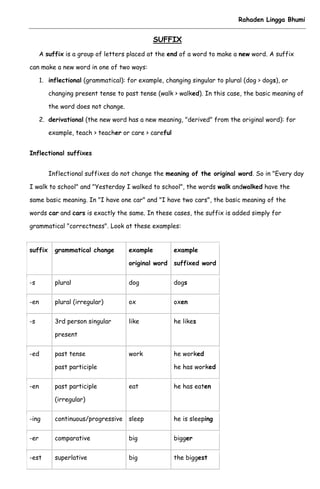
A suffix is a group of letters placed at the end of a word to make a new word. A suffix 
can make a new word in one of two ways: 
1. inflectional (grammatical): for example, changing singular to plural (dog > dogs), or 
changing present tense to past tense (walk > walked). In this case, the basic meaning of 
the word does not change. 
2. derivational (the new word has a new meaning, "derived" from the original word): for 
example, teach > teacher or care > careful 
Inflectional suffixes 
Inflectional suffixes do not change the meaning of the original word. So in "Every day 
I walk to school" and "Yesterday I walked to school", the words walk andwalked have the 
same basic meaning. In "I have one car" and "I have two cars", the basic meaning of the 
words car and cars is exactly the same. In these cases, the suffix is added simply for 
grammatical "correctness". Look at these examples: 
suffix grammatical change example 
original word 
example 
suffixed word 
-s plural dog dogs 
-en plural (irregular) ox oxen 
-s 3rd person singular 
present 
like he likes 
-ed past tense 
past participle 
work he worked 
he has worked 
-en past participle 
(irregular) 
eat he has eaten 
-ing continuous/progressive sleep he is sleeping 
-er comparative big bigger 
-est superlative big the biggest
Derivational suffixes 
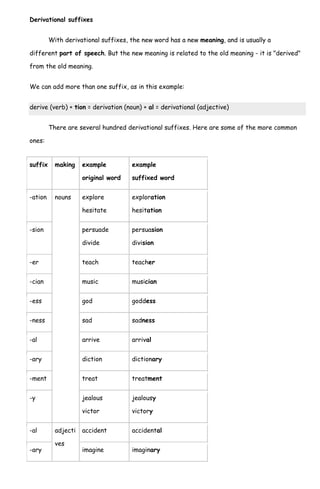
With derivational suffixes, the new word has a new meaning, and is usually a 
different part of speech. But the new meaning is related to the old meaning - it is "derived" 
from the old meaning. 
We can add more than one suffix, as in this example: 
derive (verb) + tion = derivation (noun) + al = derivational (adjective) 
There are several hundred derivational suffixes. Here are some of the more common 
ones: 
suffix making example 
original word 
example 
suffixed word 
-ation nouns explore 
hesitate 
exploration 
hesitation 
-sion persuade 
divide 
persuasion 
division 
-er teach teacher 
-cian music musician 
-ess god goddess 
-ness sad sadness 
-al arrive arrival 
-ary diction dictionary 
-ment treat treatment 
-y jealous 
victor 
jealousy 
victory 
-al adjecti 
ves 
accident accidental 
-ary imagine imaginary
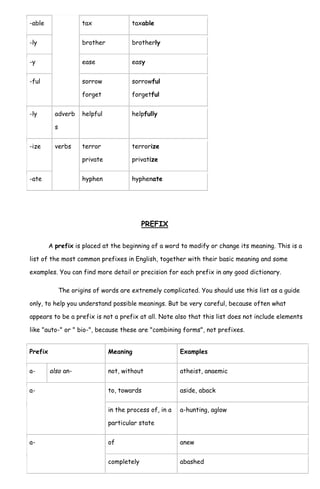
-able tax taxable 
-ly brother brotherly 
-y ease easy 
-ful sorrow 
forget 
sorrowful 
forgetful 
-ly adverb 
s 
helpful helpfully 
-ize verbs terror 
private 
terrorize 
privatize 
-ate hyphen hyphenate 
PREFIX 
A prefix is placed at the beginning of a word to modify or change its meaning. This is a 
list of the most common prefixes in English, together with their basic meaning and some 
examples. You can find more detail or precision for each prefix in any good dictionary. 
The origins of words are extremely complicated. You should use this list as a guide 
only, to help you understand possible meanings. But be very careful, because often what 
appears to be a prefix is not a prefix at all. Note also that this list does not include elements 
like "auto-" or " bio-", because these are "combining forms", not prefixes. 
Prefix Meaning Examples 
a- also an- not, without atheist, anaemic 
a- to, towards aside, aback 
in the process of, in a 
particular state 
a-hunting, aglow 
a- of anew 
completely abashed
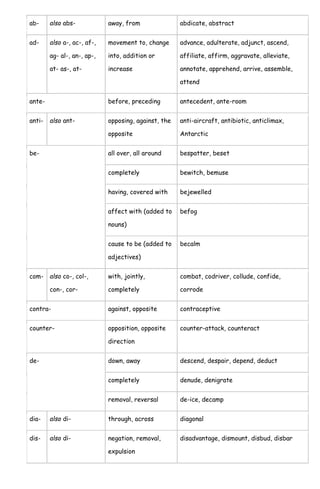
ab- also abs- away, from abdicate, abstract 
ad- also a-, ac-, af-, 
ag- al-, an-, ap-, 
at- as-, at-movement 
to, change 
into, addition or 
increase 
advance, adulterate, adjunct, ascend, 
affiliate, affirm, aggravate, alleviate, 
annotate, apprehend, arrive, assemble, 
attend 
ante- before, preceding antecedent, ante-room 
anti- also ant- opposing, against, the 
opposite 
anti-aircraft, antibiotic, anticlimax, 
Antarctic 
be- all over, all around bespatter, beset 
completely bewitch, bemuse 
having, covered with bejewelled 
affect with (added to 
nouns) 
befog 
cause to be (added to 
adjectives) 
becalm 
com- also co-, col-, 
con-, cor-with, 
jointly, 
completely 
combat, codriver, collude, confide, 
corrode 
contra- against, opposite contraceptive 
counter- opposition, opposite 
direction 
counter-attack, counteract 
de- down, away descend, despair, depend, deduct 
completely denude, denigrate 
removal, reversal de-ice, decamp 
dia- also di- through, across diagonal 
dis- also di- negation, removal, 
expulsion 
disadvantage, dismount, disbud, disbar
en- also em- put into or on engulf, enmesh 
bring into the 
condition of 
enlighten, embitter 
intensification entangle, enrage 
ex- also e-, ef- out exit, exclude, expand 
upward exalt, extol 
completely excruciate, exasperate 
previous ex-wife 
extra- outside, beyond extracurricular 
hemi- half hemisphere 
hyper- beyond, more than, 
more than normal 
hypersonic, hyperactive 
hypo- under hypodermic, hypothermia 
in- also il-, im- not, without infertile, inappropriate, impossible 
also il-, im-, ir- in, into, towards, 
inside 
influence, influx, imbibe 
infra- below infrared, infrastructure 
inter- between, among interact, interchange 
intra- inside, within intramural, intravenous 
non- absence, negation non-smoker, non-alcoholic 
ob- also oc-, of-, op- blocking, against, 
concealing 
obstruct, occult, offend, oppose 
out- surpassing, exceeding outperform 
external, away from outbuilding, outboard
over- excessively, 
completely 
overconfident, overburdened, overjoyed 
upper, outer, over, 
above 
overcoat, overcast 
peri- round, about perimeter 
post- after in time or order postpone 
pre- before in time, place, 
order or importance 
pre-adolescent, prelude, precondition 
pro- favouring, in support 
of 
pro-African 
acting for proconsul 
motion forwards or 
away 
propulsion 
before in time, place 
or order 
prologue 
re- again repaint, reappraise, reawake 
semi- half, partly semicircle, semi-conscious 
sub- also suc-, suf-, 
sug-, sup-, sur-, 
sus-at 
a lower position submarine, subsoil 
lower in rank sub-lieutenant 
nearly, approximately sub-tropical 
syn- also sym- in union, acting 
together 
synchronize, symmetry 
trans- across, beyond transnational, transatlantic 
into a different state translate 
ultra- beyond ultraviolet, ultrasonic
extreme ultramicroscopic 
un- not unacceptable, unreal, unhappy, unmanned 
reversal or 
cancellation of action 
or state 
unplug, unmask 
under- beneath, below underarm, undercarriage 
lower in rank undersecretary 
not enough underdeveloped

Suffix & Prefix

  • 1.
    Rahaden Lingga Bhumi SUFFIX A suffix is a group of letters placed at the end of a word to make a new word. A suffix can make a new word in one of two ways: 1. inflectional (grammatical): for example, changing singular to plural (dog > dogs), or changing present tense to past tense (walk > walked). In this case, the basic meaning of the word does not change. 2. derivational (the new word has a new meaning, "derived" from the original word): for example, teach > teacher or care > careful Inflectional suffixes Inflectional suffixes do not change the meaning of the original word. So in "Every day I walk to school" and "Yesterday I walked to school", the words walk andwalked have the same basic meaning. In "I have one car" and "I have two cars", the basic meaning of the words car and cars is exactly the same. In these cases, the suffix is added simply for grammatical "correctness". Look at these examples: suffix grammatical change example original word example suffixed word -s plural dog dogs -en plural (irregular) ox oxen -s 3rd person singular present like he likes -ed past tense past participle work he worked he has worked -en past participle (irregular) eat he has eaten -ing continuous/progressive sleep he is sleeping -er comparative big bigger -est superlative big the biggest
  • 2.
    Derivational suffixes Withderivational suffixes, the new word has a new meaning, and is usually a different part of speech. But the new meaning is related to the old meaning - it is "derived" from the old meaning. We can add more than one suffix, as in this example: derive (verb) + tion = derivation (noun) + al = derivational (adjective) There are several hundred derivational suffixes. Here are some of the more common ones: suffix making example original word example suffixed word -ation nouns explore hesitate exploration hesitation -sion persuade divide persuasion division -er teach teacher -cian music musician -ess god goddess -ness sad sadness -al arrive arrival -ary diction dictionary -ment treat treatment -y jealous victor jealousy victory -al adjecti ves accident accidental -ary imagine imaginary
  • 3.
    -able tax taxable -ly brother brotherly -y ease easy -ful sorrow forget sorrowful forgetful -ly adverb s helpful helpfully -ize verbs terror private terrorize privatize -ate hyphen hyphenate PREFIX A prefix is placed at the beginning of a word to modify or change its meaning. This is a list of the most common prefixes in English, together with their basic meaning and some examples. You can find more detail or precision for each prefix in any good dictionary. The origins of words are extremely complicated. You should use this list as a guide only, to help you understand possible meanings. But be very careful, because often what appears to be a prefix is not a prefix at all. Note also that this list does not include elements like "auto-" or " bio-", because these are "combining forms", not prefixes. Prefix Meaning Examples a- also an- not, without atheist, anaemic a- to, towards aside, aback in the process of, in a particular state a-hunting, aglow a- of anew completely abashed
  • 4.
    ab- also abs-away, from abdicate, abstract ad- also a-, ac-, af-, ag- al-, an-, ap-, at- as-, at-movement to, change into, addition or increase advance, adulterate, adjunct, ascend, affiliate, affirm, aggravate, alleviate, annotate, apprehend, arrive, assemble, attend ante- before, preceding antecedent, ante-room anti- also ant- opposing, against, the opposite anti-aircraft, antibiotic, anticlimax, Antarctic be- all over, all around bespatter, beset completely bewitch, bemuse having, covered with bejewelled affect with (added to nouns) befog cause to be (added to adjectives) becalm com- also co-, col-, con-, cor-with, jointly, completely combat, codriver, collude, confide, corrode contra- against, opposite contraceptive counter- opposition, opposite direction counter-attack, counteract de- down, away descend, despair, depend, deduct completely denude, denigrate removal, reversal de-ice, decamp dia- also di- through, across diagonal dis- also di- negation, removal, expulsion disadvantage, dismount, disbud, disbar
  • 5.
    en- also em-put into or on engulf, enmesh bring into the condition of enlighten, embitter intensification entangle, enrage ex- also e-, ef- out exit, exclude, expand upward exalt, extol completely excruciate, exasperate previous ex-wife extra- outside, beyond extracurricular hemi- half hemisphere hyper- beyond, more than, more than normal hypersonic, hyperactive hypo- under hypodermic, hypothermia in- also il-, im- not, without infertile, inappropriate, impossible also il-, im-, ir- in, into, towards, inside influence, influx, imbibe infra- below infrared, infrastructure inter- between, among interact, interchange intra- inside, within intramural, intravenous non- absence, negation non-smoker, non-alcoholic ob- also oc-, of-, op- blocking, against, concealing obstruct, occult, offend, oppose out- surpassing, exceeding outperform external, away from outbuilding, outboard
  • 6.
    over- excessively, completely overconfident, overburdened, overjoyed upper, outer, over, above overcoat, overcast peri- round, about perimeter post- after in time or order postpone pre- before in time, place, order or importance pre-adolescent, prelude, precondition pro- favouring, in support of pro-African acting for proconsul motion forwards or away propulsion before in time, place or order prologue re- again repaint, reappraise, reawake semi- half, partly semicircle, semi-conscious sub- also suc-, suf-, sug-, sup-, sur-, sus-at a lower position submarine, subsoil lower in rank sub-lieutenant nearly, approximately sub-tropical syn- also sym- in union, acting together synchronize, symmetry trans- across, beyond transnational, transatlantic into a different state translate ultra- beyond ultraviolet, ultrasonic
  • 7.
    extreme ultramicroscopic un-not unacceptable, unreal, unhappy, unmanned reversal or cancellation of action or state unplug, unmask under- beneath, below underarm, undercarriage lower in rank undersecretary not enough underdeveloped