Performance comparison of Two class boosted
decision tree and Two class decision forest
algorithms in predicting fake job postings
FHA. Shibly1, Uzzal Sharma2 and HMM. Naleer3
Presented By :-
FHA. Shibly
Senior Lecturer, South Eastern University of Sri Lanka
Ph.D. Candidate, Assam Don Bosco University, India
Introduction – Fake Job Postings
Many businesses prefer to post their vacancies electronically so that job applicants can
access them quickly and timely. But this purpose may be one form of scam on the part of
the fraud individuals because they give job applicants during terms of taking money from
them or collecting their personal information for involving in cybercrimes.
Fake job posting advertisements can be written against a reputable firm for breaching its
reputation. The fraudulent post-detection work draws proper attention to obtaining an
automated tool to identify fake jobs and report them to people to avoid applying for such
situations.
At present, many machine learning algorithms have been used to detect such fraudulent
posts. But, the performance of such algorithms to be measured and compared to find a
proper algorithm to incorporate in identifying fake things
Introduction – Machine Learning
• Two class boosted decision tree and Two class decision forest
algorithms are widely used. A boosted decision tree is an ensemble
learning method in which the second tree corrects for the errors of the
first tree, the third tree corrects for the errors of the first and second
trees, and so forth. Predictions are based on the entire ensemble of
trees together that makes the prediction.
• Decision forests are fast, supervised ensemble models. This module is
a good choice if you want to predict a target with a maximum of two
outcomes.
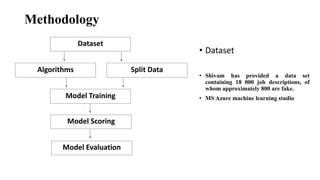
Methodology
• Dataset
• Shivam has provided a data set
containing 18 000 job descriptions, of
whom approximately 800 are fake.
• MS Azure machine learning studio
Dataset
Algorithms Split Data
Model Training
Model Scoring
Model Evaluation
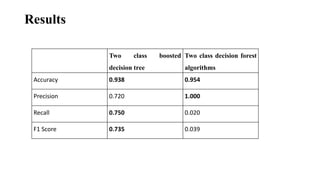
Results
Two class boosted
decision tree
Two class decision forest
algorithms
Accuracy 0.938 0.954
Precision 0.720 1.000
Recall 0.750 0.020
F1 Score 0.735 0.039
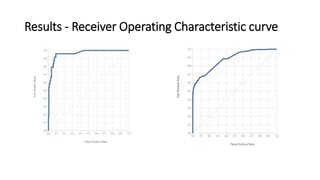
Results - Receiver Operating Characteristic curve
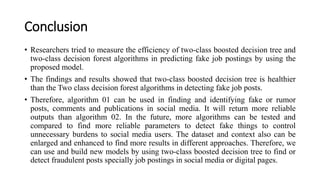
Conclusion
• Researchers tried to measure the efficiency of two-class boosted decision tree and
two-class decision forest algorithms in predicting fake job postings by using the
proposed model.
• The findings and results showed that two-class boosted decision tree is healthier
than the Two class decision forest algorithms in detecting fake job posts.
• Therefore, algorithm 01 can be used in finding and identifying fake or rumor
posts, comments and publications in social media. It will return more reliable
outputs than algorithm 02. In the future, more algorithms can be tested and
compared to find more reliable parameters to detect fake things to control
unnecessary burdens to social media users. The dataset and context also can be
enlarged and enhanced to find more results in different approaches. Therefore, we
can use and build new models by using two-class boosted decision tree to find or
detect fraudulent posts specially job postings in social media or digital pages.

Predicting Fake Job Posts

  • 1.
    Performance comparison ofTwo class boosted decision tree and Two class decision forest algorithms in predicting fake job postings FHA. Shibly1, Uzzal Sharma2 and HMM. Naleer3 Presented By :- FHA. Shibly Senior Lecturer, South Eastern University of Sri Lanka Ph.D. Candidate, Assam Don Bosco University, India
  • 2.
    Introduction – FakeJob Postings Many businesses prefer to post their vacancies electronically so that job applicants can access them quickly and timely. But this purpose may be one form of scam on the part of the fraud individuals because they give job applicants during terms of taking money from them or collecting their personal information for involving in cybercrimes. Fake job posting advertisements can be written against a reputable firm for breaching its reputation. The fraudulent post-detection work draws proper attention to obtaining an automated tool to identify fake jobs and report them to people to avoid applying for such situations. At present, many machine learning algorithms have been used to detect such fraudulent posts. But, the performance of such algorithms to be measured and compared to find a proper algorithm to incorporate in identifying fake things
  • 3.
    Introduction – MachineLearning • Two class boosted decision tree and Two class decision forest algorithms are widely used. A boosted decision tree is an ensemble learning method in which the second tree corrects for the errors of the first tree, the third tree corrects for the errors of the first and second trees, and so forth. Predictions are based on the entire ensemble of trees together that makes the prediction. • Decision forests are fast, supervised ensemble models. This module is a good choice if you want to predict a target with a maximum of two outcomes.
  • 4.
    Methodology • Dataset • Shivamhas provided a data set containing 18 000 job descriptions, of whom approximately 800 are fake. • MS Azure machine learning studio Dataset Algorithms Split Data Model Training Model Scoring Model Evaluation
  • 5.
    Results Two class boosted decisiontree Two class decision forest algorithms Accuracy 0.938 0.954 Precision 0.720 1.000 Recall 0.750 0.020 F1 Score 0.735 0.039
  • 6.
    Results - ReceiverOperating Characteristic curve
  • 7.
    Conclusion • Researchers triedto measure the efficiency of two-class boosted decision tree and two-class decision forest algorithms in predicting fake job postings by using the proposed model. • The findings and results showed that two-class boosted decision tree is healthier than the Two class decision forest algorithms in detecting fake job posts. • Therefore, algorithm 01 can be used in finding and identifying fake or rumor posts, comments and publications in social media. It will return more reliable outputs than algorithm 02. In the future, more algorithms can be tested and compared to find more reliable parameters to detect fake things to control unnecessary burdens to social media users. The dataset and context also can be enlarged and enhanced to find more results in different approaches. Therefore, we can use and build new models by using two-class boosted decision tree to find or detect fraudulent posts specially job postings in social media or digital pages.