Fake Social Media Profile Detection
Team Members :
•Pratik Bhosale
•Omkar Chalke
•Kunal Ghadi
•Harsh Malap
Mentor : Prof. Kanchan Doke
Index
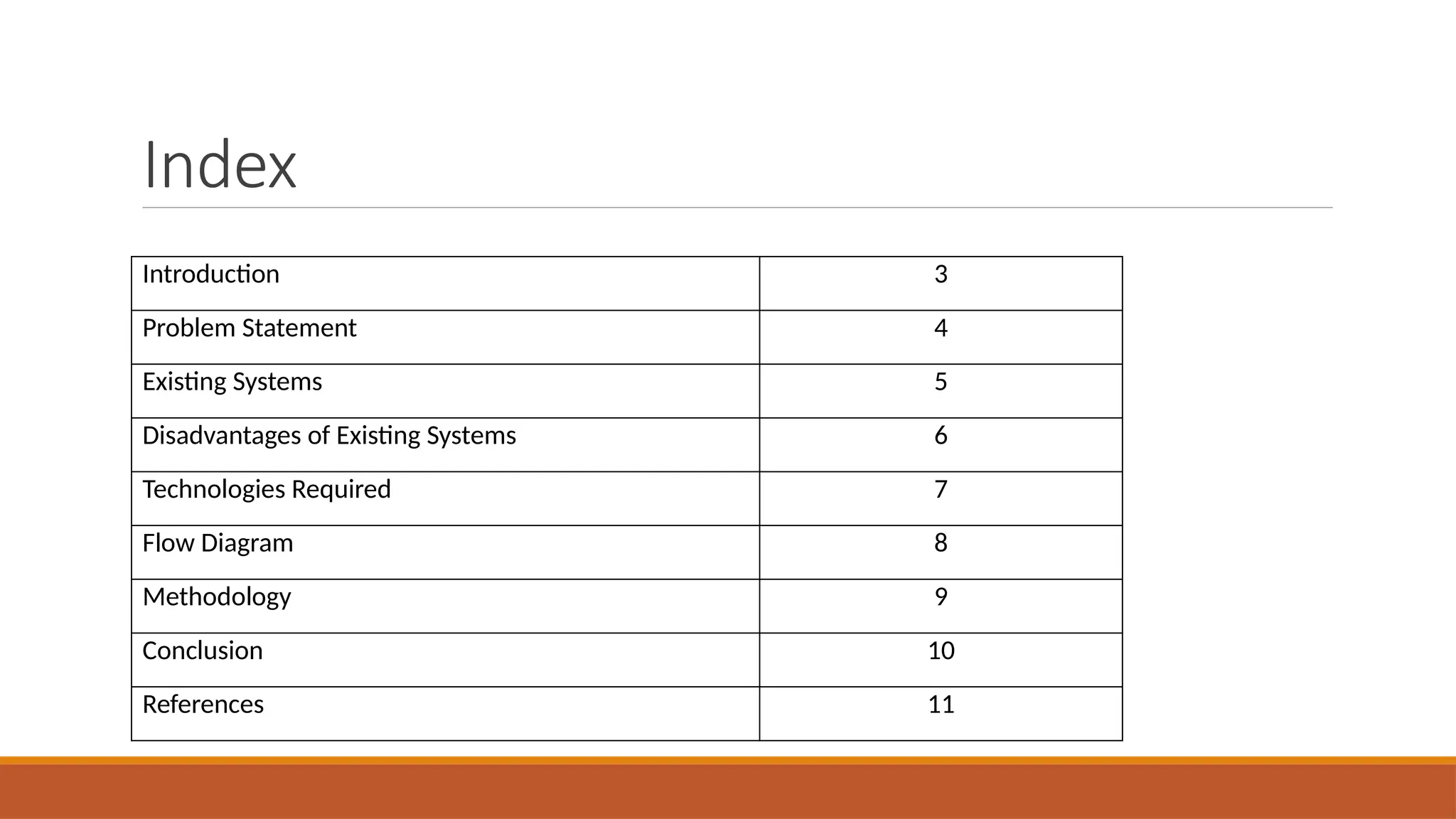
Introduction 3
Problem Statement 4
Existing Systems 5
Disadvantages of Existing Systems 6
Technologies Required 7
Flow Diagram 8
Methodology 9
Conclusion 10
References 11
Introduction
In the digital age, social media has become an integral part of our lives, connecting people
across the globe. However, the rise of social media platforms has also given way to the
proliferation of fake profiles. These fake profiles can have detrimental effects, including
spreading misinformation, conducting fraudulent activities, and compromising user privacy.
Detecting and mitigating fake social media profiles is crucial to maintaining the integrity and
trustworthiness of these platforms. This project aims to develop a robust system to identify and
flag fake profiles using advanced machine learning algorithms and data analysis techniques,
thereby enhancing the safety and reliability of social media interactions.
Problem Statement
1) Proliferation of fake social media profiles is a growing concern.
2) Fake profiles are used for malicious activities, including : spreading misinformation,
conduction phishing attacks, commiting identity theft and manipulating public opinion.
3) These activities undermine the credibility of social media platforms.
4) Traditional detection methods are often inadequate, relying on : manual review and
simplistic algorithms.
5) There is an urgent need for an advanced, automated system to : Accurately identify fake
profiles, mitigate security risks and ensure a safer and more trustworthy online environment.
Existing System
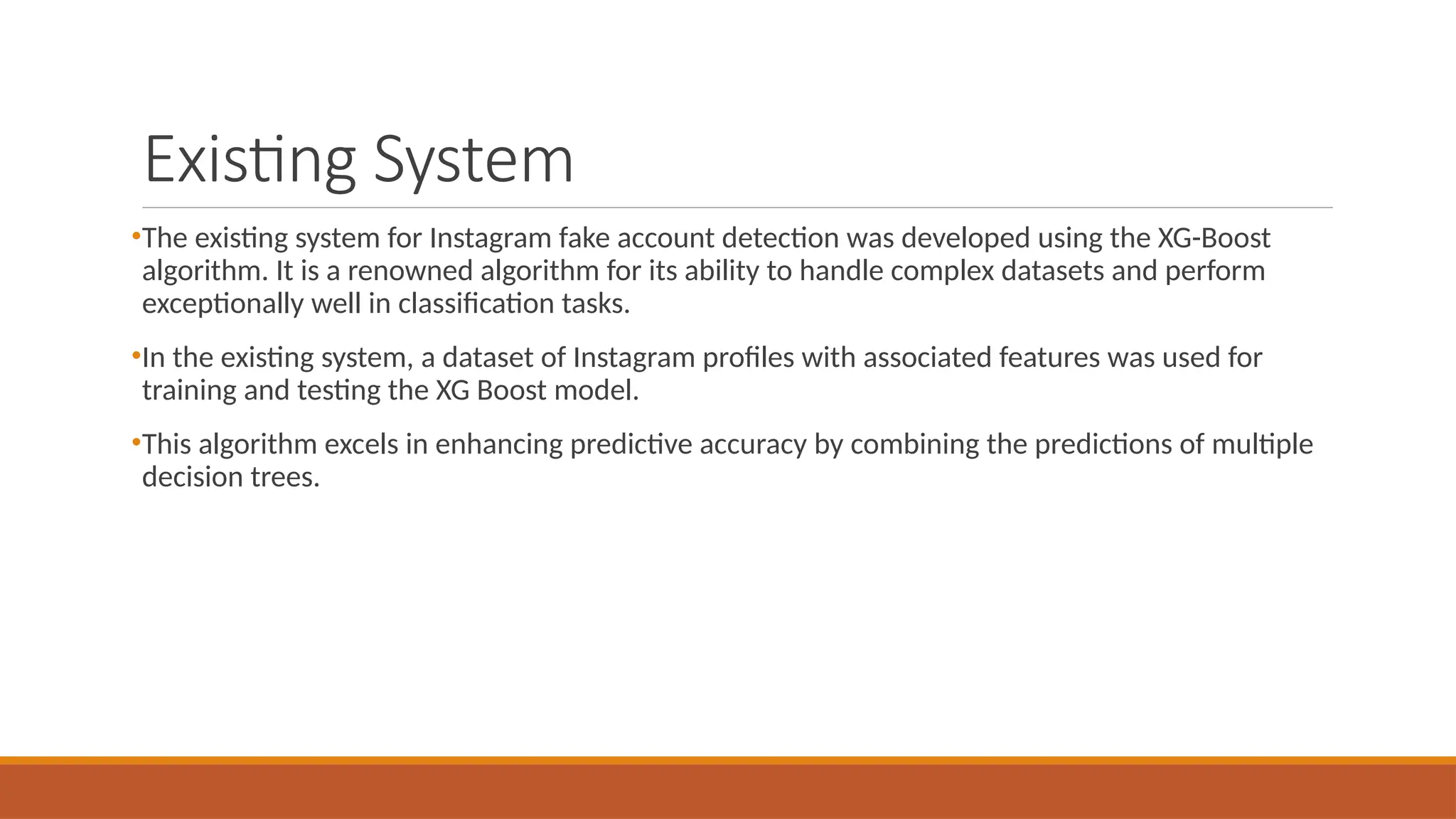
•The existing system for Instagram fake account detection was developed using the XG-Boost
algorithm. It is a renowned algorithm for its ability to handle complex datasets and perform
exceptionally well in classification tasks.
•In the existing system, a dataset of Instagram profiles with associated features was used for
training and testing the XG Boost model.
•This algorithm excels in enhancing predictive accuracy by combining the predictions of multiple
decision trees.
Disadvantages of Existing System
•Limited explanation of Predictions : The XG boost algorithm is often considered as ‘black box’
model, making it challenging to provide detailed explanations for its predictions. This lack of
transparency can be a disadvantage when users need to understand why a profile is flagged as
fake.
•Sensitivity to imbalanced datasets : Like many machine learning algorithms, this algorithm can
be sensitive to imbalance datasets.
•Resource Intensiveness : This algorithm can be computationally intensive, especially for large
datasets. This can lead to longer training and inference times.
Technologies Required :
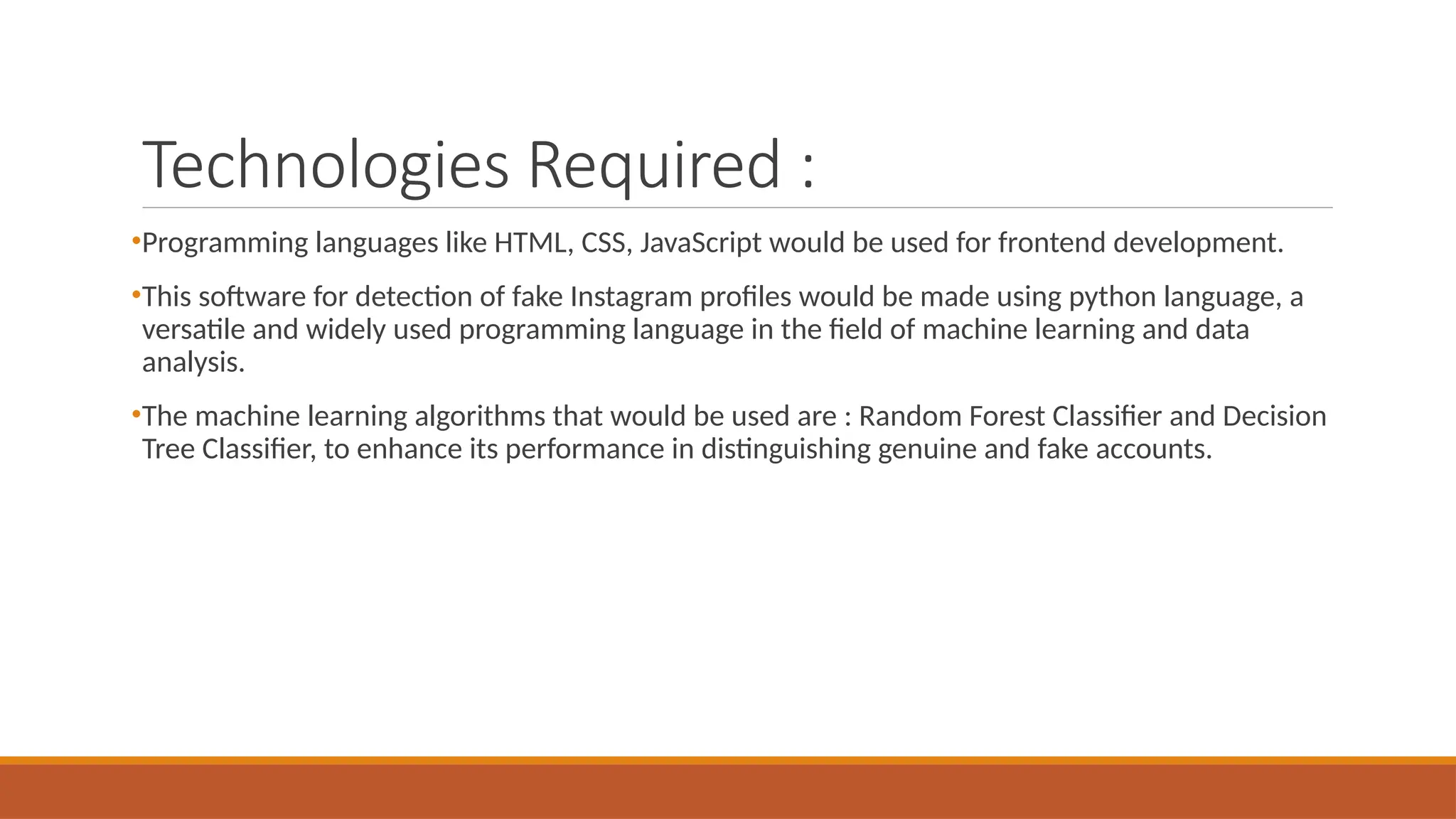
•Programming languages like HTML, CSS, JavaScript would be used for frontend development.
•This software for detection of fake Instagram profiles would be made using python language, a
versatile and widely used programming language in the field of machine learning and data
analysis.
•The machine learning algorithms that would be used are : Random Forest Classifier and Decision
Tree Classifier, to enhance its performance in distinguishing genuine and fake accounts.
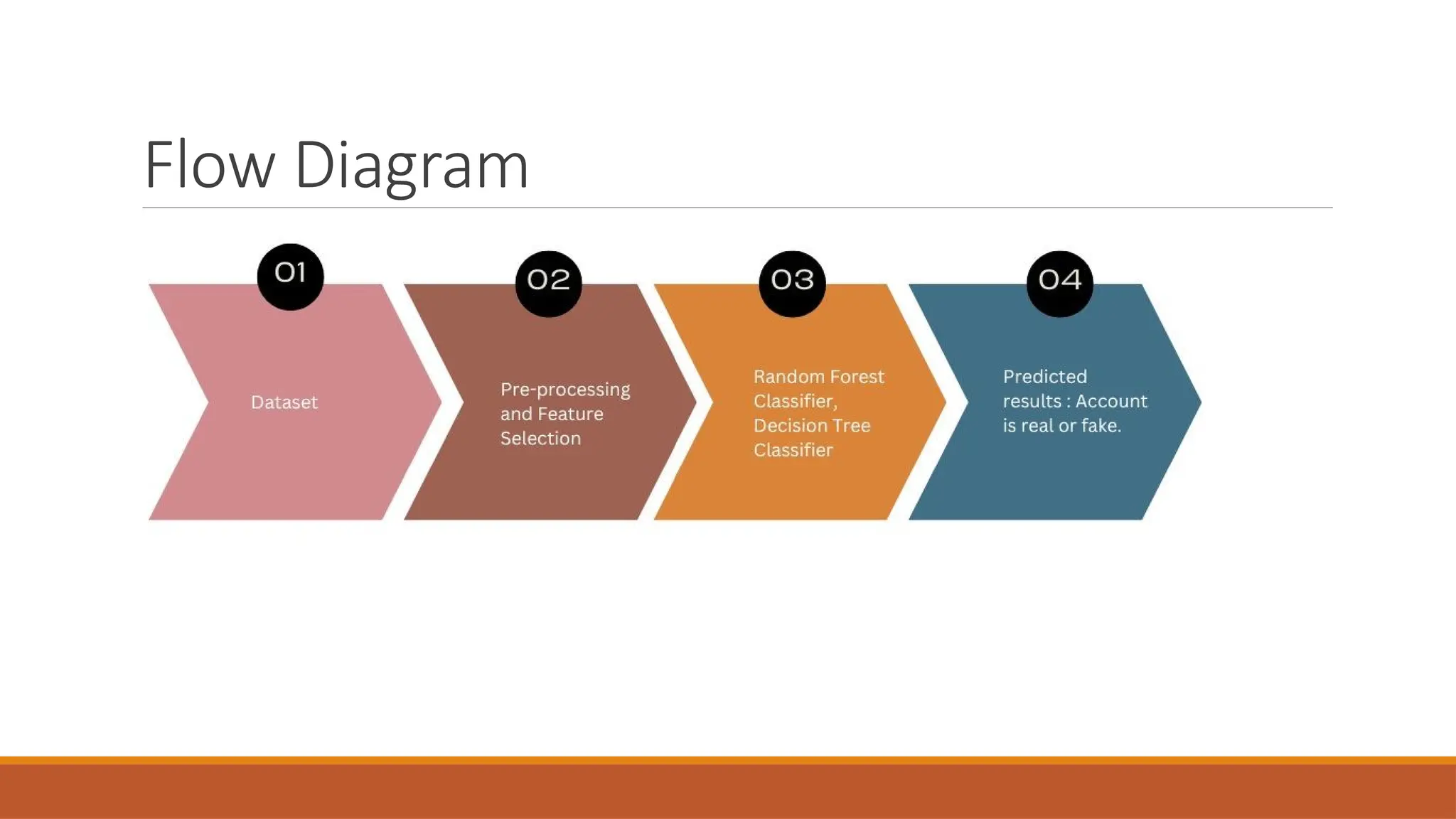
Flow Diagram
Methodology
1. Data Collection : Gather datasets of both legitimate and fake social media profiles.
2. Feature Extraction : Identify key features of fake profiles such as characters used in username,
profile age, number of followers, etc.
3. Data preprocessing : Split data into training and testing sets.
4. Model Selection and Training : Choose and train suitable machine learning algorithms like
Random Forest and Decision Tree.
5. Model Evaluation : Evaluate the accuracy of prediction of these models.
6. Implementation : Develop a user interface for users to enter profile details and know if the
profile is real or fake.
7. Maintenance and Updates : The model can be evolved to implement features for users to report
and gather additional data on suspicious profiles.
Conclusion
•The detection and mitigation of fake social media profiles is critical for ensuring the integrity and
safety of online interactions. Our proposed solution leverages advanced machine learning
algorithms, to effectively identify and flag fraudulent accounts. By implementing this system,
social media platforms can significantly reduce the prevalence of fake profiles, enhancing user
trust and platform credibility. Future work will focus on continuously improving the detection
algorithms and adapting to new tactics used by malicious actors.
References
•Dr. M. Sirish Kumar, Dr Jasmine Sabeena, Konduru Manasa Veena, Kummari Pavan, Malepati
Sukavya, Kundavaram Sravanthi, “Fake Profile Detection on Social Networking Websites using
Machine Learning”, 2023 International Conference on Sustainable Computing and Smart
Systems (ICSCSS), IEEE Conference, 2023
•Information Warfare: The Role of Social Media in Conflict. UNT Digital Library.
https://digital.library.unt.edu/ark:/67531/metadc503647.
•The 15 Biggest Social Media Sites and Apps [2022]. Dreamgrow.
https://www.dreamgrow.com/top-15-most-popular-social-networking-sites.
•Dudatiev, A. V. (2017). Complex information security of STS: models of influence and
protection : monography. VNTU.

Fake Social Media Profile Detection.pptx

  • 1.
    Fake Social MediaProfile Detection Team Members : •Pratik Bhosale •Omkar Chalke •Kunal Ghadi •Harsh Malap Mentor : Prof. Kanchan Doke
  • 2.
    Index Introduction 3 Problem Statement4 Existing Systems 5 Disadvantages of Existing Systems 6 Technologies Required 7 Flow Diagram 8 Methodology 9 Conclusion 10 References 11
  • 3.
    Introduction In the digitalage, social media has become an integral part of our lives, connecting people across the globe. However, the rise of social media platforms has also given way to the proliferation of fake profiles. These fake profiles can have detrimental effects, including spreading misinformation, conducting fraudulent activities, and compromising user privacy. Detecting and mitigating fake social media profiles is crucial to maintaining the integrity and trustworthiness of these platforms. This project aims to develop a robust system to identify and flag fake profiles using advanced machine learning algorithms and data analysis techniques, thereby enhancing the safety and reliability of social media interactions.
  • 4.
    Problem Statement 1) Proliferationof fake social media profiles is a growing concern. 2) Fake profiles are used for malicious activities, including : spreading misinformation, conduction phishing attacks, commiting identity theft and manipulating public opinion. 3) These activities undermine the credibility of social media platforms. 4) Traditional detection methods are often inadequate, relying on : manual review and simplistic algorithms. 5) There is an urgent need for an advanced, automated system to : Accurately identify fake profiles, mitigate security risks and ensure a safer and more trustworthy online environment.
  • 5.
    Existing System •The existingsystem for Instagram fake account detection was developed using the XG-Boost algorithm. It is a renowned algorithm for its ability to handle complex datasets and perform exceptionally well in classification tasks. •In the existing system, a dataset of Instagram profiles with associated features was used for training and testing the XG Boost model. •This algorithm excels in enhancing predictive accuracy by combining the predictions of multiple decision trees.
  • 6.
    Disadvantages of ExistingSystem •Limited explanation of Predictions : The XG boost algorithm is often considered as ‘black box’ model, making it challenging to provide detailed explanations for its predictions. This lack of transparency can be a disadvantage when users need to understand why a profile is flagged as fake. •Sensitivity to imbalanced datasets : Like many machine learning algorithms, this algorithm can be sensitive to imbalance datasets. •Resource Intensiveness : This algorithm can be computationally intensive, especially for large datasets. This can lead to longer training and inference times.
  • 7.
    Technologies Required : •Programminglanguages like HTML, CSS, JavaScript would be used for frontend development. •This software for detection of fake Instagram profiles would be made using python language, a versatile and widely used programming language in the field of machine learning and data analysis. •The machine learning algorithms that would be used are : Random Forest Classifier and Decision Tree Classifier, to enhance its performance in distinguishing genuine and fake accounts.
  • 8.
  • 9.
    Methodology 1. Data Collection: Gather datasets of both legitimate and fake social media profiles. 2. Feature Extraction : Identify key features of fake profiles such as characters used in username, profile age, number of followers, etc. 3. Data preprocessing : Split data into training and testing sets. 4. Model Selection and Training : Choose and train suitable machine learning algorithms like Random Forest and Decision Tree. 5. Model Evaluation : Evaluate the accuracy of prediction of these models. 6. Implementation : Develop a user interface for users to enter profile details and know if the profile is real or fake. 7. Maintenance and Updates : The model can be evolved to implement features for users to report and gather additional data on suspicious profiles.
  • 10.
    Conclusion •The detection andmitigation of fake social media profiles is critical for ensuring the integrity and safety of online interactions. Our proposed solution leverages advanced machine learning algorithms, to effectively identify and flag fraudulent accounts. By implementing this system, social media platforms can significantly reduce the prevalence of fake profiles, enhancing user trust and platform credibility. Future work will focus on continuously improving the detection algorithms and adapting to new tactics used by malicious actors.
  • 11.
    References •Dr. M. SirishKumar, Dr Jasmine Sabeena, Konduru Manasa Veena, Kummari Pavan, Malepati Sukavya, Kundavaram Sravanthi, “Fake Profile Detection on Social Networking Websites using Machine Learning”, 2023 International Conference on Sustainable Computing and Smart Systems (ICSCSS), IEEE Conference, 2023 •Information Warfare: The Role of Social Media in Conflict. UNT Digital Library. https://digital.library.unt.edu/ark:/67531/metadc503647. •The 15 Biggest Social Media Sites and Apps [2022]. Dreamgrow. https://www.dreamgrow.com/top-15-most-popular-social-networking-sites. •Dudatiev, A. V. (2017). Complex information security of STS: models of influence and protection : monography. VNTU.