INTRODUCTION/OVERVIEW
Fake jobposting detection is the process of identifying
whether a job advertisement is real or fraudulent. It involves
analyzing the content of job posts to spot misleading or scam-
related patterns. Techniques like Natural Language
Processing (NLP) and machine learning help in detecting
suspicious language and behavior. This protects job seekers
from fraud and improves trust in job platforms. The goal is to
automatically classify job posts as either real or fake.
5.
Problem statement
• Risein fraudulent job postings on job portals.
• Job seekers fall for fake offers, leading to data or
money loss.
Objective
• Accurately classify job postings as real or fake job posting
• Train ML models to classify jobs as real or fake.
• Build a user-friendly system to help detect fraud.
• Continuously update the model to adapt to new tactics used in fake job
postings.
6.
Motivation / UseCase
• Online job fraud is increasing, with fake job postings targeting job seekers for identity theft, financial scams,
and phishing
• Costly Consequences means Victims can lose money, compromise personal data, and
also damage to professional life
Why is Detection Important?
7.
Who benefits ?
•It is benefits to some stockholder like job seekers to protect from job scams and Recruitment
Platforms (e.g., LinkedIn, Indeed) for trust on user
Some use cases
• Real-TimeAlerts to job seekers when a potential scam is detected.
• Data-Driven Insights to improve trust and safety across hiring ecosystems.
8.
Existing system
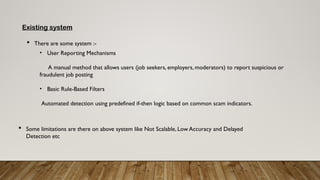
Thereare some system :-
• User Reporting Mechanisms
A manual method that allows users (job seekers, employers, moderators) to report suspicious or
fraudulent job posting
• Basic Rule-Based Filters
Automated detection using predefined if-then logic based on common scam indicators.
Some limitations are there on above system like Not Scalable, Low Accuracy and Delayed
Detection etc
9.
Proposed system
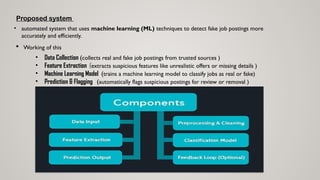
• automatedsystem that uses machine learning (ML) techniques to detect fake job postings more
accurately and efficiently.
Working of this
• Data Collection (collects real and fake job postings from trusted sources )
• Feature Extraction (extracts suspicious features like unrealistic offers or missing details )
• Machine Learning Model (trains a machine learning model to classify jobs as real or fake)
• Prediction & Flagging (automatically flags suspicious postings for review or removal )
Modules
Data CollectionModule
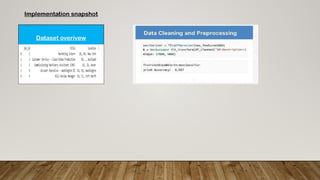
Data Preprocessing Module
Feature Extraction Module
Machine Learning Module
Category Tools /Technologies
Languages Python
Libraries Pandas, NumPy, Scikit-learn, NLTK, Matplotlib
ML Algorithms Logistic Regression, Random Forest, etc
Visualization Matplotlib, Seaborn
Tools and technologies
13.
Future scope
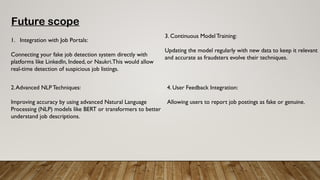
1. Integrationwith Job Portals:
Connecting your fake job detection system directly with
platforms like LinkedIn, Indeed, or Naukri.This would allow
real-time detection of suspicious job listings.
2.Advanced NLP Techniques:
Improving accuracy by using advanced Natural Language
Processing (NLP) models like BERT or transformers to better
understand job descriptions.
3. Continuous Model Training:
Updating the model regularly with new data to keep it relevant
and accurate as fraudsters evolve their techniques.
4. User Feedback Integration:
Allowing users to report job postings as fake or genuine.