MODERATOR – DR M. L. BARMAN 
PRESENTED BY- DR. NISHANT PRABHAKAR 
DEPT OF PEDIATRICS NSCB MCH JABALPUR(M. P.)
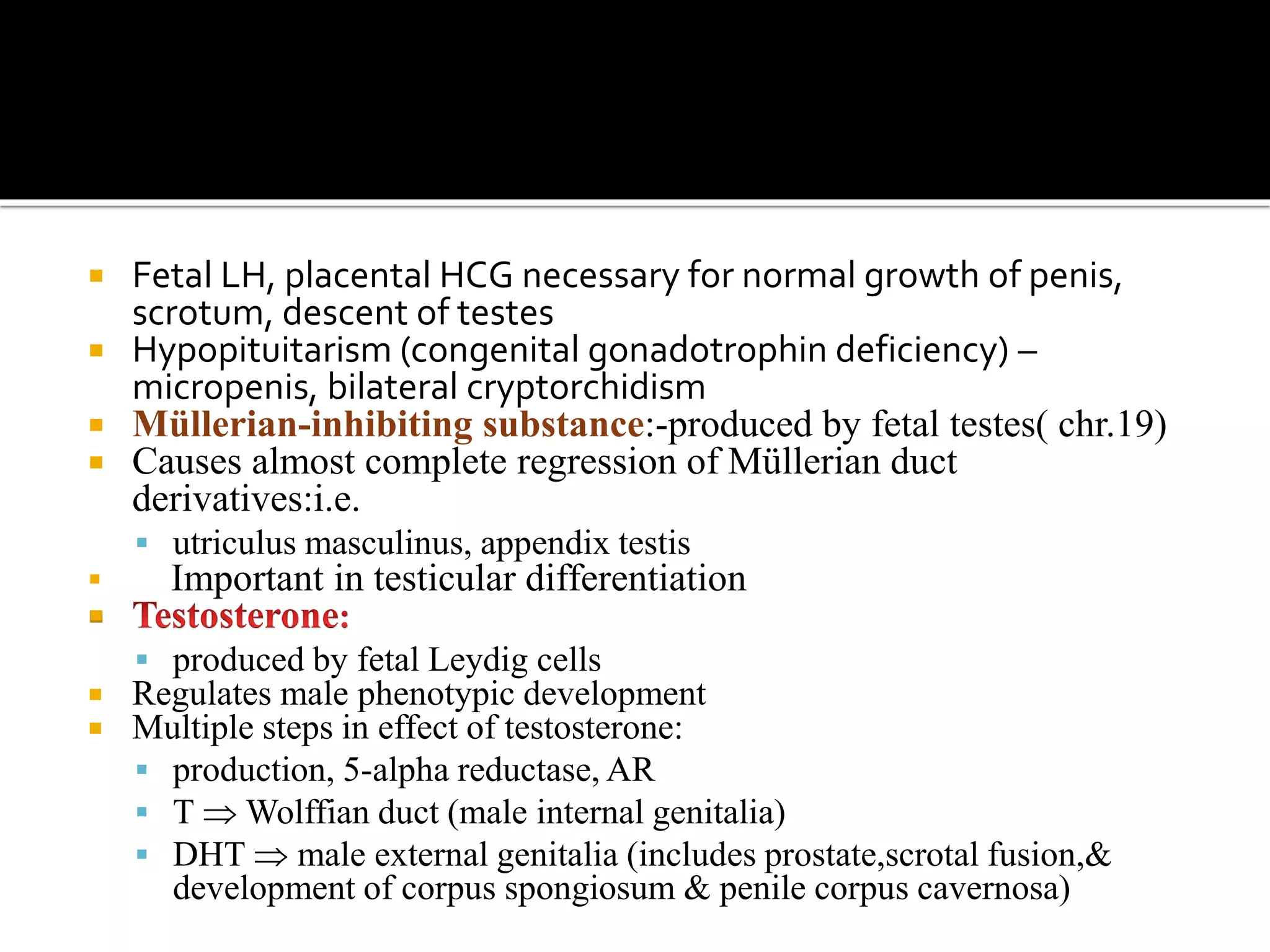
 Germ cells arise from celomic epithelium of hindgut & migrate into gonadal ridge at 4-6 weeks of gestation. These cells combine with somatic 
cells to give rise to bipotential gonads 
 1-undeferentiated stage (4-8 wk) 
 genital tubercle (phalus) 
 labioscrotal swellings 
 urogenital folds 
 urogenital sinus 
 45XO embryo the ovaries develop but undergo atresia 
  streak ovaries 
 Gonadal differentiation at 6-8 wk gestation 
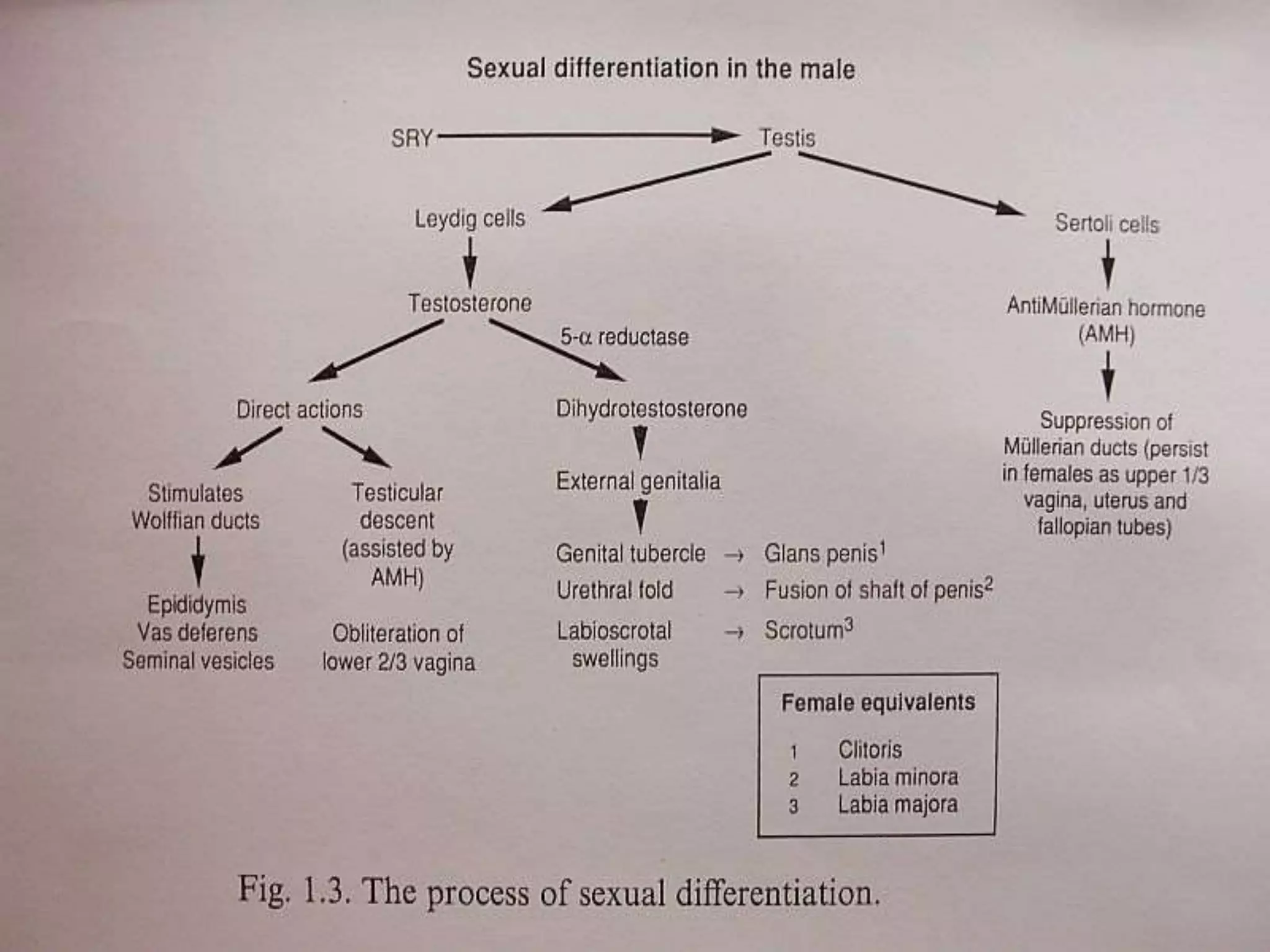
 TDF gene ie SRY gene(Y-chromosome): 
 stimulates gonads towards testicular differentiation 
 Absence of TDF: gonads differentiate into ovaries 
 Wolffian duct from mesonephros 
 Müllerian duct from coelomic epithelium 
 Endocrine effect during this phase is crucial: 
 paracrine action of hormones produced by ipsilateral gonad 
 testis (MIS, T)  male internal genitalia 
 ovary (nil)  female internal genitalia
 Fetal LH, placental HCG necessary for normal growth of penis, 
scrotum, descent of testes 
 Hypopituitarism (congenital gonadotrophin deficiency) – 
micropenis, bilateral cryptorchidism 
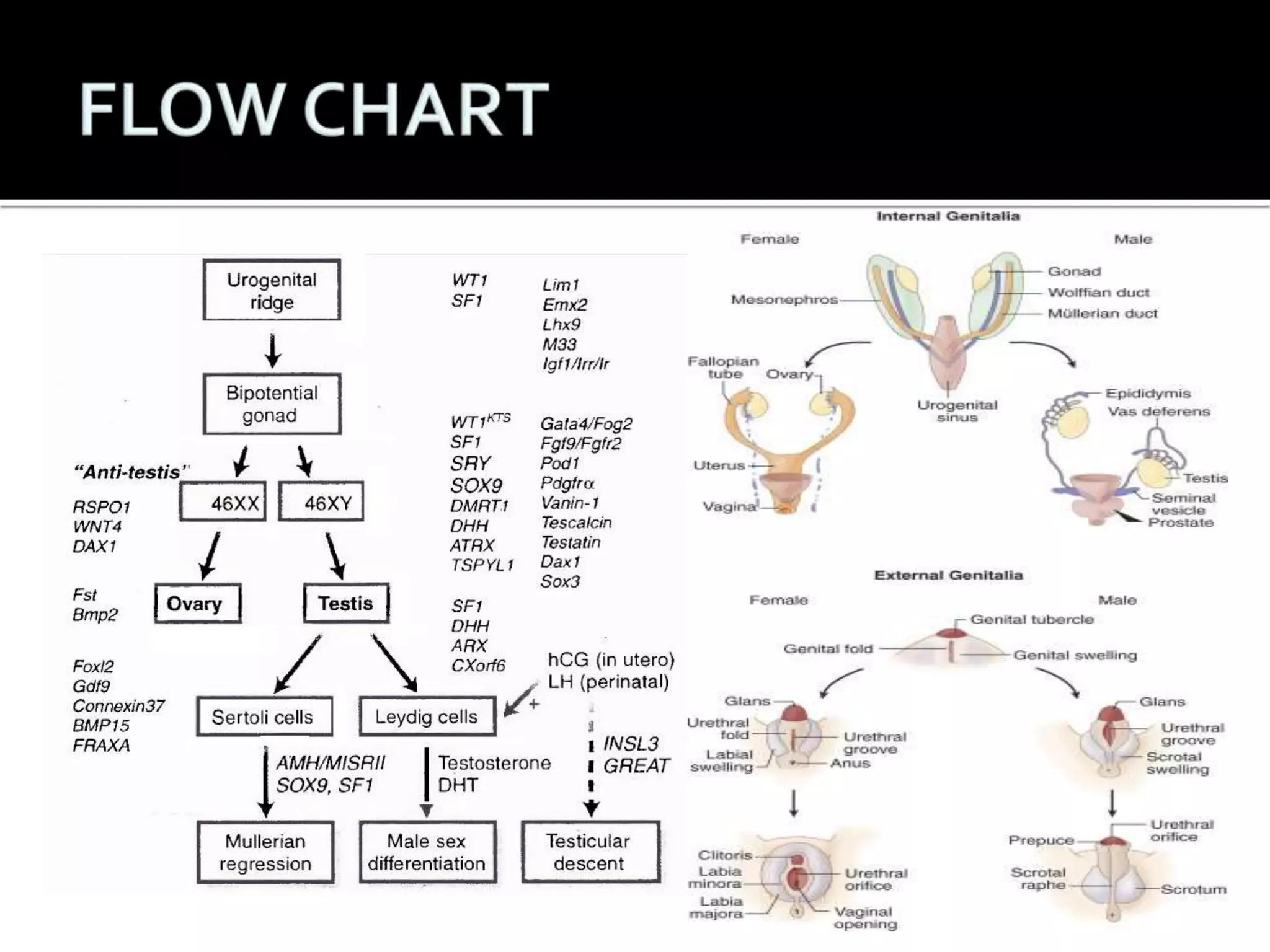
 Müllerian-inhibiting substance:-produced by fetal testes( chr.19) 
 Causes almost complete regression of Müllerian duct 
derivatives:i.e. 
 utriculus masculinus, appendix testis 
 Important in testicular differentiation 
 
 produced by fetal Leydig cells 
 Regulates male phenotypic development 
 Multiple steps in effect of testosterone: 
 production, 5-alpha reductase, AR 
 T Wolffian duct (male internal genitalia) 
 DHT  male external genitalia (includes prostate,scrotal fusion,& 
development of corpus spongiosum & penile corpus cavernosa)
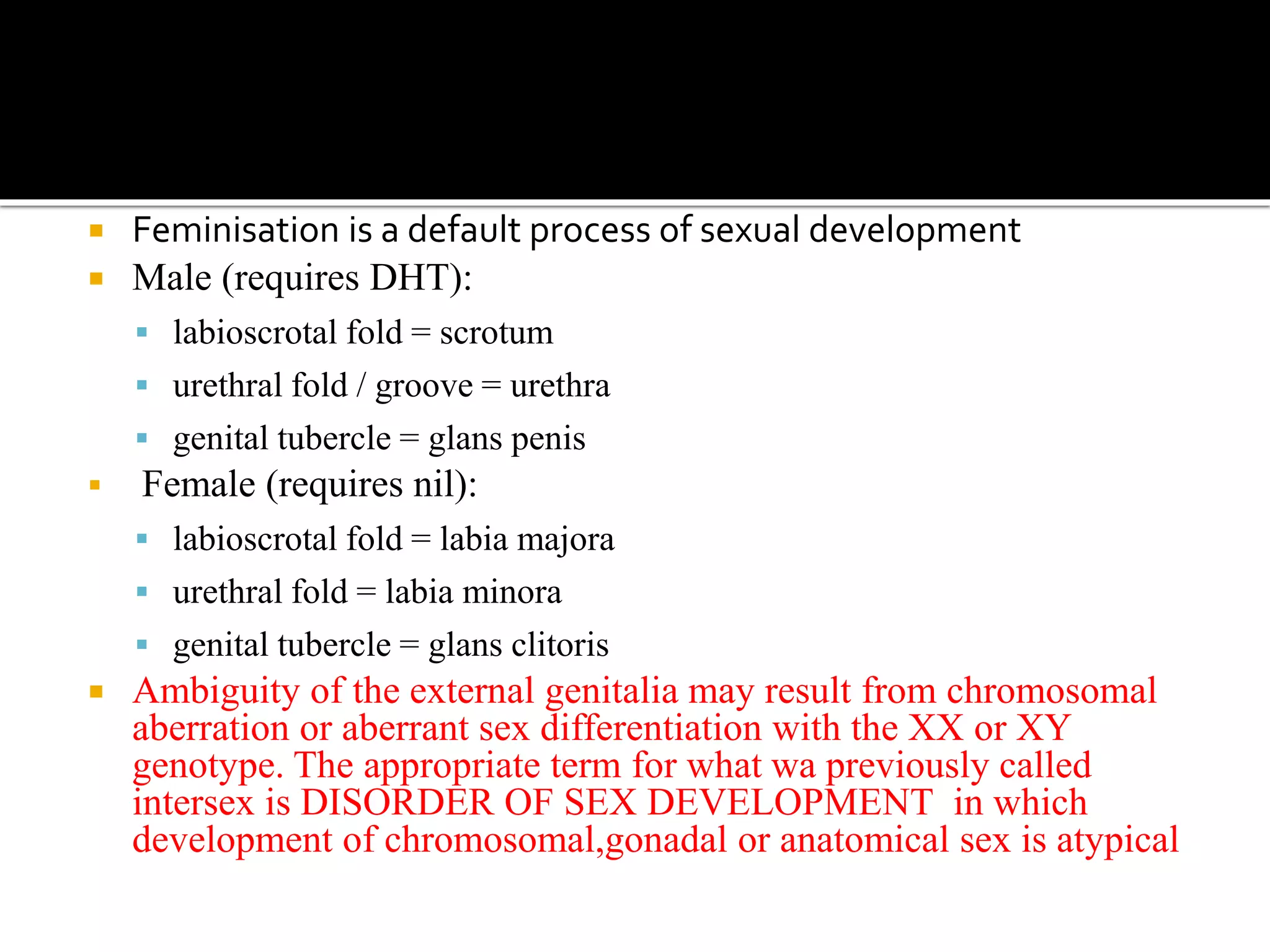
 Feminisation is a default process of sexual development 
 Male (requires DHT): 
 labioscrotal fold = scrotum 
 urethral fold / groove = urethra 
 genital tubercle = glans penis 
 Female (requires nil): 
 labioscrotal fold = labia majora 
 urethral fold = labia minora 
 genital tubercle = glans clitoris 
 Ambiguity of the external genitalia may result from chromosomal 
aberration or aberrant sex differentiation with the XX or XY 
genotype. The appropriate term for what wa previously called 
intersex is DISORDER OF SEX DEVELOPMENT in which 
development of chromosomal,gonadal or anatomical sex is atypical
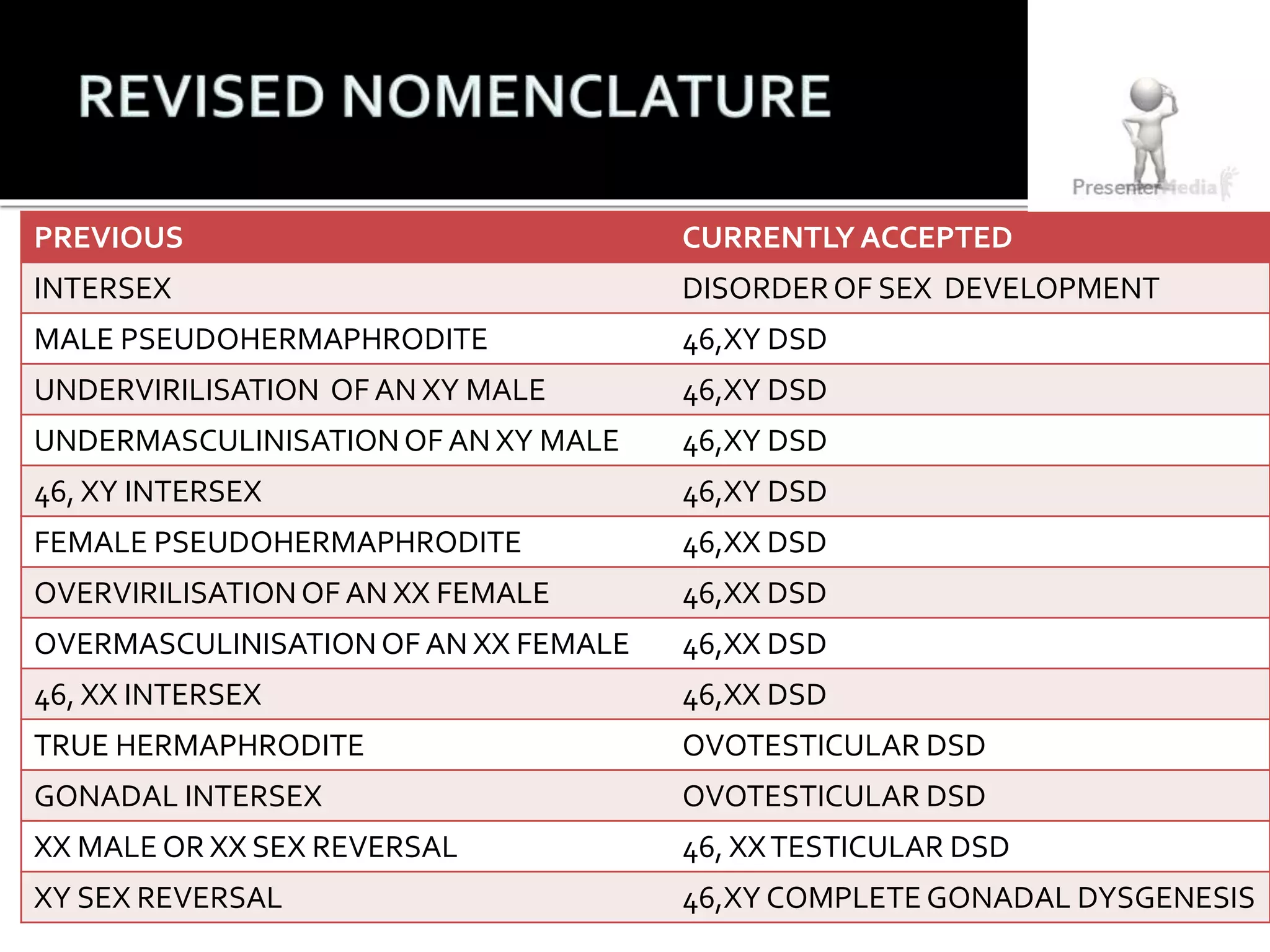
PREVIOUS CURRENTLY ACCEPTED 
INTERSEX DISORDEROF SEX DEVELOPMENT 
MALE PSEUDOHERMAPHRODITE 46,XY DSD 
UNDERVIRILISATION OF AN XY MALE 46,XY DSD 
UNDERMASCULINISATION OF AN XY MALE 46,XY DSD 
46, XY INTERSEX 46,XY DSD 
FEMALE PSEUDOHERMAPHRODITE 46,XX DSD 
OVERVIRILISATION OFAN XX FEMALE 46,XX DSD 
OVERMASCULINISATIONOF AN XX FEMALE 46,XX DSD 
46, XX INTERSEX 46,XX DSD 
TRUE HERMAPHRODITE OVOTESTICULAR DSD 
GONADAL INTERSEX OVOTESTICULAR DSD 
XX MALE OR XX SEX REVERSAL 46, XX TESTICULAR DSD 
XY SEX REVERSAL 46,XY COMPLETE GONADAL DYSGENESIS
 
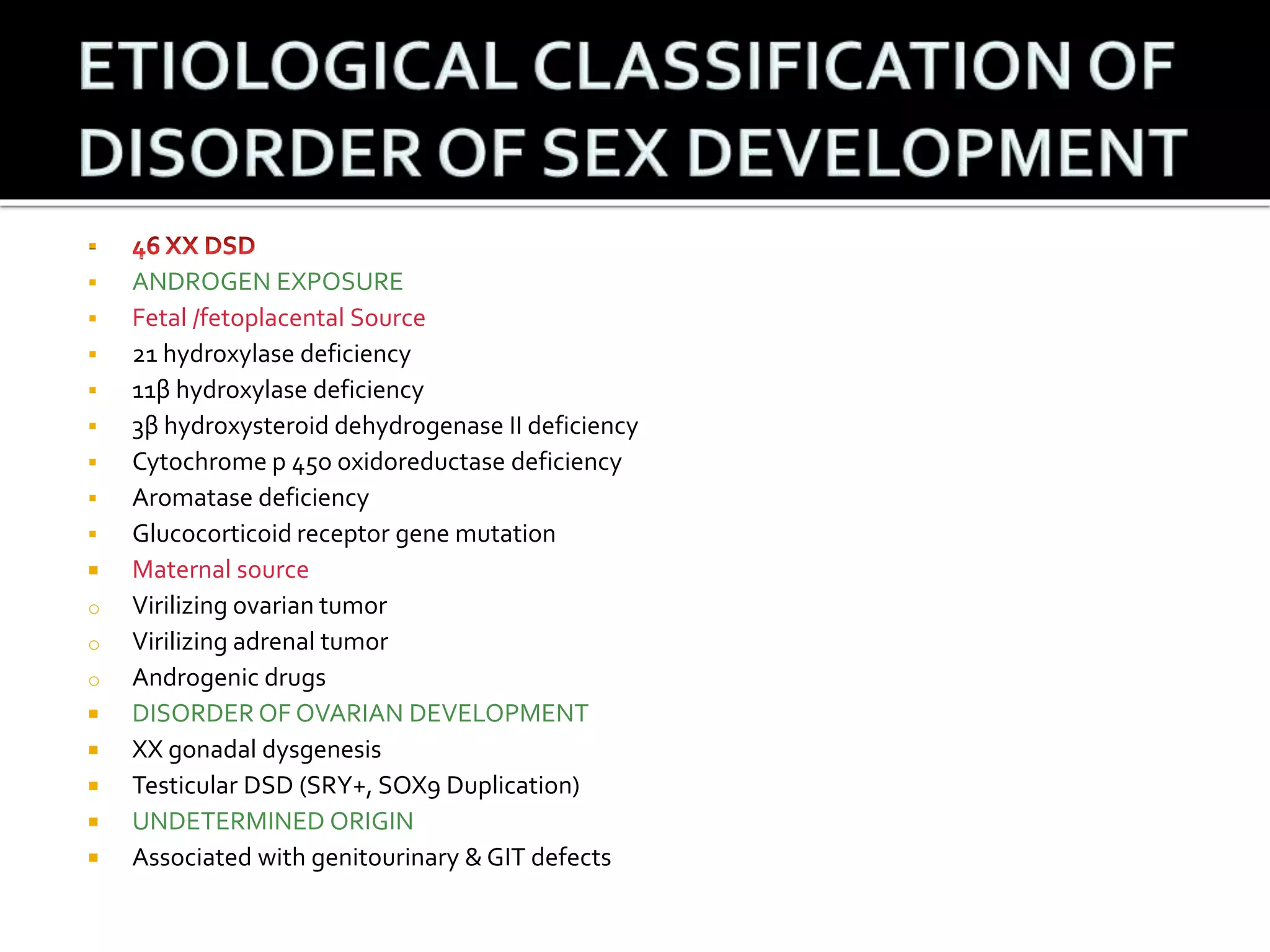
 ANDROGEN EXPOSURE 
 Fetal /fetoplacental Source 
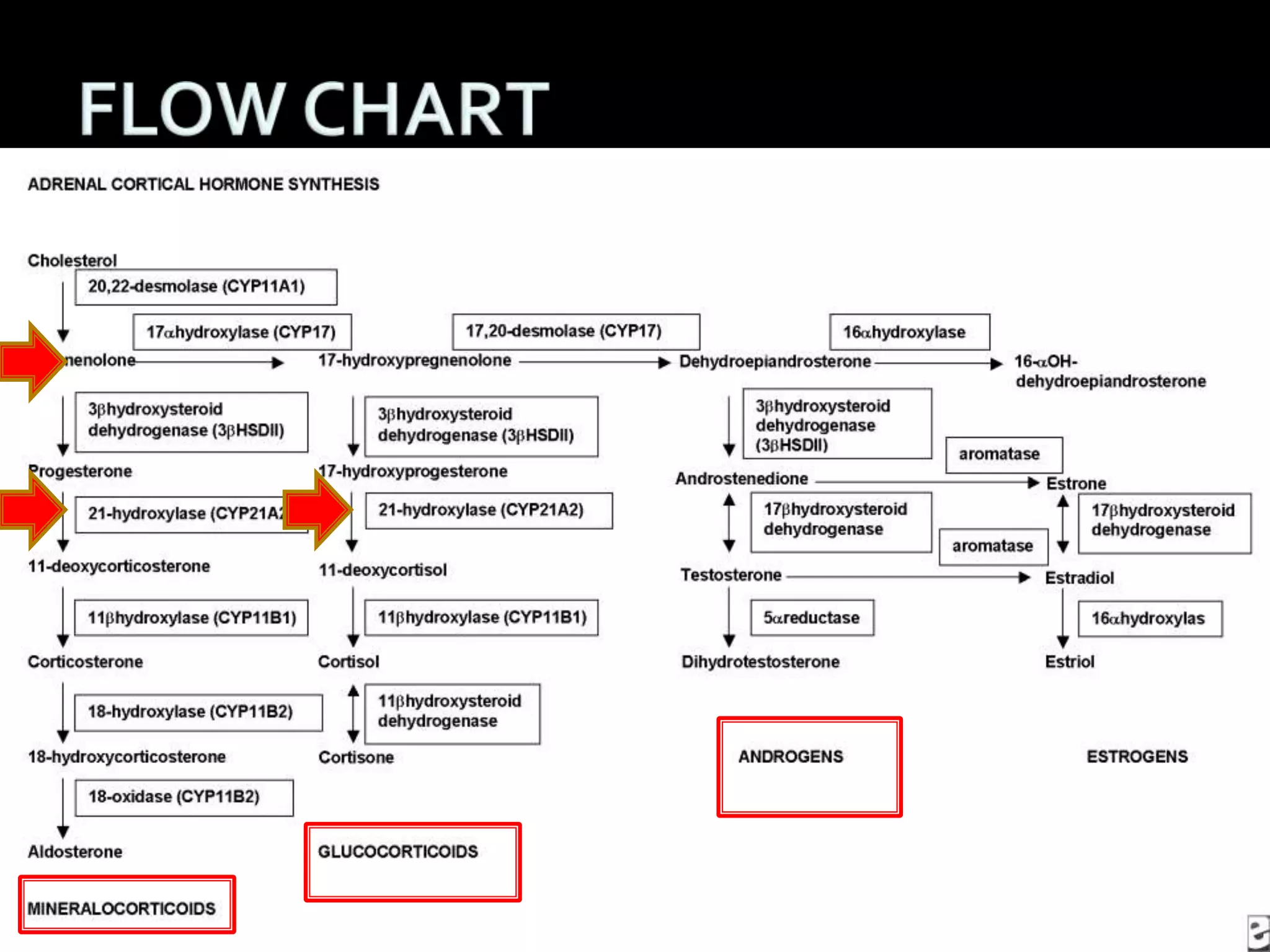
 21 hydroxylase deficiency 
 11β hydroxylase deficiency 
 3β hydroxysteroid dehydrogenase II deficiency 
 Cytochrome p 45o oxidoreductase deficiency 
 Aromatase deficiency 
 Glucocorticoid receptor gene mutation 
 Maternal source 
o Virilizing ovarian tumor 
o Virilizing adrenal tumor 
o Androgenic drugs 
 DISORDER OF OVARIAN DEVELOPMENT 
 XX gonadal dysgenesis 
 Testicular DSD (SRY+, SOX9 Duplication) 
 UNDETERMINED ORIGIN 
 Associated with genitourinary & GIT defects
 
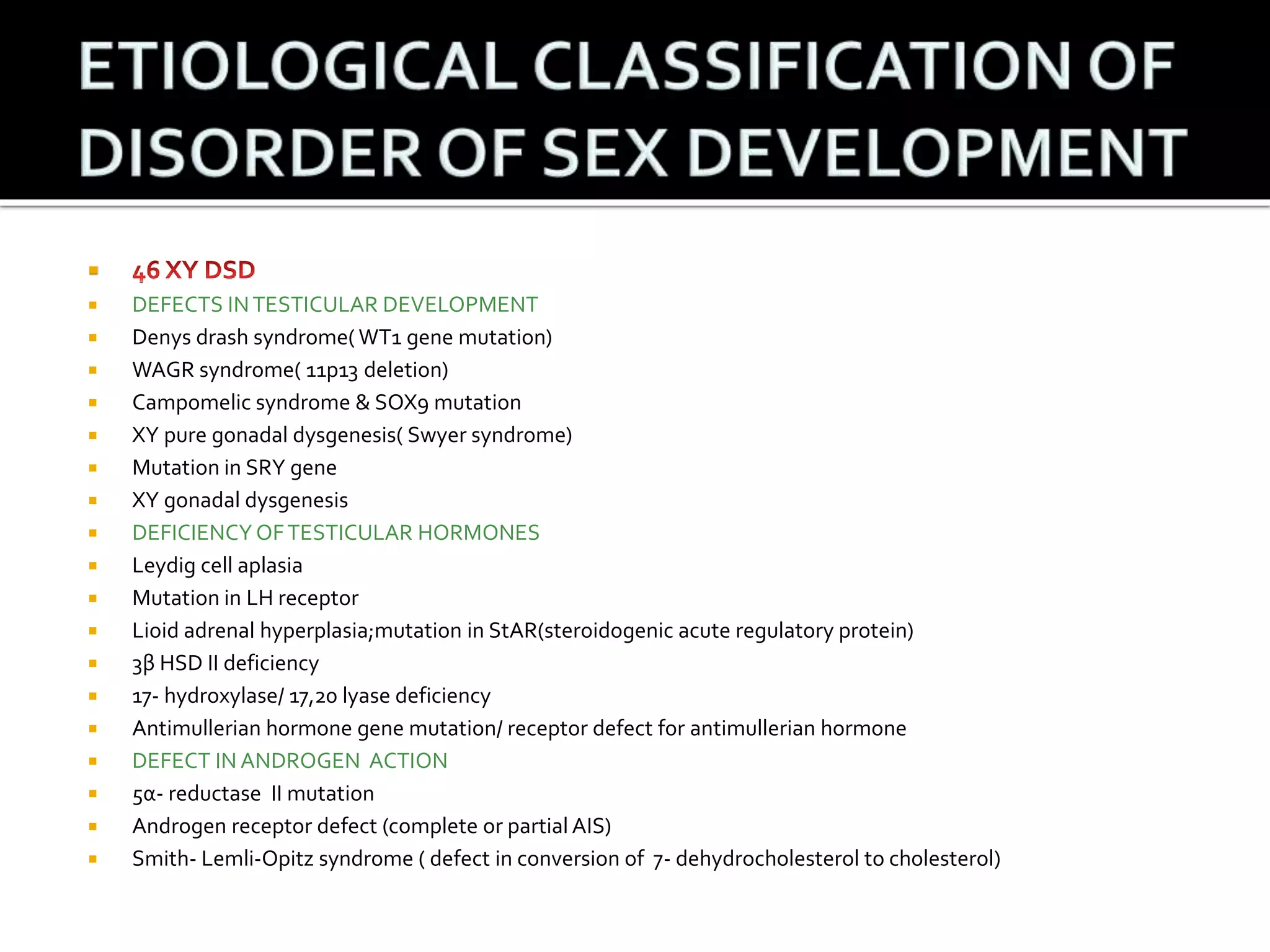
 DEFECTS IN TESTICULAR DEVELOPMENT 
 Denys drash syndrome( WT1 gene mutation) 
 WAGR syndrome( 11p13 deletion) 
 Campomelic syndrome & SOX9 mutation 
 XY pure gonadal dysgenesis( Swyer syndrome) 
 Mutation in SRY gene 
 XY gonadal dysgenesis 
 DEFICIENCY OF TESTICULAR HORMONES 
 Leydig cell aplasia 
 Mutation in LH receptor 
 Lioid adrenal hyperplasia;mutation in StAR(steroidogenic acute regulatory protein) 
 3β HSD II deficiency 
 17- hydroxylase/ 17,20 lyase deficiency 
 Antimullerian hormone gene mutation/ receptor defect for antimullerian hormone 
 DEFECT IN ANDROGEN ACTION 
 5α- reductase II mutation 
 Androgen receptor defect (complete or partial AIS) 
 Smith- Lemli-Opitz syndrome ( defect in conversion of 7- dehydrocholesterol to cholesterol)
 
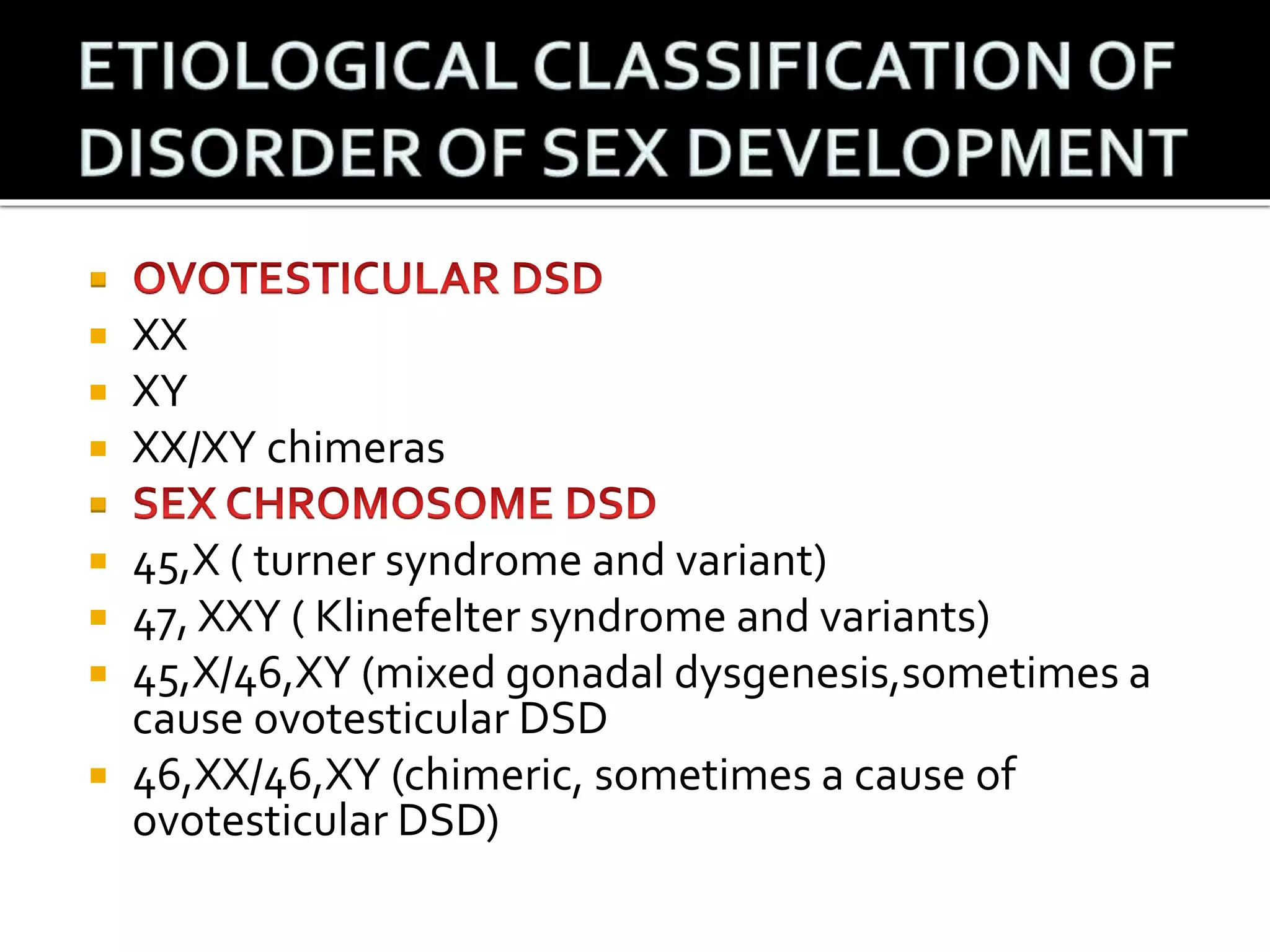
 XX 
 XY 
 XX/XY chimeras 
 
 45,X ( turner syndrome and variant) 
 47, XXY ( Klinefelter syndrome and variants) 
 45,X/46,XY (mixed gonadal dysgenesis,sometimes a 
cause ovotesticular DSD 
 46,XX/46,XY (chimeric, sometimes a cause of 
ovotesticular DSD)
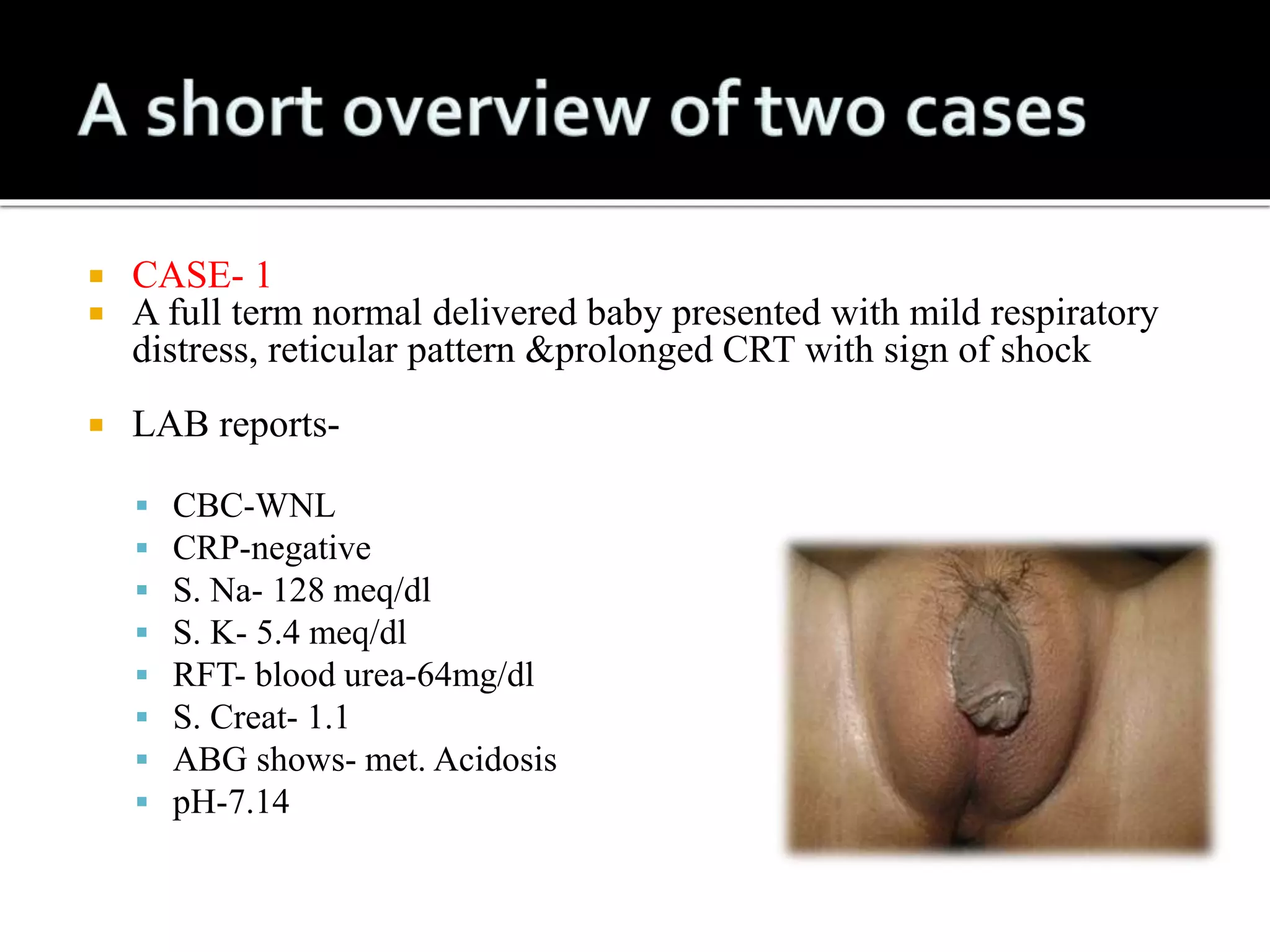
 CASE- 1 
 A full term normal delivered baby presented with mild respiratory 
distress, reticular pattern &prolonged CRT with sign of shock 
 LAB reports- 
 CBC-WNL 
 CRP-negative 
 S. Na- 128 meq/dl 
 S. K- 5.4 meq/dl 
 RFT- blood urea-64mg/dl 
 S. Creat- 1.1 
 ABG shows- met. Acidosis 
 pH-7.14
 USG ABDOMEN = Presence of uterus 
 KARYOTYPE = 46XX 
 17 HYDROXY PROGESTERONE = Markedly elevated 
 Baby was resuscitated with fluids ; Started upon initially with 
injectable hydrocort; Then on oral hydrocort & fludrocort… 
 DIAGNOSIS= 46XX FEMALE DSD WITH 21 HYDROXYLASE 
DEFICIENCY
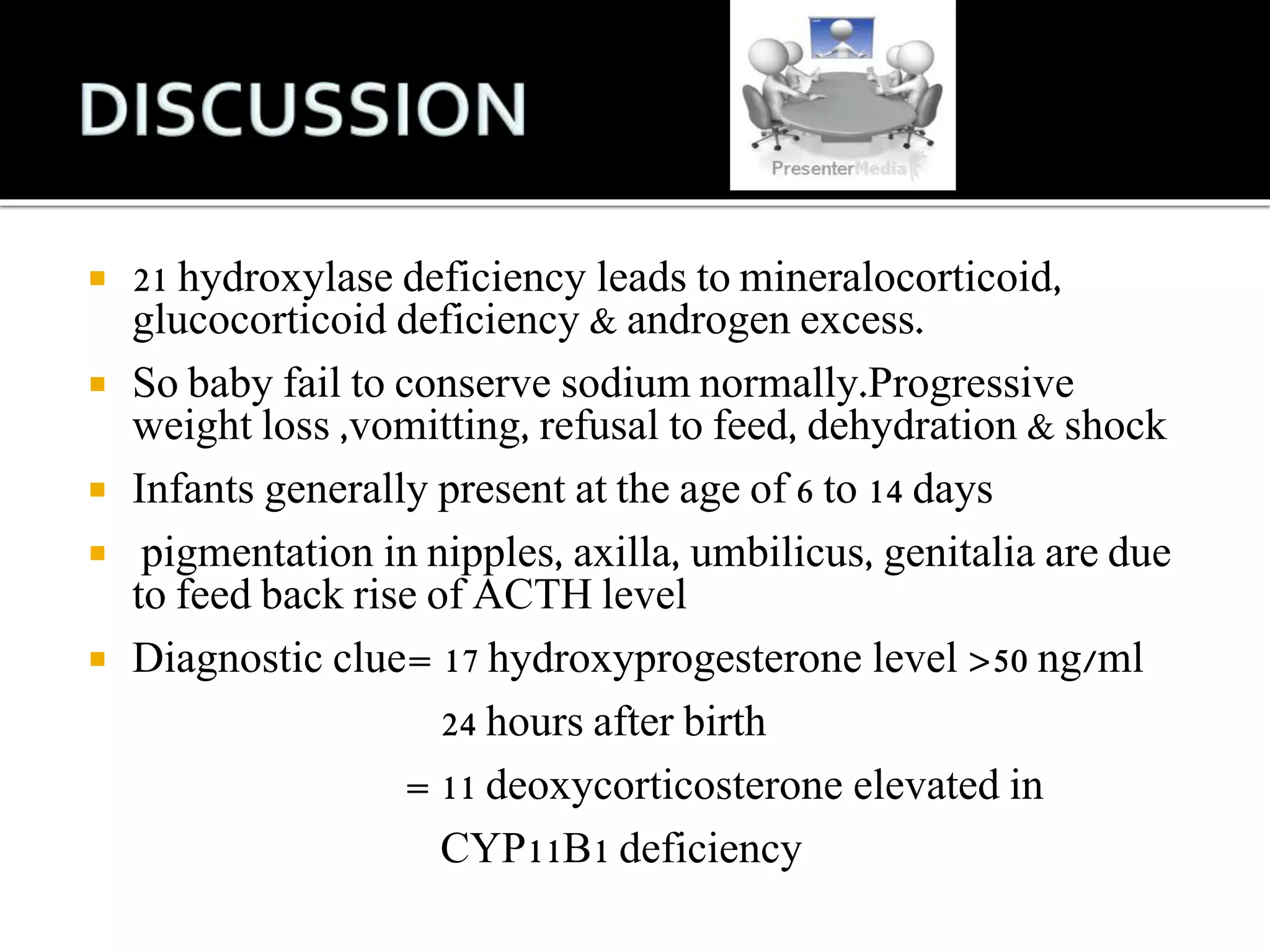
 21 hydroxylase deficiency leads to mineralocorticoid, 
glucocorticoid deficiency & androgen excess. 
 So baby fail to conserve sodium normally.Progressive 
weight loss ,vomitting, refusal to feed, dehydration & shock 
 Infants generally present at the age of 6 to 14 days 
 pigmentation in nipples, axilla, umbilicus, genitalia are due 
to feed back rise of ACTH level 
 Diagnostic clue= 17 hydroxyprogesterone level >50 ng/ml 
24 hours after birth 
= 11 deoxycorticosterone elevated in 
CYP11B1 deficiency
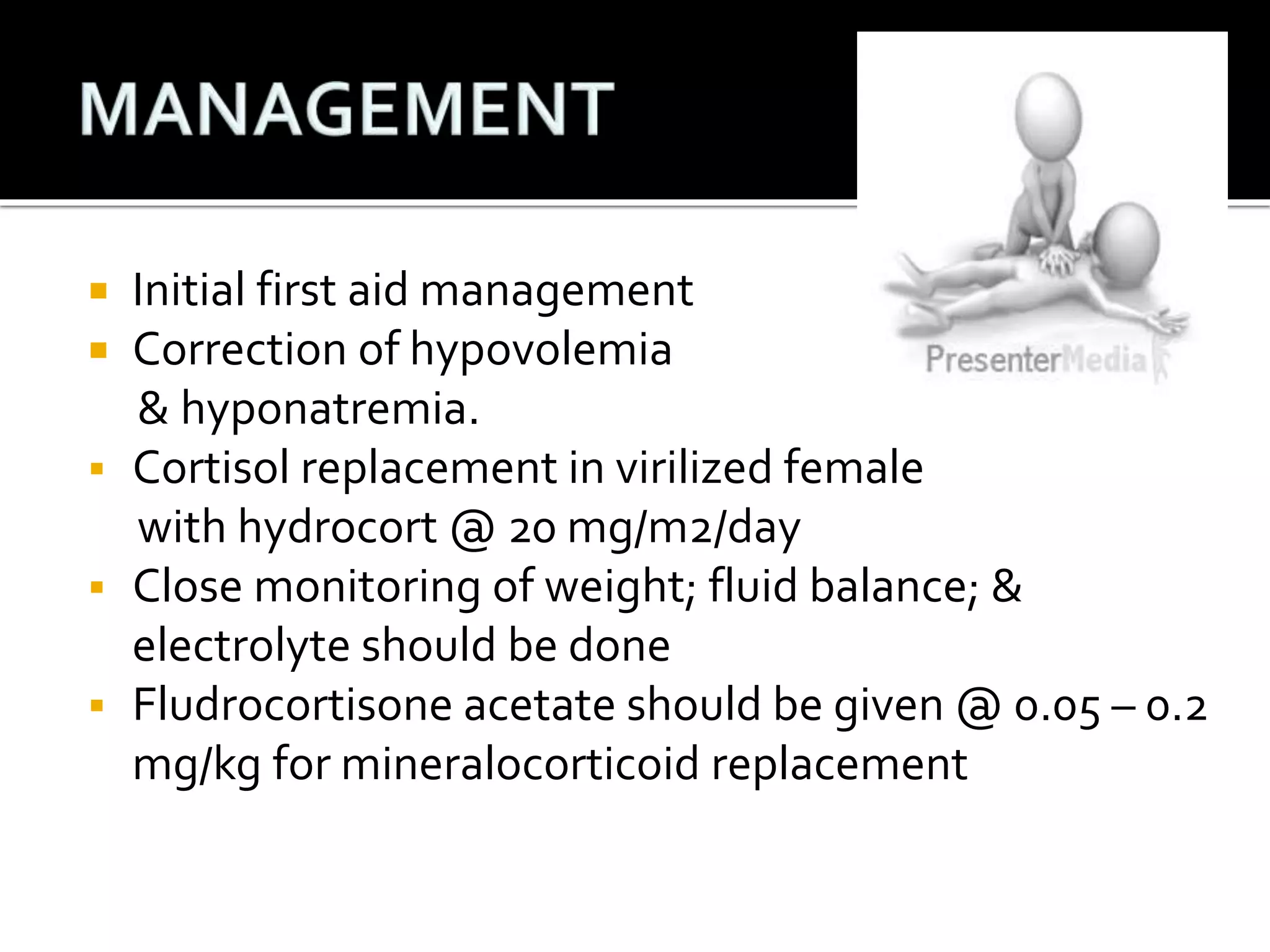
 Initial first aid management 
 Correction of hypovolemia 
& hyponatremia. 
 Cortisol replacement in virilized female 
with hydrocort @ 20 mg/m2/day 
 Close monitoring of weight; fluid balance; & 
electrolyte should be done 
 Fludrocortisone acetate should be given @ 0.05 – 0.2 
mg/kg for mineralocorticoid replacement
 
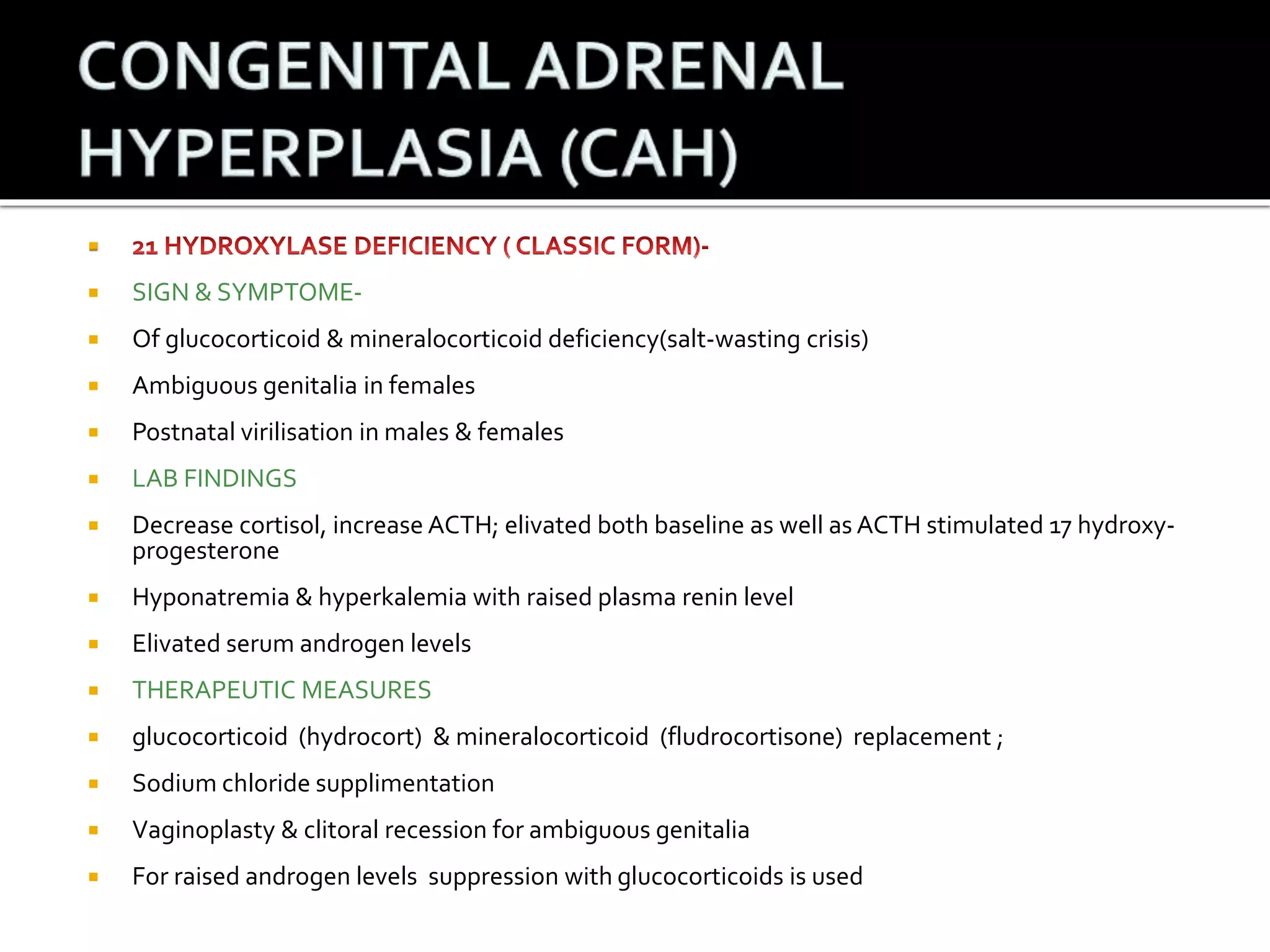
 SIGN & SYMPTOME- 
 Of glucocorticoid & mineralocorticoid deficiency(salt-wasting crisis) 
 Ambiguous genitalia in females 
 Postnatal virilisation in males & females 
 LAB FINDINGS 
 Decrease cortisol, increase ACTH; elivated both baseline as well as ACTH stimulated 17 hydroxy-progesterone 
 Hyponatremia & hyperkalemia with raised plasma renin level 
 Elivated serum androgen levels 
 THERAPEUTIC MEASURES 
 glucocorticoid (hydrocort) & mineralocorticoid (fludrocortisone) replacement ; 
 Sodium chloride supplimentation 
 Vaginoplasty & clitoral recession for ambiguous genitalia 
 For raised androgen levels suppression with glucocorticoids is used
 
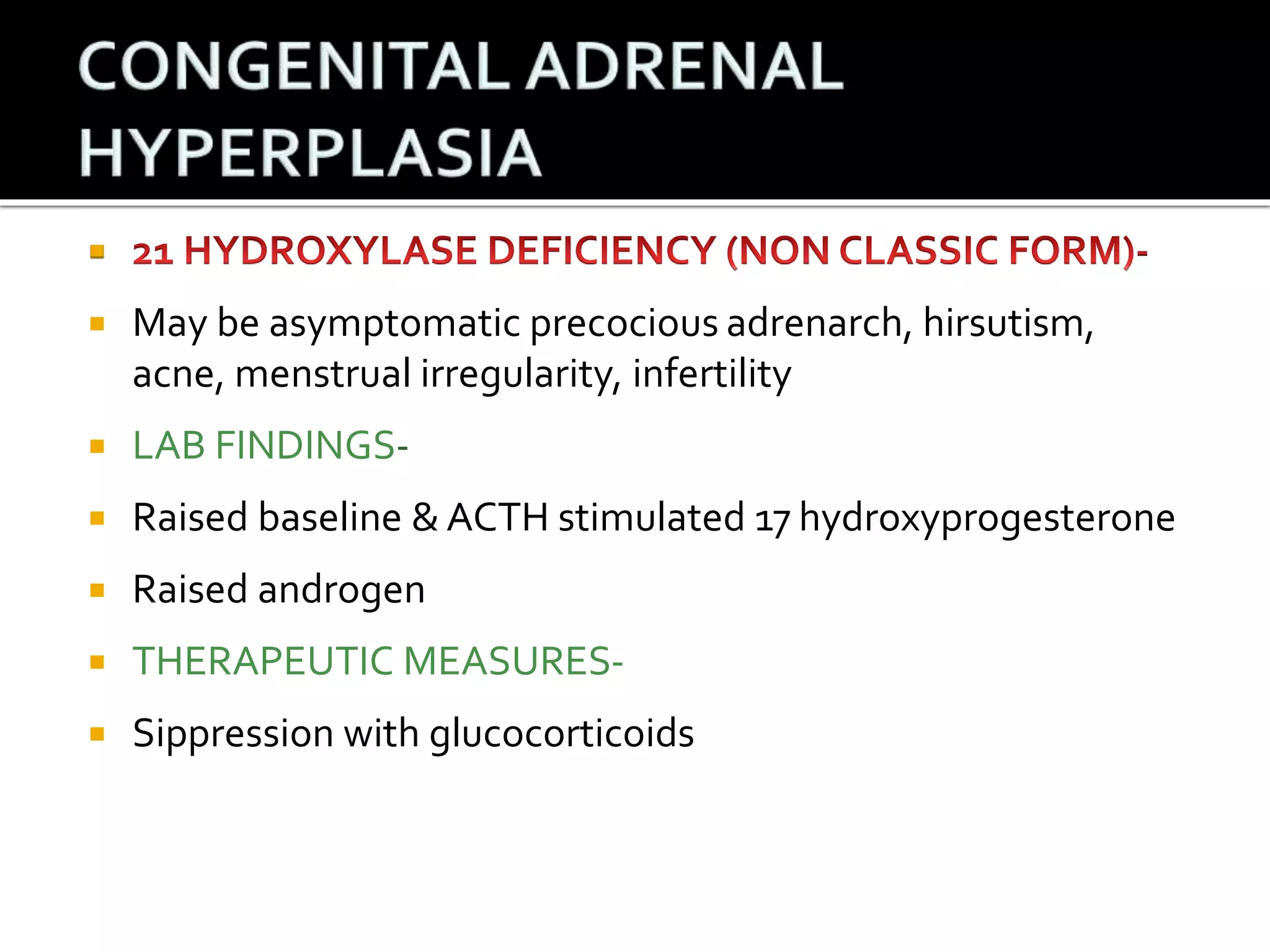
 May be asymptomatic precocious adrenarch, hirsutism, 
acne, menstrual irregularity, infertility 
 LAB FINDINGS- 
 Raised baseline & ACTH stimulated 17 hydroxyprogesterone 
 Raised androgen 
 THERAPEUTIC MEASURES- 
 Sippression with glucocorticoids
 
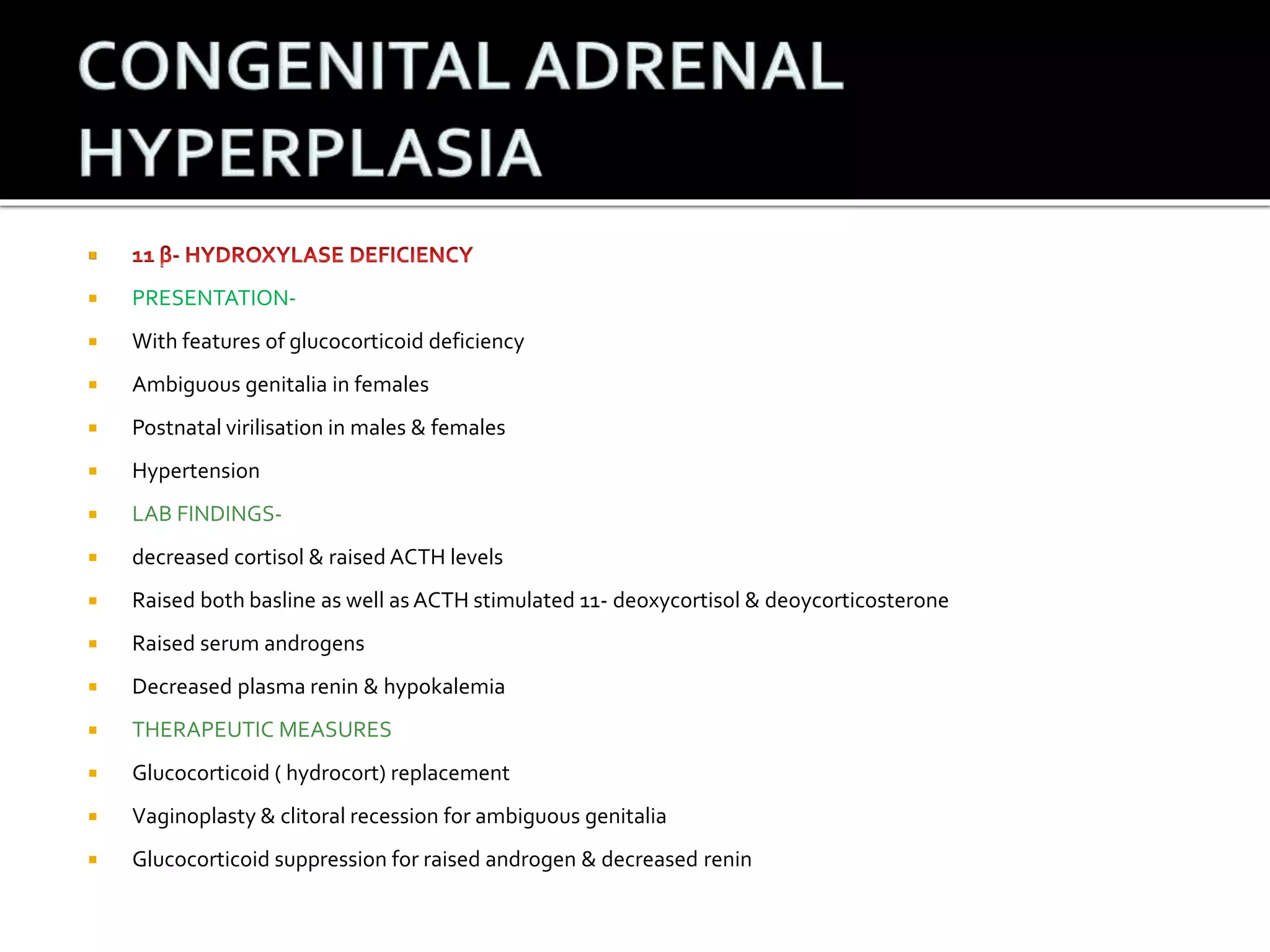
 PRESENTATION- 
 With features of glucocorticoid deficiency 
 Ambiguous genitalia in females 
 Postnatal virilisation in males & females 
 Hypertension 
 LAB FINDINGS- 
 decreased cortisol & raised ACTH levels 
 Raised both basline as well as ACTH stimulated 11- deoxycortisol & deoycorticosterone 
 Raised serum androgens 
 Decreased plasma renin & hypokalemia 
 THERAPEUTIC MEASURES 
 Glucocorticoid ( hydrocort) replacement 
 Vaginoplasty & clitoral recession for ambiguous genitalia 
 Glucocorticoid suppression for raised androgen & decreased renin
 
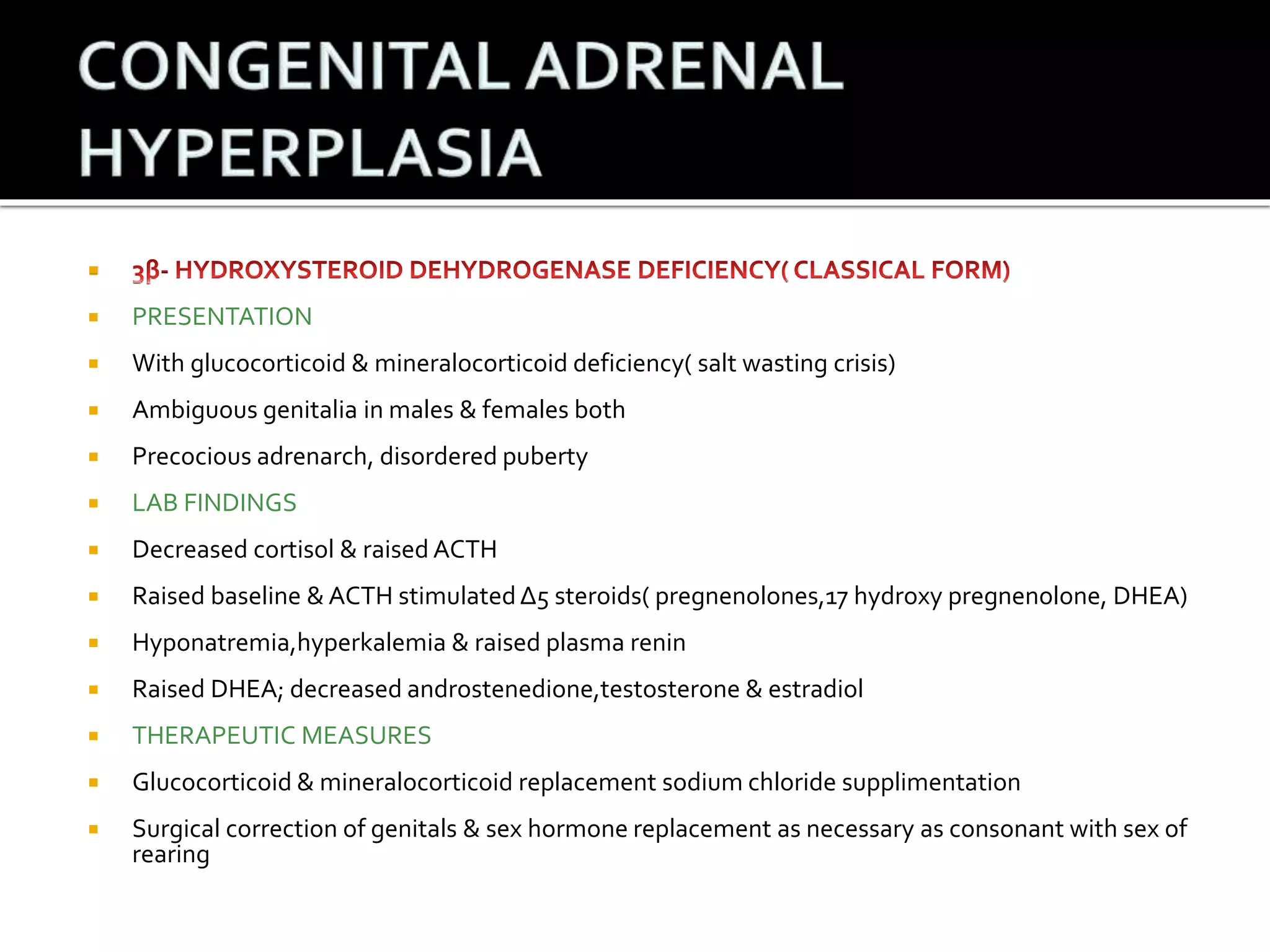
 PRESENTATION 
 With glucocorticoid & mineralocorticoid deficiency( salt wasting crisis) 
 Ambiguous genitalia in males & females both 
 Precocious adrenarch, disordered puberty 
 LAB FINDINGS 
 Decreased cortisol & raised ACTH 
 Raised baseline & ACTH stimulated Δ5 steroids( pregnenolones,17 hydroxy pregnenolone, DHEA) 
 Hyponatremia,hyperkalemia & raised plasma renin 
 Raised DHEA; decreased androstenedione,testosterone & estradiol 
 THERAPEUTIC MEASURES 
 Glucocorticoid & mineralocorticoid replacement sodium chloride supplimentation 
 Surgical correction of genitals & sex hormone replacement as necessary as consonant with sex of 
rearing
 
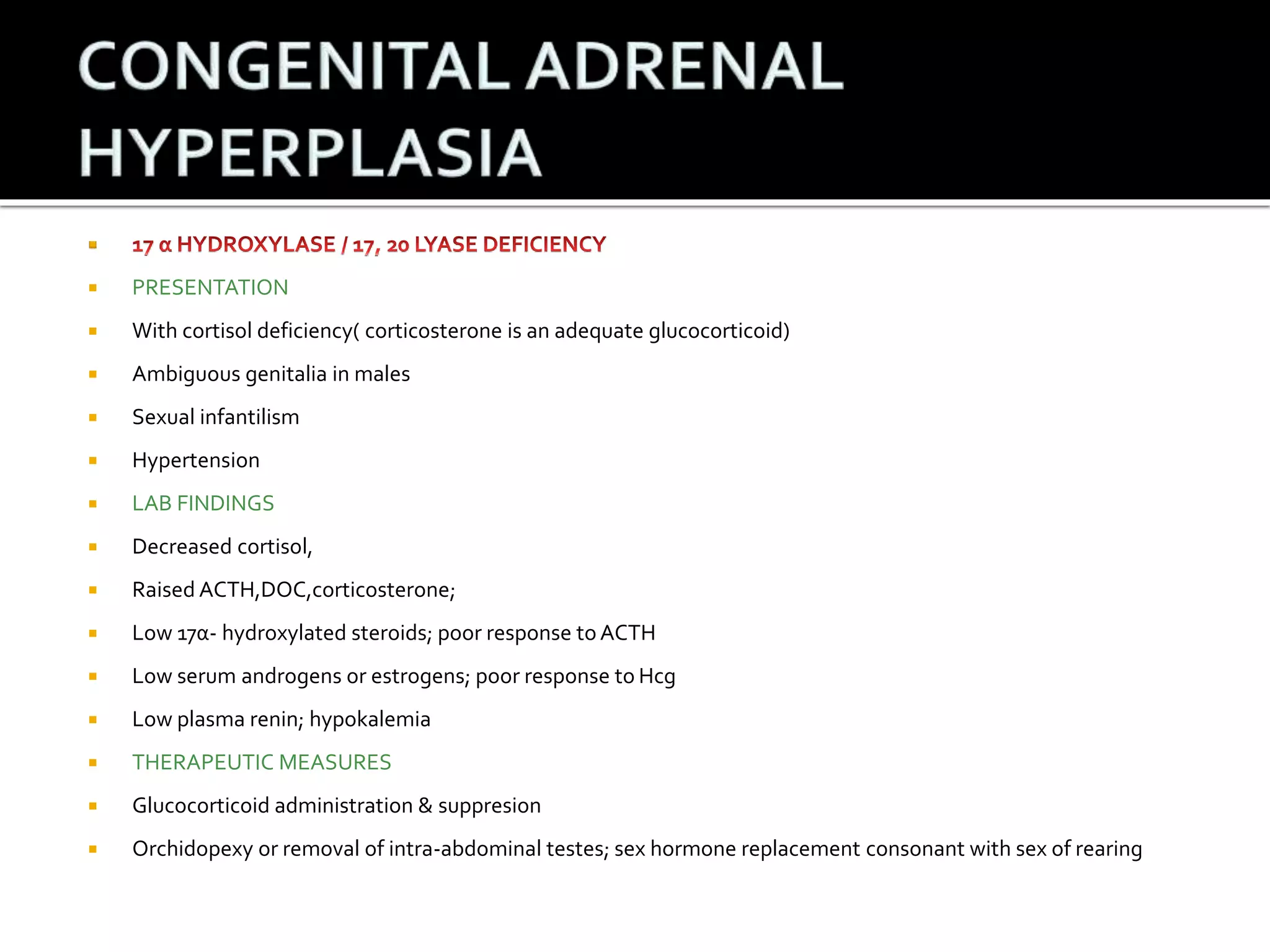
 PRESENTATION 
 With cortisol deficiency( corticosterone is an adequate glucocorticoid) 
 Ambiguous genitalia in males 
 Sexual infantilism 
 Hypertension 
 LAB FINDINGS 
 Decreased cortisol, 
 Raised ACTH,DOC,corticosterone; 
 Low 17α- hydroxylated steroids; poor response to ACTH 
 Low serum androgens or estrogens; poor response to Hcg 
 Low plasma renin; hypokalemia 
 THERAPEUTIC MEASURES 
 Glucocorticoid administration & suppresion 
 Orchidopexy or removal of intra-abdominal testes; sex hormone replacement consonant with sex of rearing
 
 PRESENTATION 
 Glucocorticoid & mineralocorticoid deficiency( salt wasting crisis) 
 Ambiguous genitalia in males 
 Poor pubertal development or premature ovarian failure in females 
 LAB FINDINGS 
 Raised ACTH, low levels of all steroid hormones,decreased or absent response to ACTH 
 Hyponatremia, hyperkalemia, low aldosterone,raised plasma renin 
 Decreased or absent response to hCG in males 
 Raised FSH & LH & low estradiol ( after puberty) in females 
 THERAPEUTIC MEASURES 
 Glucocorticoid & mineralocorticoid replacement & sodium chloride supplimentation 
 Orchidopexy or removal of intra-abdominal testes;sex hormone replacement consonant with sex of rearing 
 Estrogen replacement in females
 
 PRESENTATION 
 Glucocorticoid deficiency 
 Ambiguous genitalia in males & females 
 Maternal virilizationAntley- Bixler syndrome 
 LAB FINDINGS 
 Low cortisol; raised ACTH, pregnenolone & progesterone 
 Raised serum androgen prenatally, low androgen & estrogens at puberty 
 Decreased ratio of estrogen to androgen 
 THERAPEUTIC MEASURES 
 Glucocorticoid replacement 
 Surgical correction of genitals and sex hormone replacement as necessary,consonant with sex of 
rearing
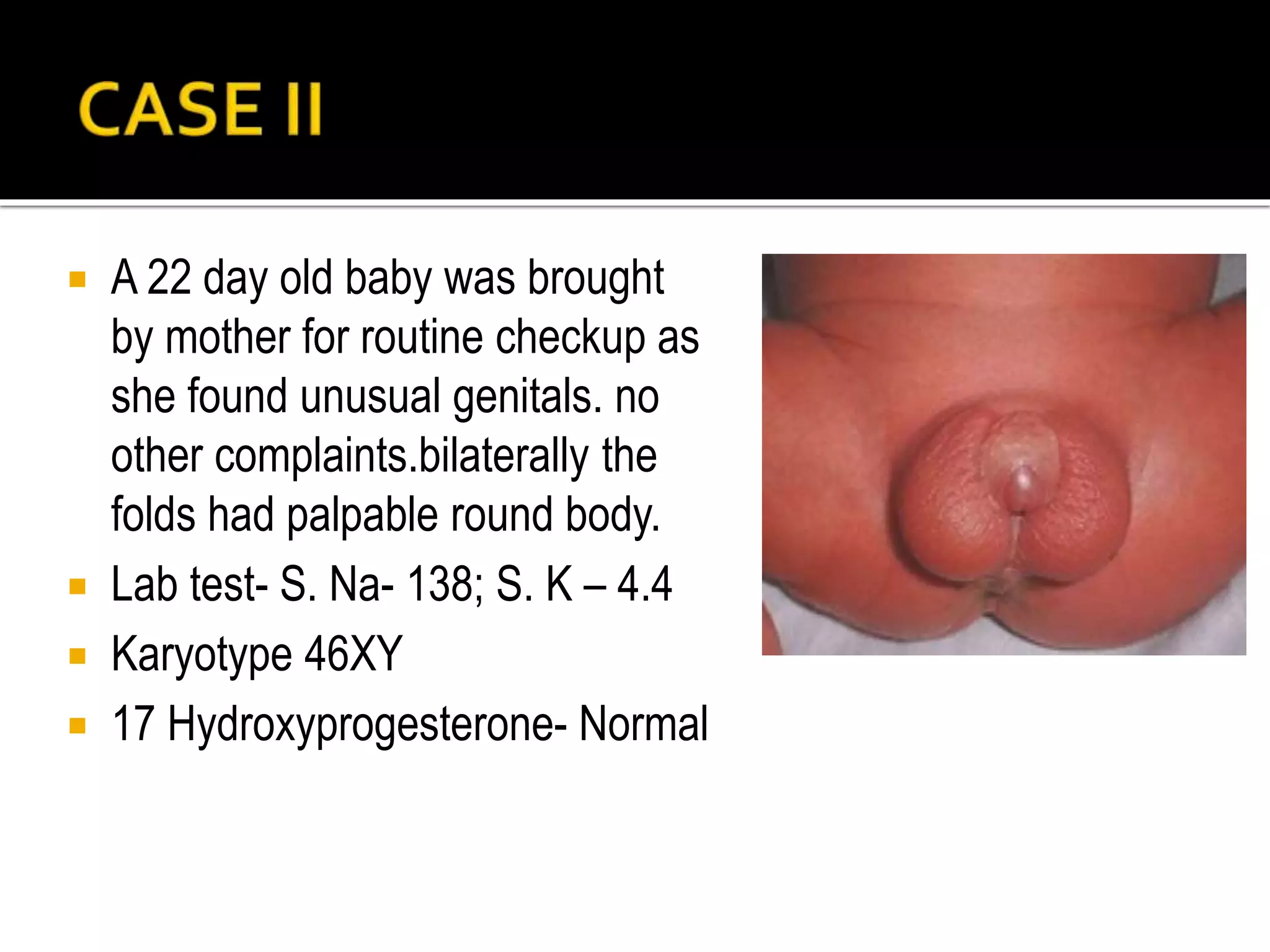
 A 22 day old baby was brought 
by mother for routine checkup as 
she found unusual genitals. no 
other complaints.bilaterally the 
folds had palpable round body. 
 Lab test- S. Na- 138; S. K – 4.4 
 Karyotype 46XY 
 17 Hydroxyprogesterone- Normal
 Testosterone/DHT ratio= normal 
 Increased LH;Testosterone; & Androgen levels 
 DIAGNOSIS= Complete androgen insensitivity 
 Also called testicular feminisation (female phenotype) 
 In utero loss of androgen & MIS secretion means loss of internal genitalia 
 Females with inguinal hernia with complete androgen insensitivity diagnosed 
with amenorrhea absence of pubic hair or hormonal profile. 
 Treated with Gonadectomy & Estrogen replacement therapy 
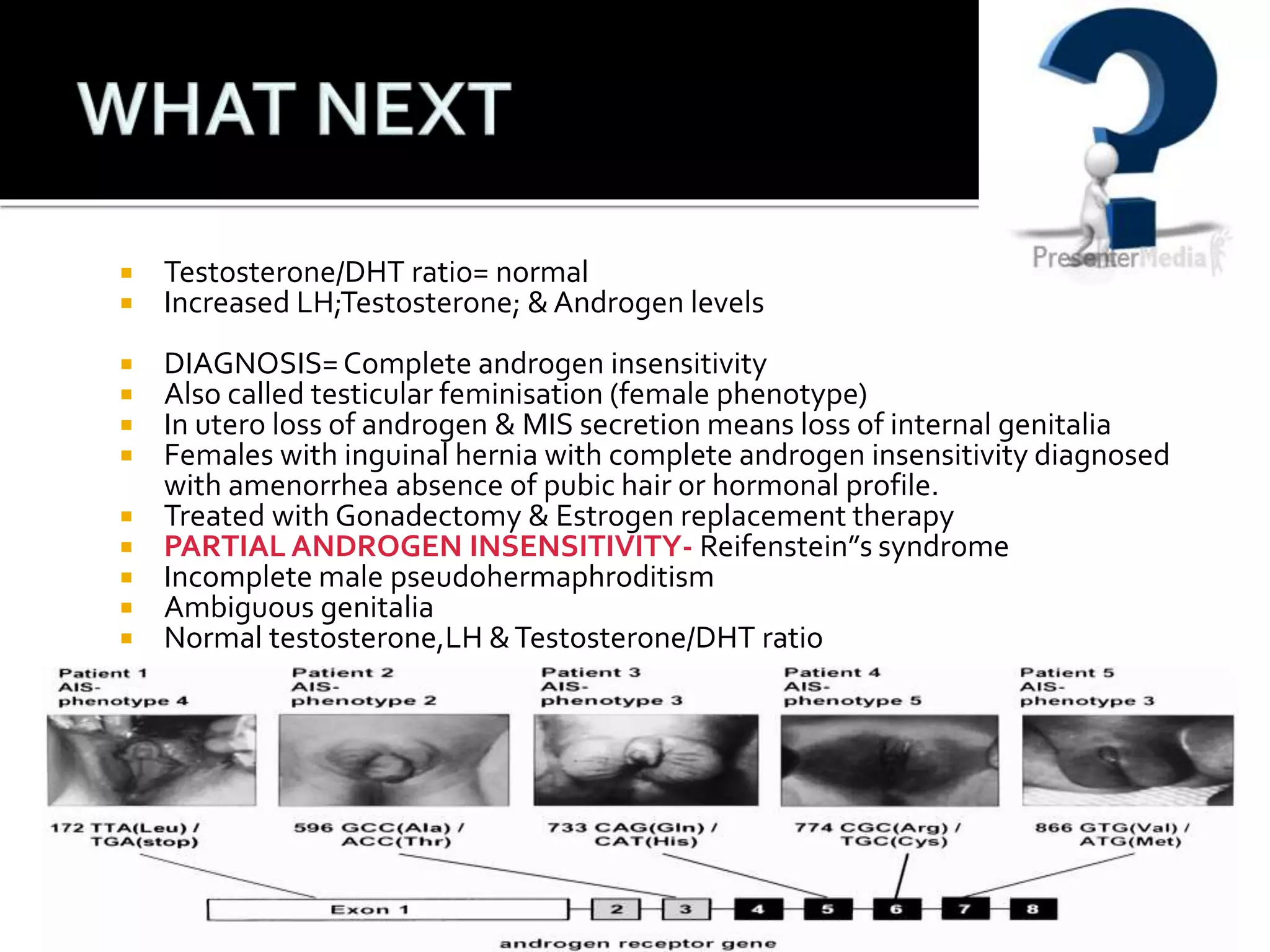
 PARTIAL ANDROGEN INSENSITIVITY- Reifenstein”s syndrome 
 Incomplete male pseudohermaphroditism 
 Ambiguous genitalia 
 Normal testosterone,LH & Testosterone/DHT ratio
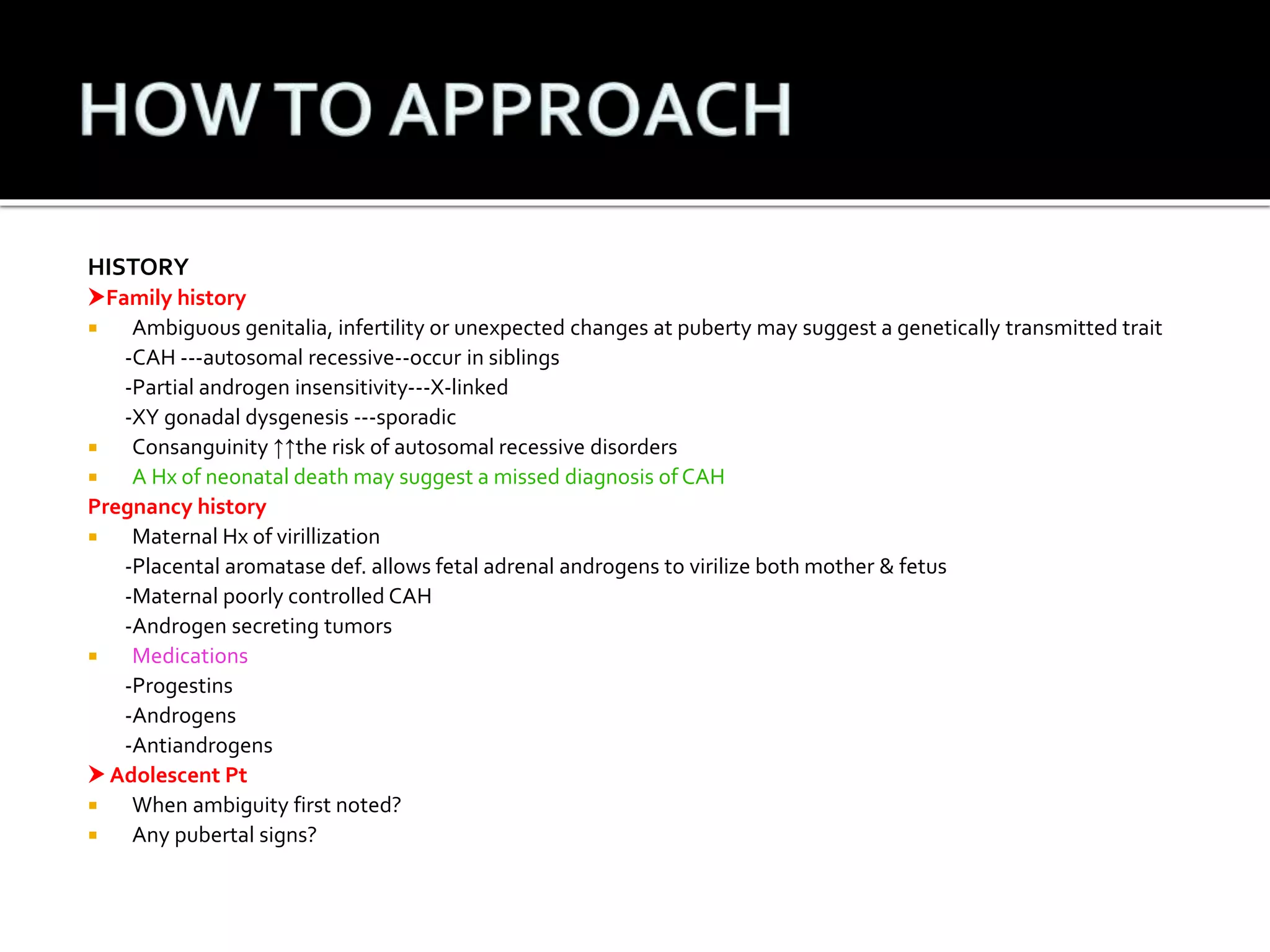
HISTORY 
Family history 
 Ambiguous genitalia, infertility or unexpected changes at puberty may suggest a genetically transmitted trait 
-CAH ---autosomal recessive--occur in siblings 
-Partial androgen insensitivity---X-linked 
-XY gonadal dysgenesis ---sporadic 
 Consanguinity ↑↑the risk of autosomal recessive disorders 
 A Hx of neonatal death may suggest a missed diagnosis of CAH 
Pregnancy history 
 Maternal Hx of virillization 
-Placental aromatase def. allows fetal adrenal androgens to virilize both mother & fetus 
-Maternal poorly controlled CAH 
-Androgen secreting tumors 
 Medications 
-Progestins 
-Androgens 
-Antiandrogens 
 Adolescent Pt 
 When ambiguity first noted? 
 Any pubertal signs?
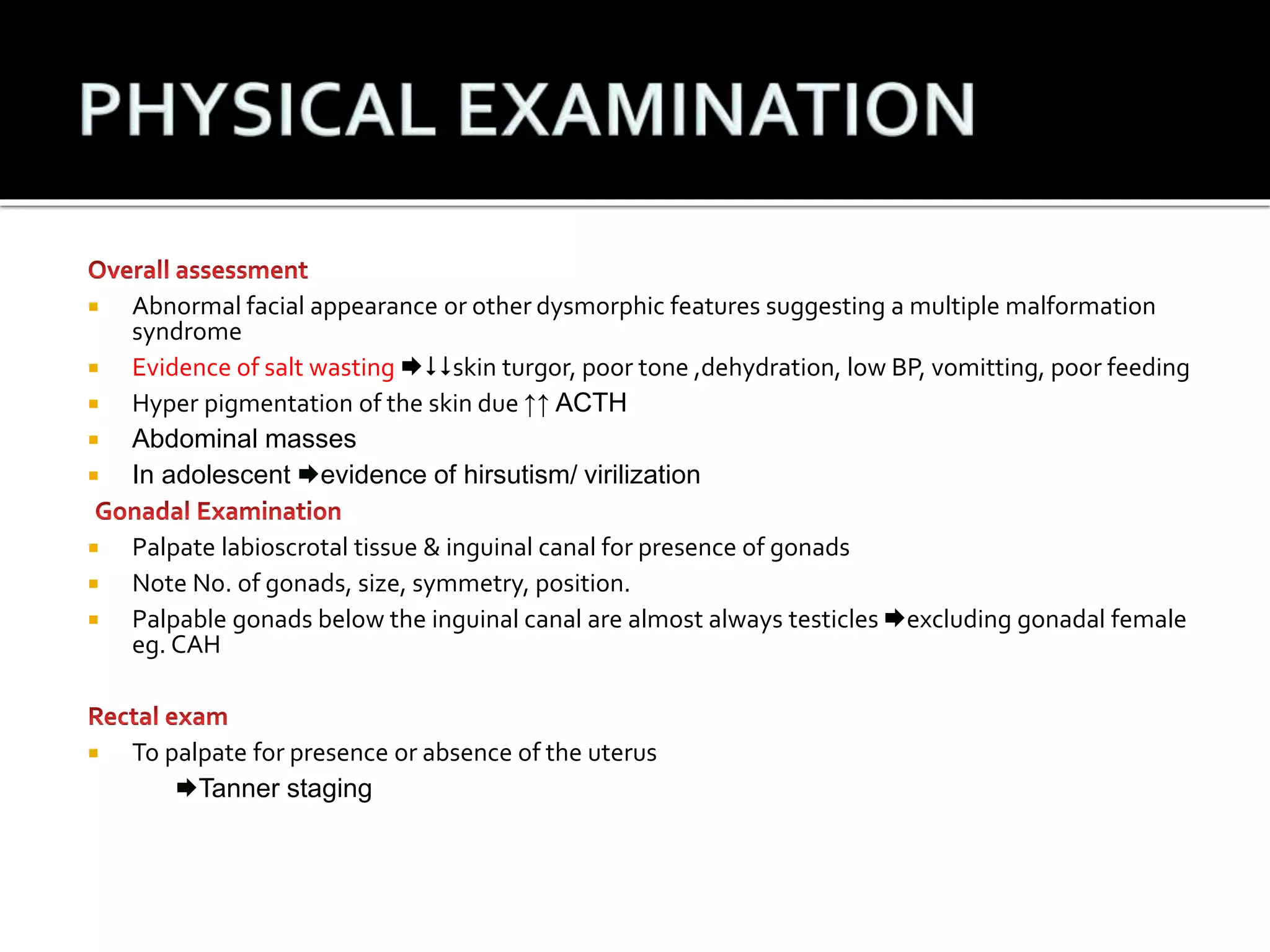
 Abnormal facial appearance or other dysmorphic features suggesting a multiple malformation 
syndrome 
 Evidence of salt wasting skin turgor, poor tone ,dehydration, low BP, vomitting, poor feeding 
 Hyper pigmentation of the skin due ↑↑ ACTH 
 Abdominal masses 
 In adolescent evidence of hirsutism/ virilization 
 Palpate labioscrotal tissue & inguinal canal for presence of gonads 
 Note No. of gonads, size, symmetry, position. 
 Palpable gonads below the inguinal canal are almost always testicles excluding gonadal female 
eg. CAH 
 To palpate for presence or absence of the uterus 
Tanner staging
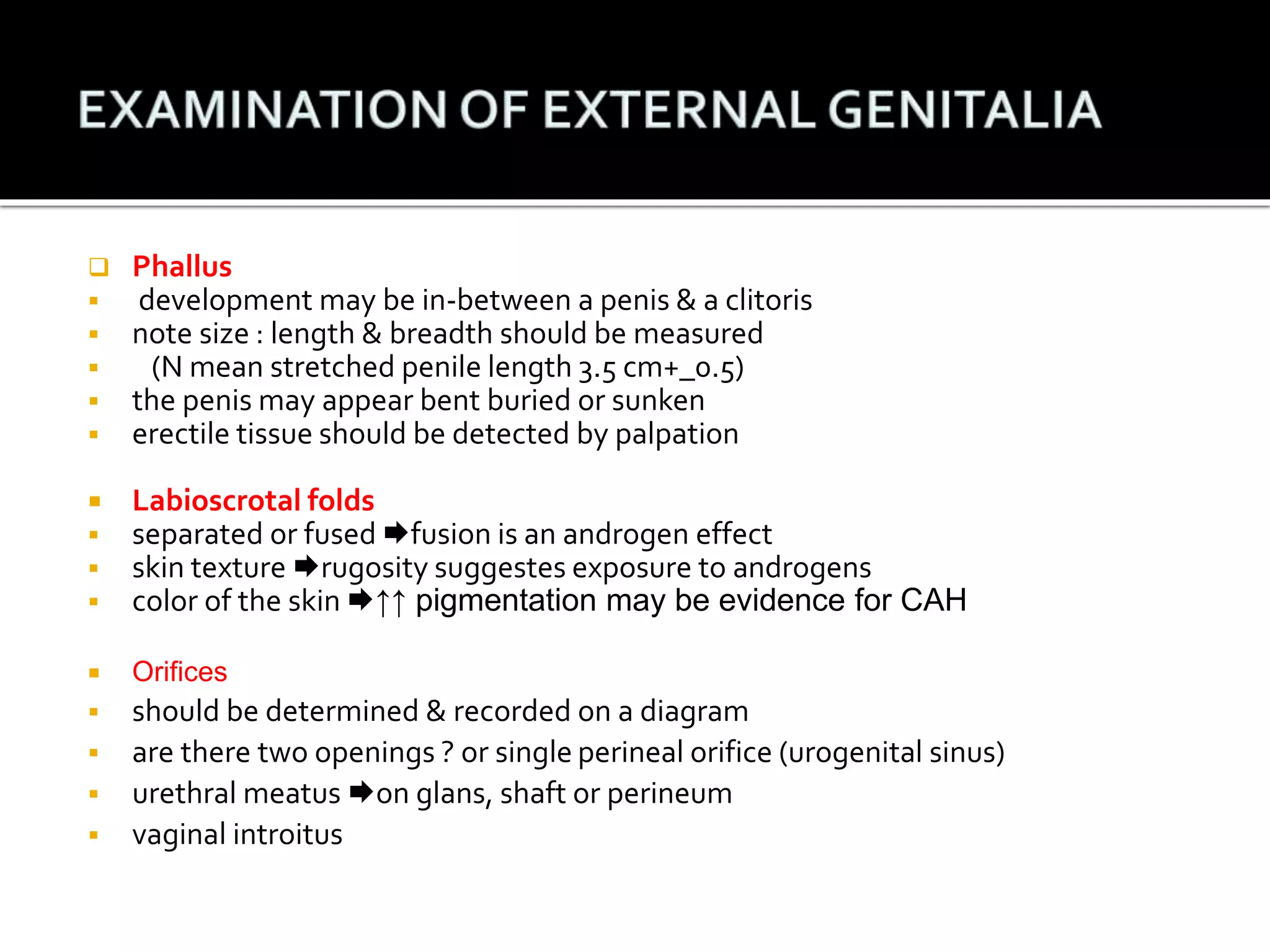
 Phallus 
 development may be in-between a penis & a clitoris 
 note size : length & breadth should be measured 
 (N mean stretched penile length 3.5 cm+_0.5) 
 the penis may appear bent buried or sunken 
 erectile tissue should be detected by palpation 
 Labioscrotal folds 
 separated or fused fusion is an androgen effect 
 skin texture rugosity suggestes exposure to androgens 
 color of the skin ↑↑ pigmentation may be evidence for CAH 
 Orifices 
 should be determined & recorded on a diagram 
 are there two openings ? or single perineal orifice (urogenital sinus) 
 urethral meatus on glans, shaft or perineum 
 vaginal introitus
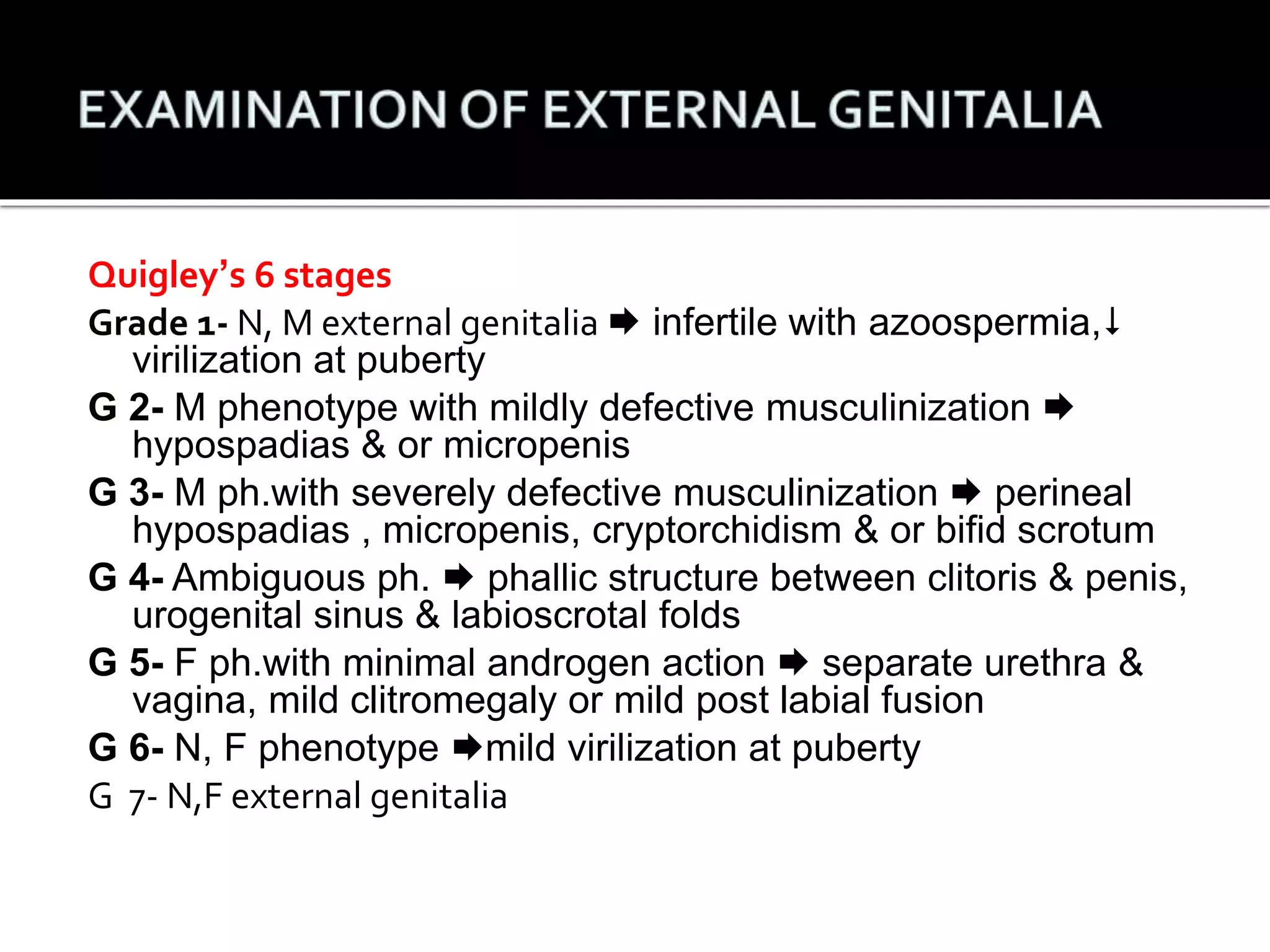
Quigley’s 6 stages 
Grade 1- N, M external genitalia  infertile with azoospermia, 
virilization at puberty 
G 2- M phenotype with mildly defective musculinization  
hypospadias & or micropenis 
G 3- M ph.with severely defective musculinization  perineal 
hypospadias , micropenis, cryptorchidism & or bifid scrotum 
G 4- Ambiguous ph.  phallic structure between clitoris & penis, 
urogenital sinus & labioscrotal folds 
G 5- F ph.with minimal androgen action  separate urethra & 
vagina, mild clitromegaly or mild post labial fusion 
G 6- N, F phenotype mild virilization at puberty 
G 7- N,F external genitalia
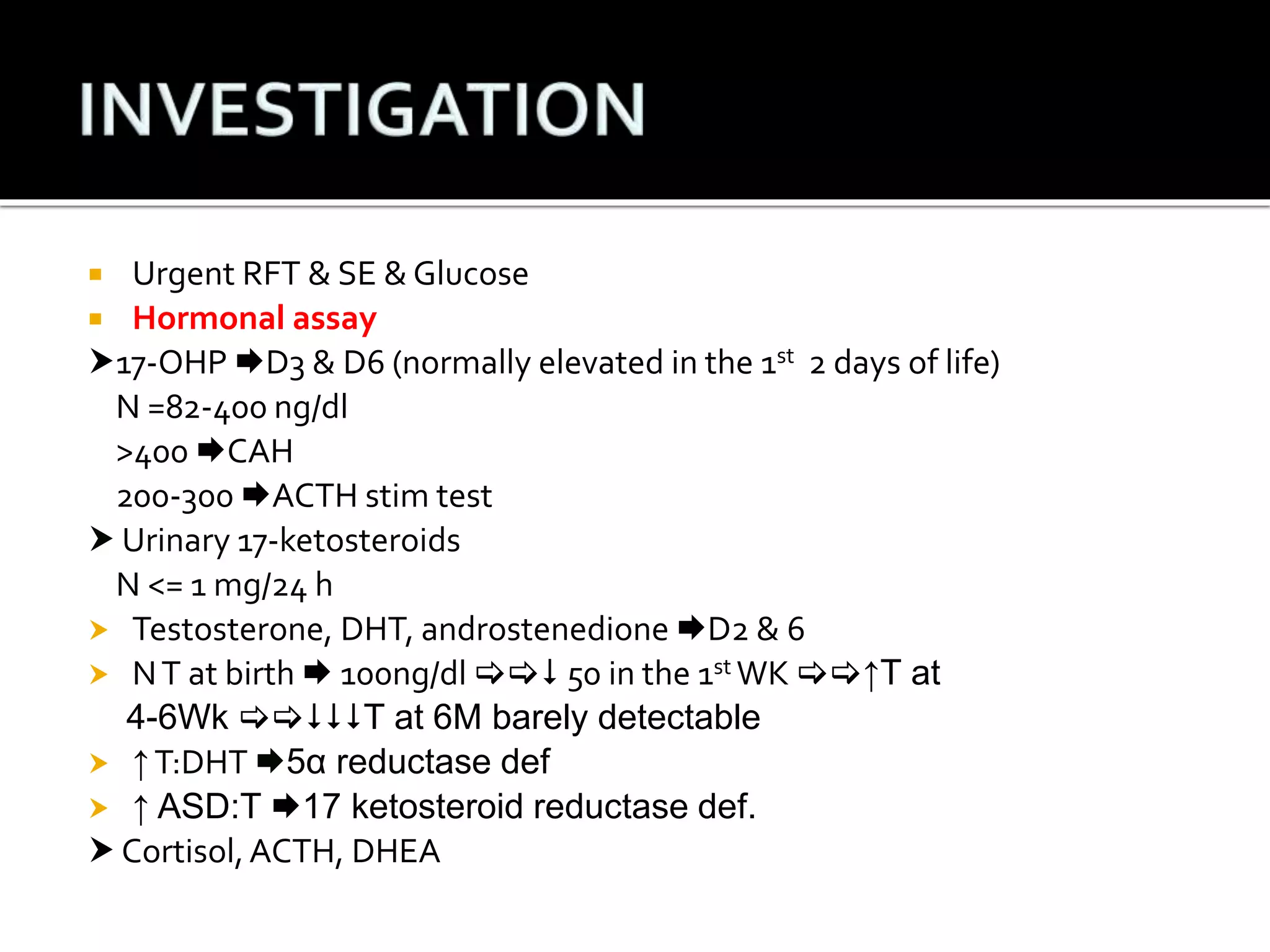
 Urgent RFT & SE & Glucose 
 Hormonal assay 
17-OHP D3 & D6 (normally elevated in the 1st 2 days of life) 
N =82-400 ng/dl 
>400 CAH 
200-300 ACTH stimtest 
 Urinary 17-ketosteroids 
N <= 1 mg/24 h 
 Testosterone, DHT, androstenedione D2 & 6 
 N T at birth  100ng/dl  50 in the 1stWK ↑T at 
4-6Wk T at 6M barely detectable 
 ↑T:DHT 5α reductase def 
 ↑ ASD:T 17 ketosteroid reductase def. 
 Cortisol, ACTH, DHEA
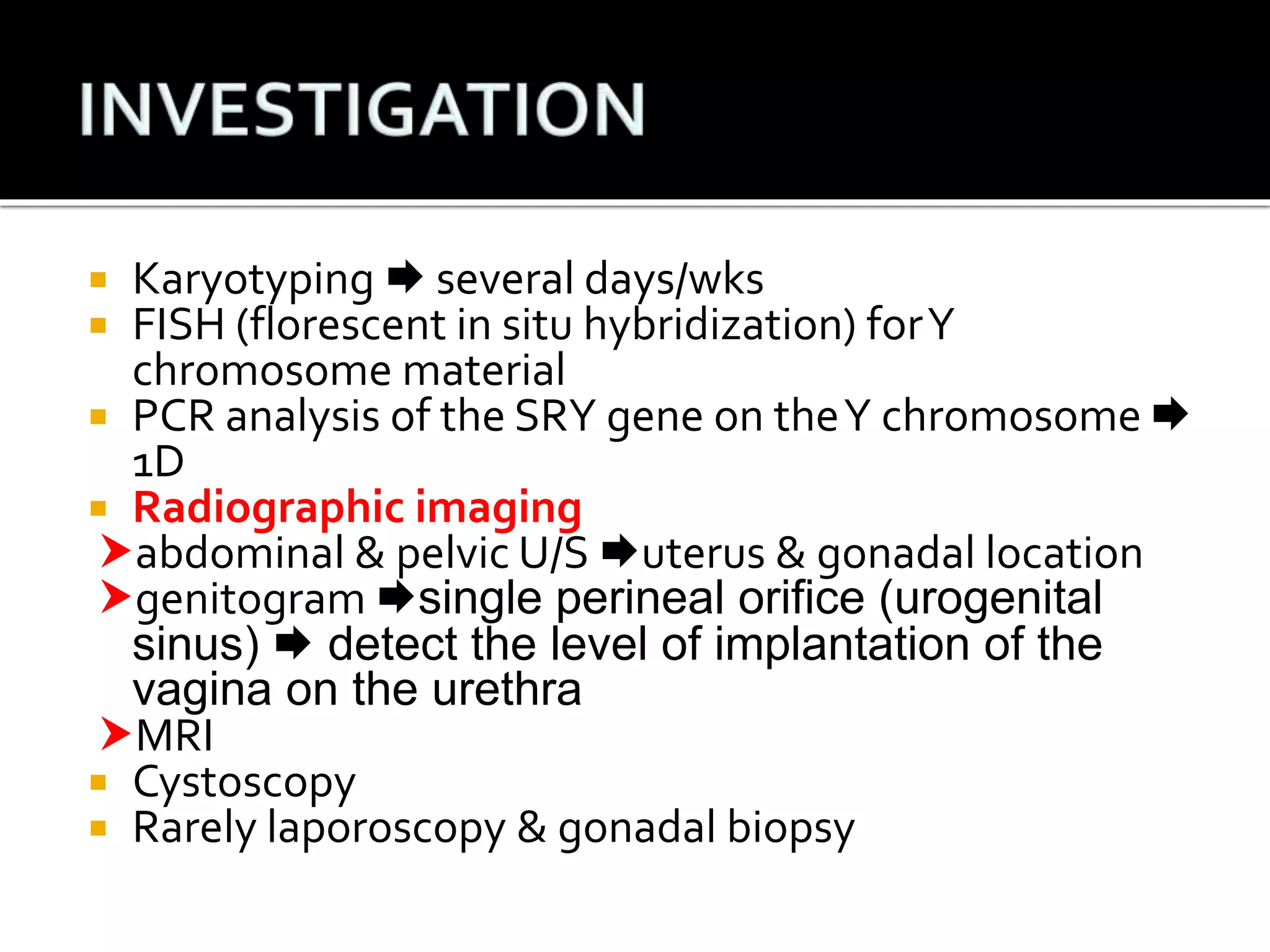
 Karyotyping  several days/wks 
 FISH (florescent in situ hybridization) for Y 
chromosome material 
 PCR analysis of the SRY gene on the Y chromosome  
1D 
 Radiographic imaging 
abdominal & pelvic U/S uterus & gonadal location 
genitogram single perineal orifice (urogenital 
sinus)  detect the level of implantation of the 
vagina on the urethra 
MRI 
 Cystoscopy 
 Rarely laporoscopy & gonadal biopsy
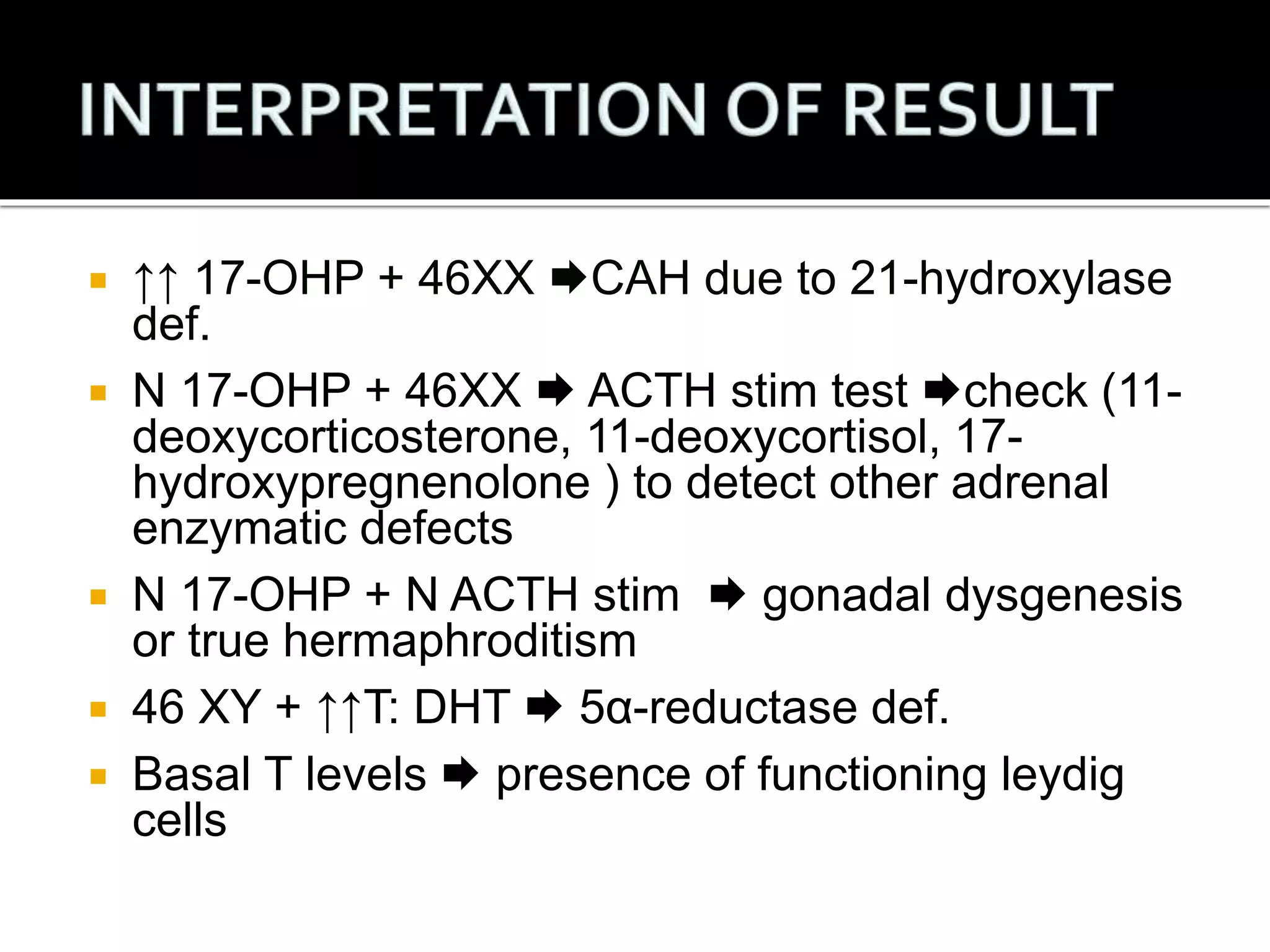
 ↑↑ 17-OHP + 46XX CAH due to 21-hydroxylase 
def. 
 N 17-OHP + 46XX  ACTH stim test check (11- 
deoxycorticosterone, 11-deoxycortisol, 17- 
hydroxypregnenolone ) to detect other adrenal 
enzymatic defects 
 N 17-OHP + N ACTH stim  gonadal dysgenesis 
or true hermaphroditism 
 46 XY + ↑↑T: DHT  5α-reductase def. 
 Basal T levels  presence of functioning leydig 
cells
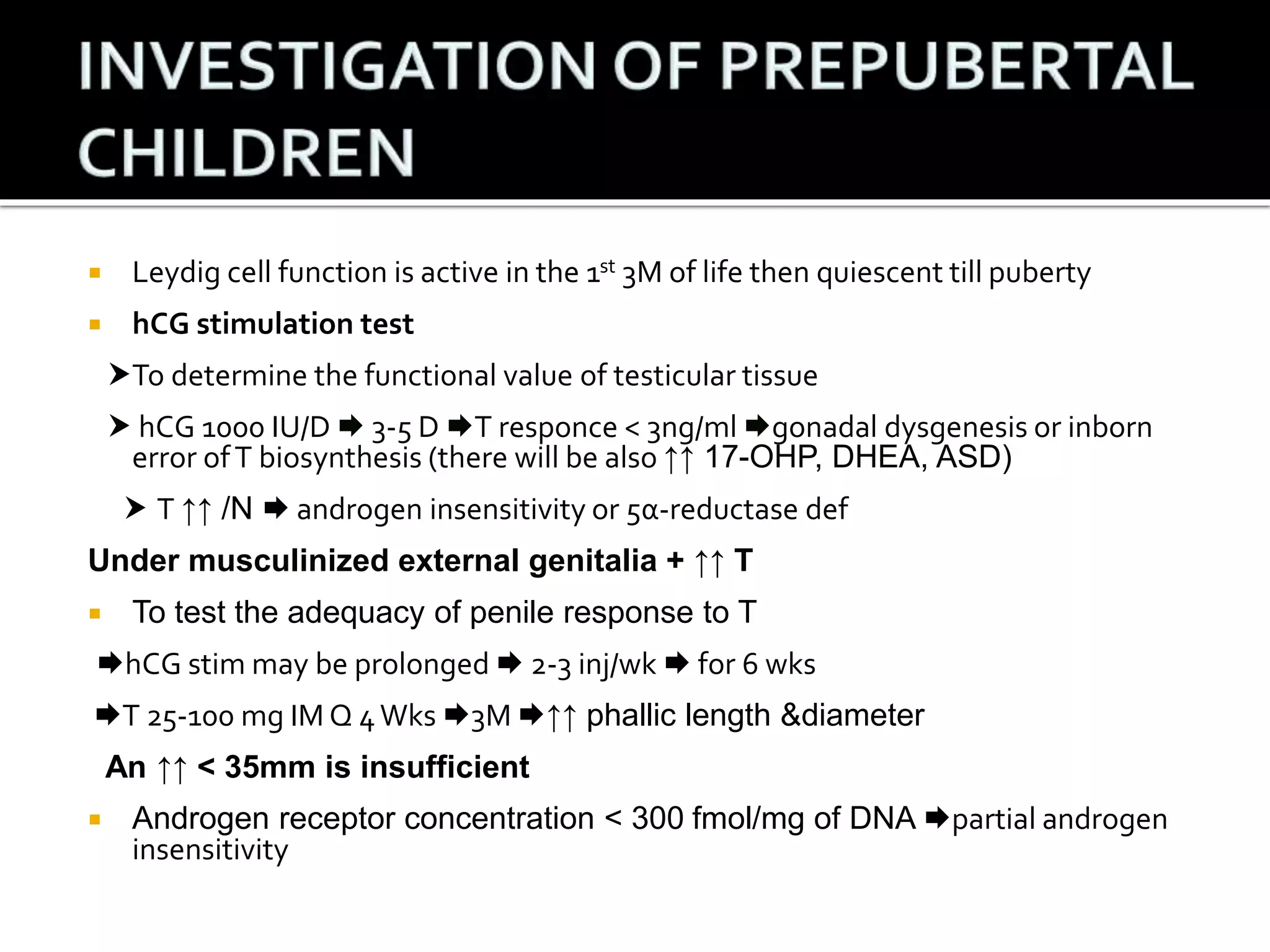
 Leydig cell function is active in the 1st 3M of life then quiescent till puberty 
 hCG stimulation test 
To determine the functional value of testicular tissue 
 hCG 1000 IU/D  3-5 D T responce < 3ng/ml gonadal dysgenesis or inborn 
error of T biosynthesis (there will be also ↑↑ 17-OHP, DHEA, ASD) 
 T ↑↑ /N  androgen insensitivity or 5α-reductase def 
Under musculinized external genitalia + ↑↑ T 
 To test the adequacy of penile response to T 
hCG stimmay be prolonged  2-3 inj/wk  for 6 wks 
T 25-100 mg IM Q 4 Wks 3M ↑↑ phallic length &diameter 
An ↑↑ < 35mm is insufficient 
 Androgen receptor concentration < 300 fmol/mg of DNA partial androgen 
insensitivity
 It requires multidisciplinary team including: 
Endocrinologist 
Gynecologist 
Surgeon 
Ped urologist 
Psychologist 
Geneticist 
Radiologist 
 Psychological support for the parents 
 Gender assignment 
 Medical treatment 
 Surgical treatment
 Show the baby to the parents 
 Counsel both parents together 
What to tell the parents? 
 The baby is healthy but the external genitalia is incompletely 
developed & tests are necessary to determine the sex 
 There are other babies with similar condition 
 A No. of treatable conditions can result in atypical genetalia 
 Reassurance that a good outcome can be anticipated 
 How long the process of investigation will take ? Around 3-4 Wk 
 Give them appt times & names of the people who will see them 
 To talk about their fears of future sexual identity & sexual 
orientation of their child  preferably with psychologist or social 
worker 
 Support when it comes to facing their friend & relatives
 It is extremely distressing for the parents & must be dealt with as an emergency 
 There is profound pressure on the medical team to announce gender .....however 
 Postpone making a gender assignment until sufficient information is available 
& the results of investigation has enabled the most appropriate choice of the 
sex of rearing 
 The choice must be the result of full discussion between parents & medical team 
 The decision is guided by 
Anatomical condition & functional abilities of the genitalia 
Fertility potential (presence of F internal genital organs) 
The etiology of the genital malformation 
The family’s cultural & religious background 
 Girls with CAH are fertile & must always be assigned a female sex
 In cases which can not be fertile, gender assignment will depend on: 
The appearance of the external genitalia 
The potential for unambiguous appearance 
The potential for normal sexual functioning 
 True hermaphroditism F since ovarian function may be preserved & may be 
fertile 
 Great care should be taken in declaring a male sex considering: 
Potential for reconstructive surgery 
Probability for pubertal virilization 
Response of the external genitalia to exogenous & endog. T 
 Pt with small phallus & poor response to androgens may be reared as F In cases 
which can not be fertile, gender assignment will depend on: 
 5α-reductase M sex assignement  
pubertal virilization  penile growth (subnormal) & male sexual identity 
 Inborn errors of T biosynthesis F effective M reconstructive surgery is highly 
unlikely 
 Complete Androgen Insensitivity  F 
Partial A I  preferably F
CAH 
 Monitor electrolytes & glucose 
 Hypoglycemia can appear in the first hours 
 Serum electrolytes will become abnormal D 6-14 
 Hydrocortisone 10-20 mg/m2/D PO 
 Fludrocortisone acetate (florinef) 0.1 mg/D 
Prenatal RX CAH 
 Mothers with family Hx Dexamethasone is started at 5 wks 
If confirmed DX of CAH in F fetus (by chorion villus sampling/amniocentesis)  
continue Rx till term 90% N genitaliaSex steroid replacement therapy at 
puberty 
T enanthate 200-300 mg IM/ M: 
 M Pt with steroid enzyme def 
 M Pt with partial gonadal dysgenesis, low leydig cell No, true hermaphrodite 
Estrogen premarin 0.625 mg PO/D 
for one year . Then cyclic estrogen progesterone or OCP (if there is uterus) 
 F Pt with enzyme def  3β-OH –steroid dehydrogenase & 17-hydroxylase 
 F 46 XY partial gonadal dysgenesis, true herma, M pseudohermaphrodites
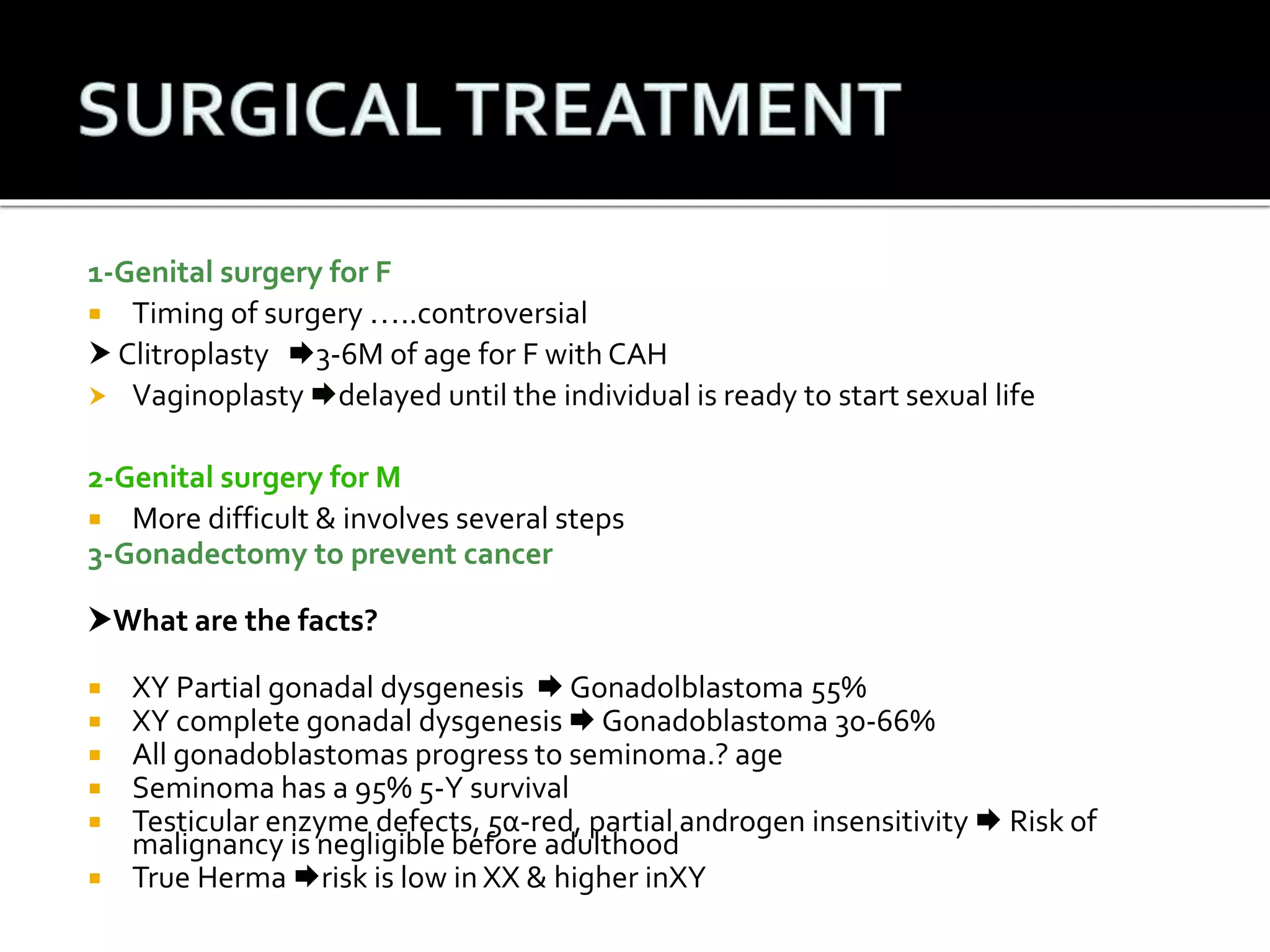
1-Genital surgery for F 
 Timing of surgery …..controversial 
 Clitroplasty 3-6M of age for F with CAH 
 Vaginoplasty delayed until the individual is ready to start sexual life 
2-Genital surgery for M 
 More difficult & involves several steps 
3-Gonadectomy to prevent cancer 
What are the facts? 
 XY Partial gonadal dysgenesis  Gonadolblastoma 55% 
 XY complete gonadal dysgenesis  Gonadoblastoma 30-66% 
 All gonadoblastomas progress to seminoma.? age 
 Seminoma has a 95% 5-Y survival 
 Testicular enzyme defects, 5α-red, partial androgen insensitivity  Risk of 
malignancy is negligible before adulthood 
 True Herma risk is low in XX & higher inXY
 Pt raised as F  gonadectomy must be performed in childhood 
 Pt raised as M  cantroversial 
1-Gonadectomy is recommended by many physicians followed by HRT 
2- Close medical surveillance 
-Biopsy in childhood & excising gonads with 
gonadoblastoma 
-Repeated biopsy at puberty 
-Follow up /palpation by experienced Dr every 
6-12 M4-Gonadectomy to remove source of T 
 in Pt raised as F to prevent progressive virilization especially at puberty 
5-Laparoscopy 
For evaluation of internal genitalia & gonadal biopsy 
 For excision of mullarian structures in pt raised as M or Pt raised as F with 
non communicating mullarian structures 
 For gonadectomy
Approach to a case of ambiguous genitalia

Approach to a case of ambiguous genitalia

  • 1.
    MODERATOR – DRM. L. BARMAN PRESENTED BY- DR. NISHANT PRABHAKAR DEPT OF PEDIATRICS NSCB MCH JABALPUR(M. P.)
  • 2.
     Germ cellsarise from celomic epithelium of hindgut & migrate into gonadal ridge at 4-6 weeks of gestation. These cells combine with somatic cells to give rise to bipotential gonads  1-undeferentiated stage (4-8 wk)  genital tubercle (phalus)  labioscrotal swellings  urogenital folds  urogenital sinus  45XO embryo the ovaries develop but undergo atresia   streak ovaries  Gonadal differentiation at 6-8 wk gestation  TDF gene ie SRY gene(Y-chromosome):  stimulates gonads towards testicular differentiation  Absence of TDF: gonads differentiate into ovaries  Wolffian duct from mesonephros  Müllerian duct from coelomic epithelium  Endocrine effect during this phase is crucial:  paracrine action of hormones produced by ipsilateral gonad  testis (MIS, T)  male internal genitalia  ovary (nil)  female internal genitalia
  • 3.
     Fetal LH,placental HCG necessary for normal growth of penis, scrotum, descent of testes  Hypopituitarism (congenital gonadotrophin deficiency) – micropenis, bilateral cryptorchidism  Müllerian-inhibiting substance:-produced by fetal testes( chr.19)  Causes almost complete regression of Müllerian duct derivatives:i.e.  utriculus masculinus, appendix testis  Important in testicular differentiation   produced by fetal Leydig cells  Regulates male phenotypic development  Multiple steps in effect of testosterone:  production, 5-alpha reductase, AR  T Wolffian duct (male internal genitalia)  DHT  male external genitalia (includes prostate,scrotal fusion,& development of corpus spongiosum & penile corpus cavernosa)
  • 6.
     Feminisation isa default process of sexual development  Male (requires DHT):  labioscrotal fold = scrotum  urethral fold / groove = urethra  genital tubercle = glans penis  Female (requires nil):  labioscrotal fold = labia majora  urethral fold = labia minora  genital tubercle = glans clitoris  Ambiguity of the external genitalia may result from chromosomal aberration or aberrant sex differentiation with the XX or XY genotype. The appropriate term for what wa previously called intersex is DISORDER OF SEX DEVELOPMENT in which development of chromosomal,gonadal or anatomical sex is atypical
  • 7.
    PREVIOUS CURRENTLY ACCEPTED INTERSEX DISORDEROF SEX DEVELOPMENT MALE PSEUDOHERMAPHRODITE 46,XY DSD UNDERVIRILISATION OF AN XY MALE 46,XY DSD UNDERMASCULINISATION OF AN XY MALE 46,XY DSD 46, XY INTERSEX 46,XY DSD FEMALE PSEUDOHERMAPHRODITE 46,XX DSD OVERVIRILISATION OFAN XX FEMALE 46,XX DSD OVERMASCULINISATIONOF AN XX FEMALE 46,XX DSD 46, XX INTERSEX 46,XX DSD TRUE HERMAPHRODITE OVOTESTICULAR DSD GONADAL INTERSEX OVOTESTICULAR DSD XX MALE OR XX SEX REVERSAL 46, XX TESTICULAR DSD XY SEX REVERSAL 46,XY COMPLETE GONADAL DYSGENESIS
  • 8.
      ANDROGENEXPOSURE  Fetal /fetoplacental Source  21 hydroxylase deficiency  11β hydroxylase deficiency  3β hydroxysteroid dehydrogenase II deficiency  Cytochrome p 45o oxidoreductase deficiency  Aromatase deficiency  Glucocorticoid receptor gene mutation  Maternal source o Virilizing ovarian tumor o Virilizing adrenal tumor o Androgenic drugs  DISORDER OF OVARIAN DEVELOPMENT  XX gonadal dysgenesis  Testicular DSD (SRY+, SOX9 Duplication)  UNDETERMINED ORIGIN  Associated with genitourinary & GIT defects
  • 9.
      DEFECTSIN TESTICULAR DEVELOPMENT  Denys drash syndrome( WT1 gene mutation)  WAGR syndrome( 11p13 deletion)  Campomelic syndrome & SOX9 mutation  XY pure gonadal dysgenesis( Swyer syndrome)  Mutation in SRY gene  XY gonadal dysgenesis  DEFICIENCY OF TESTICULAR HORMONES  Leydig cell aplasia  Mutation in LH receptor  Lioid adrenal hyperplasia;mutation in StAR(steroidogenic acute regulatory protein)  3β HSD II deficiency  17- hydroxylase/ 17,20 lyase deficiency  Antimullerian hormone gene mutation/ receptor defect for antimullerian hormone  DEFECT IN ANDROGEN ACTION  5α- reductase II mutation  Androgen receptor defect (complete or partial AIS)  Smith- Lemli-Opitz syndrome ( defect in conversion of 7- dehydrocholesterol to cholesterol)
  • 10.
      XX  XY  XX/XY chimeras   45,X ( turner syndrome and variant)  47, XXY ( Klinefelter syndrome and variants)  45,X/46,XY (mixed gonadal dysgenesis,sometimes a cause ovotesticular DSD  46,XX/46,XY (chimeric, sometimes a cause of ovotesticular DSD)
  • 11.
     CASE- 1  A full term normal delivered baby presented with mild respiratory distress, reticular pattern &prolonged CRT with sign of shock  LAB reports-  CBC-WNL  CRP-negative  S. Na- 128 meq/dl  S. K- 5.4 meq/dl  RFT- blood urea-64mg/dl  S. Creat- 1.1  ABG shows- met. Acidosis  pH-7.14
  • 12.
     USG ABDOMEN= Presence of uterus  KARYOTYPE = 46XX  17 HYDROXY PROGESTERONE = Markedly elevated  Baby was resuscitated with fluids ; Started upon initially with injectable hydrocort; Then on oral hydrocort & fludrocort…  DIAGNOSIS= 46XX FEMALE DSD WITH 21 HYDROXYLASE DEFICIENCY
  • 14.
     21 hydroxylasedeficiency leads to mineralocorticoid, glucocorticoid deficiency & androgen excess.  So baby fail to conserve sodium normally.Progressive weight loss ,vomitting, refusal to feed, dehydration & shock  Infants generally present at the age of 6 to 14 days  pigmentation in nipples, axilla, umbilicus, genitalia are due to feed back rise of ACTH level  Diagnostic clue= 17 hydroxyprogesterone level >50 ng/ml 24 hours after birth = 11 deoxycorticosterone elevated in CYP11B1 deficiency
  • 15.
     Initial firstaid management  Correction of hypovolemia & hyponatremia.  Cortisol replacement in virilized female with hydrocort @ 20 mg/m2/day  Close monitoring of weight; fluid balance; & electrolyte should be done  Fludrocortisone acetate should be given @ 0.05 – 0.2 mg/kg for mineralocorticoid replacement
  • 16.
      SIGN& SYMPTOME-  Of glucocorticoid & mineralocorticoid deficiency(salt-wasting crisis)  Ambiguous genitalia in females  Postnatal virilisation in males & females  LAB FINDINGS  Decrease cortisol, increase ACTH; elivated both baseline as well as ACTH stimulated 17 hydroxy-progesterone  Hyponatremia & hyperkalemia with raised plasma renin level  Elivated serum androgen levels  THERAPEUTIC MEASURES  glucocorticoid (hydrocort) & mineralocorticoid (fludrocortisone) replacement ;  Sodium chloride supplimentation  Vaginoplasty & clitoral recession for ambiguous genitalia  For raised androgen levels suppression with glucocorticoids is used
  • 17.
      Maybe asymptomatic precocious adrenarch, hirsutism, acne, menstrual irregularity, infertility  LAB FINDINGS-  Raised baseline & ACTH stimulated 17 hydroxyprogesterone  Raised androgen  THERAPEUTIC MEASURES-  Sippression with glucocorticoids
  • 18.
      PRESENTATION-  With features of glucocorticoid deficiency  Ambiguous genitalia in females  Postnatal virilisation in males & females  Hypertension  LAB FINDINGS-  decreased cortisol & raised ACTH levels  Raised both basline as well as ACTH stimulated 11- deoxycortisol & deoycorticosterone  Raised serum androgens  Decreased plasma renin & hypokalemia  THERAPEUTIC MEASURES  Glucocorticoid ( hydrocort) replacement  Vaginoplasty & clitoral recession for ambiguous genitalia  Glucocorticoid suppression for raised androgen & decreased renin
  • 19.
      PRESENTATION  With glucocorticoid & mineralocorticoid deficiency( salt wasting crisis)  Ambiguous genitalia in males & females both  Precocious adrenarch, disordered puberty  LAB FINDINGS  Decreased cortisol & raised ACTH  Raised baseline & ACTH stimulated Δ5 steroids( pregnenolones,17 hydroxy pregnenolone, DHEA)  Hyponatremia,hyperkalemia & raised plasma renin  Raised DHEA; decreased androstenedione,testosterone & estradiol  THERAPEUTIC MEASURES  Glucocorticoid & mineralocorticoid replacement sodium chloride supplimentation  Surgical correction of genitals & sex hormone replacement as necessary as consonant with sex of rearing
  • 20.
      PRESENTATION  With cortisol deficiency( corticosterone is an adequate glucocorticoid)  Ambiguous genitalia in males  Sexual infantilism  Hypertension  LAB FINDINGS  Decreased cortisol,  Raised ACTH,DOC,corticosterone;  Low 17α- hydroxylated steroids; poor response to ACTH  Low serum androgens or estrogens; poor response to Hcg  Low plasma renin; hypokalemia  THERAPEUTIC MEASURES  Glucocorticoid administration & suppresion  Orchidopexy or removal of intra-abdominal testes; sex hormone replacement consonant with sex of rearing
  • 21.
      PRESENTATION  Glucocorticoid & mineralocorticoid deficiency( salt wasting crisis)  Ambiguous genitalia in males  Poor pubertal development or premature ovarian failure in females  LAB FINDINGS  Raised ACTH, low levels of all steroid hormones,decreased or absent response to ACTH  Hyponatremia, hyperkalemia, low aldosterone,raised plasma renin  Decreased or absent response to hCG in males  Raised FSH & LH & low estradiol ( after puberty) in females  THERAPEUTIC MEASURES  Glucocorticoid & mineralocorticoid replacement & sodium chloride supplimentation  Orchidopexy or removal of intra-abdominal testes;sex hormone replacement consonant with sex of rearing  Estrogen replacement in females
  • 22.
      PRESENTATION  Glucocorticoid deficiency  Ambiguous genitalia in males & females  Maternal virilizationAntley- Bixler syndrome  LAB FINDINGS  Low cortisol; raised ACTH, pregnenolone & progesterone  Raised serum androgen prenatally, low androgen & estrogens at puberty  Decreased ratio of estrogen to androgen  THERAPEUTIC MEASURES  Glucocorticoid replacement  Surgical correction of genitals and sex hormone replacement as necessary,consonant with sex of rearing
  • 23.
     A 22day old baby was brought by mother for routine checkup as she found unusual genitals. no other complaints.bilaterally the folds had palpable round body.  Lab test- S. Na- 138; S. K – 4.4  Karyotype 46XY  17 Hydroxyprogesterone- Normal
  • 24.
     Testosterone/DHT ratio=normal  Increased LH;Testosterone; & Androgen levels  DIAGNOSIS= Complete androgen insensitivity  Also called testicular feminisation (female phenotype)  In utero loss of androgen & MIS secretion means loss of internal genitalia  Females with inguinal hernia with complete androgen insensitivity diagnosed with amenorrhea absence of pubic hair or hormonal profile.  Treated with Gonadectomy & Estrogen replacement therapy  PARTIAL ANDROGEN INSENSITIVITY- Reifenstein”s syndrome  Incomplete male pseudohermaphroditism  Ambiguous genitalia  Normal testosterone,LH & Testosterone/DHT ratio
  • 25.
    HISTORY Family history  Ambiguous genitalia, infertility or unexpected changes at puberty may suggest a genetically transmitted trait -CAH ---autosomal recessive--occur in siblings -Partial androgen insensitivity---X-linked -XY gonadal dysgenesis ---sporadic  Consanguinity ↑↑the risk of autosomal recessive disorders  A Hx of neonatal death may suggest a missed diagnosis of CAH Pregnancy history  Maternal Hx of virillization -Placental aromatase def. allows fetal adrenal androgens to virilize both mother & fetus -Maternal poorly controlled CAH -Androgen secreting tumors  Medications -Progestins -Androgens -Antiandrogens  Adolescent Pt  When ambiguity first noted?  Any pubertal signs?
  • 26.
     Abnormal facialappearance or other dysmorphic features suggesting a multiple malformation syndrome  Evidence of salt wasting skin turgor, poor tone ,dehydration, low BP, vomitting, poor feeding  Hyper pigmentation of the skin due ↑↑ ACTH  Abdominal masses  In adolescent evidence of hirsutism/ virilization  Palpate labioscrotal tissue & inguinal canal for presence of gonads  Note No. of gonads, size, symmetry, position.  Palpable gonads below the inguinal canal are almost always testicles excluding gonadal female eg. CAH  To palpate for presence or absence of the uterus Tanner staging
  • 27.
     Phallus development may be in-between a penis & a clitoris  note size : length & breadth should be measured  (N mean stretched penile length 3.5 cm+_0.5)  the penis may appear bent buried or sunken  erectile tissue should be detected by palpation  Labioscrotal folds  separated or fused fusion is an androgen effect  skin texture rugosity suggestes exposure to androgens  color of the skin ↑↑ pigmentation may be evidence for CAH  Orifices  should be determined & recorded on a diagram  are there two openings ? or single perineal orifice (urogenital sinus)  urethral meatus on glans, shaft or perineum  vaginal introitus
  • 28.
    Quigley’s 6 stages Grade 1- N, M external genitalia  infertile with azoospermia, virilization at puberty G 2- M phenotype with mildly defective musculinization  hypospadias & or micropenis G 3- M ph.with severely defective musculinization  perineal hypospadias , micropenis, cryptorchidism & or bifid scrotum G 4- Ambiguous ph.  phallic structure between clitoris & penis, urogenital sinus & labioscrotal folds G 5- F ph.with minimal androgen action  separate urethra & vagina, mild clitromegaly or mild post labial fusion G 6- N, F phenotype mild virilization at puberty G 7- N,F external genitalia
  • 29.
     Urgent RFT& SE & Glucose  Hormonal assay 17-OHP D3 & D6 (normally elevated in the 1st 2 days of life) N =82-400 ng/dl >400 CAH 200-300 ACTH stimtest  Urinary 17-ketosteroids N <= 1 mg/24 h  Testosterone, DHT, androstenedione D2 & 6  N T at birth  100ng/dl  50 in the 1stWK ↑T at 4-6Wk T at 6M barely detectable  ↑T:DHT 5α reductase def  ↑ ASD:T 17 ketosteroid reductase def.  Cortisol, ACTH, DHEA
  • 30.
     Karyotyping several days/wks  FISH (florescent in situ hybridization) for Y chromosome material  PCR analysis of the SRY gene on the Y chromosome  1D  Radiographic imaging abdominal & pelvic U/S uterus & gonadal location genitogram single perineal orifice (urogenital sinus)  detect the level of implantation of the vagina on the urethra MRI  Cystoscopy  Rarely laporoscopy & gonadal biopsy
  • 31.
     ↑↑ 17-OHP+ 46XX CAH due to 21-hydroxylase def.  N 17-OHP + 46XX  ACTH stim test check (11- deoxycorticosterone, 11-deoxycortisol, 17- hydroxypregnenolone ) to detect other adrenal enzymatic defects  N 17-OHP + N ACTH stim  gonadal dysgenesis or true hermaphroditism  46 XY + ↑↑T: DHT  5α-reductase def.  Basal T levels  presence of functioning leydig cells
  • 32.
     Leydig cellfunction is active in the 1st 3M of life then quiescent till puberty  hCG stimulation test To determine the functional value of testicular tissue  hCG 1000 IU/D  3-5 D T responce < 3ng/ml gonadal dysgenesis or inborn error of T biosynthesis (there will be also ↑↑ 17-OHP, DHEA, ASD)  T ↑↑ /N  androgen insensitivity or 5α-reductase def Under musculinized external genitalia + ↑↑ T  To test the adequacy of penile response to T hCG stimmay be prolonged  2-3 inj/wk  for 6 wks T 25-100 mg IM Q 4 Wks 3M ↑↑ phallic length &diameter An ↑↑ < 35mm is insufficient  Androgen receptor concentration < 300 fmol/mg of DNA partial androgen insensitivity
  • 33.
     It requiresmultidisciplinary team including: Endocrinologist Gynecologist Surgeon Ped urologist Psychologist Geneticist Radiologist  Psychological support for the parents  Gender assignment  Medical treatment  Surgical treatment
  • 34.
     Show thebaby to the parents  Counsel both parents together What to tell the parents?  The baby is healthy but the external genitalia is incompletely developed & tests are necessary to determine the sex  There are other babies with similar condition  A No. of treatable conditions can result in atypical genetalia  Reassurance that a good outcome can be anticipated  How long the process of investigation will take ? Around 3-4 Wk  Give them appt times & names of the people who will see them  To talk about their fears of future sexual identity & sexual orientation of their child  preferably with psychologist or social worker  Support when it comes to facing their friend & relatives
  • 35.
     It isextremely distressing for the parents & must be dealt with as an emergency  There is profound pressure on the medical team to announce gender .....however  Postpone making a gender assignment until sufficient information is available & the results of investigation has enabled the most appropriate choice of the sex of rearing  The choice must be the result of full discussion between parents & medical team  The decision is guided by Anatomical condition & functional abilities of the genitalia Fertility potential (presence of F internal genital organs) The etiology of the genital malformation The family’s cultural & religious background  Girls with CAH are fertile & must always be assigned a female sex
  • 36.
     In caseswhich can not be fertile, gender assignment will depend on: The appearance of the external genitalia The potential for unambiguous appearance The potential for normal sexual functioning  True hermaphroditism F since ovarian function may be preserved & may be fertile  Great care should be taken in declaring a male sex considering: Potential for reconstructive surgery Probability for pubertal virilization Response of the external genitalia to exogenous & endog. T  Pt with small phallus & poor response to androgens may be reared as F In cases which can not be fertile, gender assignment will depend on:  5α-reductase M sex assignement  pubertal virilization  penile growth (subnormal) & male sexual identity  Inborn errors of T biosynthesis F effective M reconstructive surgery is highly unlikely  Complete Androgen Insensitivity  F Partial A I  preferably F
  • 37.
    CAH  Monitorelectrolytes & glucose  Hypoglycemia can appear in the first hours  Serum electrolytes will become abnormal D 6-14  Hydrocortisone 10-20 mg/m2/D PO  Fludrocortisone acetate (florinef) 0.1 mg/D Prenatal RX CAH  Mothers with family Hx Dexamethasone is started at 5 wks If confirmed DX of CAH in F fetus (by chorion villus sampling/amniocentesis)  continue Rx till term 90% N genitaliaSex steroid replacement therapy at puberty T enanthate 200-300 mg IM/ M:  M Pt with steroid enzyme def  M Pt with partial gonadal dysgenesis, low leydig cell No, true hermaphrodite Estrogen premarin 0.625 mg PO/D for one year . Then cyclic estrogen progesterone or OCP (if there is uterus)  F Pt with enzyme def  3β-OH –steroid dehydrogenase & 17-hydroxylase  F 46 XY partial gonadal dysgenesis, true herma, M pseudohermaphrodites
  • 38.
    1-Genital surgery forF  Timing of surgery …..controversial  Clitroplasty 3-6M of age for F with CAH  Vaginoplasty delayed until the individual is ready to start sexual life 2-Genital surgery for M  More difficult & involves several steps 3-Gonadectomy to prevent cancer What are the facts?  XY Partial gonadal dysgenesis  Gonadolblastoma 55%  XY complete gonadal dysgenesis  Gonadoblastoma 30-66%  All gonadoblastomas progress to seminoma.? age  Seminoma has a 95% 5-Y survival  Testicular enzyme defects, 5α-red, partial androgen insensitivity  Risk of malignancy is negligible before adulthood  True Herma risk is low in XX & higher inXY
  • 39.
     Pt raisedas F  gonadectomy must be performed in childhood  Pt raised as M  cantroversial 1-Gonadectomy is recommended by many physicians followed by HRT 2- Close medical surveillance -Biopsy in childhood & excising gonads with gonadoblastoma -Repeated biopsy at puberty -Follow up /palpation by experienced Dr every 6-12 M4-Gonadectomy to remove source of T  in Pt raised as F to prevent progressive virilization especially at puberty 5-Laparoscopy For evaluation of internal genitalia & gonadal biopsy  For excision of mullarian structures in pt raised as M or Pt raised as F with non communicating mullarian structures  For gonadectomy