Precipitin Reaction


   Purpose: To understand the
biological basis of the precipitin
reaction, and how to perform, and
      analyze the reaction.
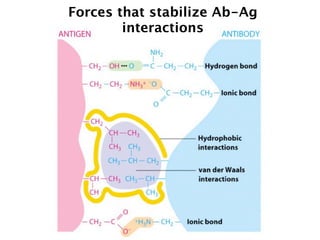
Forces that stabilize Ab-Ag
        interactions
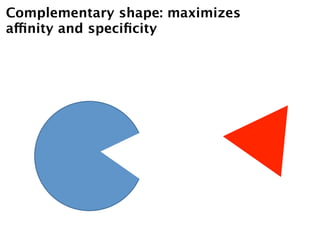
Complementary shape: maximizes
affinity and specificity
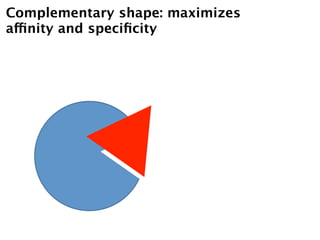
Complementary shape: maximizes
affinity and specificity
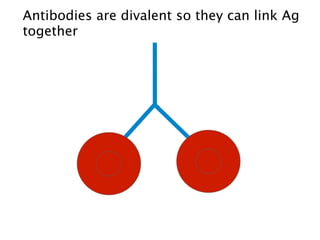
Antibodies are divalent so they can link Ag
together
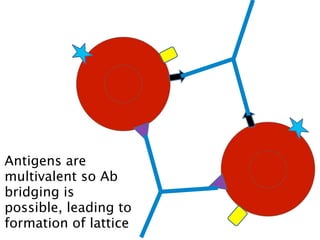
Antigens are
multivalent so Ab
bridging is
possible, leading to
formation of lattice
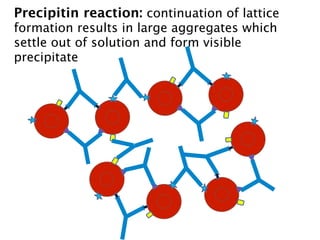
Precipitin reaction: continuation of lattice
formation results in large aggregates which
settle out of solution and form visible
precipitate
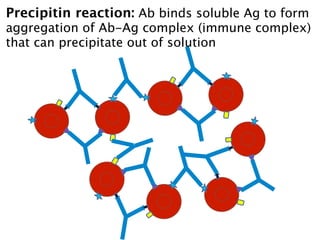
Precipitin reaction: Ab binds soluble Ag to form
aggregation of Ab-Ag complex (immune complex)
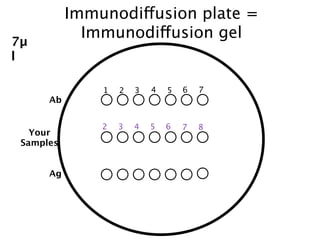
that can precipitate out of solution
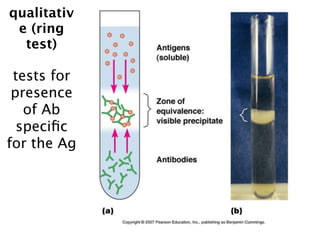
qualitativ
 e (ring
  test)

 tests for
 presence
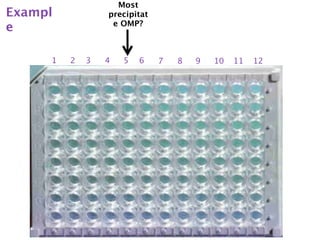
   of Ab
  specific
for the Ag
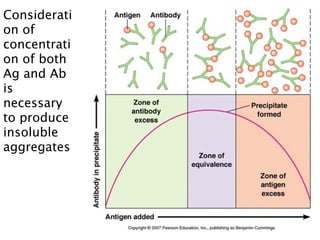
Considerati
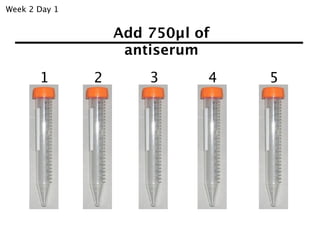
on of
concentrati
on of both
Ag and Ab
is
necessary
to produce
insoluble
aggregates
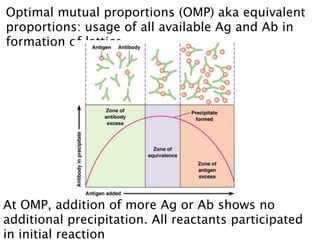
Optimal mutual proportions (OMP) aka equivalent
proportions: usage of all available Ag and Ab in
formation of lattice


At OMP, addition of more Ag or Ab shows no
additional precipitation. All reactants participated
in initial reaction
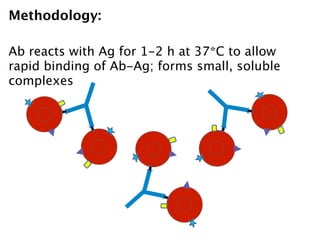
Methodology:

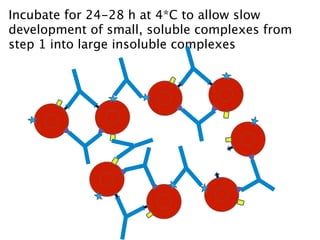
Ab reacts with Ag for 1-2 h at 37*C to allow
rapid binding of Ab-Ag; forms small, soluble
complexes
Incubate for 24-28 h at 4*C to allow slow
development of small, soluble complexes from
step 1 into large insoluble complexes
Hence want to determine OMP= optimal
concentration of Ab and Ag to allow precipitin
reaction to occur

SO dilute Ag, keep Ab constant, measure amount
of precipitation, and determine dilution of Ag
that gives greatest amount of precipitation


Dilution of Ag that gives greatest precipitation =
OMP aka equivalence
• Change Ag amounts (mg), add to constant
  amount of Ab, measure amount of
  precipitation


• Plot amounts of precipitate VS amount of Ag
  added


• To determine if a particular SN has excess Ag
  or Ab, Add more Ag or Ab and see if additional
  precipitation occurs
Our Antigen
Ovalbumin:
•Most prevalent protein in
chicken eggs
•Used as an allergen in test
patients
•Used as molecular weight
Agglutination            Precipitin Reaction
Qualitative (slide test)    Qualitative (ring test)
Ag – SRBC/Ab - α-SRBC        Ag – OA /Ab – α-OA
Quantitative (microtiter   Quantitative (microtiter
        plate)                     assay)
     Result: Titer              Results: OMP
  Serially diluted Ab        Serially diluted Ag
More sensitive (need .      Less sensitive (need
      8-16mg)                   80-320mg)
   Ag is not soluble            Ag is soluble
Serum: The clear liquid that can be separated
from clotted blood. Serum differs from
plasma, the liquid portion of normal unclotted
blood containing the red and white cells and
platelets. It is the clot that makes the
difference between serum and plasma.


Antiserum: antibody containing serum
Protocol


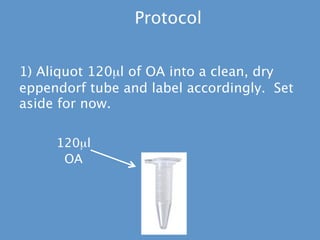
1) Aliquot 120µl of OA into a clean, dry
eppendorf tube and label accordingly. Set
aside for now.
 
     120µl
      OA
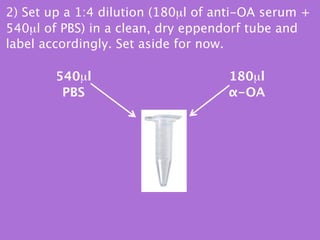
2) Set up a 1:4 dilution (180µl of anti-OA serum +
540µl of PBS) in a clean, dry eppendorf tube and
label accordingly. Set aside for now.

        540µl                       180µl
         PBS                        α-OA
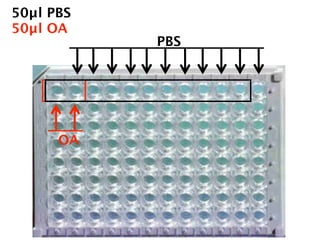
50µl PBS
50µl OA
           PBS


      OA
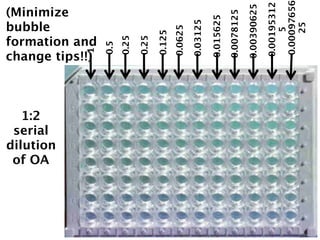
1:2
 serial

 of OA
           bubble


dilution
           (Minimize


             1
           formation and
           change tips!!)  


             0.5
             0.25

             0.25

             0.125
            0.0625

            0.03125

            0.015625
            0.0078125

            0.00390625

            0.00195312
                 5
            0.00097656
                 25
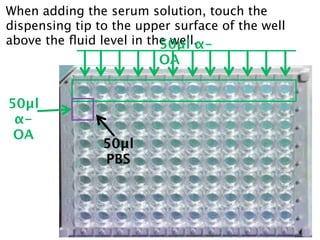
When adding the serum solution, touch the
dispensing tip to the upper surface of the well
above the fluid level in the well.
                          50µl α-
                         OA


50µl
 α-
 OA
                50µl
                PBS
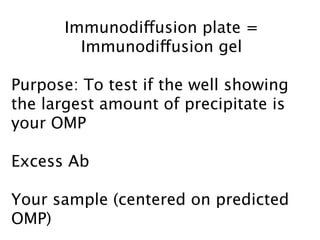
Immunodiffusion plate =
        Immunodiffusion gel

Purpose: To test if the well showing
the largest amount of precipitate is
your OMP

Excess Ab

Your sample (centered on predicted
OMP)
Day 2
• Centrifuge plate (microtiter) 10 mins at 1200

 rpm

• Prepare 2 plates (petri dishes): 10mL of agar to

 each dish

• Label plates

• Incubate plates in fridge for 45-60 mins.

• Remove plates
Day 2
• Examine Day 1 plates

• Determine well(s) that show largest amount of

 precipitate…OMP?


*Be very careful to not to disrupt the precipitate

 (do not shake)!
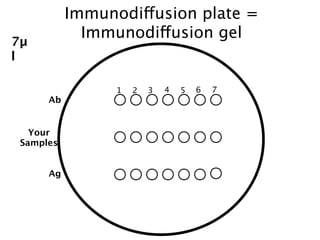
Immunodiffusion plate =
7µ
             Immunodiffusion gel
l

                 1   2   3   4   5   6   7
      Ab


   Your
 Samples


      Ag
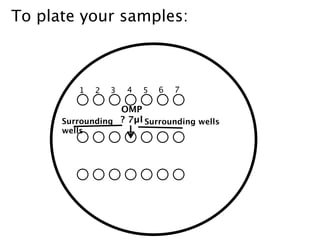
To plate your samples:


          1   2   3   4   5   6   7

                  OMP
      Surrounding ? 7µl Surrounding wells
      wells
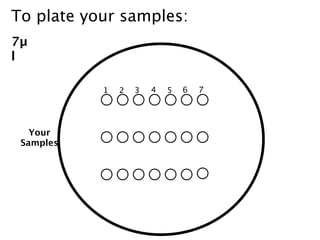
To plate your samples:
7µ
l

           1   2   3   4   5   6   7


   Your
 Samples
Most
Exampl           precipitat
                  e OMP?
e

     1   2   3   4   5   6    7   8   9   10   11   12
Immunodiffusion plate =
7µ
             Immunodiffusion gel
l

               1   2   3   4   5   6   7
      Ab

               2   3   4   5   6   7   8
   Your
 Samples


      Ag
Schedule a time to view your plate
tomorrow

If you know when you can make it, let me know

If not, find time tomorrow to come find me in
MH-317

     I will go with you to view your
immunodiffusion
         plate
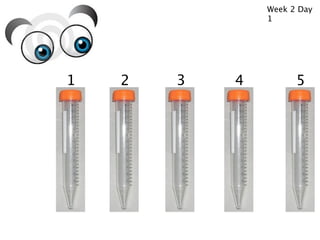
Week 2 Day 1
                Dilutions of Ag
               Final Volume= 750µl
                    [OMP]

       1        2       3     4      5
Week 2 Day 1


                   Add 750µl of
                    antiserum
       1       2       3      4   5
Week 2 Day
                1


1   2   3   4         5
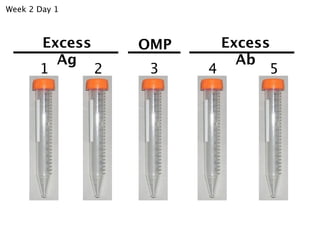
Week 2 Day 1


       Excess     OMP     Excess
         Ag                 Ab
       1      2    3    4       5
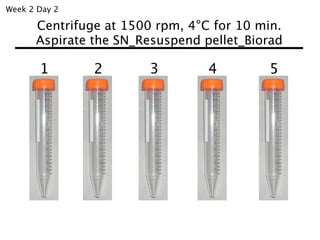
Week 2 Day 2

      Centrifuge at 1500 rpm, 4°C for 10 min.
      Aspirate the SN_Resuspend pellet_Biorad

       1       2        3        4        5
Calculations

•Construct a standard curve (total protein
concentration vs antigen concentration)
•Calculate the amount of antibody protein at
equivalence
•       OMP, [ppt] = [antigen] + [antibody]
• Using the dilution of the original antiserum at
equivalence, calculate the amount of antibody
protein per ml of original undiluted antiserum
 

Precipitin 1

  • 1.
    Precipitin Reaction Purpose: To understand the biological basis of the precipitin reaction, and how to perform, and analyze the reaction.
  • 2.
    Forces that stabilizeAb-Ag interactions
  • 3.
  • 4.
  • 5.
    Antibodies are divalentso they can link Ag together
  • 6.
    Antigens are multivalent soAb bridging is possible, leading to formation of lattice
  • 7.
    Precipitin reaction: continuationof lattice formation results in large aggregates which settle out of solution and form visible precipitate
  • 8.
    Precipitin reaction: Abbinds soluble Ag to form aggregation of Ab-Ag complex (immune complex) that can precipitate out of solution
  • 9.
    qualitativ e (ring test) tests for presence of Ab specific for the Ag
  • 10.
    Considerati on of concentrati on ofboth Ag and Ab is necessary to produce insoluble aggregates
  • 11.
    Optimal mutual proportions(OMP) aka equivalent proportions: usage of all available Ag and Ab in formation of lattice At OMP, addition of more Ag or Ab shows no additional precipitation. All reactants participated in initial reaction
  • 12.
    Methodology: Ab reacts withAg for 1-2 h at 37*C to allow rapid binding of Ab-Ag; forms small, soluble complexes
  • 13.
    Incubate for 24-28h at 4*C to allow slow development of small, soluble complexes from step 1 into large insoluble complexes
  • 14.
    Hence want todetermine OMP= optimal concentration of Ab and Ag to allow precipitin reaction to occur SO dilute Ag, keep Ab constant, measure amount of precipitation, and determine dilution of Ag that gives greatest amount of precipitation Dilution of Ag that gives greatest precipitation = OMP aka equivalence
  • 15.
    • Change Agamounts (mg), add to constant amount of Ab, measure amount of precipitation • Plot amounts of precipitate VS amount of Ag added • To determine if a particular SN has excess Ag or Ab, Add more Ag or Ab and see if additional precipitation occurs
  • 16.
    Our Antigen Ovalbumin: •Most prevalentprotein in chicken eggs •Used as an allergen in test patients •Used as molecular weight
  • 17.
    Agglutination Precipitin Reaction Qualitative (slide test) Qualitative (ring test) Ag – SRBC/Ab - α-SRBC Ag – OA /Ab – α-OA Quantitative (microtiter Quantitative (microtiter plate) assay) Result: Titer Results: OMP Serially diluted Ab Serially diluted Ag More sensitive (need . Less sensitive (need 8-16mg) 80-320mg) Ag is not soluble Ag is soluble
  • 18.
    Serum: The clearliquid that can be separated from clotted blood. Serum differs from plasma, the liquid portion of normal unclotted blood containing the red and white cells and platelets. It is the clot that makes the difference between serum and plasma. Antiserum: antibody containing serum
  • 19.
    Protocol 1) Aliquot 120µlof OA into a clean, dry eppendorf tube and label accordingly. Set aside for now.   120µl OA
  • 20.
    2) Set upa 1:4 dilution (180µl of anti-OA serum + 540µl of PBS) in a clean, dry eppendorf tube and label accordingly. Set aside for now. 540µl 180µl PBS α-OA
  • 21.
  • 22.
    1:2 serial ofOA bubble dilution (Minimize 1 formation and change tips!!)   0.5 0.25 0.25 0.125 0.0625 0.03125 0.015625 0.0078125 0.00390625 0.00195312 5 0.00097656 25
  • 23.
    When adding theserum solution, touch the dispensing tip to the upper surface of the well above the fluid level in the well. 50µl α- OA 50µl α- OA 50µl PBS
  • 24.
    Immunodiffusion plate = Immunodiffusion gel Purpose: To test if the well showing the largest amount of precipitate is your OMP Excess Ab Your sample (centered on predicted OMP)
  • 25.
    Day 2 • Centrifugeplate (microtiter) 10 mins at 1200 rpm • Prepare 2 plates (petri dishes): 10mL of agar to each dish • Label plates • Incubate plates in fridge for 45-60 mins. • Remove plates
  • 26.
    Day 2 • ExamineDay 1 plates • Determine well(s) that show largest amount of precipitate…OMP? *Be very careful to not to disrupt the precipitate (do not shake)!
  • 27.
    Immunodiffusion plate = 7µ Immunodiffusion gel l 1 2 3 4 5 6 7 Ab Your Samples Ag
  • 28.
    To plate yoursamples: 1 2 3 4 5 6 7 OMP Surrounding ? 7µl Surrounding wells wells
  • 29.
    To plate yoursamples: 7µ l 1 2 3 4 5 6 7 Your Samples
  • 30.
    Most Exampl precipitat e OMP? e 1 2 3 4 5 6 7 8 9 10 11 12
  • 31.
    Immunodiffusion plate = 7µ Immunodiffusion gel l 1 2 3 4 5 6 7 Ab 2 3 4 5 6 7 8 Your Samples Ag
  • 32.
    Schedule a timeto view your plate tomorrow If you know when you can make it, let me know If not, find time tomorrow to come find me in MH-317 I will go with you to view your immunodiffusion plate
  • 33.
    Week 2 Day1 Dilutions of Ag Final Volume= 750µl [OMP] 1 2 3 4 5
  • 34.
    Week 2 Day1 Add 750µl of antiserum 1 2 3 4 5
  • 35.
    Week 2 Day 1 1 2 3 4 5
  • 36.
    Week 2 Day1 Excess OMP Excess Ag Ab 1 2 3 4 5
  • 37.
    Week 2 Day2 Centrifuge at 1500 rpm, 4°C for 10 min. Aspirate the SN_Resuspend pellet_Biorad 1 2 3 4 5
  • 38.
    Calculations •Construct a standardcurve (total protein concentration vs antigen concentration) •Calculate the amount of antibody protein at equivalence • OMP, [ppt] = [antigen] + [antibody] • Using the dilution of the original antiserum at equivalence, calculate the amount of antibody protein per ml of original undiluted antiserum  

Editor's Notes

  • #2 \n
  • #3 \n
  • #4 \n
  • #5 \n
  • #6 \n
  • #7 \n
  • #8 \n
  • #9 http://classes.midlandstech.edu/carterp/Courses/bio225/chap18/Slide14.GIF. precipitate should form near interface between the two solutions= zone of optimal mutual proportions \n
  • #10 http://classes.midlandstech.edu/carterp/Courses/bio225/chap18/lecture2.htm\n
  • #11 excess Ab: all epitopes on Ag are covered by Ab- cock blocks subsequent lattice formation\nexcess Ag: has similar effect... so all Ab already bound to Ag and doesn't really care if new Ag is added-not sufficient Ab to cross--link Ag to form lattice, more precipitation does not occur\n
  • #12 \n
  • #13 \n
  • #14 \n
  • #15 \n
  • #16 http://www.biology-online.org/dictionary/Ovalbumin\n
  • #17 \n
  • #18 http://www.medterms.com/script/main/art.asp?articlekey=5470\n
  • #19 \n
  • #20 \n
  • #21 3) Deliver 50μl of PBS to wells 2 through 12 in row A\n Add 50 mL of the antigen (OA) solution (what you made in step 1) to wells 1 and 2 of row A. \n\n \n
  • #22 \n
  • #23 \n
  • #24 If you have excess Ab in your sample, it will diffuse (migrate) toward the Ag you plated. If you have excess Ag it will diffuse (migrate) toward the Ab you plated. This will allow you to confirm or deny your predicted OMP. By plating the samples from surrounding wells of your microtitter plate, you will be able to identify the correct OMP.\n
  • #25 \n
  • #26 \n
  • #27 \n
  • #28 \n
  • #29 \n
  • #30 \n
  • #31 \n
  • #32 \n
  • #33 http://www.therapak.com/catalog/img/lg/29854.jpg\n
  • #34 \n
  • #35 Observe turbidity- incubate 1h at 37°C- rank precipitate 1-5 (5=most precipitate)\n
  • #36 \n
  • #37 \n
  • #38 \n