Molecular Diagnostics 4th year
1 Mr. Omer Yahia Elhussein
Prenatal test
Molecular Diagnostics:
Is a technique used to analyze biological markers in the genome and
proteome by applying molecular biology to medical testing.
Clinical Genetics:
Is the specialty concerned with the diagnosis of inherited disorders and
birth defects, with the estimation of genetic risks and with genetic
counseling of family members.
Genetic counseling:
Is advice based on analyzing the probability that patient having a
genetic defect.
 Important aspect of genetic counseling is finding out whether a
fetus is normal.
Genetic testing is done for three main purposes: prenatal diagnosis,
newborn screening, and carrier (heterozygote) detection.
Prenatal diagnosis: is done to assess whether a fetus is at risk for a
genetic disorder.
Carrier (heterozygote)
detection:
Is testing individuals to see
whether they are carriers
(heterozygotes) for a
recessive genetic disease is
done to identify those who
may pass on a deleterious
gene to their offspring.
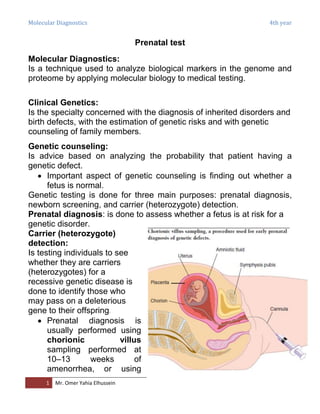
 Prenatal diagnosis is
usually performed using
chorionic villus
sampling performed at
10–13 weeks of
amenorrhea, or using
Molecular Diagnostics 4th year
2 Mr. Omer Yahia Elhussein
amniotic cells from
amniotic fluid sampled
either at 16 weeks of
amenorrhea or after.
Chorionic villus sampling
 The chorion is a
membrane layer
surrounding the fetus and
consisting entirely of
embryonic tissue.
 Advantages of the
technique are that the
parents can learn whether
the fetus has a genetic
defect earlier in the
pregnancy than with
amniocentesis and that cell
cultures are not required to
do the biochemical assays.
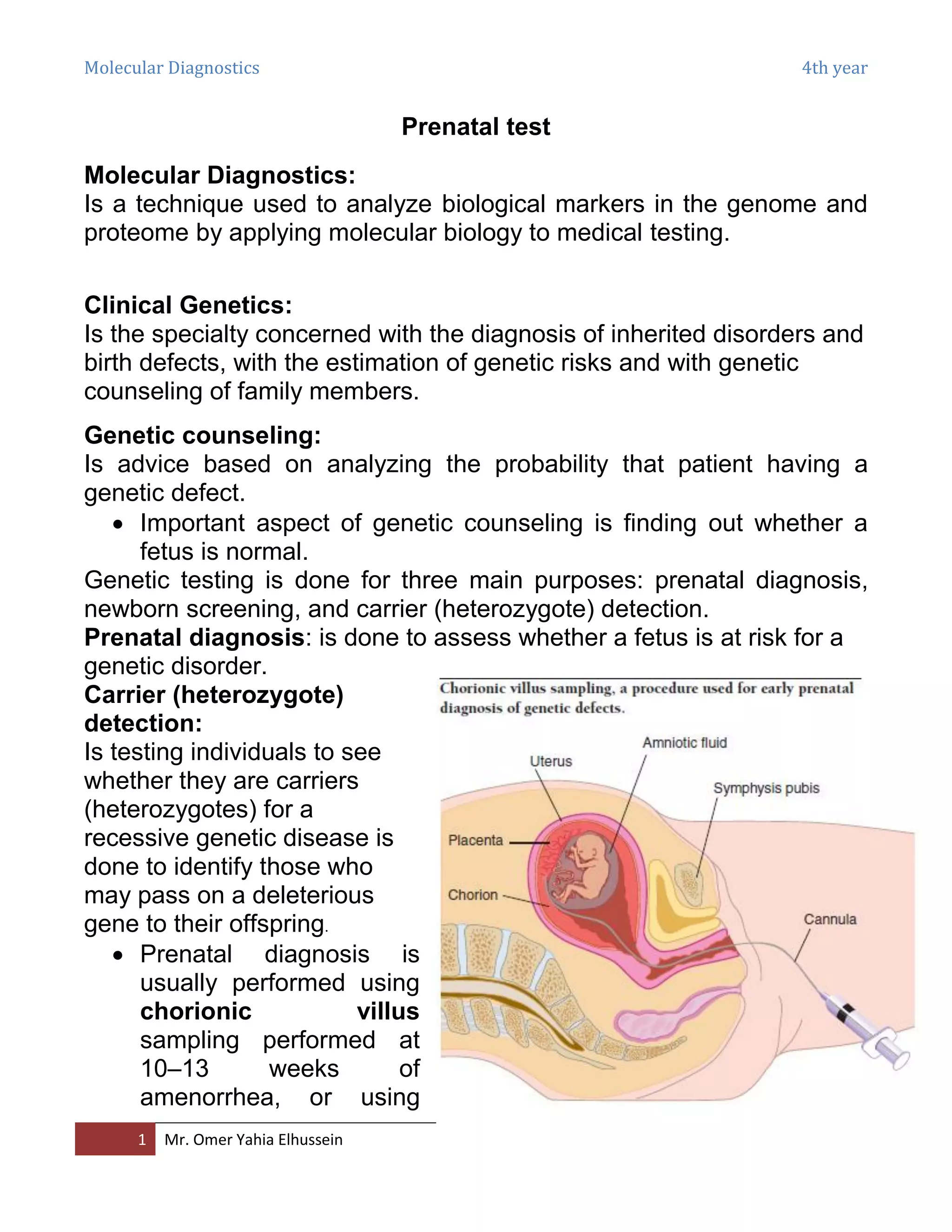
Amniocentesis procedure:
 The fluid contains cells that the
fetus’s skin has sloughed off;
these cells can be cultured in
the laboratory and then
examined for protein or
enzyme alterations or
deficiencies, DNA changes,
and chromosomal
abnormalities.
 So what type of testing could
be applied to prenatal?
They are as follow:
Molecular Diagnostics 4th year
3 Mr. Omer Yahia Elhussein
A. Genetic illness that caused by chromosomal anomalies, abnormalities of
chromosomal structure or number.
1. Down syndrome (Trisomy 21).
2. Patau syndrome (Trisomy 13)
3. Edwards syndrome (Trisomy 18)
4. Klinefelter Syndrome
(XXY male, XXY syndrome, XXXY syndrome, XXYY syndrome,
XXXXY syndrome, XXXYY syndrome.
5. DiGeorge Syndrome (a deletion on the long arm of chromosome 22)
6. Cri-du-chat Syndrome (chromosome deletion 5p syndrome).
7. Turner syndrome (Absence of one copy of X chromosome).
B. Genetic ill health has many facets. Many inherited genetic diseases are
caused by abnormal forms, mutations, of single genes inherited through
the gametes (sperm and egg).
1. Sickle cell anemia.
2. Cystic fibrosis.
3. Phenylketonuria.
4. Muscular dystrophy.
5. Thalassaemia.
6. Huntington disease
7. Hemophilia
C. Some cancer genetic syndromes:
1. Familial adenomatous polyposis [FAP].
2. Retinoblastoma [RB].
3. Multiple endocrine neoplasia type 2A.
4. Li-Fraumeni Syndrome.
Molecular Diagnostics 4th year
4 Mr. Omer Yahia Elhussein
3
2
1
2
1
1
2
1
2
3
1
2
3
4
1
2
Short arm (p)
Long arm (q)
Region q2
Band p23
Chromosome 8
CentromerCentromer
3
2
1
2
1
1
2
1
2
3
1
2
3
4
1
2
Short arm (p)
Long arm (q)
Region q2
Band p23
Chromosome 8
CentromerCentromer
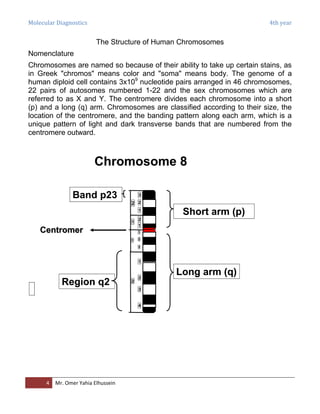
The Structure of Human Chromosomes
Nomenclature
Chromosomes are named so because of their ability to take up certain stains, as
in Greek "chromos" means color and "soma" means body. The genome of a
human diploid cell contains 3x10⁹
nucleotide pairs arranged in 46 chromosomes,
22 pairs of autosomes numbered 1-22 and the sex chromosomes which are
referred to as X and Y. The centromere divides each chromosome into a short
(p) and a long (q) arm. Chromosomes are classified according to their size, the
location of the centromere, and the banding pattern along each arm, which is a
unique pattern of light and dark transverse bands that are numbered from the
centromere outward.
Molecular Diagnostics 4th year
5 Mr. Omer Yahia Elhussein
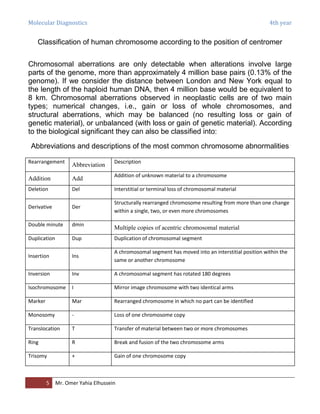
Classification of human chromosome according to the position of centromer
Chromosomal aberrations are only detectable when alterations involve large
parts of the genome, more than approximately 4 million base pairs (0.13% of the
genome). If we consider the distance between London and New York equal to
the length of the haploid human DNA, then 4 million base would be equivalent to
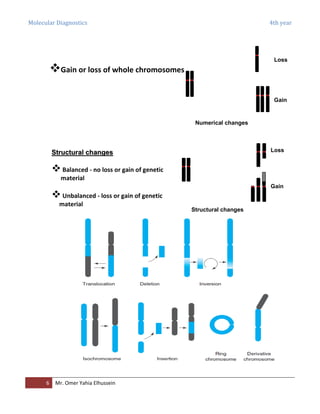
8 km. Chromosomal aberrations observed in neoplastic cells are of two main
types; numerical changes, i.e., gain or loss of whole chromosomes, and
structural aberrations, which may be balanced (no resulting loss or gain of
genetic material), or unbalanced (with loss or gain of genetic material). According
to the biological significant they can also be classified into:
Abbreviations and descriptions of the most common chromosome abnormalities
Rearrangement
Abbreviation
Description
Addition Add
Addition of unknown material to a chromosome
Deletion Del Interstitial or terminal loss of chromosomal material
Derivative Der
Structurally rearranged chromosome resulting from more than one change
within a single, two, or even more chromosomes
Double minute dmin
Multiple copies of acentric chromosomal material
Duplication Dup Duplication of chromosomal segment
Insertion Ins
A chromosomal segment has moved into an interstitial position within the
same or another chromosome
Inversion Inv A chromosomal segment has rotated 180 degrees
Isochromosome I Mirror image chromosome with two identical arms
Marker Mar Rearranged chromosome in which no part can be identified
Monosomy - Loss of one chromosome copy
Translocation T Transfer of material between two or more chromosomes
Ring R Break and fusion of the two chromosome arms
Trisomy + Gain of one chromosome copy
Molecular Diagnostics 4th year
6 Mr. Omer Yahia Elhussein
Numerical changes
Gain
Loss
Structural changes
Loss
Gain
Gain or loss of whole chromosomes
SSttrruuccttuurraall cchhaannggeess
Balanced - no loss or gain of genetic
material
Unbalanced - loss or gain of genetic
material
Molecular Diagnostics 4th year
7 Mr. Omer Yahia Elhussein
References:
 Peter J. Russell, i Genetics: Copyright © Pearson Education.
 Cell and Molecular Biology concepts and experiments 6 edition.

Pre natal test

  • 1.
    Molecular Diagnostics 4thyear 1 Mr. Omer Yahia Elhussein Prenatal test Molecular Diagnostics: Is a technique used to analyze biological markers in the genome and proteome by applying molecular biology to medical testing. Clinical Genetics: Is the specialty concerned with the diagnosis of inherited disorders and birth defects, with the estimation of genetic risks and with genetic counseling of family members. Genetic counseling: Is advice based on analyzing the probability that patient having a genetic defect.  Important aspect of genetic counseling is finding out whether a fetus is normal. Genetic testing is done for three main purposes: prenatal diagnosis, newborn screening, and carrier (heterozygote) detection. Prenatal diagnosis: is done to assess whether a fetus is at risk for a genetic disorder. Carrier (heterozygote) detection: Is testing individuals to see whether they are carriers (heterozygotes) for a recessive genetic disease is done to identify those who may pass on a deleterious gene to their offspring.  Prenatal diagnosis is usually performed using chorionic villus sampling performed at 10–13 weeks of amenorrhea, or using
  • 2.
    Molecular Diagnostics 4thyear 2 Mr. Omer Yahia Elhussein amniotic cells from amniotic fluid sampled either at 16 weeks of amenorrhea or after. Chorionic villus sampling  The chorion is a membrane layer surrounding the fetus and consisting entirely of embryonic tissue.  Advantages of the technique are that the parents can learn whether the fetus has a genetic defect earlier in the pregnancy than with amniocentesis and that cell cultures are not required to do the biochemical assays. Amniocentesis procedure:  The fluid contains cells that the fetus’s skin has sloughed off; these cells can be cultured in the laboratory and then examined for protein or enzyme alterations or deficiencies, DNA changes, and chromosomal abnormalities.  So what type of testing could be applied to prenatal? They are as follow:
  • 3.
    Molecular Diagnostics 4thyear 3 Mr. Omer Yahia Elhussein A. Genetic illness that caused by chromosomal anomalies, abnormalities of chromosomal structure or number. 1. Down syndrome (Trisomy 21). 2. Patau syndrome (Trisomy 13) 3. Edwards syndrome (Trisomy 18) 4. Klinefelter Syndrome (XXY male, XXY syndrome, XXXY syndrome, XXYY syndrome, XXXXY syndrome, XXXYY syndrome. 5. DiGeorge Syndrome (a deletion on the long arm of chromosome 22) 6. Cri-du-chat Syndrome (chromosome deletion 5p syndrome). 7. Turner syndrome (Absence of one copy of X chromosome). B. Genetic ill health has many facets. Many inherited genetic diseases are caused by abnormal forms, mutations, of single genes inherited through the gametes (sperm and egg). 1. Sickle cell anemia. 2. Cystic fibrosis. 3. Phenylketonuria. 4. Muscular dystrophy. 5. Thalassaemia. 6. Huntington disease 7. Hemophilia C. Some cancer genetic syndromes: 1. Familial adenomatous polyposis [FAP]. 2. Retinoblastoma [RB]. 3. Multiple endocrine neoplasia type 2A. 4. Li-Fraumeni Syndrome.
  • 4.
    Molecular Diagnostics 4thyear 4 Mr. Omer Yahia Elhussein 3 2 1 2 1 1 2 1 2 3 1 2 3 4 1 2 Short arm (p) Long arm (q) Region q2 Band p23 Chromosome 8 CentromerCentromer 3 2 1 2 1 1 2 1 2 3 1 2 3 4 1 2 Short arm (p) Long arm (q) Region q2 Band p23 Chromosome 8 CentromerCentromer The Structure of Human Chromosomes Nomenclature Chromosomes are named so because of their ability to take up certain stains, as in Greek "chromos" means color and "soma" means body. The genome of a human diploid cell contains 3x10⁹ nucleotide pairs arranged in 46 chromosomes, 22 pairs of autosomes numbered 1-22 and the sex chromosomes which are referred to as X and Y. The centromere divides each chromosome into a short (p) and a long (q) arm. Chromosomes are classified according to their size, the location of the centromere, and the banding pattern along each arm, which is a unique pattern of light and dark transverse bands that are numbered from the centromere outward.
  • 5.
    Molecular Diagnostics 4thyear 5 Mr. Omer Yahia Elhussein Classification of human chromosome according to the position of centromer Chromosomal aberrations are only detectable when alterations involve large parts of the genome, more than approximately 4 million base pairs (0.13% of the genome). If we consider the distance between London and New York equal to the length of the haploid human DNA, then 4 million base would be equivalent to 8 km. Chromosomal aberrations observed in neoplastic cells are of two main types; numerical changes, i.e., gain or loss of whole chromosomes, and structural aberrations, which may be balanced (no resulting loss or gain of genetic material), or unbalanced (with loss or gain of genetic material). According to the biological significant they can also be classified into: Abbreviations and descriptions of the most common chromosome abnormalities Rearrangement Abbreviation Description Addition Add Addition of unknown material to a chromosome Deletion Del Interstitial or terminal loss of chromosomal material Derivative Der Structurally rearranged chromosome resulting from more than one change within a single, two, or even more chromosomes Double minute dmin Multiple copies of acentric chromosomal material Duplication Dup Duplication of chromosomal segment Insertion Ins A chromosomal segment has moved into an interstitial position within the same or another chromosome Inversion Inv A chromosomal segment has rotated 180 degrees Isochromosome I Mirror image chromosome with two identical arms Marker Mar Rearranged chromosome in which no part can be identified Monosomy - Loss of one chromosome copy Translocation T Transfer of material between two or more chromosomes Ring R Break and fusion of the two chromosome arms Trisomy + Gain of one chromosome copy
  • 6.
    Molecular Diagnostics 4thyear 6 Mr. Omer Yahia Elhussein Numerical changes Gain Loss Structural changes Loss Gain Gain or loss of whole chromosomes SSttrruuccttuurraall cchhaannggeess Balanced - no loss or gain of genetic material Unbalanced - loss or gain of genetic material
  • 7.
    Molecular Diagnostics 4thyear 7 Mr. Omer Yahia Elhussein References:  Peter J. Russell, i Genetics: Copyright © Pearson Education.  Cell and Molecular Biology concepts and experiments 6 edition.