Topic:
Topic: Prawn Culture
Presenting to: Sir Waqas Ahmad Shams
Presenting by:
Seema Hassan
Sanam Taj
Shagufta
Siraj Ghani
Tabassum Malik
Introduction
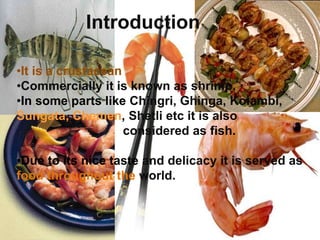
•It is a crustacean
•Commercially it is known as shrimp.
•In some parts like Chingri, Ghinga, Kolambi,
Sungata, Chemen, Shetli etc it is also
considered as fish.
•Due to its nice taste and delicacy it is served as
food throughout the world.
Production
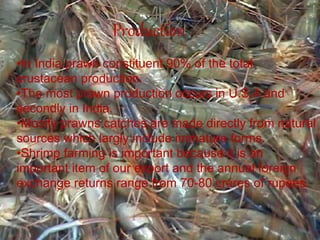
•In India prawn constituent 90% of the total
crustacean production.
•The most prawn production occurs in U.S.A and
secondly in India.
•Mostly prawns catches are made directly from natural
sources which largly include immature forms.
•Shrimp farming is important because it is an
important item of our export and the annual foreign
exchange returns range from 70-80 crores of rupees.
Shrimp aquaculture in Pakistan
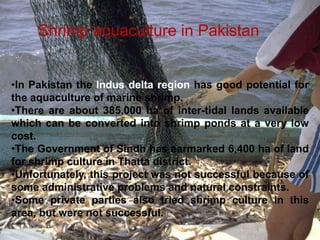
•In Pakistan the Indus delta region has good potential for
the aquaculture of marine shrimp.
•There are about 385,000 ha of inter-tidal lands available
which can be converted into shrimp ponds at a very low
cost.
•The Government of Sindh has earmarked 6,400 ha of land
for shrimp culture in Thatta district.
•Unfortunately, this project was not successful because of
some administrative problems and natural constraints.
•Some private parties also tried shrimp culture in this
area, but were not successful.
Natural Constraints To
Shrimp Farming In Pakistan
Salinity:
• The salinities in the Indus delta creek reach as high as
45 ppt in the dry season (unsuitable for shrimp culture)
Temperature:
• The other constraint is that of temperature. Most tropical
penaeid shrimp species grow best within a temperature
range of 28 to 32°C.
• In such areas only one crop of shrimp in summer months
can be harvested as against two in other south east
Asian countries.
Types of prawn
• Prawn inhibits all types of water i.e
– Sea water
– Fresh-water
– Estuaries
• Their greatest quality lies in their
adaptation to changing factors like
– Temperature
– Oxygen concentration
– salinity
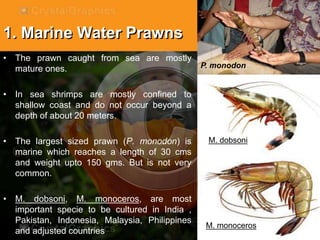
1. Marine Water Prawns
• The prawn caught from sea are mostly
mature ones.
• In sea shrimps are mostly confined to
shallow coast and do not occur beyond a
depth of about 20 meters.
• The largest sized prawn (P. monodon) is
marine which reaches a length of 30 cms
and weight upto 150 gms. But is not very
common.
• M. dobsoni, M. monoceros, are most
important specie to be cultured in India ,
Pakistan, Indonesia, Malaysia, Philippines
and adjusted countries
P. monodon
M. monoceros
M. dobsoni
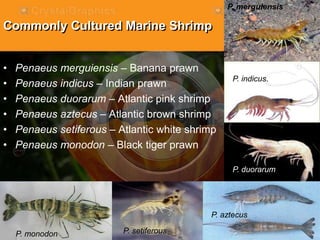
Commonly Cultured Marine Shrimp
• Penaeus merguiensis – Banana prawn
• Penaeus indicus – Indian prawn
• Penaeus duorarum – Atlantic pink shrimp
• Penaeus aztecus – Atlantic brown shrimp
• Penaeus setiferous – Atlantic white shrimp
• Penaeus monodon – Black tiger prawn
P. merguiensis
P. indicus.
P. monodon
P. duorarum
P. aztecus
P. setiferous
2. Estuaries Prawn
• The fauna of these regions is the same except
Parapenaeopsis stylifera which is exclusively
marine.
• These are mostly immature.
• The important areas of prawn production in
estuaries are the backwaters extending to the
southern half of Kerala coast.
• Several lakes like Pulicat, Ennur, Collair, Chilka,
etc and the mouth of numerious hill streams in the
Malabar also serve as fishing grounds for prawns.
• Besides this , the estuaries of the Ganges and the
Brahmaputra rivers in the east are of considerable
importance.
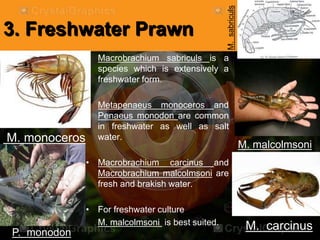
3. Freshwater Prawn
• Macrobrachium sabriculs is a
species which is extensively a
freshwater form.
• Metapenaeus monoceros and
Penaeus monodon are common
in freshwater as well as salt
water.
• Macrobrachium carcinus and
Macrobrachium malcolmsoni are
fresh and brakish water.
• For freshwater culture
M. malcolmsoni is best suited.
M.sabriculs
M. monoceros
P. monodon
M. carcinus
M. malcolmsoni
Reproduction
• The marine and brakish water specie spawn in sea.
• They are drifted along with the current to coastal waters
or estuaries where they undergo development till they
reaches the jevenile stage.
• The post larvae feed upon the dead organic matter of
plants and animals and upon small benthomic organisms
• For breeding the juvinile prawn has to enter the sea.
• The fresh water specie like Macrobrachium malcolmsoni
spawn in fresh water , then they are drifted to estuaries
and after attaining the juvenile stage swim back to
Fresh-water.
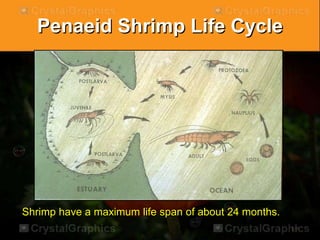
Penaeid Shrimp Life Cycle
Shrimp have a maximum life span of about 24 months.
Season for prawn fishery
• The ideal season for fishing at Bombay coast
is from August to October
• In Saurashtra it is from July to Septmber.
• On eastern coast, it starts from moonsoon
and extend upto March-April.
• Fishing is done throughout the year in the
backwaters of Kerala.
• Different lakes have different fishing season.
• In freshwater, it extends from March to June-
July.
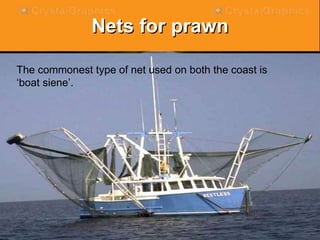
Nets for prawn
• The commonest type of net used on both
the coast is ‘boat siene’.
The commonest type of net used on both the coast is
‘boat siene’.
Life CycleNets for prawn
•In estuaries and backwaters, a particular type of conical
net, supported by a pair of stakes in bieng used. This net
has a wide mouth and is set against the tide. The tidal
water bring prawn and other crustaceans which get
engulfed into such nets.
•Other type of nets like cast net, drag net, wall net etc
are also used for this purpose.
•Small nets and several other devices like trapping of
prawn by clothes by making small fences are bieng used
in paddy fields which are also used for this purpose.
• the crafts used for prawn fishing are the same as that
used for the collection of fishes.
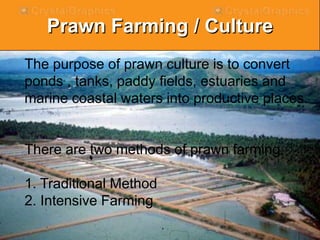
Prawn Farming / Culture
The purpose of prawn culture is to convert
ponds , tanks, paddy fields, estuaries and
marine coastal waters into productive places.
There are two methods of prawn farming.
1. Traditional Method
2. Intensive Farming
1. Traditional Method
• It is old and conservative method.
• This method is widely used in India.
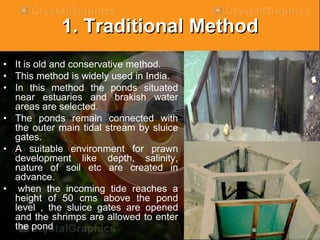
• In this method the ponds situated
near estuaries and brakish water
areas are selected.
• The ponds remain connected with
the outer main tidal stream by sluice
gates.
• A suitable environment for prawn
development like depth, salinity,
nature of soil etc are created in
advance.
• when the incoming tide reaches a
height of 50 cms above the pond
level , the sluice gates are opened
and the shrimps are allowed to enter
the pond
Traditional Method
• A mesh screen is placed near the gate to prevent the escape of
the post larval stages of prawn at dead tidal hours
• The developing shrimps depend entirely on natural diet.
• However in Philippines where a slightly altered type of
traditional method is used and the natural diet has been largly
suplimmented by an artificial one.
• Collection and harvesting is generally done by draining out the
pond water in such a way as to prevent the escape of prawns.
• Another method of harvesting is to set up a bag nets of bamboo
traps near the sluice gates.
• During the night electric bulbs which atttract are also used for
quick trapping.
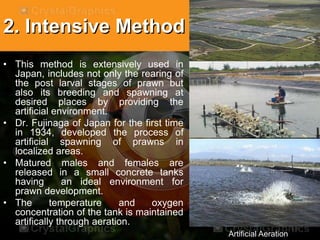
2. Intensive Method
• This method is extensively used in
Japan, includes not only the rearing of
the post larval stages of prawn but
also its breeding and spawning at
desired places by providing the
artificial environment.
• Dr. Fujinaga of Japan for the first time
in 1934, developed the process of
artificial spawning of prawns in
localized areas.
• Matured males and females are
released in a small concrete tanks
having an ideal environment for
prawn development.
• The temperature and oxygen
concentration of the tank is maintained
artifically through aeration.
Artificial Aeration
Water Quality for Growout Ponds
• Temperature: > 68F
• Salinity: 0.5 - 35 ppt
• Dissolved Oxygen: > 5 ppm
• pH: 7.0 – 8.3
• Unionized Ammonia: < 0.01 ppm
• Nitrite: < 1.0 ppm
• Nitrate: < 60 ppm
Intensive Method
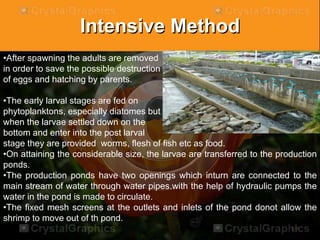
• After spawning the adults are removed in order to
save the possible destruction of eggs and hatching by
parents.
• The early larval stages are fed on phytoplanktons,
especially diatomes but when the larvae settled down
on the bottom and enter into the post larval stage they
are provided worms, flesh of fish etc as food.
• On attaining the considerable size, the larvae are
transferred to the production ponds.
• The production ponds have two openings which inturn
are connected to the main stream of water through
water pipes.with the help of hydraulic pumps the water
in the pond is made to circulate.
• The fixed mesh screens at the outlets and inlets of the
pond donot allow the shrimp to move out of th pond.
Intensive Method
•After spawning the adults are removed
in order to save the possible destruction
of eggs and hatching by parents.
•The early larval stages are fed on
phytoplanktons, especially diatomes but
when the larvae settled down on the
bottom and enter into the post larval
stage they are provided worms, flesh of fish etc as food.
•On attaining the considerable size, the larvae are transferred to the production
ponds.
•The production ponds have two openings which inturn are connected to the
main stream of water through water pipes.with the help of hydraulic pumps the
water in the pond is made to circulate.
•The fixed mesh screens at the outlets and inlets of the pond donot allow the
shrimp to move out of th pond.
Advantages of intensive Mathod
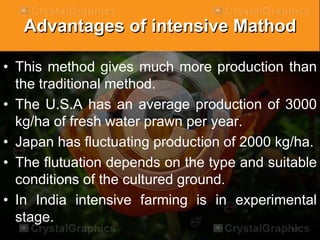
• This method gives much more production than
the traditional method.
• The U.S.A has an average production of 3000
kg/ha of fresh water prawn per year.
• Japan has fluctuating production of 2000 kg/ha.
• The flutuation depends on the type and suitable
conditions of the cultured ground.
• In India intensive farming is in experimental
stage.
Preservation and Processing
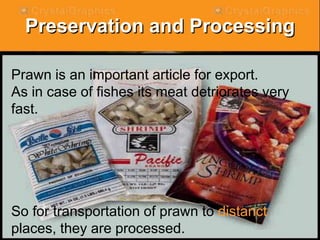
• Prawn is an important
article for export.
• As in case of fishes its
meat detriorates very
fast.
• So for transportation of
prawn to distanct
places, they are
processed.
Prawn is an important article for export.
As in case of fishes its meat detriorates very
fast.
So for transportation of prawn to distanct
places, they are processed.
For Short Distance
• If distance is short then they are packed
between layers of ice either entirely or
after removing caphalothrax.
Long time preservation
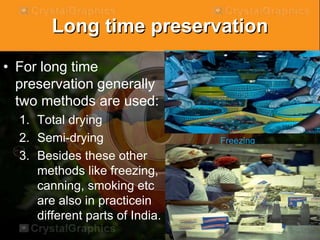
• For long time
preservation generally
two methods are used:
1. Total drying
2. Semi-drying
3. Besides these other
methods like freezing,
canning, smoking etc
are also in practicein
different parts of India.
Freezing
Total Drying Method
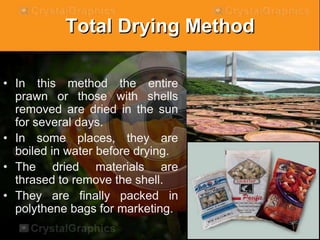
• In this method the entire
prawn or those with shells
removed are dried in the sun
for several days.
• In some places, they are
boiled in water before drying.
• The dried materials are
thrased to remove the shell.
• They are finally packed in
polythene bags for marketing.
Semidrying Technique
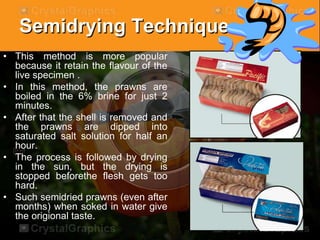
• This method is more popular
because it retain the flavour of the
live specimen .
• In this method, the prawns are
boiled in the 6% brine for just 2
minutes.
• After that the shell is removed and
the prawns are dipped into
saturated salt solution for half an
hour.
• The process is followed by drying
in the sun, but the drying is
stopped beforethe flesh gets too
hard.
• Such semidried prawns (even after
months) when soked in water give
the origional taste.
Prawn culture

Prawn culture

  • 2.
    Topic: Topic: Prawn Culture Presentingto: Sir Waqas Ahmad Shams Presenting by: Seema Hassan Sanam Taj Shagufta Siraj Ghani Tabassum Malik
  • 3.
    Introduction •It is acrustacean •Commercially it is known as shrimp. •In some parts like Chingri, Ghinga, Kolambi, Sungata, Chemen, Shetli etc it is also considered as fish. •Due to its nice taste and delicacy it is served as food throughout the world.
  • 4.
    Production •In India prawnconstituent 90% of the total crustacean production. •The most prawn production occurs in U.S.A and secondly in India. •Mostly prawns catches are made directly from natural sources which largly include immature forms. •Shrimp farming is important because it is an important item of our export and the annual foreign exchange returns range from 70-80 crores of rupees.
  • 5.
    Shrimp aquaculture inPakistan •In Pakistan the Indus delta region has good potential for the aquaculture of marine shrimp. •There are about 385,000 ha of inter-tidal lands available which can be converted into shrimp ponds at a very low cost. •The Government of Sindh has earmarked 6,400 ha of land for shrimp culture in Thatta district. •Unfortunately, this project was not successful because of some administrative problems and natural constraints. •Some private parties also tried shrimp culture in this area, but were not successful.
  • 6.
    Natural Constraints To ShrimpFarming In Pakistan Salinity: • The salinities in the Indus delta creek reach as high as 45 ppt in the dry season (unsuitable for shrimp culture) Temperature: • The other constraint is that of temperature. Most tropical penaeid shrimp species grow best within a temperature range of 28 to 32°C. • In such areas only one crop of shrimp in summer months can be harvested as against two in other south east Asian countries.
  • 7.
    Types of prawn •Prawn inhibits all types of water i.e – Sea water – Fresh-water – Estuaries • Their greatest quality lies in their adaptation to changing factors like – Temperature – Oxygen concentration – salinity
  • 8.
    1. Marine WaterPrawns • The prawn caught from sea are mostly mature ones. • In sea shrimps are mostly confined to shallow coast and do not occur beyond a depth of about 20 meters. • The largest sized prawn (P. monodon) is marine which reaches a length of 30 cms and weight upto 150 gms. But is not very common. • M. dobsoni, M. monoceros, are most important specie to be cultured in India , Pakistan, Indonesia, Malaysia, Philippines and adjusted countries P. monodon M. monoceros M. dobsoni
  • 9.
    Commonly Cultured MarineShrimp • Penaeus merguiensis – Banana prawn • Penaeus indicus – Indian prawn • Penaeus duorarum – Atlantic pink shrimp • Penaeus aztecus – Atlantic brown shrimp • Penaeus setiferous – Atlantic white shrimp • Penaeus monodon – Black tiger prawn P. merguiensis P. indicus. P. monodon P. duorarum P. aztecus P. setiferous
  • 10.
    2. Estuaries Prawn •The fauna of these regions is the same except Parapenaeopsis stylifera which is exclusively marine. • These are mostly immature. • The important areas of prawn production in estuaries are the backwaters extending to the southern half of Kerala coast. • Several lakes like Pulicat, Ennur, Collair, Chilka, etc and the mouth of numerious hill streams in the Malabar also serve as fishing grounds for prawns. • Besides this , the estuaries of the Ganges and the Brahmaputra rivers in the east are of considerable importance.
  • 11.
    3. Freshwater Prawn •Macrobrachium sabriculs is a species which is extensively a freshwater form. • Metapenaeus monoceros and Penaeus monodon are common in freshwater as well as salt water. • Macrobrachium carcinus and Macrobrachium malcolmsoni are fresh and brakish water. • For freshwater culture M. malcolmsoni is best suited. M.sabriculs M. monoceros P. monodon M. carcinus M. malcolmsoni
  • 12.
    Reproduction • The marineand brakish water specie spawn in sea. • They are drifted along with the current to coastal waters or estuaries where they undergo development till they reaches the jevenile stage. • The post larvae feed upon the dead organic matter of plants and animals and upon small benthomic organisms • For breeding the juvinile prawn has to enter the sea. • The fresh water specie like Macrobrachium malcolmsoni spawn in fresh water , then they are drifted to estuaries and after attaining the juvenile stage swim back to Fresh-water.
  • 13.
    Penaeid Shrimp LifeCycle Shrimp have a maximum life span of about 24 months.
  • 14.
    Season for prawnfishery • The ideal season for fishing at Bombay coast is from August to October • In Saurashtra it is from July to Septmber. • On eastern coast, it starts from moonsoon and extend upto March-April. • Fishing is done throughout the year in the backwaters of Kerala. • Different lakes have different fishing season. • In freshwater, it extends from March to June- July.
  • 15.
    Nets for prawn •The commonest type of net used on both the coast is ‘boat siene’. The commonest type of net used on both the coast is ‘boat siene’.
  • 16.
    Life CycleNets forprawn •In estuaries and backwaters, a particular type of conical net, supported by a pair of stakes in bieng used. This net has a wide mouth and is set against the tide. The tidal water bring prawn and other crustaceans which get engulfed into such nets. •Other type of nets like cast net, drag net, wall net etc are also used for this purpose. •Small nets and several other devices like trapping of prawn by clothes by making small fences are bieng used in paddy fields which are also used for this purpose. • the crafts used for prawn fishing are the same as that used for the collection of fishes.
  • 17.
    Prawn Farming /Culture The purpose of prawn culture is to convert ponds , tanks, paddy fields, estuaries and marine coastal waters into productive places. There are two methods of prawn farming. 1. Traditional Method 2. Intensive Farming
  • 18.
    1. Traditional Method •It is old and conservative method. • This method is widely used in India. • In this method the ponds situated near estuaries and brakish water areas are selected. • The ponds remain connected with the outer main tidal stream by sluice gates. • A suitable environment for prawn development like depth, salinity, nature of soil etc are created in advance. • when the incoming tide reaches a height of 50 cms above the pond level , the sluice gates are opened and the shrimps are allowed to enter the pond
  • 19.
    Traditional Method • Amesh screen is placed near the gate to prevent the escape of the post larval stages of prawn at dead tidal hours • The developing shrimps depend entirely on natural diet. • However in Philippines where a slightly altered type of traditional method is used and the natural diet has been largly suplimmented by an artificial one. • Collection and harvesting is generally done by draining out the pond water in such a way as to prevent the escape of prawns. • Another method of harvesting is to set up a bag nets of bamboo traps near the sluice gates. • During the night electric bulbs which atttract are also used for quick trapping.
  • 20.
    2. Intensive Method •This method is extensively used in Japan, includes not only the rearing of the post larval stages of prawn but also its breeding and spawning at desired places by providing the artificial environment. • Dr. Fujinaga of Japan for the first time in 1934, developed the process of artificial spawning of prawns in localized areas. • Matured males and females are released in a small concrete tanks having an ideal environment for prawn development. • The temperature and oxygen concentration of the tank is maintained artifically through aeration. Artificial Aeration
  • 21.
    Water Quality forGrowout Ponds • Temperature: > 68F • Salinity: 0.5 - 35 ppt • Dissolved Oxygen: > 5 ppm • pH: 7.0 – 8.3 • Unionized Ammonia: < 0.01 ppm • Nitrite: < 1.0 ppm • Nitrate: < 60 ppm
  • 22.
    Intensive Method • Afterspawning the adults are removed in order to save the possible destruction of eggs and hatching by parents. • The early larval stages are fed on phytoplanktons, especially diatomes but when the larvae settled down on the bottom and enter into the post larval stage they are provided worms, flesh of fish etc as food. • On attaining the considerable size, the larvae are transferred to the production ponds. • The production ponds have two openings which inturn are connected to the main stream of water through water pipes.with the help of hydraulic pumps the water in the pond is made to circulate. • The fixed mesh screens at the outlets and inlets of the pond donot allow the shrimp to move out of th pond.
  • 23.
    Intensive Method •After spawningthe adults are removed in order to save the possible destruction of eggs and hatching by parents. •The early larval stages are fed on phytoplanktons, especially diatomes but when the larvae settled down on the bottom and enter into the post larval stage they are provided worms, flesh of fish etc as food. •On attaining the considerable size, the larvae are transferred to the production ponds. •The production ponds have two openings which inturn are connected to the main stream of water through water pipes.with the help of hydraulic pumps the water in the pond is made to circulate. •The fixed mesh screens at the outlets and inlets of the pond donot allow the shrimp to move out of th pond.
  • 24.
    Advantages of intensiveMathod • This method gives much more production than the traditional method. • The U.S.A has an average production of 3000 kg/ha of fresh water prawn per year. • Japan has fluctuating production of 2000 kg/ha. • The flutuation depends on the type and suitable conditions of the cultured ground. • In India intensive farming is in experimental stage.
  • 25.
    Preservation and Processing •Prawn is an important article for export. • As in case of fishes its meat detriorates very fast. • So for transportation of prawn to distanct places, they are processed. Prawn is an important article for export. As in case of fishes its meat detriorates very fast. So for transportation of prawn to distanct places, they are processed.
  • 26.
    For Short Distance •If distance is short then they are packed between layers of ice either entirely or after removing caphalothrax.
  • 27.
    Long time preservation •For long time preservation generally two methods are used: 1. Total drying 2. Semi-drying 3. Besides these other methods like freezing, canning, smoking etc are also in practicein different parts of India. Freezing
  • 28.
    Total Drying Method •In this method the entire prawn or those with shells removed are dried in the sun for several days. • In some places, they are boiled in water before drying. • The dried materials are thrased to remove the shell. • They are finally packed in polythene bags for marketing.
  • 29.
    Semidrying Technique • Thismethod is more popular because it retain the flavour of the live specimen . • In this method, the prawns are boiled in the 6% brine for just 2 minutes. • After that the shell is removed and the prawns are dipped into saturated salt solution for half an hour. • The process is followed by drying in the sun, but the drying is stopped beforethe flesh gets too hard. • Such semidried prawns (even after months) when soked in water give the origional taste.