Cryopreservation of fish
gametes
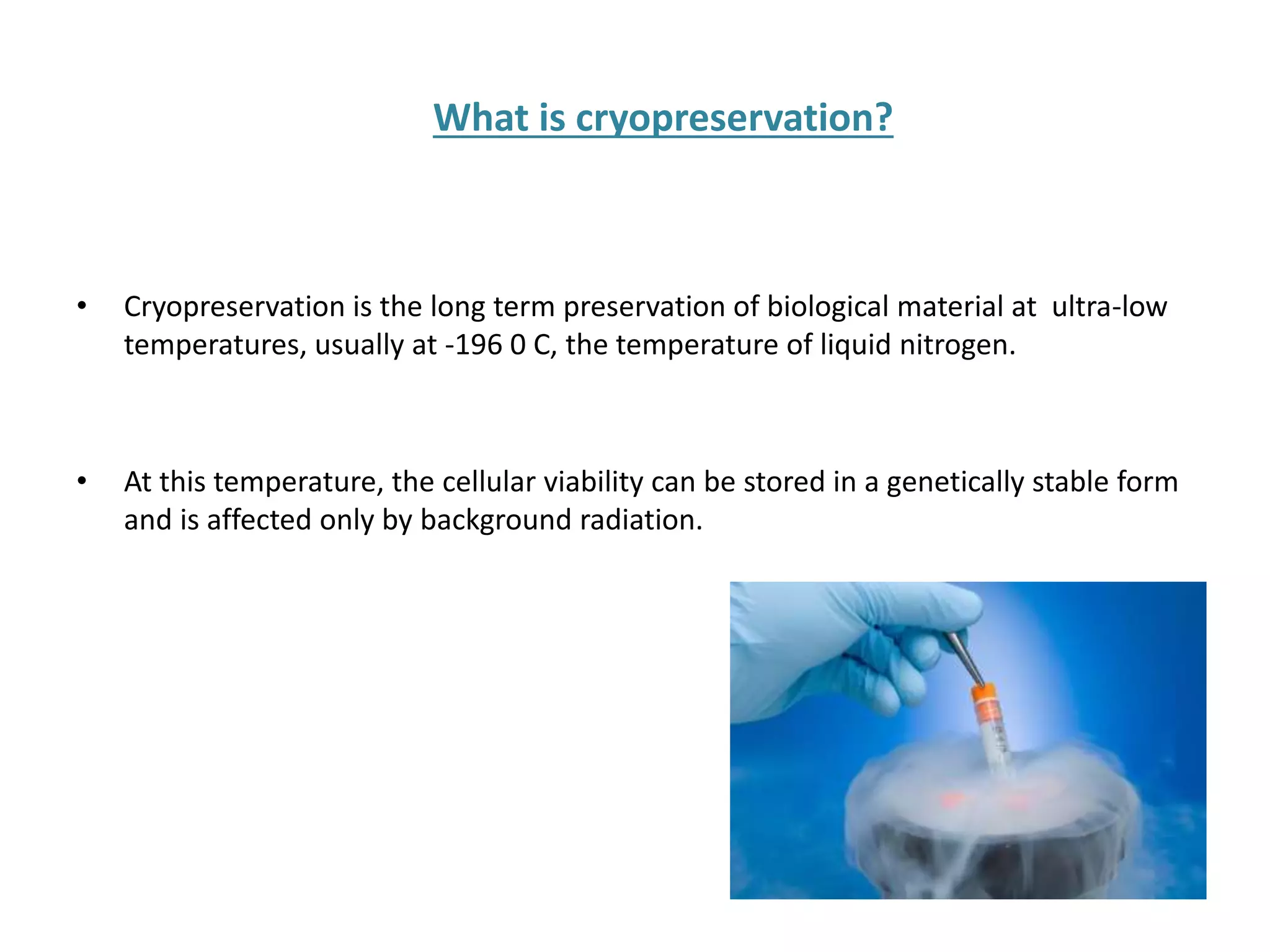
What is cryopreservation?
• Cryopreservation is the long term preservation of biological material at ultra-low
temperatures, usually at -196 0 C, the temperature of liquid nitrogen.
• At this temperature, the cellular viability can be stored in a genetically stable form
and is affected only by background radiation.
Why cryopreservation?
Cryopreservation has several practical applications in fisheries and aquaculture. They
are :
1. Wider distribution of gametes from one location to another location
2. Reduces number of male broodfish to be maintained
3. Facilitates extension of period of seed availability
4. Selective breeding programmes wherein a large number of families have to be
maintained
5. Production of androgenetic fish
6. Conservation of genetic resources
Cryopreservation of fish spermatozoa:
• The spermatozoa of several species of finfish and shellfish have been
cryopreserved and `Sperm banks’ established for some species.
This is because of :
-Smaller size (4-6 um)
-Larger number per unit volume (several million spermatozoa/ml milt)
-Repeatability and ease of collection and handling
-Simple membrane (easy to dehydrate or cryoprotect spermatozoa)
Figure: Minute spermatozoa found within Figure: A mature egg (oocyte)
seminiferous lobule
Handling of spermatozoa prior to freezing
• Collection of spermatozoa from mature male, avoiding contamination with urine,
mucus, water, faeces, etc.
Collection of spermatozoa
• Males may be injected with spawning agent to ensure higher milt volume
• Motility test to be carried out to ensure milt quality
• Spermatozoa showing 70% or more motility should be selected for
cryopreservation
• Extender is a solution of inorganic and organic chemicals, resembling that of blood
or seminal plasma
• An extender is slightly hypertonic and prevents spermatozoa
dehydration/exhaustion
• Chemical formulations of extenders used for cryopreservation vary widely
depending upon the physiological and chemical characteristics of spermatozoa
• Extenders inhibit motility, but initiate motility when diluted with water or
activating solution
EXTENDER
Figure: Determination of pH of extender Figure: Checking motilityof spermatzoa
CRYOPROTECTANT :
• Cryoprotectant is added to extender – milt mixture to minimize freeze-damage to
cells during cooling/ freezing.
• Common cryoprotectants recommended are – dimethyl sulfoxide (DMSO),
methanol, glycerol, DMA, etc.
• The optimum concentration of cryoprotectant is 5-15% of the total volume of the
diluent (extender + milt + cryoprotectant).
• Cryoprotectants are of two types- intracellular (penetrating) and extracellular
(non-penetrating)
• Equilibration period : It is the time allowed for cryoprotectant to penetrate into the
sperm cells. It may vary from a few minutes to several minutes.
Storage containers:
• Diluted spermatozoa are normally stored in polypropylene vials (1-2 ml), as pellets
(40-200 µl) and in 0.25 or 0.50 ml plastic and then it forms a seal when comes in
contact with a fluid.
Figure: Filling plastic straw with diluted spermatozoa
Dilution ratio:
• The spz : diluent ratio varies between 1:1 and 1:10, depending upon species.
• The dilution ratio should be such that the spz need not be diluted further at the
time of fertilization.
Cooling/freezing rate:
• Cooling/freezing is considered the most critical variable of cryopreservation.
• The optimum rate is between 10 and 450C per minute.
• Liquid nitrogen (-1960C) is the most commonly used cryogen for freezing and
storing spz.
• Frozen spermatozoa samples are stored in vapor phase or immersed under liquid
nitrogen.
Figure: Straws being frozen over LN2 Figure: Frozen straws being immersed in LN2
Warming/thawing rate:
• Thawing is also considered an important variable in cryopreservation.
• Very rapid thawing rates are used to avoid recrystallization.
• Slow warming rate may result in recrystallization.
• Thawing of preserved spz is accomplished by agitating them in hot-water bath at
370C for 10-15 seconds
• Thawing rates of 50-700C are recommended, although higher rates of 100-15000C
have also been used.
Figure: Straws being thawed at 370C
Viability of cryopreserved spermatozoa :
• Spermatozoa stored under LN2 remain fertile indefinite.
• They should be thawed only when required for checking motility.
• Motility, fertilization and hatching rates, fry survival, etc. are the common criteria
for judging the post-thaw viability/fertility of cryopreserved spermatozoa
Cryopreservation of eggs/embryos:
• No success
• The fundamental problems are – insufficient dehydration during cooling/freezing
due to relatively large size (1-6 mm) of fish eggs, the presence of membranes of
different water permeability.
• Also permeation of cryoprotectant even into smaller eggs and embryos is low.
• However, success has been achieved with invertebrate eggs and embryos.
• Sea urchin embryos, oyster larvae (trochophore) and penaied shrimp naupli have
been successfully cryopreserved and revived.
Embryonic cell cryopreservation:
• Studies show that the cells from blastula can be removed and successfully
cryopreserved
• This involves dechorionization of unfertilized water-hardened egg, removal of
nucleus from the egg, micro-injection of thawed dissociated cells from mid-
blastula into the enucleated egg and its subsequent development into a viable
embryo
17 - Cryopreservation  of  fish gametes.pptx

17 - Cryopreservation of fish gametes.pptx

  • 1.
  • 2.
    What is cryopreservation? •Cryopreservation is the long term preservation of biological material at ultra-low temperatures, usually at -196 0 C, the temperature of liquid nitrogen. • At this temperature, the cellular viability can be stored in a genetically stable form and is affected only by background radiation.
  • 3.
    Why cryopreservation? Cryopreservation hasseveral practical applications in fisheries and aquaculture. They are : 1. Wider distribution of gametes from one location to another location 2. Reduces number of male broodfish to be maintained 3. Facilitates extension of period of seed availability 4. Selective breeding programmes wherein a large number of families have to be maintained 5. Production of androgenetic fish 6. Conservation of genetic resources
  • 4.
    Cryopreservation of fishspermatozoa: • The spermatozoa of several species of finfish and shellfish have been cryopreserved and `Sperm banks’ established for some species. This is because of : -Smaller size (4-6 um) -Larger number per unit volume (several million spermatozoa/ml milt) -Repeatability and ease of collection and handling -Simple membrane (easy to dehydrate or cryoprotect spermatozoa) Figure: Minute spermatozoa found within Figure: A mature egg (oocyte) seminiferous lobule
  • 5.
    Handling of spermatozoaprior to freezing • Collection of spermatozoa from mature male, avoiding contamination with urine, mucus, water, faeces, etc. Collection of spermatozoa • Males may be injected with spawning agent to ensure higher milt volume • Motility test to be carried out to ensure milt quality • Spermatozoa showing 70% or more motility should be selected for cryopreservation
  • 6.
    • Extender isa solution of inorganic and organic chemicals, resembling that of blood or seminal plasma • An extender is slightly hypertonic and prevents spermatozoa dehydration/exhaustion • Chemical formulations of extenders used for cryopreservation vary widely depending upon the physiological and chemical characteristics of spermatozoa • Extenders inhibit motility, but initiate motility when diluted with water or activating solution EXTENDER Figure: Determination of pH of extender Figure: Checking motilityof spermatzoa
  • 7.
    CRYOPROTECTANT : • Cryoprotectantis added to extender – milt mixture to minimize freeze-damage to cells during cooling/ freezing. • Common cryoprotectants recommended are – dimethyl sulfoxide (DMSO), methanol, glycerol, DMA, etc. • The optimum concentration of cryoprotectant is 5-15% of the total volume of the diluent (extender + milt + cryoprotectant). • Cryoprotectants are of two types- intracellular (penetrating) and extracellular (non-penetrating) • Equilibration period : It is the time allowed for cryoprotectant to penetrate into the sperm cells. It may vary from a few minutes to several minutes.
  • 8.
    Storage containers: • Dilutedspermatozoa are normally stored in polypropylene vials (1-2 ml), as pellets (40-200 µl) and in 0.25 or 0.50 ml plastic and then it forms a seal when comes in contact with a fluid. Figure: Filling plastic straw with diluted spermatozoa
  • 9.
    Dilution ratio: • Thespz : diluent ratio varies between 1:1 and 1:10, depending upon species. • The dilution ratio should be such that the spz need not be diluted further at the time of fertilization.
  • 10.
    Cooling/freezing rate: • Cooling/freezingis considered the most critical variable of cryopreservation. • The optimum rate is between 10 and 450C per minute. • Liquid nitrogen (-1960C) is the most commonly used cryogen for freezing and storing spz. • Frozen spermatozoa samples are stored in vapor phase or immersed under liquid nitrogen. Figure: Straws being frozen over LN2 Figure: Frozen straws being immersed in LN2
  • 11.
    Warming/thawing rate: • Thawingis also considered an important variable in cryopreservation. • Very rapid thawing rates are used to avoid recrystallization. • Slow warming rate may result in recrystallization. • Thawing of preserved spz is accomplished by agitating them in hot-water bath at 370C for 10-15 seconds • Thawing rates of 50-700C are recommended, although higher rates of 100-15000C have also been used. Figure: Straws being thawed at 370C
  • 12.
    Viability of cryopreservedspermatozoa : • Spermatozoa stored under LN2 remain fertile indefinite. • They should be thawed only when required for checking motility. • Motility, fertilization and hatching rates, fry survival, etc. are the common criteria for judging the post-thaw viability/fertility of cryopreserved spermatozoa
  • 13.
    Cryopreservation of eggs/embryos: •No success • The fundamental problems are – insufficient dehydration during cooling/freezing due to relatively large size (1-6 mm) of fish eggs, the presence of membranes of different water permeability. • Also permeation of cryoprotectant even into smaller eggs and embryos is low. • However, success has been achieved with invertebrate eggs and embryos. • Sea urchin embryos, oyster larvae (trochophore) and penaied shrimp naupli have been successfully cryopreserved and revived.
  • 14.
    Embryonic cell cryopreservation: •Studies show that the cells from blastula can be removed and successfully cryopreserved • This involves dechorionization of unfertilized water-hardened egg, removal of nucleus from the egg, micro-injection of thawed dissociated cells from mid- blastula into the enucleated egg and its subsequent development into a viable embryo