Pragmatism’s
Concept of Truth
PREFACE
Began in the US around 1870
The most influential philosophy at 19th
reflection of American’s philosophy of life
spreads all around the world along with US’ supremacy
ORIGIN
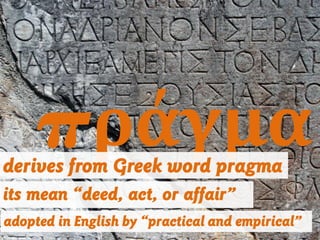
πράγμαderives from Greek word pragma
its mean “deed, act, or affair”
adopted in English by “practical and empirical”
Pragmatism:any approach that emphasizes what can be done in
the actual world rather than in an ideal world
a beliefs that the truth or value of a doctrine
depending on its application for the benefit of man
the set of belief that the truth cannot be realized except
by practicing it. Their standard of truthful is the
effectiveness and its success, their measure is by choose
which has more effectiveness, succession, and benefit.
etc…
Pragmatism:the doctrines that the meaning of conceptions is
to be sought in their practical bearings. The
function of thought is to guide the action, and
that truth is preeminently to be tested by the
practical consequences of belief, and as a
method of philosophy, in which the truth of a
proposition is measured by its correspondence
with experimental results and by its practical
outcome.
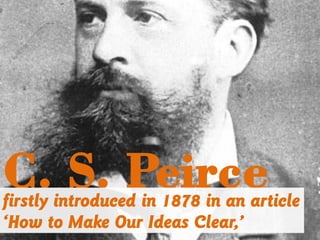
C. S. Peircefirstly introduced in 1878 in an article
‘How to Make Our Ideas Clear,’
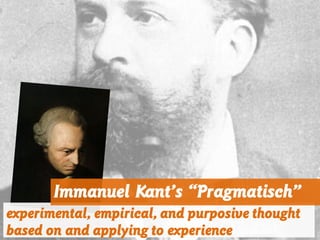
experimental, empirical, and purposive thought
based on and applying to experience
Immanuel Kant’s “Pragmatisch”
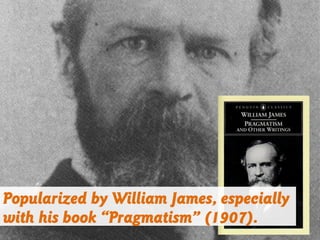
Popularized by William James, especially
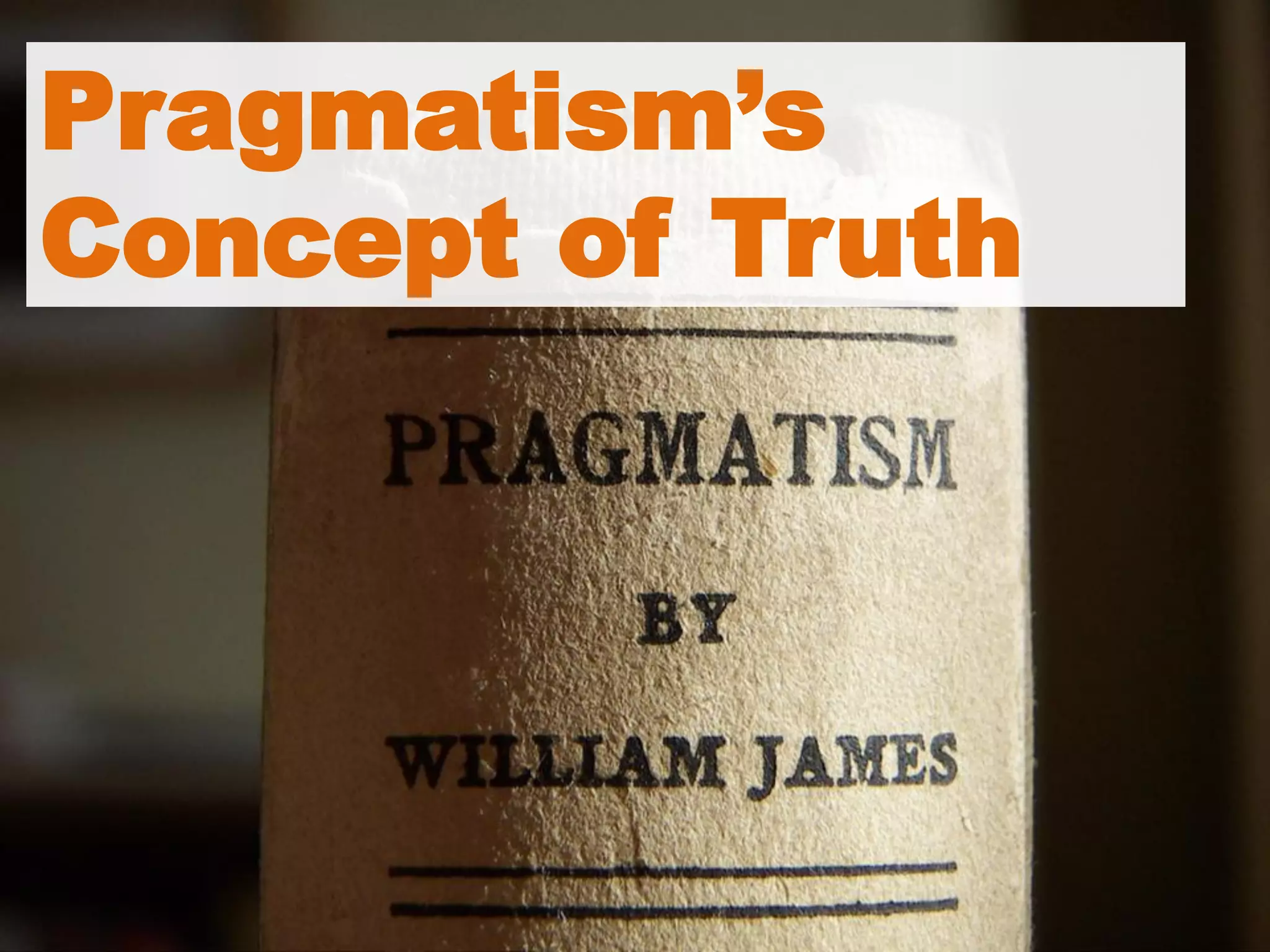
with his book “Pragmatism” (1907).
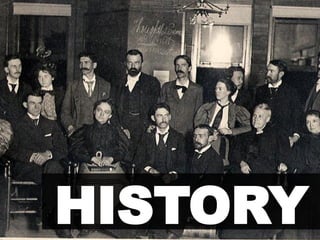
HISTORY
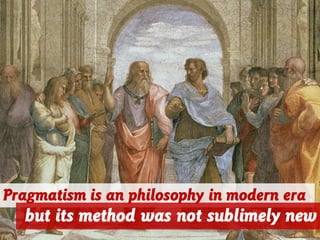
Pragmatism is an philosophy in modern era
but its method was not sublimely new
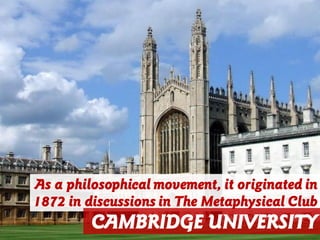
As a philosophical movement, it originated in
1872 in discussions in The Metaphysical Club
CAMBRIDGE UNIVERSITY
In its early stage of its development, pragmatism
attempts to unify science and philosophy
and solve endless philosophical-metaphysical debate
In its further development, the method is
applied in every aspect of human life
Because it is a philosophy of human action,
every aspect of human life becomes its field
Pragmatism began to decline in 1920,
eliminated by Analytic Philosophy’s
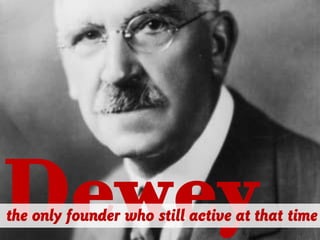
Deweythe only founder who still active at that time
Supported in the next decades by second and third
generation thinkers afterwards, pragmatic thought
finally rises again in semiotics, sociology, social
psychology, economics, and other fields.
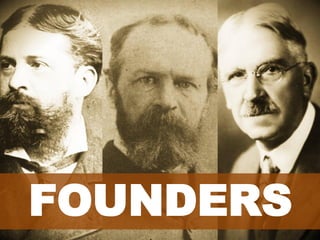
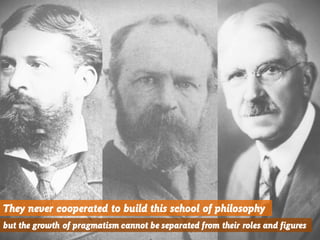
FOUNDERS
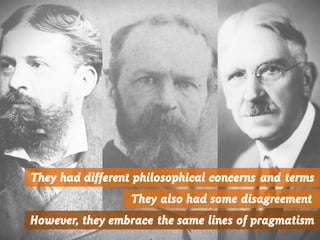
They had different philosophical concerns and terms
They also had some disagreement
However, they embrace the same lines of pragmatism
They never cooperated to build this school of philosophy
but the growth of pragmatism cannot be separated from their roles and figures
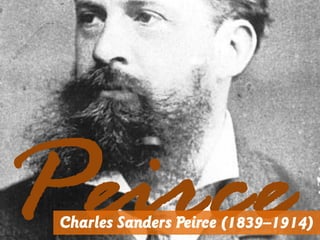
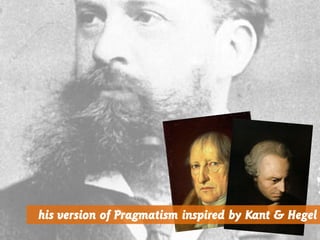
Charles Sanders Peirce (1839–1914)
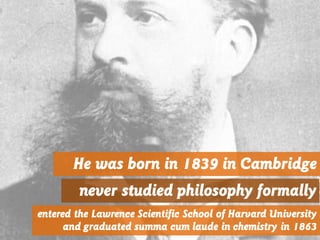
He was born in 1839 in Cambridge
never studied philosophy formally
entered the Lawrence Scientific School of Harvard University
and graduated summa cum laude in chemistry in 1863
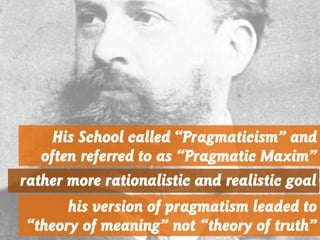
His School called “Pragmaticism” and
often referred to as “Pragmatic Maxim”
rather more rationalistic and realistic goal
his version of pragmatism leaded to
“theory of meaning” not “theory of truth”
his version of Pragmatism inspired by Kant & Hegel
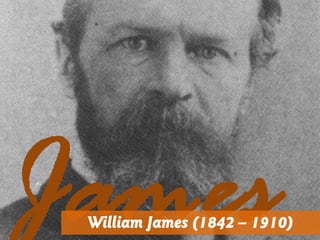
William James (1842 – 1910)
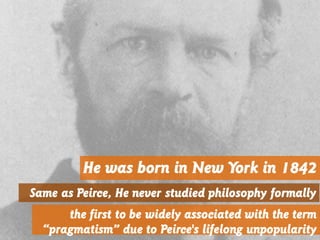
He was born in New York in 1842
Same as Peirce, He never studied philosophy formally
the first to be widely associated with the term
“pragmatism” due to Peirce's lifelong unpopularity
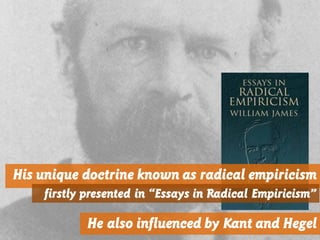
His unique doctrine known as radical empiricism
firstly presented in “Essays in Radical Empiricism”
He also influenced by Kant and Hegel
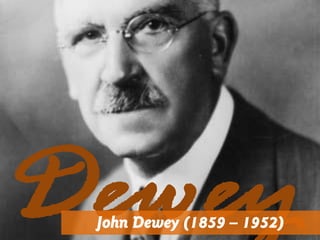
John Dewey (1859 – 1952)
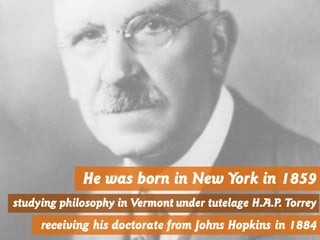
He was born in New York in 1859
studying philosophy in Vermont under tutelage H.A.P. Torrey
receiving his doctorate from Johns Hopkins in 1884
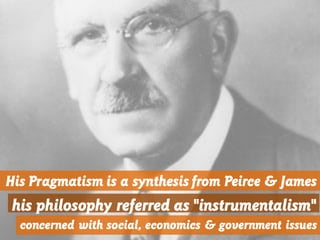
His Pragmatism is a synthesis from Peirce & James
his philosophy referred as "instrumentalism"
concerned with social, economics & government issues
CONCEPT of TRUTH
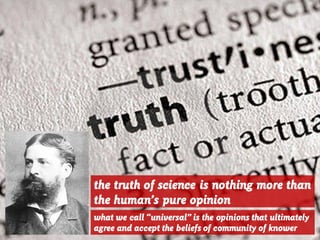
the truth of science is nothing more than
the human’s pure opinion
what we call “universal” is the opinions that ultimately
agree and accept the beliefs of community of knower
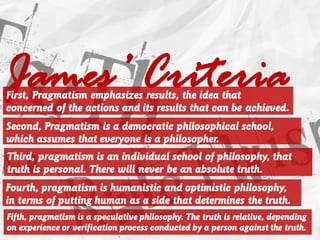
James’ CriteriaFirst, Pragmatism emphasizes results, the idea that
concerned of the actions and its results that can be achieved.
Second, Pragmatism is a democratic philosophical school,
which assumes that everyone is a philosopher.
Third, pragmatism is an individual school of philosophy, that
truth is personal. There will never be an absolute truth.
Fourth, pragmatism is humanistic and optimistic philosophy,
in terms of putting human as a side that determines the truth.
Fifth, pragmatism is a speculative philosophy. The truth is relative, depending
on experience or verification process conducted by a person against the truth.
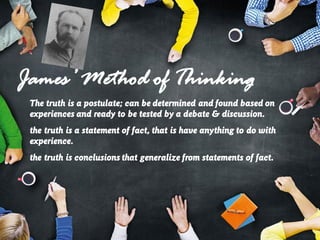
James’ Method of Thinking
The truth is a postulate; can be determined and found based on
experiences and ready to be tested by a debate & discussion.
the truth is a statement of fact, that is have anything to do with
experience.
the truth is conclusions that generalize from statements of fact.
ISLAMIC VIEW
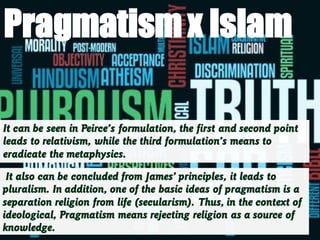
It can be seen in Peirce’s formulation, the first and second point
leads to relativism, while the third formulation’s means to
eradicate the metaphysics.
It also can be concluded from James’ principles, it leads to
pluralism. In addition, one of the basic ideas of pragmatism is a
separation religion from life (secularism). Thus, in the context of
ideological, Pragmatism means rejecting religion as a source of
knowledge.
Pragmatismx Islam
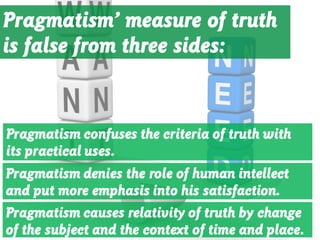
Pragmatism’ measure of truth
is false from three sides:
Pragmatism confuses the criteria of truth with
its practical uses.
Pragmatism denies the role of human intellect
and put more emphasis into his satisfaction.
Pragmatism causes relativity of truth by change
of the subject and the context of time and place.
Islamic teaching sets the standard of deeds according to
command and prohibitions from Allah. This does not mean
Islam deny the benefit as one aspect of human deeds.
However the benefit concept is not same as pragmatism,
Islam has set it up based on maslahah, not on what desired
by their passion. Allah give humans the benefit, although not
in the form of matter, right now or later in hereafter.
Pragmatism had many contradictions with
Islamic teaching, especially in definition
and standard of truth.
CONCLUSION
It also leads to pluralism, humanism,
secularism, and the other harmful doctrines.
Therefore, we cannot accept it.
Pragmatism’s Concept of Truth

Pragmatism’s Concept of Truth

  • 1.
  • 2.
  • 3.
    Began in theUS around 1870 The most influential philosophy at 19th
  • 4.
    reflection of American’sphilosophy of life spreads all around the world along with US’ supremacy
  • 5.
  • 6.
    πράγμαderives from Greekword pragma its mean “deed, act, or affair” adopted in English by “practical and empirical”
  • 7.
    Pragmatism:any approach thatemphasizes what can be done in the actual world rather than in an ideal world a beliefs that the truth or value of a doctrine depending on its application for the benefit of man the set of belief that the truth cannot be realized except by practicing it. Their standard of truthful is the effectiveness and its success, their measure is by choose which has more effectiveness, succession, and benefit. etc…
  • 8.
    Pragmatism:the doctrines thatthe meaning of conceptions is to be sought in their practical bearings. The function of thought is to guide the action, and that truth is preeminently to be tested by the practical consequences of belief, and as a method of philosophy, in which the truth of a proposition is measured by its correspondence with experimental results and by its practical outcome.
  • 9.
    C. S. Peircefirstlyintroduced in 1878 in an article ‘How to Make Our Ideas Clear,’
  • 10.
    experimental, empirical, andpurposive thought based on and applying to experience Immanuel Kant’s “Pragmatisch”
  • 11.
    Popularized by WilliamJames, especially with his book “Pragmatism” (1907).
  • 12.
  • 13.
    Pragmatism is anphilosophy in modern era but its method was not sublimely new
  • 14.
    As a philosophicalmovement, it originated in 1872 in discussions in The Metaphysical Club CAMBRIDGE UNIVERSITY
  • 15.
    In its earlystage of its development, pragmatism attempts to unify science and philosophy and solve endless philosophical-metaphysical debate
  • 16.
    In its furtherdevelopment, the method is applied in every aspect of human life Because it is a philosophy of human action, every aspect of human life becomes its field
  • 17.
    Pragmatism began todecline in 1920, eliminated by Analytic Philosophy’s
  • 18.
    Deweythe only founderwho still active at that time
  • 19.
    Supported in thenext decades by second and third generation thinkers afterwards, pragmatic thought finally rises again in semiotics, sociology, social psychology, economics, and other fields.
  • 20.
  • 21.
    They had differentphilosophical concerns and terms They also had some disagreement However, they embrace the same lines of pragmatism
  • 22.
    They never cooperatedto build this school of philosophy but the growth of pragmatism cannot be separated from their roles and figures
  • 23.
  • 24.
    He was bornin 1839 in Cambridge never studied philosophy formally entered the Lawrence Scientific School of Harvard University and graduated summa cum laude in chemistry in 1863
  • 25.
    His School called“Pragmaticism” and often referred to as “Pragmatic Maxim” rather more rationalistic and realistic goal his version of pragmatism leaded to “theory of meaning” not “theory of truth”
  • 26.
    his version ofPragmatism inspired by Kant & Hegel
  • 27.
  • 28.
    He was bornin New York in 1842 Same as Peirce, He never studied philosophy formally the first to be widely associated with the term “pragmatism” due to Peirce's lifelong unpopularity
  • 29.
    His unique doctrineknown as radical empiricism firstly presented in “Essays in Radical Empiricism” He also influenced by Kant and Hegel
  • 30.
  • 31.
    He was bornin New York in 1859 studying philosophy in Vermont under tutelage H.A.P. Torrey receiving his doctorate from Johns Hopkins in 1884
  • 32.
    His Pragmatism isa synthesis from Peirce & James his philosophy referred as "instrumentalism" concerned with social, economics & government issues
  • 33.
  • 34.
    the truth ofscience is nothing more than the human’s pure opinion what we call “universal” is the opinions that ultimately agree and accept the beliefs of community of knower
  • 35.
    James’ CriteriaFirst, Pragmatismemphasizes results, the idea that concerned of the actions and its results that can be achieved. Second, Pragmatism is a democratic philosophical school, which assumes that everyone is a philosopher. Third, pragmatism is an individual school of philosophy, that truth is personal. There will never be an absolute truth. Fourth, pragmatism is humanistic and optimistic philosophy, in terms of putting human as a side that determines the truth. Fifth, pragmatism is a speculative philosophy. The truth is relative, depending on experience or verification process conducted by a person against the truth.
  • 36.
    James’ Method ofThinking The truth is a postulate; can be determined and found based on experiences and ready to be tested by a debate & discussion. the truth is a statement of fact, that is have anything to do with experience. the truth is conclusions that generalize from statements of fact.
  • 37.
  • 38.
    It can beseen in Peirce’s formulation, the first and second point leads to relativism, while the third formulation’s means to eradicate the metaphysics. It also can be concluded from James’ principles, it leads to pluralism. In addition, one of the basic ideas of pragmatism is a separation religion from life (secularism). Thus, in the context of ideological, Pragmatism means rejecting religion as a source of knowledge. Pragmatismx Islam
  • 39.
    Pragmatism’ measure oftruth is false from three sides: Pragmatism confuses the criteria of truth with its practical uses. Pragmatism denies the role of human intellect and put more emphasis into his satisfaction. Pragmatism causes relativity of truth by change of the subject and the context of time and place.
  • 40.
    Islamic teaching setsthe standard of deeds according to command and prohibitions from Allah. This does not mean Islam deny the benefit as one aspect of human deeds. However the benefit concept is not same as pragmatism, Islam has set it up based on maslahah, not on what desired by their passion. Allah give humans the benefit, although not in the form of matter, right now or later in hereafter.
  • 41.
    Pragmatism had manycontradictions with Islamic teaching, especially in definition and standard of truth. CONCLUSION It also leads to pluralism, humanism, secularism, and the other harmful doctrines. Therefore, we cannot accept it.