
Section Ten: The
Information System
Lifecycle
Module 10-3
System Selection
System Implementation
System Selection & Implementation
• Determine your requirements and risks
• Issue an RFP
• Evaluate proposals
• Assemble the team
• Plan the implementation
• Test the system (next module)
• Evaluate the system
• Transition or decommission the system
The RFP Process
• Should provide information on background and system
requirements
• The evaluation period may be long or short depending on
size/impact of purchase
• Due diligence on the selected company should be performed
• As with most enterprise software, there may be contract
negotiations prior to setting the final terms of the agreement
Evaluating RFPs
• Why do we need this system?
• Who’s the user?
• What does the system do?
• Where will it be implemented?
• When will it be installed?
• How will we pay for it?
• How will we implement it?
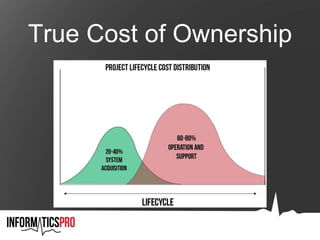
True Cost of Ownership
Assembling Your Team
• Depending on the implementation, your
implementation team may be large or small,
highly-specialized, or widely specialized
• They may be responsible for
• User feedback
• User training
• System testing
• Installation and Go Live
• Configuration management
• Communications and project management
• Sustainment
• And more…
A Sample EHR Implementation
Team
• EHR team lead
• Vendor implementation team
• EHR implementation manager/project manager
• Physician champions and other “super” users
• Nurse Lead
• Medical assistant lead
• Scheduler lead
• Registration staff lead
• Laboratory staff lead
• IT lead
• Billing staff lead
• Meaningful use lead
• Compliance lead
• Workflow redesign lead
• User training lead
• And more…
Developing Your Plan
• System overview
• Major tasks
• Required resources
• Timeline/Schedule
• Provider training
• Roles and responsibilities
• Point-of-Contact
• HW/SW installation, facilities, and materials management
• System configuration
• Interface specifications
• Documentation
• Testing
• Performance monitoring
• Go Live strategy
• Communication, education, and training
• Assessment and feedback
• Operations and support
• Termination plan
• Determine what a successful implementation looks like
User Training
• Plan for user training before you have to
• As you know, physicians are a busy group of
individuals
• Offer various types of training
• Online, in-person, hybrid training courses
• One-on-one or small group tutoring
• Webinars/interactive videos
• Specialization specific training
• Leaflets and cards near computers and stations
• Advanced “power user” training
Clinician Feedback
• How to obtain feedback from your most busy
users
• Formal & informal methods
• Feedback sessions
• Backend dashboards
• Surveys and questionnaires
• Usability testing
• Clinician champion feedback
Evaluating Systems
• Is our CIS effective?
• Did we meet our organizational goals? Clinical
goals? Quality measures?
• Quantitative evaluation methods
• Surveys, structured interviews, testing, checklists,
comparative research, etc.
• Qualitative evaluation methods
• In-depth, unstructured interviews, focus groups,
observations, case studies, document review, etc.
Creating an Evaluation Plan
• What are the goals of the evaluation?
• How will we evaluate?
• Verification
• Did we build it correctly?
• Validation
• Did we build the right system?
• Assessment of Human Factors
• Are users using the system? Liking it? Hating it?
• Clinical Assessment
• How is the system affecting patient outcomes?
Evaluating the System
• Rinse & Repeat
• Use feedback to improve implementation of future
projects and systems
Transitioning and Decommissioning
• Communicate to any users still using the system
• Transition them off the system
• Document lessons learned
• Create a project archive
• Close out procurements/contracts/agreements
• Record any impact to workflows or other process
• Perform a final project review
• Shut down the system
Review Questions
• Appraising a potential seller and their business to
establish its assets, liabilities, and commercial
potential is a process known as:
1. Request for Information
2. Request for Proposal
3. Due Diligence
4. Lessons Learned Assessment
Review Questions
• Appraising a potential seller and their business to
establish its assets, liabilities, and commercial
potential is a process known as:
1. Request for Information
2. Request for Proposal
3. Due Diligence
4. Lessons Learned Assessment
Review Questions
• A document that describes what went right with a
project, what went wrong, and what may be done
differently in the future is known as:
1. Request for Information
2. Request for Proposal
3. Due Diligence
4. Lessons Learned Assessment
Review Questions
• A document that describes what went right with a
project, what went wrong, and what may be done
differently in the future is known as:
1. Request for Information
2. Request for Proposal
3. Due Diligence
4. Lessons Learned Assessment
Review Questions
• A majority of a system’s costs take place in which
project phase?
1. Design and Development
2. Implementation
3. Evaluation & Assessment
4. Sustainment
Review Questions
• A majority of a system’s costs take place in which
project phase?
1. Design and Development
2. Implementation
3. Evaluation & Assessment
4. Sustainment

10-3 Clinical Informatics System Selection & Implementation

  • 1.
    Section Ten: The InformationSystem Lifecycle Module 10-3 System Selection System Implementation
  • 2.
    System Selection &Implementation • Determine your requirements and risks • Issue an RFP • Evaluate proposals • Assemble the team • Plan the implementation • Test the system (next module) • Evaluate the system • Transition or decommission the system
  • 3.
    The RFP Process •Should provide information on background and system requirements • The evaluation period may be long or short depending on size/impact of purchase • Due diligence on the selected company should be performed • As with most enterprise software, there may be contract negotiations prior to setting the final terms of the agreement
  • 4.
    Evaluating RFPs • Whydo we need this system? • Who’s the user? • What does the system do? • Where will it be implemented? • When will it be installed? • How will we pay for it? • How will we implement it?
  • 5.
    True Cost ofOwnership
  • 6.
    Assembling Your Team •Depending on the implementation, your implementation team may be large or small, highly-specialized, or widely specialized • They may be responsible for • User feedback • User training • System testing • Installation and Go Live • Configuration management • Communications and project management • Sustainment • And more…
  • 7.
    A Sample EHRImplementation Team • EHR team lead • Vendor implementation team • EHR implementation manager/project manager • Physician champions and other “super” users • Nurse Lead • Medical assistant lead • Scheduler lead • Registration staff lead • Laboratory staff lead • IT lead • Billing staff lead • Meaningful use lead • Compliance lead • Workflow redesign lead • User training lead • And more…
  • 8.
    Developing Your Plan •System overview • Major tasks • Required resources • Timeline/Schedule • Provider training • Roles and responsibilities • Point-of-Contact • HW/SW installation, facilities, and materials management • System configuration • Interface specifications • Documentation • Testing • Performance monitoring • Go Live strategy • Communication, education, and training • Assessment and feedback • Operations and support • Termination plan • Determine what a successful implementation looks like
  • 9.
    User Training • Planfor user training before you have to • As you know, physicians are a busy group of individuals • Offer various types of training • Online, in-person, hybrid training courses • One-on-one or small group tutoring • Webinars/interactive videos • Specialization specific training • Leaflets and cards near computers and stations • Advanced “power user” training
  • 10.
    Clinician Feedback • Howto obtain feedback from your most busy users • Formal & informal methods • Feedback sessions • Backend dashboards • Surveys and questionnaires • Usability testing • Clinician champion feedback
  • 11.
    Evaluating Systems • Isour CIS effective? • Did we meet our organizational goals? Clinical goals? Quality measures? • Quantitative evaluation methods • Surveys, structured interviews, testing, checklists, comparative research, etc. • Qualitative evaluation methods • In-depth, unstructured interviews, focus groups, observations, case studies, document review, etc.
  • 12.
    Creating an EvaluationPlan • What are the goals of the evaluation? • How will we evaluate? • Verification • Did we build it correctly? • Validation • Did we build the right system? • Assessment of Human Factors • Are users using the system? Liking it? Hating it? • Clinical Assessment • How is the system affecting patient outcomes?
  • 13.
    Evaluating the System •Rinse & Repeat • Use feedback to improve implementation of future projects and systems
  • 14.
    Transitioning and Decommissioning •Communicate to any users still using the system • Transition them off the system • Document lessons learned • Create a project archive • Close out procurements/contracts/agreements • Record any impact to workflows or other process • Perform a final project review • Shut down the system
  • 15.
    Review Questions • Appraisinga potential seller and their business to establish its assets, liabilities, and commercial potential is a process known as: 1. Request for Information 2. Request for Proposal 3. Due Diligence 4. Lessons Learned Assessment
  • 16.
    Review Questions • Appraisinga potential seller and their business to establish its assets, liabilities, and commercial potential is a process known as: 1. Request for Information 2. Request for Proposal 3. Due Diligence 4. Lessons Learned Assessment
  • 17.
    Review Questions • Adocument that describes what went right with a project, what went wrong, and what may be done differently in the future is known as: 1. Request for Information 2. Request for Proposal 3. Due Diligence 4. Lessons Learned Assessment
  • 18.
    Review Questions • Adocument that describes what went right with a project, what went wrong, and what may be done differently in the future is known as: 1. Request for Information 2. Request for Proposal 3. Due Diligence 4. Lessons Learned Assessment
  • 19.
    Review Questions • Amajority of a system’s costs take place in which project phase? 1. Design and Development 2. Implementation 3. Evaluation & Assessment 4. Sustainment
  • 20.
    Review Questions • Amajority of a system’s costs take place in which project phase? 1. Design and Development 2. Implementation 3. Evaluation & Assessment 4. Sustainment

Editor's Notes

  • #2 P 106
  • #4 Add image of the system selection process