

Principled Eclecticism
What is the principled
Eclecticism?
● It is a method of language education that combines various approaches and
methodologies to teach language depending on the aims of the lesson and
the abilities of the learners.
● It breaks the monotony of the class.
Basic Concepts
Approach:
Provides principles to decide what kind of
content and what sort of procedures are
appropriate.
Method:
It is HOW the teaching is to be conducted. It
is a practical realization of an approach.
During this method teacher can choose to use any of the
following methods and approaches:
● Grammar-translation Method:
● Direct Method:
● Structural-situational Approach:
● Audio-lingual/Audio-visual Method:
● Bilingual Method:
● Communicative Language Teaching:
● Total Physical Response:
● The Silent Way:
Grammar-translation Method: It is a method of teaching languages by which
students learn grammatical rules and then apply those rules by translating between
the target language and the native language.
Direct Method: In this method the teacher refrains from using the students' native
language. The target language is directly used for teaching all the four skills—listening,
speaking, reading and writing.
Structural-situational Approach: In this approach, the teacher
teaches language through a careful selection, gradation and presentation
of vocabulary items and structures through situation based activities.
Audio-lingual/Audio-visual Method: In this style of teaching
students are taught through a system of reinforcement. Here new words
and grammar are directly taught without using the students' native
language.
Bilingual Method: The word 'bilingual' means two languages. In
bilingual method, the teacher teaches the language by giving mother
tongue equivalents of the words or sentences.
Communicative Language Teaching: This approach lays
emphasis on oral method of teaching. It aims to develop
communicative competence in students.
Total Physical Response: It is based on the theory that memory is enhanced
through association with physical response.
The Silent Way: In this method the teacher uses a combination of silence and
gestures to focus students' attention.
● The teacher has more flexibility.
● No aspect of language skill is ignored.
● There is variety in the classroom.
● Classroom atmosphere is dynamic.
● These types of programs not only negotiate teacher skill-development within an
improved recognition of and respect for cross-cultural and multi-linguistic classroom
settings, but also encourages student pride in their heritage, language, communication
preferences and self-identity
Advantages
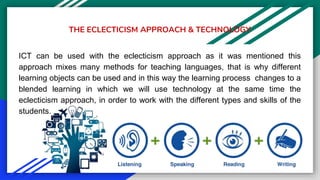
THE ECLECTICISM APPROACH & TECHNOLOGY
ICT can be used with the eclecticism approach as it was mentioned this
approach mixes many methods for teaching languages, that is why different
learning objects can be used and in this way the learning process changes to a
blended learning in which we will use technology at the same time the
eclecticism approach, in order to work with the different types and skills of the
students.
Team:
Betel Godínez
Michelle Gutiérrez
Jonathan Rodríguez

Eclecticism Approach

  • 1.
  • 2.
    What is theprincipled Eclecticism? ● It is a method of language education that combines various approaches and methodologies to teach language depending on the aims of the lesson and the abilities of the learners. ● It breaks the monotony of the class.
  • 3.
    Basic Concepts Approach: Provides principlesto decide what kind of content and what sort of procedures are appropriate. Method: It is HOW the teaching is to be conducted. It is a practical realization of an approach.
  • 4.
    During this methodteacher can choose to use any of the following methods and approaches: ● Grammar-translation Method: ● Direct Method: ● Structural-situational Approach: ● Audio-lingual/Audio-visual Method: ● Bilingual Method: ● Communicative Language Teaching: ● Total Physical Response: ● The Silent Way:
  • 5.
    Grammar-translation Method: Itis a method of teaching languages by which students learn grammatical rules and then apply those rules by translating between the target language and the native language. Direct Method: In this method the teacher refrains from using the students' native language. The target language is directly used for teaching all the four skills—listening, speaking, reading and writing.
  • 6.
    Structural-situational Approach: Inthis approach, the teacher teaches language through a careful selection, gradation and presentation of vocabulary items and structures through situation based activities. Audio-lingual/Audio-visual Method: In this style of teaching students are taught through a system of reinforcement. Here new words and grammar are directly taught without using the students' native language.
  • 7.
    Bilingual Method: Theword 'bilingual' means two languages. In bilingual method, the teacher teaches the language by giving mother tongue equivalents of the words or sentences. Communicative Language Teaching: This approach lays emphasis on oral method of teaching. It aims to develop communicative competence in students.
  • 8.
    Total Physical Response:It is based on the theory that memory is enhanced through association with physical response. The Silent Way: In this method the teacher uses a combination of silence and gestures to focus students' attention.
  • 9.
    ● The teacherhas more flexibility. ● No aspect of language skill is ignored. ● There is variety in the classroom. ● Classroom atmosphere is dynamic. ● These types of programs not only negotiate teacher skill-development within an improved recognition of and respect for cross-cultural and multi-linguistic classroom settings, but also encourages student pride in their heritage, language, communication preferences and self-identity Advantages
  • 10.
    THE ECLECTICISM APPROACH& TECHNOLOGY ICT can be used with the eclecticism approach as it was mentioned this approach mixes many methods for teaching languages, that is why different learning objects can be used and in this way the learning process changes to a blended learning in which we will use technology at the same time the eclecticism approach, in order to work with the different types and skills of the students.
  • 11.