

FOCUS ON GRAMMAR
THROUGH
TEXTUAL
ENHANCEMENT
Group 1
Esthor, Galleon, Roxas, San Jose, Tantiangco & Tare
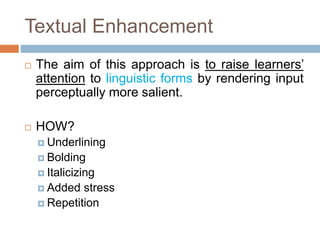
Textual Enhancement
 The aim of this approach is to raise learners’
attention to linguistic forms by rendering input
perceptually more salient.
 HOW?
 Underlining
 Bolding
 Italicizing
 Added stress
 Repetition
INPUT AND INTAKE
THEORETICAL
BACKGROUND
INPUT AND INTAKE
 Input defined as the sample of the target
language that learners are exposed to.
 Intake defined as what is registered in the
learner’s mind.
HOWEVER…
INPUT » INTAKE
The fact that the learner is exposed to input
does not necessarily guarantee that the input will
become intake.
 Thus, the central question in theories of L2
acquisition has been how input turns into
intake and how it will eventually lead to the
development of L2 competence.
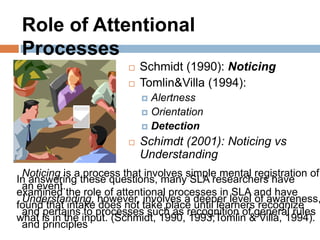
Noticing is a process that involves simple mental registration of
an event.
Understanding, however, involves a deeper level of awareness,
and pertains to processes such as recognition of general rules
and principles
In answering these questions, many SLA researchers have
examined the role of attentional processes in SLA and have
found that intake does not take place until learners recognize
what is in the input. (Schmidt, 1990, 1993;Tomlin & Villa, 1994).
 Schmidt (1990): Noticing
 Tomlin&Villa (1994):
 Alertness
 Orientation
 Detection
 Schimdt (2001): Noticing vs
Understanding
Role of Attentional
Processes
Input Enhancement
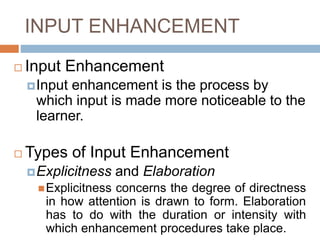
INPUT ENHANCEMENT
 Input Enhancement
Input enhancement is the process by
which input is made more noticeable to the
learner.
 Types of Input Enhancement
Explicitness and Elaboration
Explicitness concerns the degree of directness
in how attention is drawn to form. Elaboration
has to do with the duration or intensity with
which enhancement procedures take place.
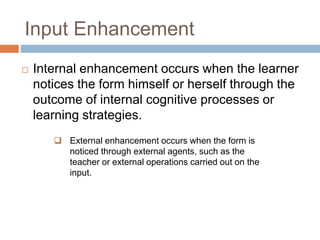
Input Enhancement
 Internal enhancement occurs when the learner
notices the form himself or herself through the
outcome of internal cognitive processes or
learning strategies.
 External enhancement occurs when the form is
noticed through external agents, such as the
teacher or external operations carried out on the
input.
As an Input Enhancement technique in
teaching grammar.
Textual Enhancement
Textual enhancement
 Textual enhancement is an external form of
input enhancement, by which learners’ attention
is drawn to linguistic forms through physically
manipulating certain aspects of the text to make
them easily noticed.
Characteristics of Textual
Enhancement
 Positive form of input enhancement.
 Implicit from of input enhancement.
 Textual enhancement attempts to make forms
salient in the input
 However, textual enhancement does not involve
any explicit instruction.
 “meaning and use must already be evident to
the learner at the time that attention is drawn to
the linguistic apparatus needed to get the
meaning across” (Doughty and Williams, 1998,

Textual Enhancement

  • 1.
    FOCUS ON GRAMMAR THROUGH TEXTUAL ENHANCEMENT Group1 Esthor, Galleon, Roxas, San Jose, Tantiangco & Tare
  • 2.
    Textual Enhancement  Theaim of this approach is to raise learners’ attention to linguistic forms by rendering input perceptually more salient.  HOW?  Underlining  Bolding  Italicizing  Added stress  Repetition
  • 3.
  • 4.
    INPUT AND INTAKE Input defined as the sample of the target language that learners are exposed to.  Intake defined as what is registered in the learner’s mind. HOWEVER…
  • 5.
    INPUT » INTAKE Thefact that the learner is exposed to input does not necessarily guarantee that the input will become intake.  Thus, the central question in theories of L2 acquisition has been how input turns into intake and how it will eventually lead to the development of L2 competence.
  • 6.
    Noticing is aprocess that involves simple mental registration of an event. Understanding, however, involves a deeper level of awareness, and pertains to processes such as recognition of general rules and principles In answering these questions, many SLA researchers have examined the role of attentional processes in SLA and have found that intake does not take place until learners recognize what is in the input. (Schmidt, 1990, 1993;Tomlin & Villa, 1994).  Schmidt (1990): Noticing  Tomlin&Villa (1994):  Alertness  Orientation  Detection  Schimdt (2001): Noticing vs Understanding Role of Attentional Processes
  • 7.
  • 8.
    INPUT ENHANCEMENT  InputEnhancement Input enhancement is the process by which input is made more noticeable to the learner.  Types of Input Enhancement Explicitness and Elaboration Explicitness concerns the degree of directness in how attention is drawn to form. Elaboration has to do with the duration or intensity with which enhancement procedures take place.
  • 9.
    Input Enhancement  Internalenhancement occurs when the learner notices the form himself or herself through the outcome of internal cognitive processes or learning strategies.  External enhancement occurs when the form is noticed through external agents, such as the teacher or external operations carried out on the input.
  • 10.
    As an InputEnhancement technique in teaching grammar. Textual Enhancement
  • 11.
    Textual enhancement  Textualenhancement is an external form of input enhancement, by which learners’ attention is drawn to linguistic forms through physically manipulating certain aspects of the text to make them easily noticed.
  • 12.
    Characteristics of Textual Enhancement Positive form of input enhancement.  Implicit from of input enhancement.  Textual enhancement attempts to make forms salient in the input  However, textual enhancement does not involve any explicit instruction.  “meaning and use must already be evident to the learner at the time that attention is drawn to the linguistic apparatus needed to get the meaning across” (Doughty and Williams, 1998,

Editor's Notes

  • #3 The assumption is that such visual or phonological modifications of input make grammatical forms more noticeable and subsequently learnable.
  • #5 It is intake that can be further processed and become part of the learner’s developing language system.
  • #7 According to Tomlin and Villa, alertness concerns learners’ readiness to receive the incoming stimuli. Orientation has to do with directing attentional resources to a particular type of input without paying attention to other input. Detection has to do with selection and registration of sensory stimuli in memory.
  • #12 Since the technique highlights the correct form in the input, it is a positive form of input enhancement.