WHAT IS A NATURAL
HAZARD?
A dangerous phenomenon, substance,
human activity or condition that may
cause loss of life, injury or other health
impacts, property damage, loss of
livelihoods and services, social and
WHAT IS A NATURAL
DISASTER?
A serious disruption of the functioning of
a community or a society involving
widespread human, material, economic,
or environmental losses and impacts
which exceeds the ability of the affected
community or society to cope using its
WHAT ARETHE 4TYPES OF
HAZARDS
• Biological Hazard
• Geological Hazard
• Hydrometeorological Hazard
• Man-Made or Technological Hazard
WHAT ARE SOME EXAMPLES
OF BIOLOGICAL HAZARDS
Examples of biological hazards include
outbreaks of epidemic diseases, plant or
animal contagion, insect or other animal
plagues and infestations.
WHAT ARE SOME EXAMPLES
OF GEOLOGICAL HAZARDS
Geological hazards include internal earth
processes, such as earthquakes, volcanic activity
and emissions, and related geophysical processes
such as mass movements, landslides, rockslides,
surface collapses, and debris or mudflows.
WHAT ARE SOME EXAMPLES OF
HYDROMETEOROLOGICAL
HAZARDS
Hydrometeorological hazards include tropical
cyclones (also known as typhoons and hurricanes),
thunderstorms, hailstorms, tornados, blizzards,
heavy snowfall, avalanches, coastal storm surges,
floods including flash floods, drought, heatwaves and
cold spells.
WHAT ARE SOME EXAMPLES OF
MAN-MADE ORTECHNOLOGICAL
HAZARDS
Examples of technological hazards include
industrial pollution, nuclear radiation,
toxic wastes, dam failures, transport
accidents, factory explosions, fires, and
chemical spills.
Get a piece of paper.
List 10 hazards in your house.Your answers
should be specific to certain locations in the
house (e.g. the shelf at the corner near the
door can fall on someone).
Do this for 10 minutes.
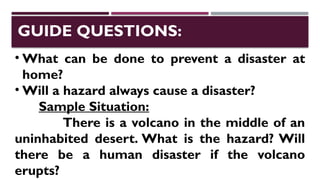
• What can be done to prevent a disaster at
home?
• Will a hazard always cause a disaster?
Sample Situation:
There is a volcano in the middle of an
uninhabited desert. What is the hazard? Will
there be a human disaster if the volcano
erupts?
GUIDE QUESTIONS:
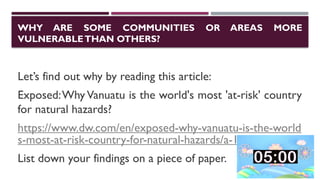
WHY ARE SOME COMMUNITIES OR AREAS MORE
VULNERABLETHAN OTHERS?
Let’s find out why by reading this article:
Exposed:Why Vanuatu is the world's most 'at-risk' country
for natural hazards?
https://www.dw.com/en/exposed-why-vanuatu-is-the-world
s-most-at-risk-country-for-natural-hazards/a-18319825
List down your findings on a piece of paper.
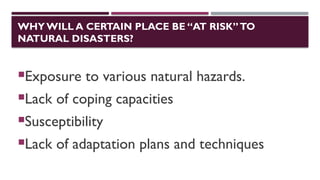
WHY WILL A CERTAIN PLACE BE “AT RISK”TO
NATURAL DISASTERS?
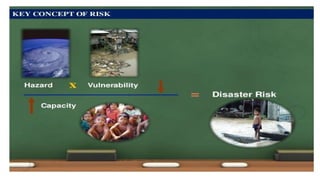
Exposure to various natural hazards.
Lack of coping capacities
Susceptibility
Lack of adaptation plans and techniques
DIFFERENT PERSPECTIVES OF DISASTER
 PHYSICAL PERSPECTIVES
Calamities are phenomena that cause great physical damage in a community’s infrastructure, its people and
their properties (e.g., houses and environmental sources of living). These cited effects of a disaster can be easily
measured and the most common.
 PSYCHOLOGICAL PERSPECTIVES
Victims of disasters may suffer from Post-Traumatic Stress Disorder (PTSD) and other serious mental health
conditions, which are not being given much attention to by the authorities or even by the victims themselves.
 SOCIO-CULTURAL PERSPECTIVES
Filipinos are generally known as “matiisin”, resourceful, helpful, optimistic, and prayerful.These characteristics
are manifested in the country’s recent fight against COVID19. Due to the National Health Emergency, Enhanced
Community Quarantine (ECQ) prevailed in the whole country.A lot of people temporarily lost their jobs, some people
stranded in different regions, repatriated OFWs were held in different quarantine facilities in Metro Manila, and all people
were restricted from going out of their homes for months. As a result, most Filipino families would rely on the
government’s help for them to get by. However, limited resources and aid from the government make people find
possible ways to survive amid the pandemic.
 ECONOMIC PERSPECTIVES
Disasters affect the economic condition of a community because they reduce local and international trade. It
can also partially or totally paralyze a country’s transportation system, just like what happened in the COVID19
pandemic. Implementation of a partial and total shutdown of local business operations results in a lot of people losing
means of living.
 POLITICAL PERSPECTIVES
Natural disasters are commonly thought to be less politically argumentative than armed conflicts, yet a
closer look shows that both the effects of a natural disaster and the resulting distribution of humanitarian aid are
profoundly linked to politics.
 BIOLOGICAL PERSPECTIVES
The disturbing effects caused by a prevalent kind of disease or virus in an epidemic or pandemic level is
known as biological disaster.
DIFFERENT PERSPECTIVES OF DISASTER
VULNERABILITY
Vulnerability describes the characteristics
and circumstances of a community, system or
asset that make it susceptible to the damaging
effects of a hazard. There are many aspects of
vulnerability, arising from various physical,
social, economic, and environmental factors.
EXAMPLES OFVULNERABILITY
 poor design and construction of buildings,
 inadequate protection of assets,
 lack of public information and awareness,
 limited official recognition of risks and preparedness measures,
and
 disregard for wise environmental management.
VULNERABILITY VARIES SIGNIFICANTLY WITHIN A COMMUNITY AND OVER TIME. THIS DEFINITION
IDENTIFIES VULNERABILITY AS A CHARACTERISTIC OF THE ELEMENT OF INTEREST WHICH IS
INDEPENDENT OF ITS EXPOSURE. HOWEVER, IN COMMON USE THE WORD IS OFTEN USED MORE
BROADLY TO INCLUDETHE ELEMENT’S EXPOSURE.
 Capacity: refers to all the strengths, attributes and resources
available within a community, organization or society to manage and
reduce disaster risks and strengthen resilience.
 Exposure: refers to the at-risk property and population.
 Resistance: refers to the measures taken to prevent, avoid or reduce
loss.
 Resilience: refers to the ability to recover prior state or achieve
desired post-disaster state.
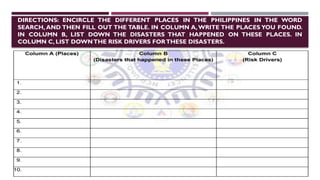
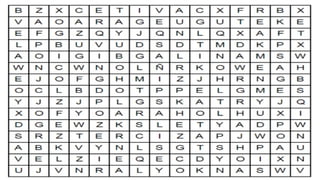
DIRECTIONS: ENCIRCLE THE DIFFERENT PLACES IN THE PHILIPPINES IN THE WORD
SEARCH, AND THEN FILL OUT THE TABLE. IN COLUMN A, WRITE THE PLACES YOU FOUND.
IN COLUMN B, LIST DOWN THE DISASTERS THAT HAPPENED ON THESE PLACES. IN
COLUMN C, LIST DOWNTHE RISK DRIVERS FORTHESE DISASTERS.
different classifications of CLASSROOM HAZARD

different classifications of CLASSROOM HAZARD

  • 2.
    WHAT IS ANATURAL HAZARD? A dangerous phenomenon, substance, human activity or condition that may cause loss of life, injury or other health impacts, property damage, loss of livelihoods and services, social and
  • 3.
    WHAT IS ANATURAL DISASTER? A serious disruption of the functioning of a community or a society involving widespread human, material, economic, or environmental losses and impacts which exceeds the ability of the affected community or society to cope using its
  • 4.
    WHAT ARETHE 4TYPESOF HAZARDS • Biological Hazard • Geological Hazard • Hydrometeorological Hazard • Man-Made or Technological Hazard
  • 5.
    WHAT ARE SOMEEXAMPLES OF BIOLOGICAL HAZARDS Examples of biological hazards include outbreaks of epidemic diseases, plant or animal contagion, insect or other animal plagues and infestations.
  • 6.
    WHAT ARE SOMEEXAMPLES OF GEOLOGICAL HAZARDS Geological hazards include internal earth processes, such as earthquakes, volcanic activity and emissions, and related geophysical processes such as mass movements, landslides, rockslides, surface collapses, and debris or mudflows.
  • 7.
    WHAT ARE SOMEEXAMPLES OF HYDROMETEOROLOGICAL HAZARDS Hydrometeorological hazards include tropical cyclones (also known as typhoons and hurricanes), thunderstorms, hailstorms, tornados, blizzards, heavy snowfall, avalanches, coastal storm surges, floods including flash floods, drought, heatwaves and cold spells.
  • 8.
    WHAT ARE SOMEEXAMPLES OF MAN-MADE ORTECHNOLOGICAL HAZARDS Examples of technological hazards include industrial pollution, nuclear radiation, toxic wastes, dam failures, transport accidents, factory explosions, fires, and chemical spills.
  • 10.
    Get a pieceof paper. List 10 hazards in your house.Your answers should be specific to certain locations in the house (e.g. the shelf at the corner near the door can fall on someone). Do this for 10 minutes.
  • 12.
    • What canbe done to prevent a disaster at home? • Will a hazard always cause a disaster? Sample Situation: There is a volcano in the middle of an uninhabited desert. What is the hazard? Will there be a human disaster if the volcano erupts? GUIDE QUESTIONS:
  • 14.
    WHY ARE SOMECOMMUNITIES OR AREAS MORE VULNERABLETHAN OTHERS? Let’s find out why by reading this article: Exposed:Why Vanuatu is the world's most 'at-risk' country for natural hazards? https://www.dw.com/en/exposed-why-vanuatu-is-the-world s-most-at-risk-country-for-natural-hazards/a-18319825 List down your findings on a piece of paper.
  • 15.
    WHY WILL ACERTAIN PLACE BE “AT RISK”TO NATURAL DISASTERS? Exposure to various natural hazards. Lack of coping capacities Susceptibility Lack of adaptation plans and techniques
  • 17.
    DIFFERENT PERSPECTIVES OFDISASTER  PHYSICAL PERSPECTIVES Calamities are phenomena that cause great physical damage in a community’s infrastructure, its people and their properties (e.g., houses and environmental sources of living). These cited effects of a disaster can be easily measured and the most common.  PSYCHOLOGICAL PERSPECTIVES Victims of disasters may suffer from Post-Traumatic Stress Disorder (PTSD) and other serious mental health conditions, which are not being given much attention to by the authorities or even by the victims themselves.  SOCIO-CULTURAL PERSPECTIVES Filipinos are generally known as “matiisin”, resourceful, helpful, optimistic, and prayerful.These characteristics are manifested in the country’s recent fight against COVID19. Due to the National Health Emergency, Enhanced Community Quarantine (ECQ) prevailed in the whole country.A lot of people temporarily lost their jobs, some people stranded in different regions, repatriated OFWs were held in different quarantine facilities in Metro Manila, and all people were restricted from going out of their homes for months. As a result, most Filipino families would rely on the government’s help for them to get by. However, limited resources and aid from the government make people find possible ways to survive amid the pandemic.
  • 18.
     ECONOMIC PERSPECTIVES Disastersaffect the economic condition of a community because they reduce local and international trade. It can also partially or totally paralyze a country’s transportation system, just like what happened in the COVID19 pandemic. Implementation of a partial and total shutdown of local business operations results in a lot of people losing means of living.  POLITICAL PERSPECTIVES Natural disasters are commonly thought to be less politically argumentative than armed conflicts, yet a closer look shows that both the effects of a natural disaster and the resulting distribution of humanitarian aid are profoundly linked to politics.  BIOLOGICAL PERSPECTIVES The disturbing effects caused by a prevalent kind of disease or virus in an epidemic or pandemic level is known as biological disaster. DIFFERENT PERSPECTIVES OF DISASTER
  • 19.
    VULNERABILITY Vulnerability describes thecharacteristics and circumstances of a community, system or asset that make it susceptible to the damaging effects of a hazard. There are many aspects of vulnerability, arising from various physical, social, economic, and environmental factors.
  • 20.
    EXAMPLES OFVULNERABILITY  poordesign and construction of buildings,  inadequate protection of assets,  lack of public information and awareness,  limited official recognition of risks and preparedness measures, and  disregard for wise environmental management.
  • 21.
    VULNERABILITY VARIES SIGNIFICANTLYWITHIN A COMMUNITY AND OVER TIME. THIS DEFINITION IDENTIFIES VULNERABILITY AS A CHARACTERISTIC OF THE ELEMENT OF INTEREST WHICH IS INDEPENDENT OF ITS EXPOSURE. HOWEVER, IN COMMON USE THE WORD IS OFTEN USED MORE BROADLY TO INCLUDETHE ELEMENT’S EXPOSURE.  Capacity: refers to all the strengths, attributes and resources available within a community, organization or society to manage and reduce disaster risks and strengthen resilience.  Exposure: refers to the at-risk property and population.  Resistance: refers to the measures taken to prevent, avoid or reduce loss.  Resilience: refers to the ability to recover prior state or achieve desired post-disaster state.
  • 22.
    DIRECTIONS: ENCIRCLE THEDIFFERENT PLACES IN THE PHILIPPINES IN THE WORD SEARCH, AND THEN FILL OUT THE TABLE. IN COLUMN A, WRITE THE PLACES YOU FOUND. IN COLUMN B, LIST DOWN THE DISASTERS THAT HAPPENED ON THESE PLACES. IN COLUMN C, LIST DOWNTHE RISK DRIVERS FORTHESE DISASTERS.