WELCOME TO OUR
SCIENCE CLASS!
Picture Analysis
Picture Analysis
Picture Analysis
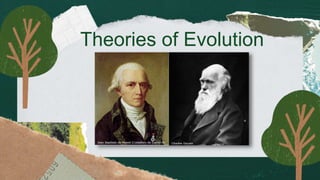
Theories of Evolution
• Explain the different theories
concerning evolution;
Lesson Objectives
• Compare Darwinian and other
theorist’s view of evolution; and
• Show appreciation on biological
evolution..
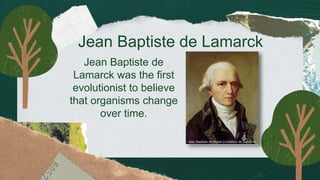
Jean Baptiste de Lamarck
Jean Baptiste de
Lamarck was the first
evolutionist to believe
that organisms change
over time.
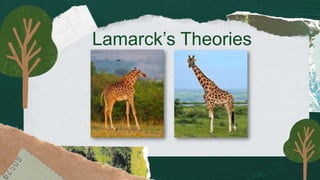
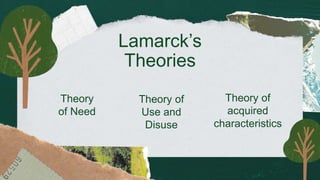
Lamarck’s Theories
Lamarck’s
Theories
Theory
of Need
Theory of
Use and
Disuse
Theory of
acquired
characteristics
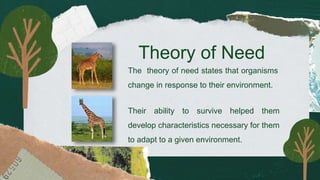
Theory of Need
The theory of need states that organisms
change in response to their environment.
Their ability to survive helped them
develop characteristics necessary for them
to adapt to a given environment.
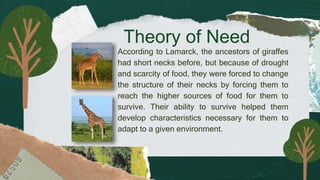
Theory of Need
According to Lamarck, the ancestors of giraffes
had short necks before, but because of drought
and scarcity of food, they were forced to change
the structure of their necks by forcing them to
reach the higher sources of food for them to
survive. Their ability to survive helped them
develop characteristics necessary for them to
adapt to a given environment.
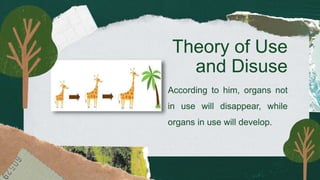
Theory of Use
and Disuse
According to him, organs not
in use will disappear, while
organs in use will develop.
Theory of Use and Disuse
According to him, organs not in use will disappear,
while organs in use will develop. Again, it is like in the
first theory where Lamarck believes that giraffes had
short necks before, but because of the need to survive
and in order to reach tall trees for food, they kept
stretching their necks until they became longer and able
to reach taller trees.
Theory of acquired
characteristics
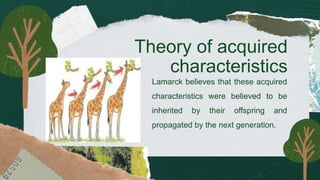
Lamarck believes that these acquired
characteristics were believed to be
inherited by their offspring and
propagated by the next generation.
But many scientists rejected the theories of Lamarck.
They understood that if there were changes in the cell
or body structure, there could be changes in the
genetic information of the species.
For example, if you change the color of your hair by
dyeing it from black to blonde, do you think class,
your child will inherit the blonde color of your hair?
Darwin’s Theory
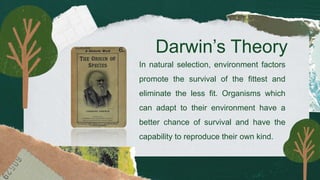
In natural selection, environment factors
promote the survival of the fittest and
eliminate the less fit. Organisms which
can adapt to their environment have a
better chance of survival and have the
capability to reproduce their own kind.
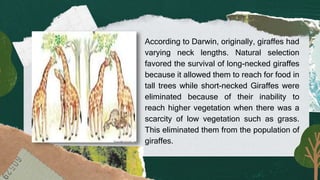
According to Darwin, originally, giraffes had
varying neck lengths. Natural selection
favored the survival of long-necked giraffes
because it allowed them to reach for food in
tall trees while short-necked Giraffes were
eliminated because of their inability to
reach higher vegetation when there was a
scarcity of low vegetation such as grass.
This eliminated them from the population of
giraffes.
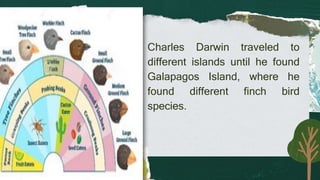
Charles Darwin traveled to
different islands until he found
Galapagos Island, where he
found different finch bird
species.
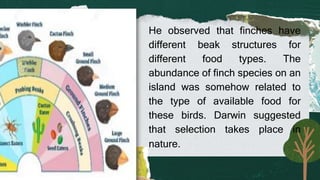
He observed that finches have
different beak structures for
different food types. The
abundance of finch species on an
island was somehow related to
the type of available food for
these birds. Darwin suggested
that selection takes place in
nature.
Did you know class organism struggle for existence in
order to survive because they need to compete for food
and space and also adapt the changes in environment.
In real life, animals migrate and find other mates, gene
continually mutate, and nature allows the fittest
organism to survive. When these conditions happen,
evolution has occurred.
Mechanism of Evolution
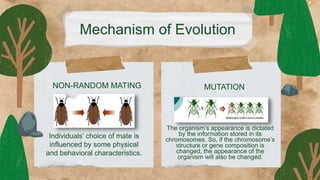
Individuals’ choice of mate is
influenced by some physical
and behavioral characteristics.
NON-RANDOM MATING MUTATION
The organism’s appearance is dictated
by the information stored in its
chromosomes. So, if the chromosome’s
structure or gene composition is
changed, the appearance of the
organism will also be changed.
Mechanism of Evolution
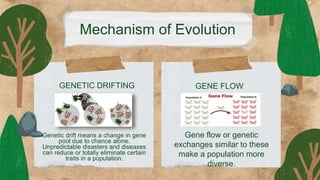
Genetic drift means a change in gene
pool due to chance alone.
Unpredictable disasters and diseases
can reduce or totally eliminate certain
traits in a population.
GENETIC DRIFTING GENE FLOW
Gene flow or genetic
exchanges similar to these
make a population more
diverse.
Mechanism of Evolution
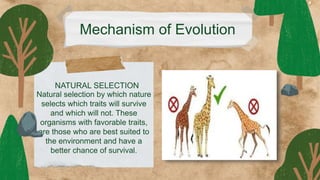
Natural selection by which nature
selects which traits will survive
and which will not. These
organisms with favorable traits,
are those who are best suited to
the environment and have a
better chance of survival.
NATURAL SELECTION
SPECIATION
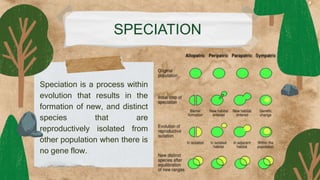
Speciation is a process within
evolution that results in the
formation of new, and distinct
species that are
reproductively isolated from
other population when there is
no gene flow.
Types of Speciation
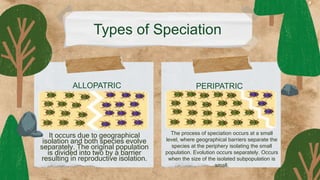
It occurs due to geographical
isolation and both species evolve
separately. The original population
is divided into two by a barrier
resulting in reproductive isolation.
ALLOPATRIC PERIPATRIC
The process of speciation occurs at a small
level, where geographical barriers separate the
species at the periphery isolating the small
population. Evolution occurs separately. Occurs
when the size of the isolated subpopulation is
small.
Types of Speciation
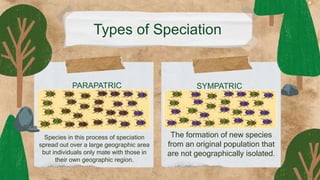
Species in this process of speciation
spread out over a large geographic area
but individuals only mate with those in
their own geographic region.
PARAPATRIC SYMPATRIC
The formation of new species
from an original population that
are not geographically isolated.
Let's review
1. What are the three
theories of Jean Baptiste
de Lamarck?
2. How natural selection
of Charles Darwin
happens?
3. What are the
mechanisms of
evolution?
To test whether you've learned something today, I
prepared 10-item multiple choice type of test to be
answered individually.
Evaluation
Directions: Choose the letter of the best answer. Write the chosen letter before
the number
1. Which of the following causes of evolution states that sexual selection is not merely by
chance?
A. Non-random mating
B. Genetic Drift
C. Gene Flow
D. Mutation
2. What is genetic drift?
A. The formation of new species.
B. A change in gene pool due to chance alone.
C. Any change in the structure of chromosomes and gene composition.
D. The migration of individuals from one population to another.
• 3.During the process of speciation, a species is first isolated _______.
• A. genetically
• B. behaviorally
• C. geographically
• D. reproductively
• 4.The following are statements thatdescribe Darwin’s theory of natural selection except___________.
• A. Members of a population will compete.
• B. Populations tend to reproduce in small numbers.
• C. Members of a population have heritable variations.
• D. Some members of a population have adaptive traits.
•
• 5. Which of the following mechanisms will cause the gene pool of two populations to change?
• A. Mutation
• B. Gene Flow
• C. Genetic Drift
• D. Natural Selection
6. Which of the following describes mutation?
A. A result of inbreeding.
B. Any change in the structure of chromosomes.
C. Change in gene pool due to migration.
D. Differential survival and reproduction of organisms.
• 7. What agent of evolutionary change can result to a population with limited variation due entirely to
chance?
• A. Mutation
• B. Gene flow
• C. Genetic drift
• D. Inbreeding
•
• 8. What do you call the process that results to the formation of new species because of evolution?
• A. Speciation
• B. Mutation
• C. Reproduction
• D. Migration
9. Who is the first evolutionist to believe that organisms change?
A. Jean Baptiste de Lamarck
B. Richard Dawkins
C. Charles Darwin
D. Steve Jones
10. It is commonly observed in plants and in some kinds of animals and a very good example of non-
random mating.
A. Genetic drift
B. Inbreeding
C. Gene flow
D. Mutation
Agreement
A. Follow-up:
Directions: Answer the following question concisely.
1. Cite some examples on the different mechanisms of evolution?
2. Imagine that you are one of the scientists during the past, which theory would
you accept? The theory of Darwin or Lamarck? Why? Briefly explain your
answer.
B. Advanced:
Directions: Give a brief response to the following question.
1. What is adaptation?
2. What are the different ways organisms in adapting the environment?
3. Why it is necessary to adapt the changing environment?
THANK YOU!

PPT8-THEORY & OCCURRENCE OF EVOLUTION.pptx

  • 1.
  • 2.
  • 3.
  • 4.
  • 5.
  • 6.
    • Explain thedifferent theories concerning evolution; Lesson Objectives • Compare Darwinian and other theorist’s view of evolution; and • Show appreciation on biological evolution..
  • 7.
    Jean Baptiste deLamarck Jean Baptiste de Lamarck was the first evolutionist to believe that organisms change over time.
  • 8.
  • 9.
    Lamarck’s Theories Theory of Need Theory of Useand Disuse Theory of acquired characteristics
  • 10.
    Theory of Need Thetheory of need states that organisms change in response to their environment. Their ability to survive helped them develop characteristics necessary for them to adapt to a given environment.
  • 11.
    Theory of Need Accordingto Lamarck, the ancestors of giraffes had short necks before, but because of drought and scarcity of food, they were forced to change the structure of their necks by forcing them to reach the higher sources of food for them to survive. Their ability to survive helped them develop characteristics necessary for them to adapt to a given environment.
  • 12.
    Theory of Use andDisuse According to him, organs not in use will disappear, while organs in use will develop.
  • 13.
    Theory of Useand Disuse According to him, organs not in use will disappear, while organs in use will develop. Again, it is like in the first theory where Lamarck believes that giraffes had short necks before, but because of the need to survive and in order to reach tall trees for food, they kept stretching their necks until they became longer and able to reach taller trees.
  • 14.
    Theory of acquired characteristics Lamarckbelieves that these acquired characteristics were believed to be inherited by their offspring and propagated by the next generation.
  • 15.
    But many scientistsrejected the theories of Lamarck. They understood that if there were changes in the cell or body structure, there could be changes in the genetic information of the species. For example, if you change the color of your hair by dyeing it from black to blonde, do you think class, your child will inherit the blonde color of your hair?
  • 16.
    Darwin’s Theory In naturalselection, environment factors promote the survival of the fittest and eliminate the less fit. Organisms which can adapt to their environment have a better chance of survival and have the capability to reproduce their own kind.
  • 17.
    According to Darwin,originally, giraffes had varying neck lengths. Natural selection favored the survival of long-necked giraffes because it allowed them to reach for food in tall trees while short-necked Giraffes were eliminated because of their inability to reach higher vegetation when there was a scarcity of low vegetation such as grass. This eliminated them from the population of giraffes.
  • 18.
    Charles Darwin traveledto different islands until he found Galapagos Island, where he found different finch bird species.
  • 19.
    He observed thatfinches have different beak structures for different food types. The abundance of finch species on an island was somehow related to the type of available food for these birds. Darwin suggested that selection takes place in nature.
  • 20.
    Did you knowclass organism struggle for existence in order to survive because they need to compete for food and space and also adapt the changes in environment. In real life, animals migrate and find other mates, gene continually mutate, and nature allows the fittest organism to survive. When these conditions happen, evolution has occurred.
  • 21.
    Mechanism of Evolution Individuals’choice of mate is influenced by some physical and behavioral characteristics. NON-RANDOM MATING MUTATION The organism’s appearance is dictated by the information stored in its chromosomes. So, if the chromosome’s structure or gene composition is changed, the appearance of the organism will also be changed.
  • 22.
    Mechanism of Evolution Geneticdrift means a change in gene pool due to chance alone. Unpredictable disasters and diseases can reduce or totally eliminate certain traits in a population. GENETIC DRIFTING GENE FLOW Gene flow or genetic exchanges similar to these make a population more diverse.
  • 23.
    Mechanism of Evolution Naturalselection by which nature selects which traits will survive and which will not. These organisms with favorable traits, are those who are best suited to the environment and have a better chance of survival. NATURAL SELECTION
  • 24.
    SPECIATION Speciation is aprocess within evolution that results in the formation of new, and distinct species that are reproductively isolated from other population when there is no gene flow.
  • 25.
    Types of Speciation Itoccurs due to geographical isolation and both species evolve separately. The original population is divided into two by a barrier resulting in reproductive isolation. ALLOPATRIC PERIPATRIC The process of speciation occurs at a small level, where geographical barriers separate the species at the periphery isolating the small population. Evolution occurs separately. Occurs when the size of the isolated subpopulation is small.
  • 26.
    Types of Speciation Speciesin this process of speciation spread out over a large geographic area but individuals only mate with those in their own geographic region. PARAPATRIC SYMPATRIC The formation of new species from an original population that are not geographically isolated.
  • 27.
    Let's review 1. Whatare the three theories of Jean Baptiste de Lamarck? 2. How natural selection of Charles Darwin happens? 3. What are the mechanisms of evolution?
  • 28.
    To test whetheryou've learned something today, I prepared 10-item multiple choice type of test to be answered individually. Evaluation
  • 29.
    Directions: Choose theletter of the best answer. Write the chosen letter before the number 1. Which of the following causes of evolution states that sexual selection is not merely by chance? A. Non-random mating B. Genetic Drift C. Gene Flow D. Mutation 2. What is genetic drift? A. The formation of new species. B. A change in gene pool due to chance alone. C. Any change in the structure of chromosomes and gene composition. D. The migration of individuals from one population to another.
  • 30.
    • 3.During theprocess of speciation, a species is first isolated _______. • A. genetically • B. behaviorally • C. geographically • D. reproductively • 4.The following are statements thatdescribe Darwin’s theory of natural selection except___________. • A. Members of a population will compete. • B. Populations tend to reproduce in small numbers. • C. Members of a population have heritable variations. • D. Some members of a population have adaptive traits. • • 5. Which of the following mechanisms will cause the gene pool of two populations to change? • A. Mutation • B. Gene Flow • C. Genetic Drift • D. Natural Selection
  • 31.
    6. Which ofthe following describes mutation? A. A result of inbreeding. B. Any change in the structure of chromosomes. C. Change in gene pool due to migration. D. Differential survival and reproduction of organisms. • 7. What agent of evolutionary change can result to a population with limited variation due entirely to chance? • A. Mutation • B. Gene flow • C. Genetic drift • D. Inbreeding • • 8. What do you call the process that results to the formation of new species because of evolution? • A. Speciation • B. Mutation • C. Reproduction • D. Migration
  • 32.
    9. Who isthe first evolutionist to believe that organisms change? A. Jean Baptiste de Lamarck B. Richard Dawkins C. Charles Darwin D. Steve Jones 10. It is commonly observed in plants and in some kinds of animals and a very good example of non- random mating. A. Genetic drift B. Inbreeding C. Gene flow D. Mutation
  • 33.
    Agreement A. Follow-up: Directions: Answerthe following question concisely. 1. Cite some examples on the different mechanisms of evolution? 2. Imagine that you are one of the scientists during the past, which theory would you accept? The theory of Darwin or Lamarck? Why? Briefly explain your answer. B. Advanced: Directions: Give a brief response to the following question. 1. What is adaptation? 2. What are the different ways organisms in adapting the environment? 3. Why it is necessary to adapt the changing environment?
  • 34.