EDUC 105 – ASSESSMENT IN
LEARNING 1
UNIT 1: NATURE AND ROLES OF ASSESSMENT
UNIT 2: RECENT TRENDS AND FOCUS OF EDUCATION
Pre-test
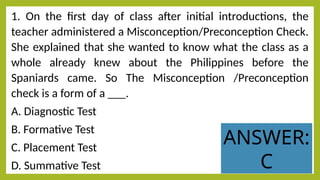
1. On the first day of class after initial introductions, the
teacher administered a Misconception/Preconception Check.
She explained that she wanted to know what the class as a
whole already knew about the Philippines before the
Spaniards came. So The Misconception /Preconception
check is a form of a ___.
A. Diagnostic Test
B. Formative Test
C. Placement Test
D. Summative Test
ANSWER:
C
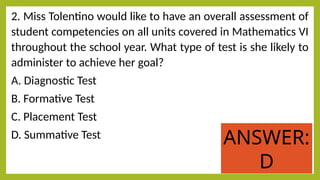
2. Miss Tolentino would like to have an overall assessment of
student competencies on all units covered in Mathematics VI
throughout the school year. What type of test is she likely to
administer to achieve her goal?
A. Diagnostic Test
B. Formative Test
C. Placement Test
D. Summative Test ANSWER:
D
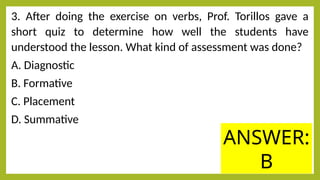
3. After doing the exercise on verbs, Prof. Torillos gave a
short quiz to determine how well the students have
understood the lesson. What kind of assessment was done?
A. Diagnostic
B. Formative
C. Placement
D. Summative
ANSWER:
B
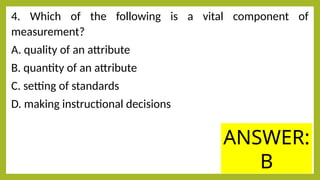
4. Which of the following is a vital component of
measurement?
A. quality of an attribute
B. quantity of an attribute
C. setting of standards
D. making instructional decisions
ANSWER:
B
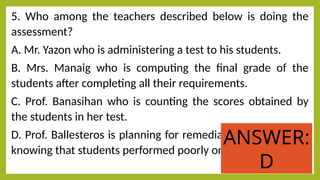
5. Who among the teachers described below is doing the
assessment?
A. Mr. Yazon who is administering a test to his students.
B. Mrs. Manaig who is computing the final grade of the
students after completing all their requirements.
C. Prof. Banasihan who is counting the scores obtained by
the students in her test.
D. Prof. Ballesteros is planning for remedial instruction after
knowing that students performed poorly on her test.
ANSWER:
D
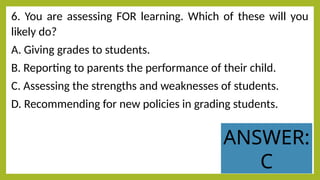
6. You are assessing FOR learning. Which of these will you
likely do?
A. Giving grades to students.
B. Reporting to parents the performance of their child.
C. Assessing the strengths and weaknesses of students.
D. Recommending for new policies in grading students.
ANSWER:
C
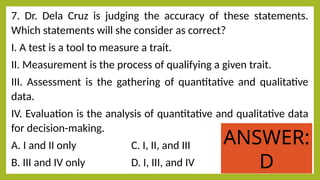
7. Dr. Dela Cruz is judging the accuracy of these statements.
Which statements will she consider as correct?
I. A test is a tool to measure a trait.
II. Measurement is the process of qualifying a given trait.
III. Assessment is the gathering of quantitative and qualitative
data.
IV. Evaluation is the analysis of quantitative and qualitative data
for decision-making.
A. I and II only C. I, II, and III
B. III and IV only D. I, III, and IV
ANSWER:
D
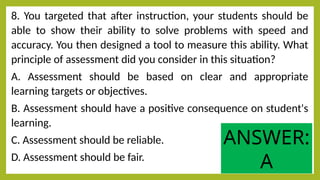
8. You targeted that after instruction, your students should be
able to show their ability to solve problems with speed and
accuracy. You then designed a tool to measure this ability. What
principle of assessment did you consider in this situation?
A. Assessment should be based on clear and appropriate
learning targets or objectives.
B. Assessment should have a positive consequence on student's
learning.
C. Assessment should be reliable.
D. Assessment should be fair.
ANSWER:
A
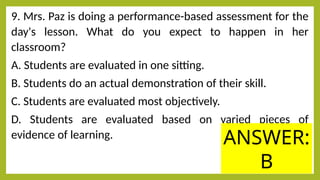
9. Mrs. Paz is doing a performance-based assessment for the
day's lesson. What do you expect to happen in her
classroom?
A. Students are evaluated in one sitting.
B. Students do an actual demonstration of their skill.
C. Students are evaluated most objectively.
D. Students are evaluated based on varied pieces of
evidence of learning. ANSWER:
B
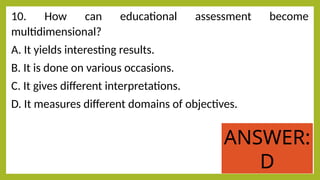
10. How can educational assessment become
multidimensional?
A. It yields interesting results.
B. It is done on various occasions.
C. It gives different interpretations.
D. It measures different domains of objectives.
ANSWER:
D
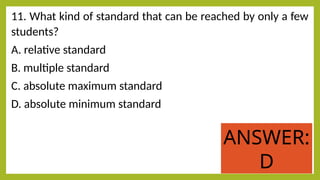
11. What kind of standard that can be reached by only a few
students?
A. relative standard
B. multiple standard
C. absolute maximum standard
D. absolute minimum standard
ANSWER:
D
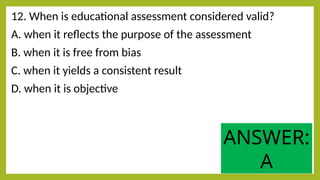
12. When is educational assessment considered valid?
A. when it reflects the purpose of the assessment
B. when it is free from bias
C. when it yields a consistent result
D. when it is objective
ANSWER:
A
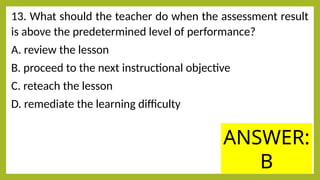
13. What should the teacher do when the assessment result
is above the predetermined level of performance?
A. review the lesson
B. proceed to the next instructional objective
C. reteach the lesson
D. remediate the learning difficulty
ANSWER:
B
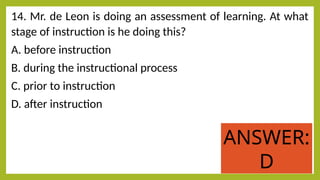
14. Mr. de Leon is doing an assessment of learning. At what
stage of instruction is he doing this?
A. before instruction
B. during the instructional process
C. prior to instruction
D. after instruction
ANSWER:
D
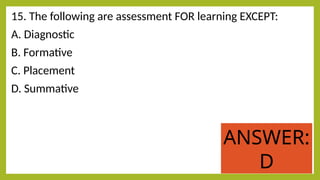
15. The following are assessment FOR learning EXCEPT:
A. Diagnostic
B. Formative
C. Placement
D. Summative
ANSWER:
D

EDUC 105 - PRE - TEST 1 UNIT 1 AND 2.pptx

  • 1.
    EDUC 105 –ASSESSMENT IN LEARNING 1 UNIT 1: NATURE AND ROLES OF ASSESSMENT UNIT 2: RECENT TRENDS AND FOCUS OF EDUCATION Pre-test
  • 2.
    1. On thefirst day of class after initial introductions, the teacher administered a Misconception/Preconception Check. She explained that she wanted to know what the class as a whole already knew about the Philippines before the Spaniards came. So The Misconception /Preconception check is a form of a ___. A. Diagnostic Test B. Formative Test C. Placement Test D. Summative Test ANSWER: C
  • 3.
    2. Miss Tolentinowould like to have an overall assessment of student competencies on all units covered in Mathematics VI throughout the school year. What type of test is she likely to administer to achieve her goal? A. Diagnostic Test B. Formative Test C. Placement Test D. Summative Test ANSWER: D
  • 4.
    3. After doingthe exercise on verbs, Prof. Torillos gave a short quiz to determine how well the students have understood the lesson. What kind of assessment was done? A. Diagnostic B. Formative C. Placement D. Summative ANSWER: B
  • 5.
    4. Which ofthe following is a vital component of measurement? A. quality of an attribute B. quantity of an attribute C. setting of standards D. making instructional decisions ANSWER: B
  • 6.
    5. Who amongthe teachers described below is doing the assessment? A. Mr. Yazon who is administering a test to his students. B. Mrs. Manaig who is computing the final grade of the students after completing all their requirements. C. Prof. Banasihan who is counting the scores obtained by the students in her test. D. Prof. Ballesteros is planning for remedial instruction after knowing that students performed poorly on her test. ANSWER: D
  • 7.
    6. You areassessing FOR learning. Which of these will you likely do? A. Giving grades to students. B. Reporting to parents the performance of their child. C. Assessing the strengths and weaknesses of students. D. Recommending for new policies in grading students. ANSWER: C
  • 8.
    7. Dr. DelaCruz is judging the accuracy of these statements. Which statements will she consider as correct? I. A test is a tool to measure a trait. II. Measurement is the process of qualifying a given trait. III. Assessment is the gathering of quantitative and qualitative data. IV. Evaluation is the analysis of quantitative and qualitative data for decision-making. A. I and II only C. I, II, and III B. III and IV only D. I, III, and IV ANSWER: D
  • 9.
    8. You targetedthat after instruction, your students should be able to show their ability to solve problems with speed and accuracy. You then designed a tool to measure this ability. What principle of assessment did you consider in this situation? A. Assessment should be based on clear and appropriate learning targets or objectives. B. Assessment should have a positive consequence on student's learning. C. Assessment should be reliable. D. Assessment should be fair. ANSWER: A
  • 10.
    9. Mrs. Pazis doing a performance-based assessment for the day's lesson. What do you expect to happen in her classroom? A. Students are evaluated in one sitting. B. Students do an actual demonstration of their skill. C. Students are evaluated most objectively. D. Students are evaluated based on varied pieces of evidence of learning. ANSWER: B
  • 11.
    10. How caneducational assessment become multidimensional? A. It yields interesting results. B. It is done on various occasions. C. It gives different interpretations. D. It measures different domains of objectives. ANSWER: D
  • 12.
    11. What kindof standard that can be reached by only a few students? A. relative standard B. multiple standard C. absolute maximum standard D. absolute minimum standard ANSWER: D
  • 13.
    12. When iseducational assessment considered valid? A. when it reflects the purpose of the assessment B. when it is free from bias C. when it yields a consistent result D. when it is objective ANSWER: A
  • 14.
    13. What shouldthe teacher do when the assessment result is above the predetermined level of performance? A. review the lesson B. proceed to the next instructional objective C. reteach the lesson D. remediate the learning difficulty ANSWER: B
  • 15.
    14. Mr. deLeon is doing an assessment of learning. At what stage of instruction is he doing this? A. before instruction B. during the instructional process C. prior to instruction D. after instruction ANSWER: D
  • 16.
    15. The followingare assessment FOR learning EXCEPT: A. Diagnostic B. Formative C. Placement D. Summative ANSWER: D