SOCIAL SCIENCE
STD:X
POLITICAL
SCIENCE
UNIT:3
DEMOCRACY AND DIVERSITY
People identify themselves and relate with others
on the basis of
• religion
• language
• class
• gender
• tribe
•physical appearance etc.
Can Democracy respond to such social differences,
divisions and inequality?
ORIGINS OF SOCIAL
DIVERSITY
Social differences based on birth
Social differences based on choices
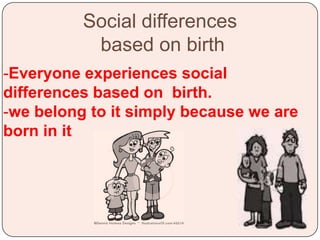
Social differences
based on birth
-Everyone experiences social
differences based on birth.
-we belong to it simply because we are
born in it
-Parents ,caste ,class ,language group
,gender religion ,social relationships all come
with birth.
-nobody can exercise any choice in this
matter.
SOCIAL GROUPS BASED
ON PERSONAL CHOICES
we choose what to study.
which occupation to take.
which cultural activities to take
part in.
•people choose to be believe in God (theists) or
do not believe in God (atheists)
•follow religion other than the one in which they
are born.
Every Social difference does not lead
to social division.
Social Division ,Divide people from one another
but they also Unite very different people.
Thus we all have more than
one identity and can belong
to more than one social
group
Son, husband , father,
brother , friend
Guide , publisher
social activist
Over lapping
Cross
cutting
1.Cross cutting social
differences
2.Over lapping social differences
CROSS CUTTING
In spite of differences the social groups
tolerate each other and live peacefully
N.IRELAND & Netherland are predominantly Christian
societies.
But, they are divided into Protestant & Catholics
N.IRELAND- class and religion overlaps each other.
Catholic are more likely to be poor, suffered same
history
IN NETHERLAND - Class and religion cross cut each
other and live peacefully
OVERLAPPING
When some social differences
overlap with other social difference.
 Blacks in America tend to be poor ,homeless
and discriminated
 Dalits in India tend to be poor and landless ,face
discrimination and injustice
1968 Olympics incident
These represent the medal ceremony of the 200 metres race in
the 1968 Olympics held at Mexico City.
The two men standing with clenched fists upraised and heads
bowed, while the American national anthem was played, are the
US athletes, Tommie Smith and John Carlos.
They are AFRICAN-AMERICANS. They had won the gold and
bronze medals respectively.
They received their medals wearing black socks and no shoes to
represent Black poverty.
With this gesture, they tried to draw international attention to
racial discrimination in the United
States. The black-gloved and raised clenched fists were meant to
symbolise BLACK POWER.
The silver medalist, white Australian athlete, Peter Norman, wore
a human rights badge on his shirt during the ceremony to show
his support to the two Americans.
CLICK
Incident of Mexico olympic-1968
•An important landmark in
the history of the
CIVIL RIGHTS MOVEMENT
IN THE UNITED STATES
•Should Carlos and Smith have raised an
internal matter of American society in an
international forum?
•Would you say that what they did was
political?
•Why do you think Peter Norman, who
was neither Black nor American, joined
in this gesture of protest?
•If you were in Norman’s place what
would you do?
Think over …
Click
The Speech By Martin Luther King Jr.
Agitation by the blacks
Rosa parks ,who was not
allowed to sit on the seat
reserved for the whites .
Agitation by students
Conclusion
•Overlapping social differences create
possibilities of deep social divisions and
tensions.
•Cross cutting social differences are easier
to accommodate social diversities.
There are two viewpoints about:
Politics and social divisions.
Politics and social tensions
•Democracy involves competition among
political parties.
•Competition divides any society.
•It plays upon the social divisions and
supports the affected social group to launch
movements in their cause.
•This may result in conflict ,violence or even
disintegration of the country.
NORTHERN IRELAND
• E.g.: N.Ireland in Uk had experienced violent
and bitter ethno-political conflict. Hundreds of
civilians ,militants and security forces lost their
lives.
• In 1998, the conflict was solved.
• In Northern Ireland, the community to
which you belong is very much part of your
identity.
•"Catholics and Protestants deal with each
other not simply as individuals but as
representative members of communities".
• People establish the religion of others on
acquaintance, often by using signifiers such
as their name ,place of living.
YUGOSLAVIA
Political and social differences in
1990s lead to several independent
countries.
These eight federal units were the six
republics: Slovenia, Croatia, Bosnia
and Herzegovina, Macedonia
,Montenegro , Serbia, and two
autonomous provinces within Serbia:
Kosovo and Vojvodina.
OUTCOMES OF POLITICS
OF
SOCIAL DIVISIONS
Factors that determine these
outcomes
Peoples
perception of
their
identities.
Perception
of the
political
leaders.
Reactions of
the
Government.
Peoples Perception of
their Identities
--if people see their identities in singular terms,
it becomes difficult to accommodate them.
--but if they see their identities in as a part of a larger
society, it helps them to stay together.
Perception of
Political Leaders
--it is easy to accommodate demands that
are within the constitutional frame work and
are not at the cost of another community.
Reactions of the
Government
-if the ruling party is willing to share power and
accommodate reasonable demands of minorities,
social division becomes less threating to the
country.
-but if they try and suppress such a demand
in the name of national unity ,the end result
is disintegration of the country.
•Thus ,in a democracy political expression of social
division is very normal and can be healthy.
•But a positive attitude towards diversity and a
willingness to accommodate it does not come easily.
•History shows that democracy is the best way to fight
for recognition and also to accommodate diversity .
Sulbha Dave
www.udgamschool.com

Political Science

  • 1.
  • 2.
  • 3.
    DEMOCRACY AND DIVERSITY Peopleidentify themselves and relate with others on the basis of • religion • language • class • gender • tribe •physical appearance etc. Can Democracy respond to such social differences, divisions and inequality?
  • 5.
    ORIGINS OF SOCIAL DIVERSITY Socialdifferences based on birth Social differences based on choices
  • 6.
    Social differences based onbirth -Everyone experiences social differences based on birth. -we belong to it simply because we are born in it
  • 7.
    -Parents ,caste ,class,language group ,gender religion ,social relationships all come with birth. -nobody can exercise any choice in this matter.
  • 8.
    SOCIAL GROUPS BASED ONPERSONAL CHOICES we choose what to study. which occupation to take. which cultural activities to take part in.
  • 9.
    •people choose tobe believe in God (theists) or do not believe in God (atheists) •follow religion other than the one in which they are born.
  • 10.
    Every Social differencedoes not lead to social division. Social Division ,Divide people from one another but they also Unite very different people.
  • 11.
    Thus we allhave more than one identity and can belong to more than one social group Son, husband , father, brother , friend Guide , publisher social activist
  • 13.
    Over lapping Cross cutting 1.Cross cuttingsocial differences 2.Over lapping social differences
  • 14.
    CROSS CUTTING In spiteof differences the social groups tolerate each other and live peacefully N.IRELAND & Netherland are predominantly Christian societies. But, they are divided into Protestant & Catholics N.IRELAND- class and religion overlaps each other. Catholic are more likely to be poor, suffered same history IN NETHERLAND - Class and religion cross cut each other and live peacefully
  • 15.
    OVERLAPPING When some socialdifferences overlap with other social difference.  Blacks in America tend to be poor ,homeless and discriminated  Dalits in India tend to be poor and landless ,face discrimination and injustice
  • 16.
    1968 Olympics incident Theserepresent the medal ceremony of the 200 metres race in the 1968 Olympics held at Mexico City. The two men standing with clenched fists upraised and heads bowed, while the American national anthem was played, are the US athletes, Tommie Smith and John Carlos. They are AFRICAN-AMERICANS. They had won the gold and bronze medals respectively. They received their medals wearing black socks and no shoes to represent Black poverty. With this gesture, they tried to draw international attention to racial discrimination in the United States. The black-gloved and raised clenched fists were meant to symbolise BLACK POWER. The silver medalist, white Australian athlete, Peter Norman, wore a human rights badge on his shirt during the ceremony to show his support to the two Americans.
  • 17.
    CLICK Incident of Mexicoolympic-1968 •An important landmark in the history of the CIVIL RIGHTS MOVEMENT IN THE UNITED STATES
  • 18.
    •Should Carlos andSmith have raised an internal matter of American society in an international forum? •Would you say that what they did was political? •Why do you think Peter Norman, who was neither Black nor American, joined in this gesture of protest? •If you were in Norman’s place what would you do? Think over …
  • 19.
    Click The Speech ByMartin Luther King Jr.
  • 20.
    Agitation by theblacks Rosa parks ,who was not allowed to sit on the seat reserved for the whites . Agitation by students
  • 21.
    Conclusion •Overlapping social differencescreate possibilities of deep social divisions and tensions. •Cross cutting social differences are easier to accommodate social diversities.
  • 22.
    There are twoviewpoints about: Politics and social divisions.
  • 23.
    Politics and socialtensions •Democracy involves competition among political parties. •Competition divides any society. •It plays upon the social divisions and supports the affected social group to launch movements in their cause. •This may result in conflict ,violence or even disintegration of the country.
  • 24.
    NORTHERN IRELAND • E.g.:N.Ireland in Uk had experienced violent and bitter ethno-political conflict. Hundreds of civilians ,militants and security forces lost their lives. • In 1998, the conflict was solved.
  • 25.
    • In NorthernIreland, the community to which you belong is very much part of your identity. •"Catholics and Protestants deal with each other not simply as individuals but as representative members of communities". • People establish the religion of others on acquaintance, often by using signifiers such as their name ,place of living.
  • 26.
    YUGOSLAVIA Political and socialdifferences in 1990s lead to several independent countries. These eight federal units were the six republics: Slovenia, Croatia, Bosnia and Herzegovina, Macedonia ,Montenegro , Serbia, and two autonomous provinces within Serbia: Kosovo and Vojvodina.
  • 27.
    OUTCOMES OF POLITICS OF SOCIALDIVISIONS Factors that determine these outcomes Peoples perception of their identities. Perception of the political leaders. Reactions of the Government.
  • 28.
    Peoples Perception of theirIdentities --if people see their identities in singular terms, it becomes difficult to accommodate them. --but if they see their identities in as a part of a larger society, it helps them to stay together.
  • 29.
    Perception of Political Leaders --itis easy to accommodate demands that are within the constitutional frame work and are not at the cost of another community.
  • 30.
    Reactions of the Government -ifthe ruling party is willing to share power and accommodate reasonable demands of minorities, social division becomes less threating to the country. -but if they try and suppress such a demand in the name of national unity ,the end result is disintegration of the country.
  • 31.
    •Thus ,in ademocracy political expression of social division is very normal and can be healthy. •But a positive attitude towards diversity and a willingness to accommodate it does not come easily. •History shows that democracy is the best way to fight for recognition and also to accommodate diversity .
  • 32.