MADATSST
&
MUKUND INGLE
PRESENT
Mr. Mukund B. Ingle
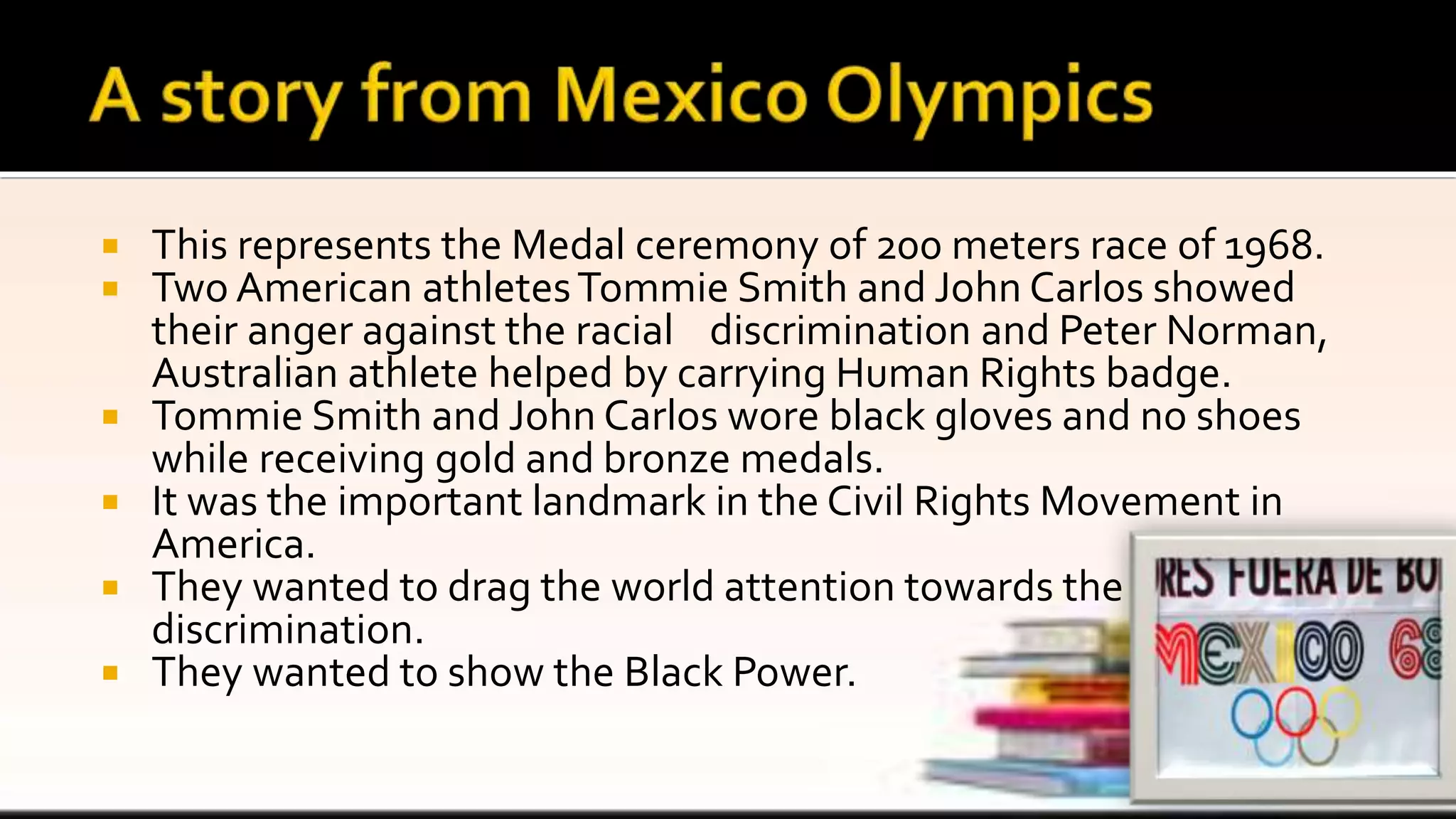
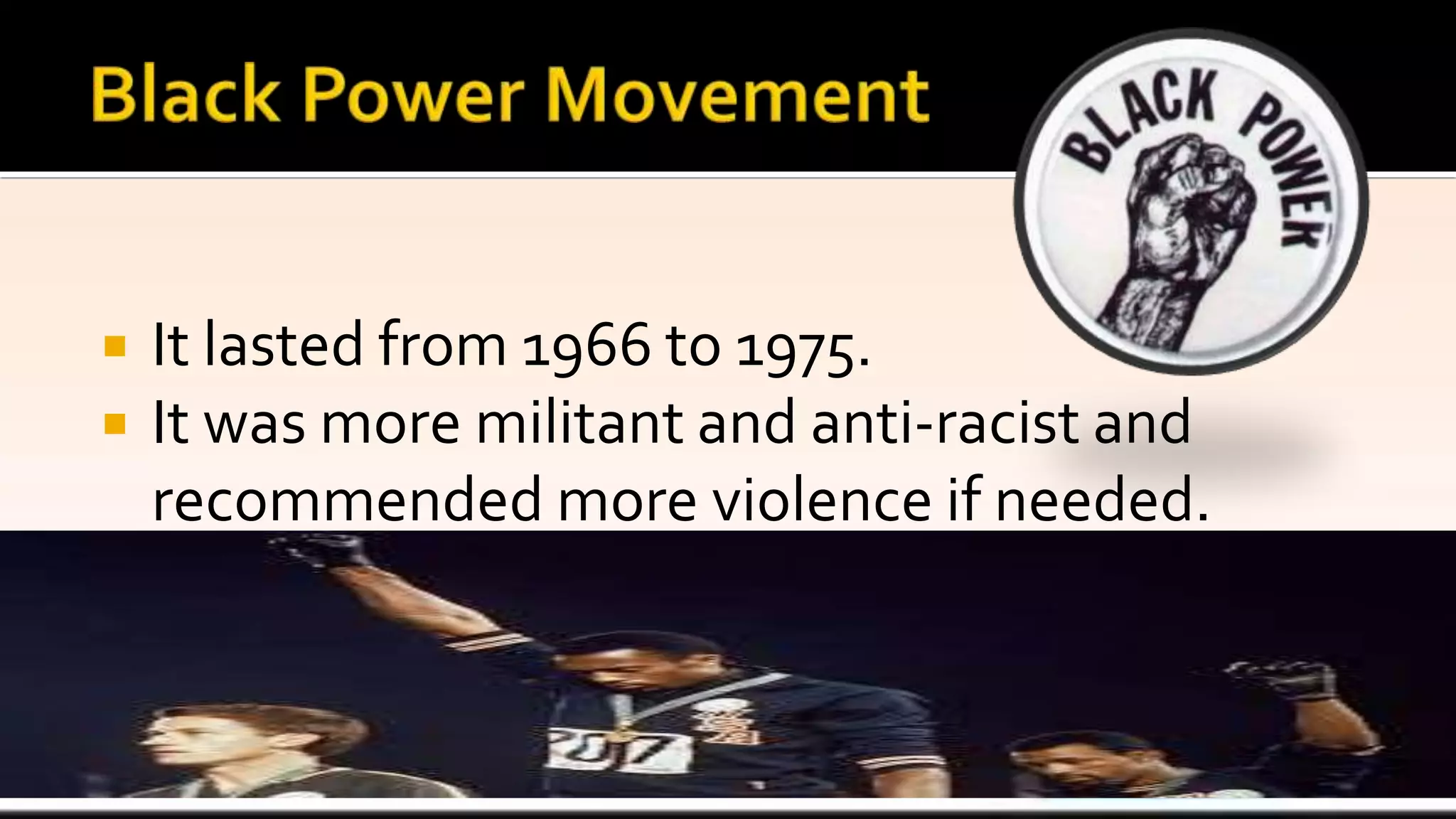
 This represents the Medal ceremony of 200 meters race of 1968.
 Two American athletesTommie Smith and John Carlos showed
their anger against the racial discrimination and Peter Norman,
Australian athlete helped by carrying Human Rights badge.
 Tommie Smith and John Carlos wore black gloves and no shoes
while receiving gold and bronze medals.
 It was the important landmark in the Civil Rights Movement in
America.
 They wanted to drag the world attention towards the
discrimination.
 They wanted to show the Black Power.
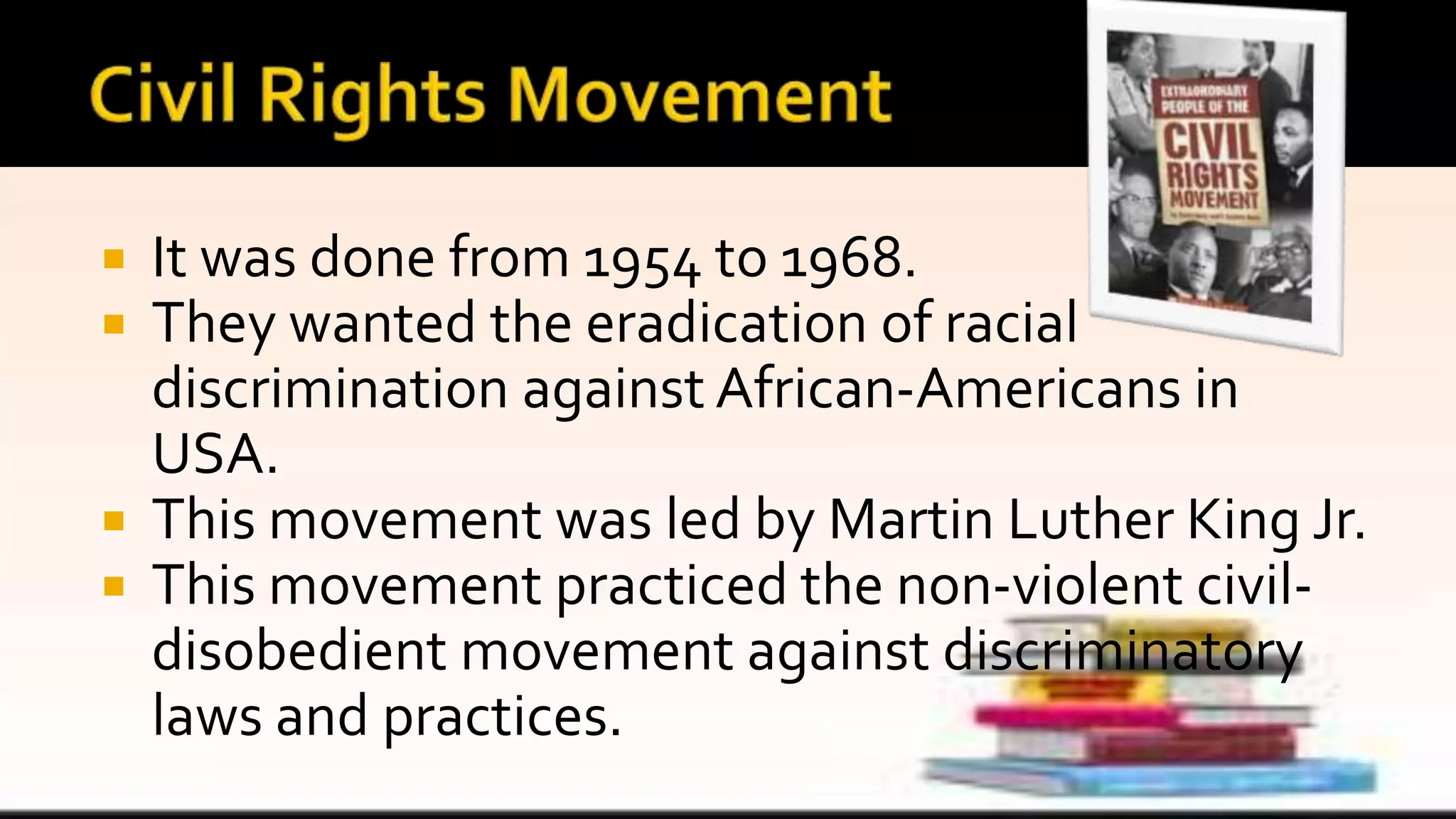
 It was done from 1954 to 1968.
 They wanted the eradication of racial
discrimination against African-Americans in
USA.
 This movement was led by Martin Luther King Jr.
 This movement practiced the non-violent civil-
disobedient movement against discriminatory
laws and practices.
 It lasted from 1966 to 1975.
 It was more militant and anti-racist and
recommended more violence if needed.
 Afro-Americans or Black is the term used for
the descendants of the slaves brought from
Africa between 17th and 19th century.
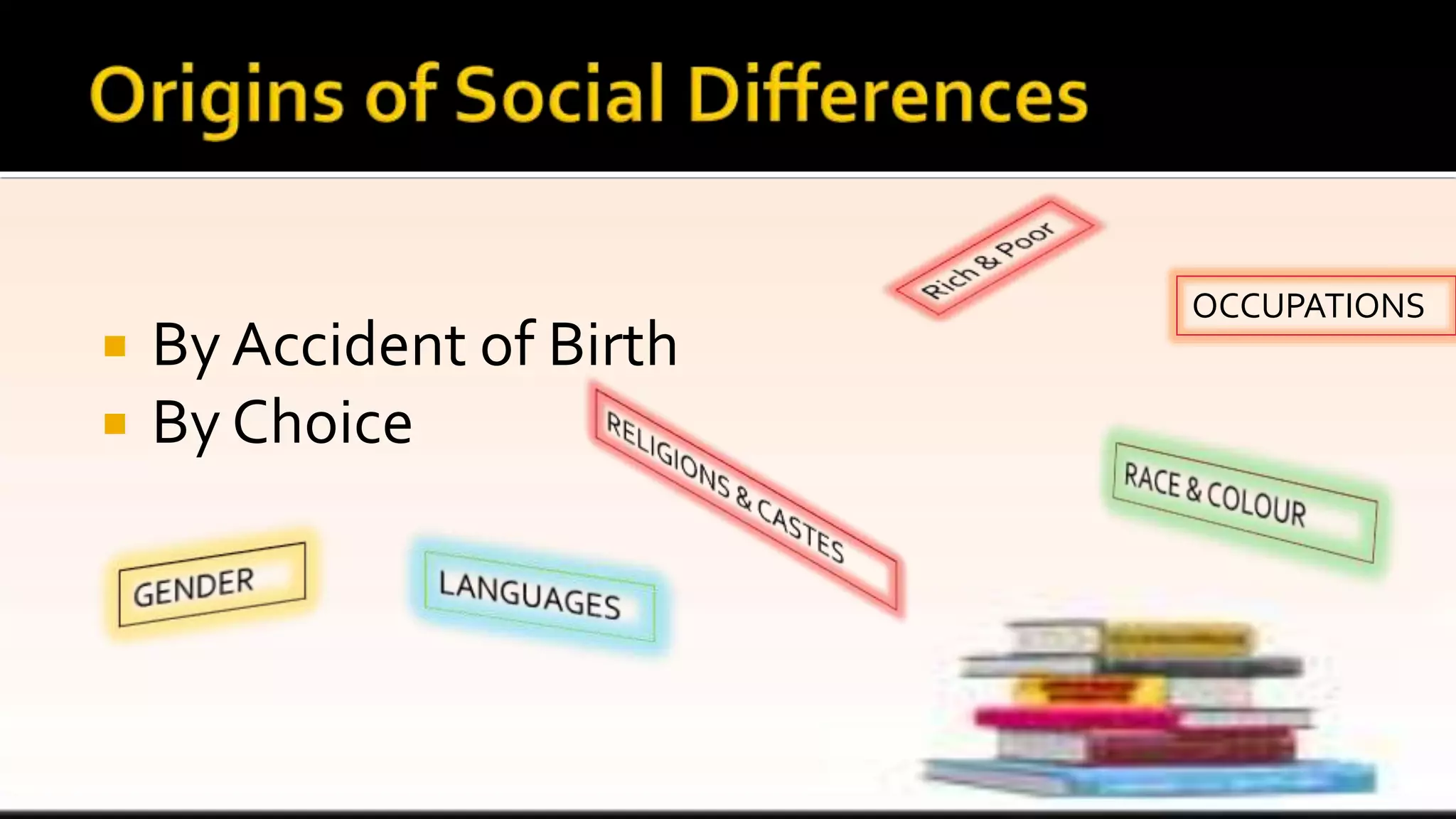
 By Accident of Birth
 By Choice
OCCUPATIONS
 Over – Lapping
 When one social difference overlaps with other is called
over – lapping.
 Blacks in America and Dalits in India are discriminated as
they are socially minor and poor.
 Over – Lapping leads to discrimination when one consider
it superior and different than other.
 Over – lapping creates acute and long lasting social
divisions.
 It difficult to accommodate.
 Cross Cutting
 When one group of people agrees on one issue
with other but disagrees on other is called cross
cutting.
 It does not create deep and acute social divisions
and tensions.
 It is possibly easy to accommodate.
 Many countries are turning from homogeneous to
heterogeneous.
 Migration has led these changes in the countries.
 India, Sri Lanka, Belgium etc.
 At first sight, it would appear that the
combination of politics and social divisions is
very dangerous and explosive.
 Their competition tends to divide any society. If
they start competing in terms of some existing
social divisions, it can make social divisions into
political divisions and lead to conflict, violence or
even disintegration of a country.
 Northern Ireland:
 Its population is divided into two major sects of Christianity: 53 per cent are
Protestants, while 44 per cent are Roman Catholics.
 The Catholics were represented by Nationalist parties who demanded that
Northern Ireland be unified with the Republic of Ireland, a predominantly
Catholic country.
 The Protestants were represented by Unionists who wanted to remain with
the UK, which is predominantly protestant.
 Hundreds of civilians, militants and security forces were killed in the fight
between Unionists and Nationalists and between the security forces of the UK
and the Nationalists.
 Ultimately it was in 1998, the peace treaty was done and conflicts were
dissolved.
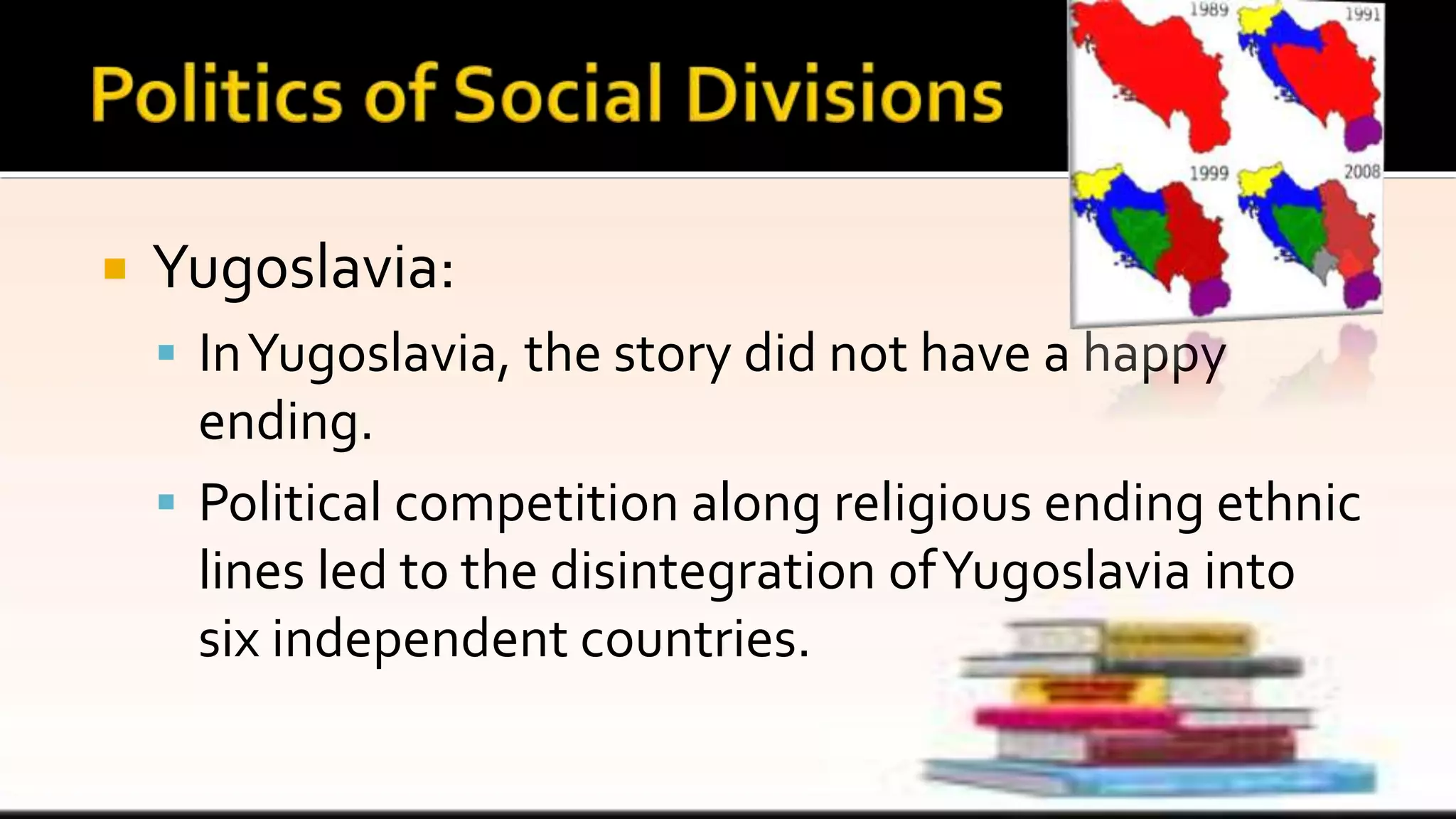
 Yugoslavia:
 InYugoslavia, the story did not have a happy
ending.
 Political competition along religious ending ethnic
lines led to the disintegration ofYugoslavia into
six independent countries.
 How people perceive their identities.
 If people see their identities in singular and
exclusive terms, it becomes very difficult to
accommodate.
 The broader the people think about their identity,
the lesser the conflicts.
 How political leaders raise the demands of any
community.
 If political parties raise the demands of particular
social group, that leads to alienation for other group.
 If demands are in the frame of constitution and for all
groups and communities, that won’t warm the unity
of the nation.
 How the government reacts to demands of different
groups.
 As we saw in the examples of Belgium and Sri Lanka, if the
rulers are willing to share power and accommodate the
reasonable demands of minority community, social
divisions become less threatening for the country.
 But if they try to suppress such a demand in the name of
national unity, the end result is often quite the opposite.
 “Thus the assertion of social diversities in a country need
not be seen as a source of danger.”
 In a democracy, political expression of social divisions is very
normal and can be healthy.
 This allows various disadvantaged and marginal social groups to
express their grievances and get the government to attend to
these.
 Expression of various kinds of social divisions in politics often
results in their cancelling one another out and thus reducing
their intensity.This leads to strengthening of a democracy.
THANK YOU

Democracy and diversity ppt

  • 1.
  • 2.
  • 3.
     This representsthe Medal ceremony of 200 meters race of 1968.  Two American athletesTommie Smith and John Carlos showed their anger against the racial discrimination and Peter Norman, Australian athlete helped by carrying Human Rights badge.  Tommie Smith and John Carlos wore black gloves and no shoes while receiving gold and bronze medals.  It was the important landmark in the Civil Rights Movement in America.  They wanted to drag the world attention towards the discrimination.  They wanted to show the Black Power.
  • 4.
     It wasdone from 1954 to 1968.  They wanted the eradication of racial discrimination against African-Americans in USA.  This movement was led by Martin Luther King Jr.  This movement practiced the non-violent civil- disobedient movement against discriminatory laws and practices.
  • 5.
     It lastedfrom 1966 to 1975.  It was more militant and anti-racist and recommended more violence if needed.
  • 6.
     Afro-Americans orBlack is the term used for the descendants of the slaves brought from Africa between 17th and 19th century.
  • 7.
     By Accidentof Birth  By Choice OCCUPATIONS
  • 8.
     Over –Lapping  When one social difference overlaps with other is called over – lapping.  Blacks in America and Dalits in India are discriminated as they are socially minor and poor.  Over – Lapping leads to discrimination when one consider it superior and different than other.  Over – lapping creates acute and long lasting social divisions.  It difficult to accommodate.
  • 9.
     Cross Cutting When one group of people agrees on one issue with other but disagrees on other is called cross cutting.  It does not create deep and acute social divisions and tensions.  It is possibly easy to accommodate.
  • 10.
     Many countriesare turning from homogeneous to heterogeneous.  Migration has led these changes in the countries.  India, Sri Lanka, Belgium etc.
  • 11.
     At firstsight, it would appear that the combination of politics and social divisions is very dangerous and explosive.  Their competition tends to divide any society. If they start competing in terms of some existing social divisions, it can make social divisions into political divisions and lead to conflict, violence or even disintegration of a country.
  • 12.
     Northern Ireland: Its population is divided into two major sects of Christianity: 53 per cent are Protestants, while 44 per cent are Roman Catholics.  The Catholics were represented by Nationalist parties who demanded that Northern Ireland be unified with the Republic of Ireland, a predominantly Catholic country.  The Protestants were represented by Unionists who wanted to remain with the UK, which is predominantly protestant.  Hundreds of civilians, militants and security forces were killed in the fight between Unionists and Nationalists and between the security forces of the UK and the Nationalists.  Ultimately it was in 1998, the peace treaty was done and conflicts were dissolved.
  • 13.
     Yugoslavia:  InYugoslavia,the story did not have a happy ending.  Political competition along religious ending ethnic lines led to the disintegration ofYugoslavia into six independent countries.
  • 14.
     How peopleperceive their identities.  If people see their identities in singular and exclusive terms, it becomes very difficult to accommodate.  The broader the people think about their identity, the lesser the conflicts.
  • 15.
     How politicalleaders raise the demands of any community.  If political parties raise the demands of particular social group, that leads to alienation for other group.  If demands are in the frame of constitution and for all groups and communities, that won’t warm the unity of the nation.
  • 16.
     How thegovernment reacts to demands of different groups.  As we saw in the examples of Belgium and Sri Lanka, if the rulers are willing to share power and accommodate the reasonable demands of minority community, social divisions become less threatening for the country.  But if they try to suppress such a demand in the name of national unity, the end result is often quite the opposite.
  • 17.
     “Thus theassertion of social diversities in a country need not be seen as a source of danger.”  In a democracy, political expression of social divisions is very normal and can be healthy.  This allows various disadvantaged and marginal social groups to express their grievances and get the government to attend to these.  Expression of various kinds of social divisions in politics often results in their cancelling one another out and thus reducing their intensity.This leads to strengthening of a democracy.
  • 18.