z NAME – Dikshant singh subh
Class – XII 'ARTS’
SUBJECT – POLITICAL SCIENCE
z
CHAPTER -2
THE END OF BIPOLARITY
z
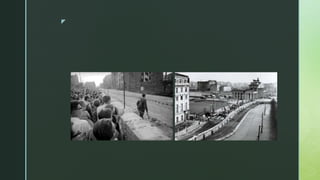
THE BERLIN WALL
The Berlin Wall symbolized the division between the capitalist and
the communist world. Built in 1961 to separate East Berlin from
West Berlin, this more than 150 kilometers long wall stood for 28
years and was finally broken by the people on 9 November 1989.
This marked the unification of the two parts of Germany and the
beginning of the end of the communist bloc.
z
z
Why was the soviet system?
 1. The Union of Soviet Socialist Republics(USSR) came into
being after the socialist revolution in Russia in 1917.
 2. The revolution was inspired by the ideals of socialism, as
opposed to capitalism, and the need for an egalitarian society.
 3.The Soviet political system centered around the communist
party, and no other political party or opposition was allowed. The
economy was planned and controlled by the state.
z
THE SECOND WORLD OR THE
SOCIALIST BLOC
 1. After the second world war, the east Europeans countries that
the Soviet army had liberated from the fascist forces came under
the control of the USSR.
 2.The political and the economic systems of all these countries
were modeled after the USSR. This group of countries was
called the Second World or the 'socialist bloc’.
 3. The Warsaw Pact, a military alliance held them together. The
USSR was the leader of the bloc.
z
PROBLEMS FACED BY THE SOVIET
SYSTEM
 1. The Soviet system however, became very bureaucratic and
authoritarian, making life difficult for its citizens.
 2.Lack of democracy and the absence of freedom of speech stifled
people who often expressed their dissent in jokes and cartoon.
 3. Most of the institutions of the Soviet state needed reform:as the
communist party controlled all the institutions and was
unaccountable to the people.
 4. The Soviet invasion of Afghanistan in 1979 weakened the system
even further. The Soviet economy was faltering in the late 1970’s
z
Gorbachev and the disintegration
 1. Mikhail Gorbachev, who had become General Secretary of the
Communist Party of the soviet union in 1985, sought to reform the soviet
system.
 2. Gorbachev initiated the policies of the economic and political reform and
the democratization within the country. The reforms were opposed by the
leaders within the communist party.
 3. A coup took place in 1991 that was encouraged by Communist Party
hardliners. The people had tasted freedom by then and did not want the old
style rule of the Communist Party. Boris Yeltsin emerged as a national hero
in opposing this coup. The Russian Republic, where Yeltsin won a popular
election, began to shakeoff centralised control. Power began to shift from
the Soviet centre to the republics, especially in the more Europeanised part
of the Soviet Union, which saw themselves as sovereign states.
z
 4. In December 1991, under the leadership of Boris Yeltsin, Russia,
Ukraine and Belarus, three major republics of the USSR declared that the
soviet union was disbanded.
 5. TheCommunist Party of the Soviet Union was banned. Capitalismand
democracy were adopted asthe bases for the post Sovietrepublics.
 6. The declaration on thedisintegration of the USSR and theformation of
the Commonwealthof Independent States (CIS) cameas a surprise to the
otherrepublics, especially to the Central Asian ones.
 7. Russia was now accepted as thesuccessor state of the Soviet Union. It
inherited the Soviet seatin the UN Security Council. Russiaaccepted all the
internationaltreaties and commitments of theSoviet Union.
 8. It took over as the only nuclear state of the post-Soviet space and
carried out somenuclear disarmament measureswith the US. The old
Soviet Unionwas thus dead and buried.
z
Why did the soviet union
disintegrated?
 1. The internal weaknesses of the soviet political and economic
institutions, which failed to meet the aspirations of the people.
were responsible for the collapse of the system.
 2. Economic stagnation for many years led to severe consumer
shortages and The large section of soviet union began ton doubt
and question the system.
z
Why did the system become so weak
and why did the economy stagnate?
 1. The soviet economy usedmuch of its resources inmaintaining a nuclear
andmilitary arsenal and thedevelopment of its satellite statesin eastern europe
and within thesoviet system (the five centralasian republics in particular). This
led to a huge economicburden that the system could notcope with.
 2. The soviet union had becomestagnant in an administrative and political sense
as well. The communist party that had ruled the soviet union for over 70 years
was not accountable to the people.
 3. When gorbachev carried out his reforms and loosened the system, he set in
motion forces and expectations that few could have predicted and became
virtually impossible to control. There were sections of soviet society which felt
that gorbachev should havemoved much faster and weredisappointed and
impatient with his methods. They did not benefi tin the way they had hoped, or
they benefited too slowly.
z
 4. They felt that their power and privilegeswere eroding and Gorbachev was
moving too quickly. In this “tug of war, Gorbachev lost support on all sides
and divided public opinion. Even those who were with him became
disillusioned as they felt that he did not adequately defend his own policies.
 5. The rise ofnationalism and the desire for sovereignty within various
republics including Russia and the Baltic Republics (Estonia, Latvia and
Lithuania), Ukraine, Georgia, and others proved to be the finaland most
immediate cause for the disintegration of the USSR.
 Here again there are differing views.
 A) One view is that nationalist urges and feelings were very much at world
throughout the history of the Soviet Union and that whether or not the
reforms had occurred there would have been an internal struggle winning
the Soviet Union. This is a ‘what-if of history, but surely it is not w
unreasonable view given the size and diversity of the Soviet wind y growing
internal problems.
 B) Others think that Gorbachev’s reforms speeded up and doe
dissatisfaction to the point that the government and buju it.
z
z
CONSEQUENCES OF
DISINTEGRATION
The collapse of the second world of the Soviet Union and the socialist
systems in eastern Europe had profound consequences for world
politics. Let us note here three broad kinds of enduring changes that
resulted from it.
 1. First of all, it meant the end of Cold War confrontations. The
ideological dispute over whether the socialist system would beat the
capitalist system was not an issue any more. Since this dispute
hadengaged the military of the two blocs, had triggered a massive
arms race and accumulation of nuclear weapons, and had led to
the existence of military blocs, the end of the confrontation
demanded an end to this arms race and a possible new peace.
z  2. Second, power relations in world politics changed and, therefore, the relative
influence of ideas and institutions also changed. The end of the Cold War left
open only two possibilities either the remaining superpower would dominate and
create a unipolar system, or different countries or groups of countries could
become important players in the international system, thereby bringing in a
multipolar system where no one power could dominate. As it turned out, the US
became the sole superpower. Backed by the power and prestigeof the US, the
capitalist economy was now the dominant economic system internationally.
Institutions like the World Bank and International Monetary Fund became
powerful advisors to all these countries since they gavethem loans for their
transitions to capitalism. Politically, the notion of liberal democracy emerged as
the best way to organise political life.
 3. Third, the end of the Soviet bloc meant the emergence of many new
countries. All these countries had their own independent aspirations and
choices. Some of them,especially the Baltic and east European states, wanted
to join the European Union and become part of the North Atlantic Treaty
Organisation (NATO). The Central Asian countries wanted to take advantage of
their geographical location and continue their close ties with Russia and also to
establish ties with the West, the US, China and others. Thus, the international
system saw many new players emerge, each with its own identity interests, and
economic and political difficulties.
z
What is "shock therapy”?
The collapse of communism was followed in most of these
countries by a painful process of transition from an authoritarian
socialist system to a democratic capitalist system. The model of
transition in Russia, Central Asia and east Europe that was
influenced by the World Bankand the IMF came to be known as
'shock therapy'.
z
What does "shock therapy" involved?
 1. It meant that private ownership was to be the dominant pattern of ownership of
property.Privatisation of state assets and corporate ownership patterns were to be
immediately brought in. Collective farms were to be replaced by private farming and
capitalism in agriculture.
 2. Shock therapy also involved adrastic change in the external orientation of these
economies. Development was now envisaged through more trade, and thus a sudden and
complete switch to free trade was considered essential. The free trade regime and foreign
direct investment(FDI) were to be the main engines of change. This also involved openness
to foreign investment, financial opening up orde regulation, and currency convertibility.
 3. Finally, the transition also involved a break up of the existing trade alliances among the
countries of the Soviet bloc. Each state from this bloc was now linked directly to the West
and not to each other in the region. The Western capitalist states now became the leaders
and thus guided and controled the development of the region through various agencies and
organisations.
z
CONSEQUENCES OF SHOCK
THERAPY
 1. It brought ruin to the economies and disaster upon the people of the entire
region. In Russia, the large state-controlled industrial complex almost collapsed,
as about 90 per cent of its industries were put up for sale to private individuals
and companies.
 2. Since the restructuring was carried out through market forces and not by
government-directed industrial policies, it led to the virtual disappearance of
entire industries. This was called 'the largest garage sale in history', as valuable
industries were undervalued and sold at throw away prices. Though all citizens
were given vouchers to participate in the sales, most citizens sold their vouchers
in the black market because they needed the money.
 3. The value of the ruble, the Russian currency, declined dramatically. The rate
of inflation was so high that people lost all their savings. The collective farm
system disintegrated leaving people without food security, and Russia started to
import food.
z
 4. The old system of social welfare was systematically destroyed. The withdrawal of government
subsidies pushed large sections of the people into poverty. The middle classes were pushed to the
periphery of society, and the academic and intellectual manpower disintegrated or migrated.
 5. Privatisation led to new disparities. Post-Soviet states, especially Russia, were divided between
rich and poor regions. Unlike the earlier system, there was now great economic inequality between
people.
 6. The construction of democratic institutions was not given the same attention and priority as the
demands of economic transformation. The constitutions of all these countries were drafted in a
hurry and most, including Russia, had a strong executive president with the widest possible powers
that rendered elected parliaments relatively weak.
 7. In Central Asia, the presidents had great powers, and several of them became very
authoritarian. For example, the presidents of Turkmenistan and Uzbekistan appointed themselves
to power first for ten years and then extended it for another ten years. They allowed no dissent or
opposition. A judicial culture and independence of the judiciary was yet to be established in most of
these countries.
 8. Most of these economies,especially Russia, started reviving in 2000, ten years after their
independence. The reason for the revival for most of their economies was the export of natural
resources like oil, naturalgas and minerals. Azerbaijan, Kazakhstan, Russia, Turkmenistan and
Uzbekistan are major oil and gas producers. Other countries have gained because of the oil
pipelines that cross their territories for which they get rent. Some amount of manufacturing has
restarted.
z
Tensions and conflicts
 1. In Russia, two republics, Chechnya and Dagestan, have had
violent secessionist movements. Moscow's method of dealing with
the Chechen rebels and indiscriminate military bombings have led
to many human rights violations but failed to deter the aspirations
for independence.
 2. In Central Asia, Tajikistan witnessed a civil war that went on for
ten years till 2001. The region as a whole has many sectarian
conflicts.
 3. There are movements against the existing regimes in Ukraine,
Kyrgyzstan and Georgia. Countries and provinces are fighting over
riverwaters. All this has led to instability, making life difficult for the
ordinary citizen.
z
 4.Central Asia has also become a zone of competition between
outside powers and oil companies. The region is next to Russia,
China, Afghanistan, and Pakistan, and close to West Asia.
 5.In eastern Europe, Czechoslovakia split peacefully into two,
with the Czechs and the Slovaks forming independent countries.
 6.But the most severe conflict took place in the Balkan republics
of Yugoslavia. After 1991, it broke apart with several provinces
like Croatia, Slovenia and Bosnia and Herzegovina declaring
independence. Ethnic Serbs opposed this, and a massacre of
non-Serb Bosnians followed. The NATO intervention and the
bombing of Yugoslavia followed the inter ethnic civil war.
z
INDIA AND POST-COMMUNIST
COUNTRIES
 1. India has maintained good relations with all the post-communist
countries. But the strongest relations are still those between Russia and
India. India's relations with Russia are an important aspect of India's foreign
policy.
 2. Indian heroes from Raj Kapoor to Amitabh Bachchan are household
names in Russia and many post-Soviet countries. One can hear Hindi film
songs all over the region, and India is part of the popular memory.
 3. Russia and India share a vision of a multipolar world order. What they
mean by a multipolar world order is the co-existence of several powers in
the international system, collective security, greater regionalism, negotiated
settlements of international conflicts, an independent foreign policy for all
countries, and decision making through bodies like the UN that should be
strengthened, democratised, and empowered.
z
 4. More than 80 bilateral agreements have been signed between India and
Russia as part of the Indo-Russian Strategic Agreement of 2001.
 5. India stands to benefit from its relationship with Russia on issues like
Kashmir, energy supplies, sharing information on international terrorism,
access to Central Asia, and balancing its relations with China.
 6. Russia stands to benefit from this relationship because India is the
second largest arms market for Russia. The Indian military gets most of its
hardware from Russia.
 7. Since India is an oil-importing nation, Russia is important to India and
has repeatedly come to the assistance of India during its oil crises. India is
seeking to increase its energy imports from Russia and the republics of
Kazakhstan and Turkmenistan. Cooperation with these republics includes
partnership and investment in oilfields.
 8. Russia is important for India’s nuclear energy plans and assisted India’s
space industry by giving, for example, the cryogenic rocket when India
needed it. Russia and India have collaborated on various scientific projects.
z
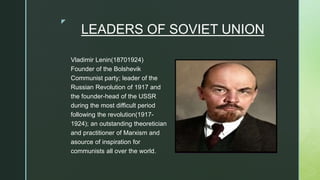
LEADERS OF SOVIET UNION
Vladimir Lenin(18701924)
Founder of the Bolshevik
Communist party; leader of the
Russian Revolution of 1917 and
the founder-head of the USSR
during the most difficult period
following the revolution(1917-
1924); an outstanding theoretician
and practitioner of Marxism and
asource of inspiration for
communists all over the world.
z
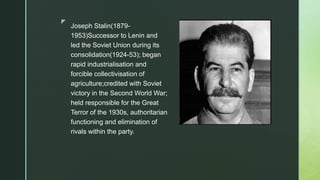
Joseph Stalin(1879-
1953)Successor to Lenin and
led the Soviet Union during its
consolidation(1924-53); began
rapid industrialisation and
forcible collectivisation of
agriculture;credited with Soviet
victory in the Second World War;
held responsible for the Great
Terror of the 1930s, authoritarian
functioning and elimination of
rivals within the party.
z
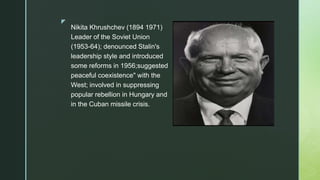
Nikita Khrushchev (1894 1971)
Leader of the Soviet Union
(1953-64); denounced Stalin's
leadership style and introduced
some reforms in 1956;suggested
peaceful coexistence" with the
West; involved in suppressing
popular rebellion in Hungary and
in the Cuban missile crisis.
z
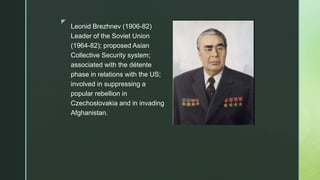
Leonid Brezhnev (1906-82)
Leader of the Soviet Union
(1964-82); proposed Asian
Collective Security system;
associated with the détente
phase in relations with the US;
involved in suppressing a
popular rebellion in
Czechoslovakia and in invading
Afghanistan.
z
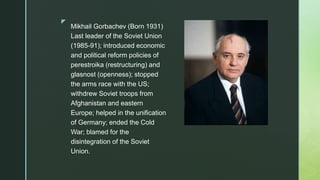
Mikhail Gorbachev (Born 1931)
Last leader of the Soviet Union
(1985-91); introduced economic
and political reform policies of
perestroika (restructuring) and
glasnost (openness); stopped
the arms race with the US;
withdrew Soviet troops from
Afghanistan and eastern
Europe; helped in the unification
of Germany; ended the Cold
War; blamed for the
disintegration of the Soviet
Union.
z
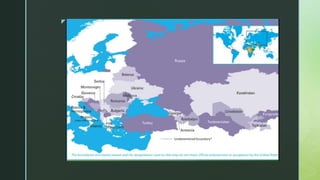
MAP OF CENTRAL, EASTERN
EUROPE AND THE
COMMONWEALTH OF
INDEPENDENT STATES
z