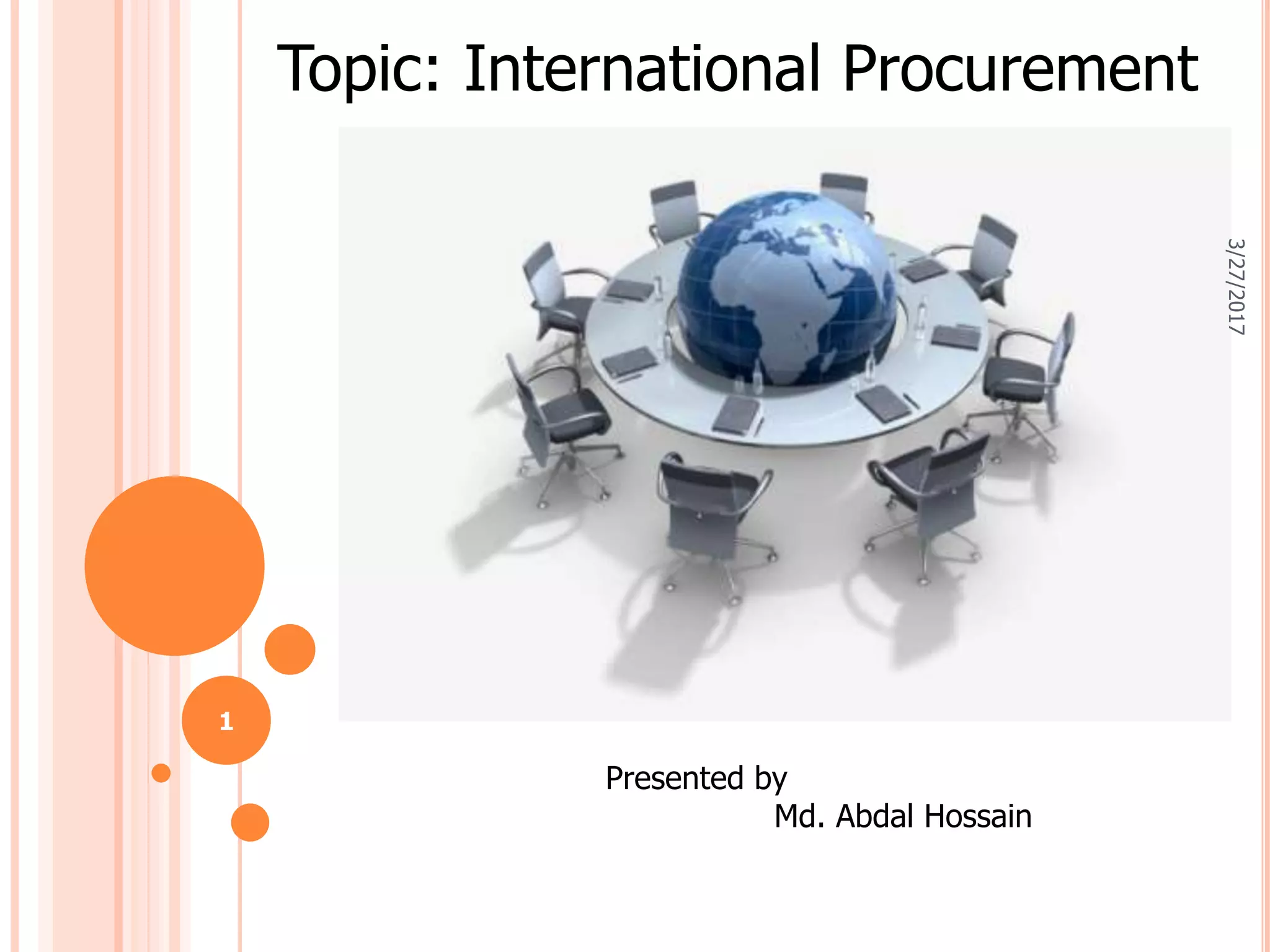
Topic: International Procurement
Presented by
Md. Abdal Hossain
3/27/2017
1
INTRODUCTION
Basically procurement is the process of
acquiring goods and services from outside the
external sources. Goods, services and works
supplied by external sources must meet the
standard requirement outline by the buyer
3/27/2017
2
QUESTION ?
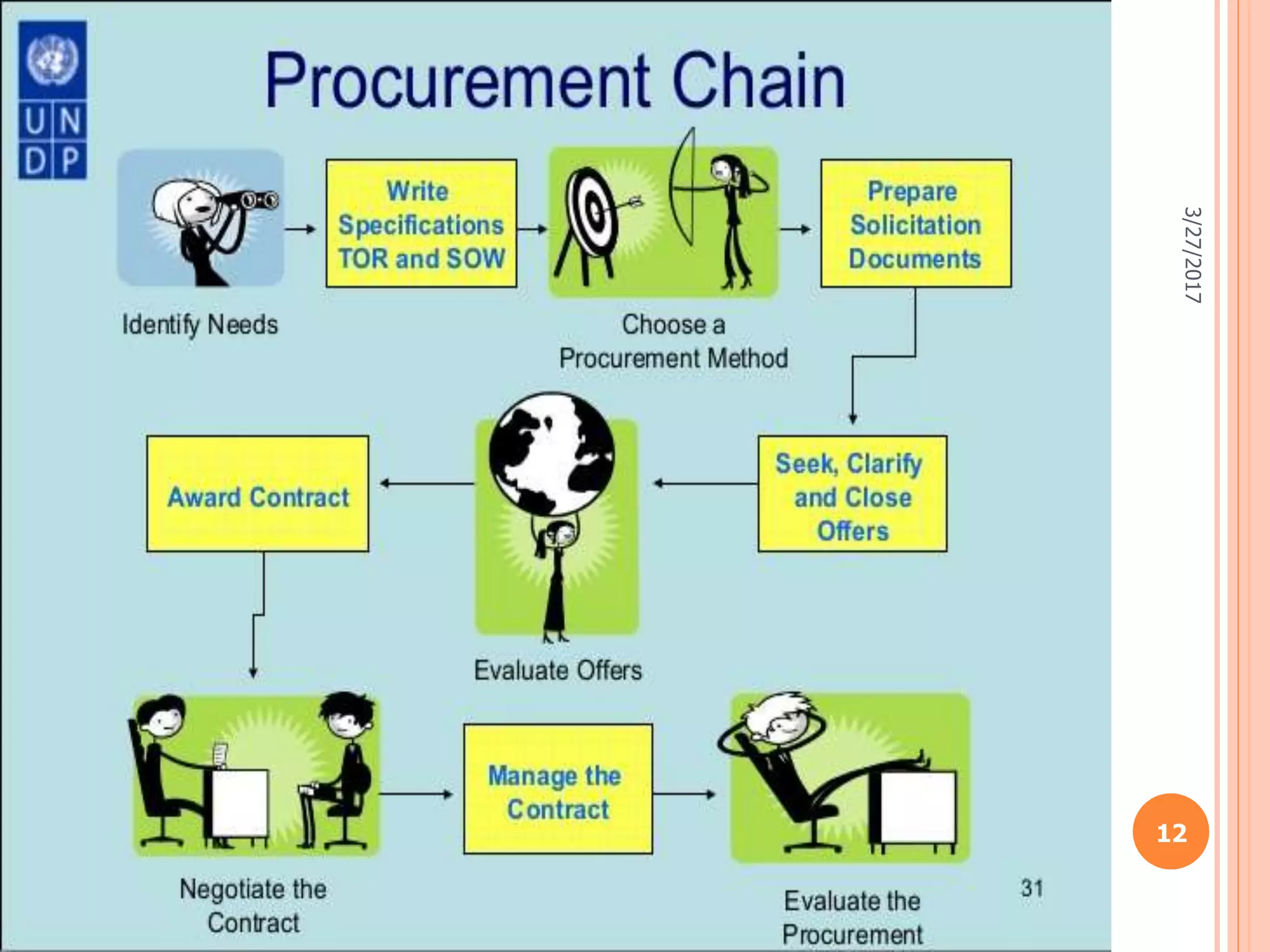
1. What are the Procurement process ?
2. What are the benefits of going international
procurement?
3. What are the risks of international procurement?
3/27/2017
3
PROCUREMENT
Procurement deals with...
 Identifying Requirements or Needs
 Supplier Selection
 Order & Track
 Supply Chain Relationship
 Managing Risk
 Cost Control
3/27/2017
4
WHY FOLLOW A PROCUREMENT PROCESS ?
• Why learn from your won mistakes when you can
learn from others mistakes ?
• The process template gives a framework to work
within_
 Save time
 Avoid acquiring the wrong solution to a problem
 Pay the right price
 Avoid overlooking vital steps in the process
• Potential suppliers know what to expect
• Minimize the risk of making a costly mistake
5
3/27/2017
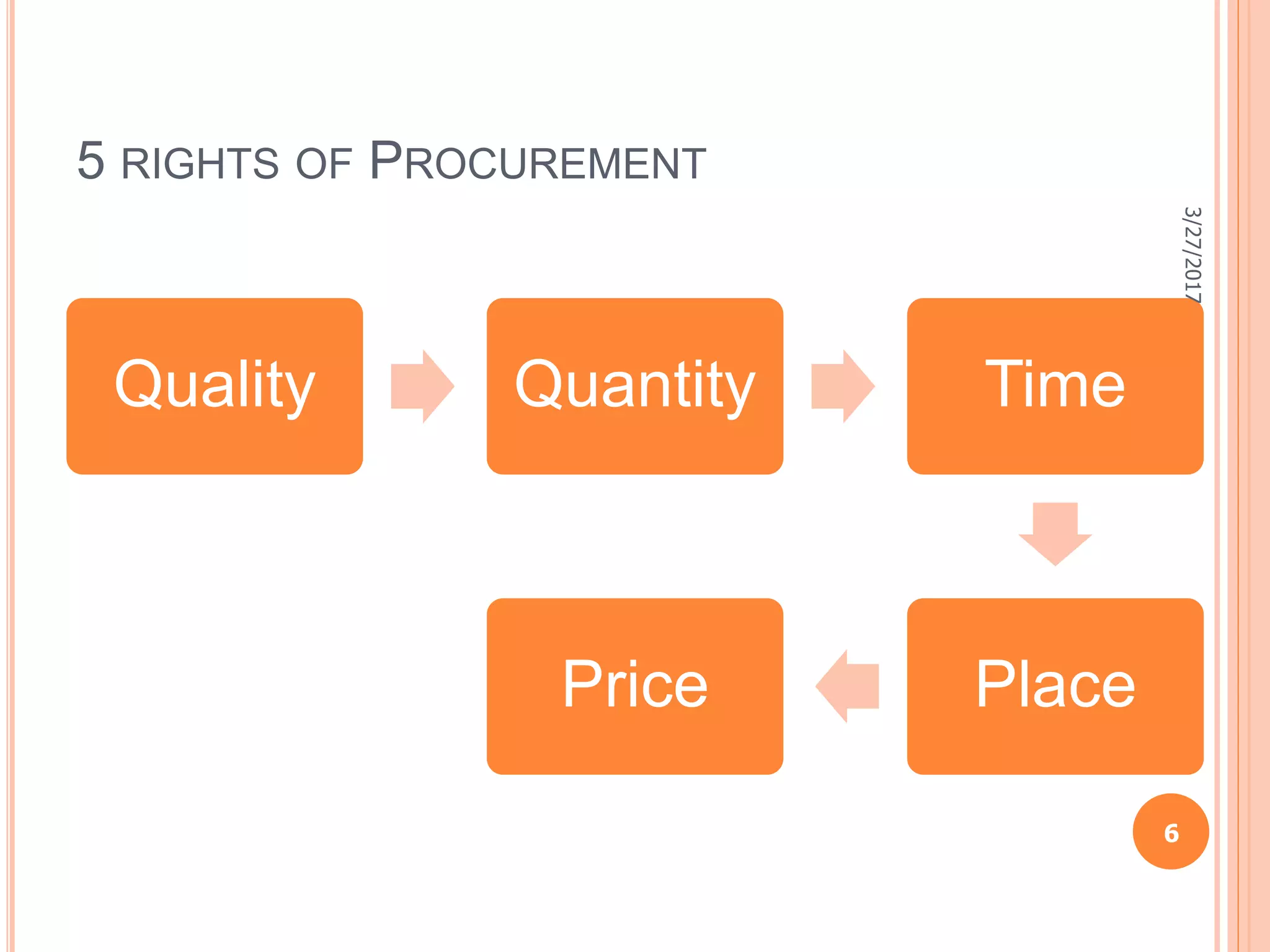
5 RIGHTS OF PROCUREMENT
Quality Quantity Time
PlacePrice
3/27/2017
6
RIGHT PRISE
Prise = monetary value of product or service
Right price ?
 lowest available price,
securing right Quality, Quantity , deliver and time
 Reasonable
3/27/2017
7
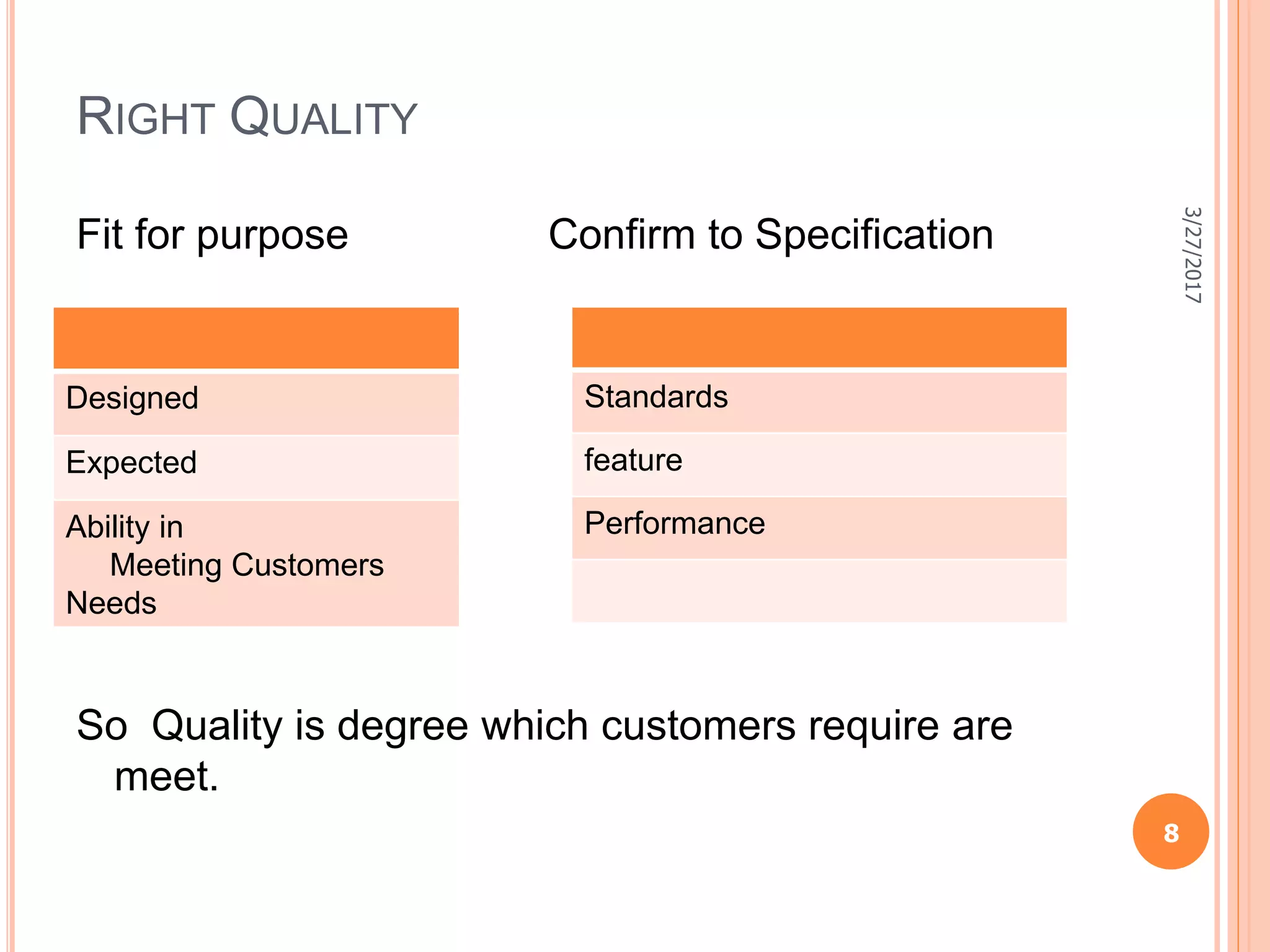
RIGHT QUALITY
Fit for purpose Confirm to Specification
So Quality is degree which customers require are
meet.
Designed
Expected
Ability in
Meeting Customers
Needs
Standards
feature
Performance
3/27/2017
8
RIGHT PLACE
 Proper communication of delivery info.
 Type of transport
 Packaging
 Direct delivery / distribution centre
 Contact details
 Procurement manages all this things
3/27/2017
9
RIGHT QUANTITY
Demand Factors :
 Demand-final product
 Inventory policy
 Market condition (demand and supplier)
 Rightly stock in and stock out by information and
calculation
 Informed decision making
3/27/2017
10
RIGHT TIME
 Purchasing Policy
 Supply chain efficiency
 Quick response –customer satisfaction
 Lead time
internal time external time
Process of buyer supplier organization
3/27/2017
11
12
3/27/2017
INTERNATIONAL PROCUREMENT
In a global economy, international procurement is a
term used to describe the process of allowing firms
around the world to bid on contracts for goods and
services.
The concept has gained popularity as shipping and
transportation costs have decreased due to an influx of
cheap, readily available fuel. The globalization of large
corporations has allowed them to reap the benefits of
lower labor and materials costs while still selling the
same quality and quantity of products.
3/27/2017
13
BENEFITS OF INTERNATIONAL PROCUREMENT
 Lower the costs
 In international procurement, industrialized nations
purchase goods from countries with a lower dollar ,
gaining in the currency exchange.
 Product specialization - some items have a lower
cost of production, based on the natural or human
resources available in different locations.
3/27/2017
14
BENEFITS OF INTERNATIONAL PROCUREMENT
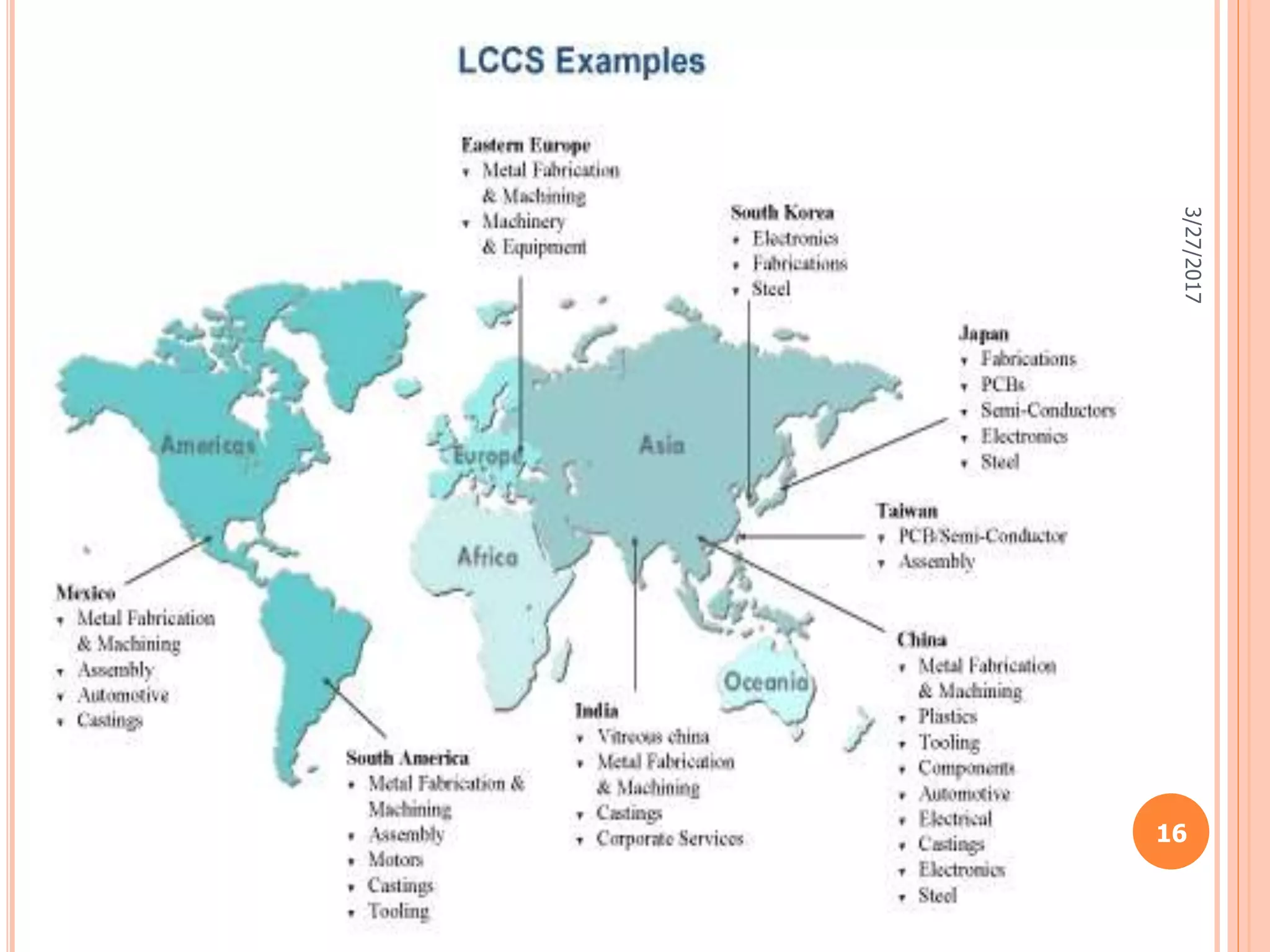
 Eg. Low cost-country sourcing (LCCS), mainly done to
reduce the operating cost of business.
 A procurement strategy in which a company uses
foreign companies with lower wages to produce
resources for manufacturing.
 By finding companies that are operate on leaner
budgets than domestic operations, a company may be
able to reduce operational expenses.
 The customer and the supplier countries like US, UK,
Canada and Australia considered as high cost country
 Whereas resource rich and regulated wage labor
locations like China, India and Indonesia, considered
low cost countries
3/27/2017
15
3/27/2017
16
BENEFITS OF INTERNATIONAL PROCUREMENT
 Stimulation of a global economy
 Each nation must have some contribution or
basket of goods that they can offer to potential
customers.
 Country which have resources that could not be
produce by other country can benefit them, thus
vice versa to the other country
 For instance, A country with no natural oil can build
an oil drilling mechanism as to be supply to country
that have natural oil.
3/27/2017
17
RISKS OF INTERNATIONAL PROCUREMENT
 Fraud risks
 A particular instance of such deceit or trickery
 Some of the suppliers received the buyer’s payment for
deposit, but failed to deliver goods and services.
 This is a transaction trap for the buyers which causes
losses to be direct and difficult to recover.
 Failure of either party to fulfill the conditions of the
contract
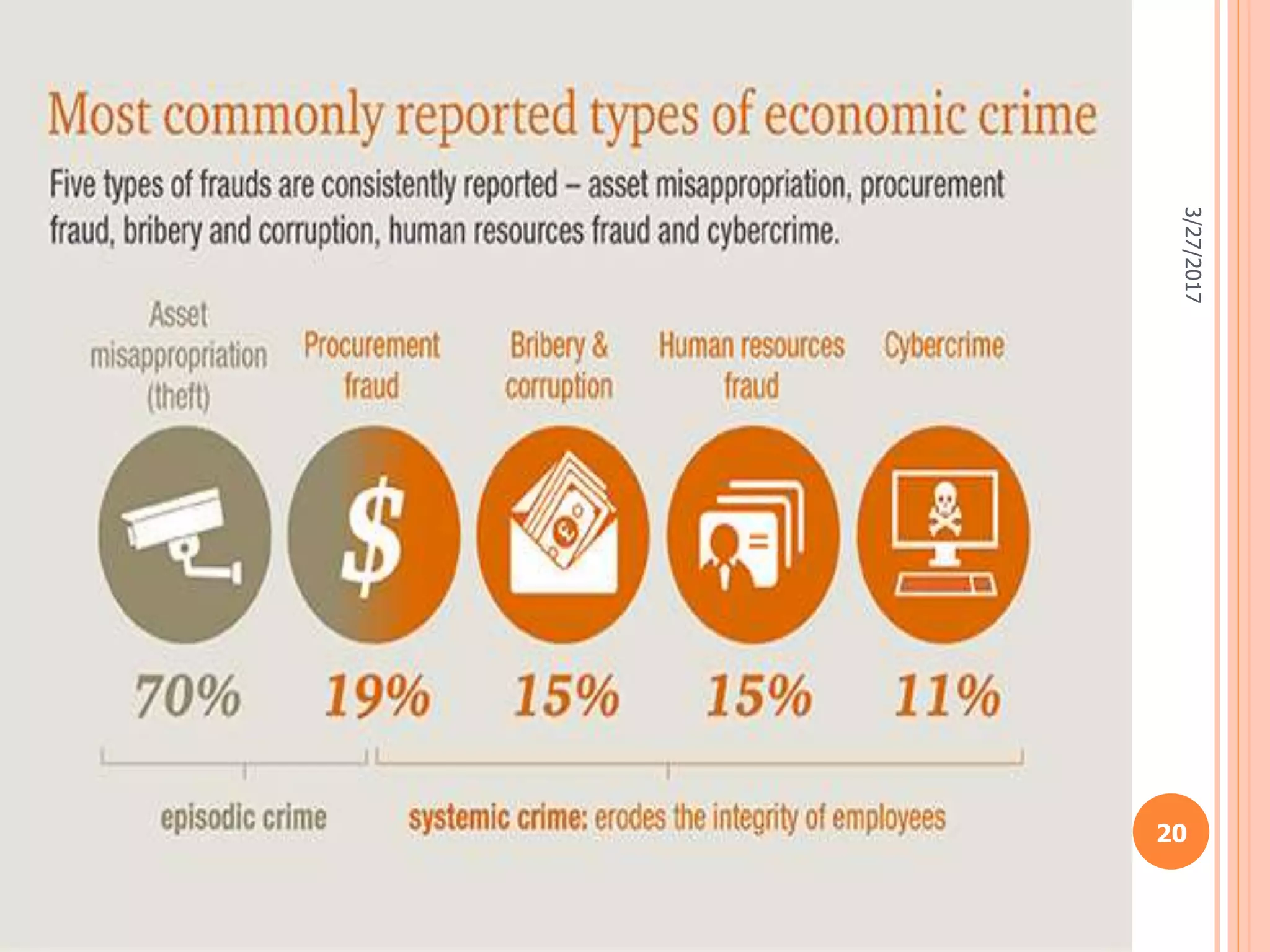
 Eg. (PricewaterhouseCoopers) PWC, one of the
broadest and most comprehensive economic crime
surveys had have ever conducted — with over 5,000
global respondents found that 29% are among
procurement fraud
3/27/2017
18
3/27/2017
19
3/27/2017
20
RISKS OF INTERNATIONAL PROCUREMENT
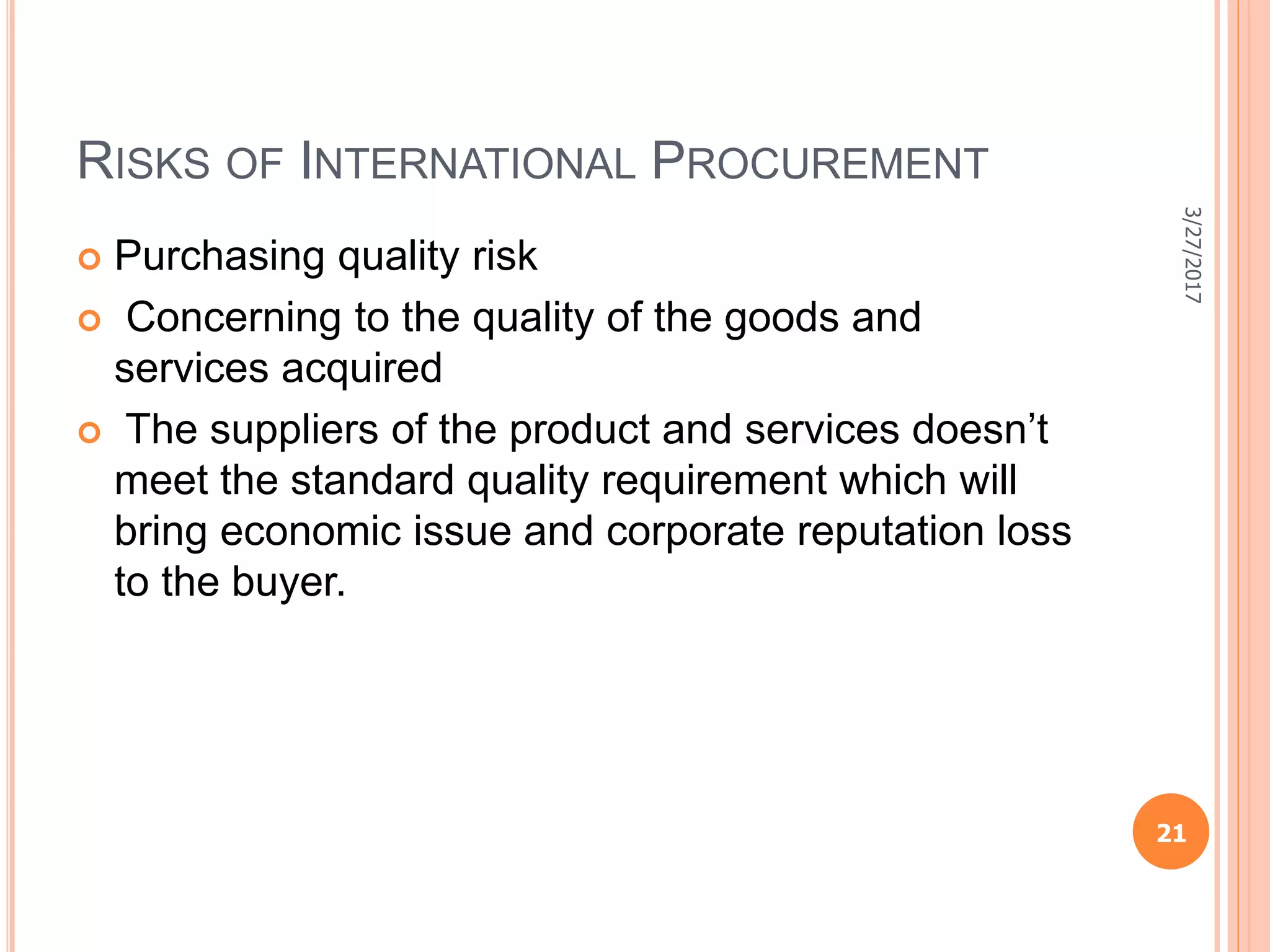
 Purchasing quality risk
 Concerning to the quality of the goods and
services acquired
 The suppliers of the product and services doesn’t
meet the standard quality requirement which will
bring economic issue and corporate reputation loss
to the buyer.
3/27/2017
21
RISKS OF INTERNATIONAL PROCUREMENT
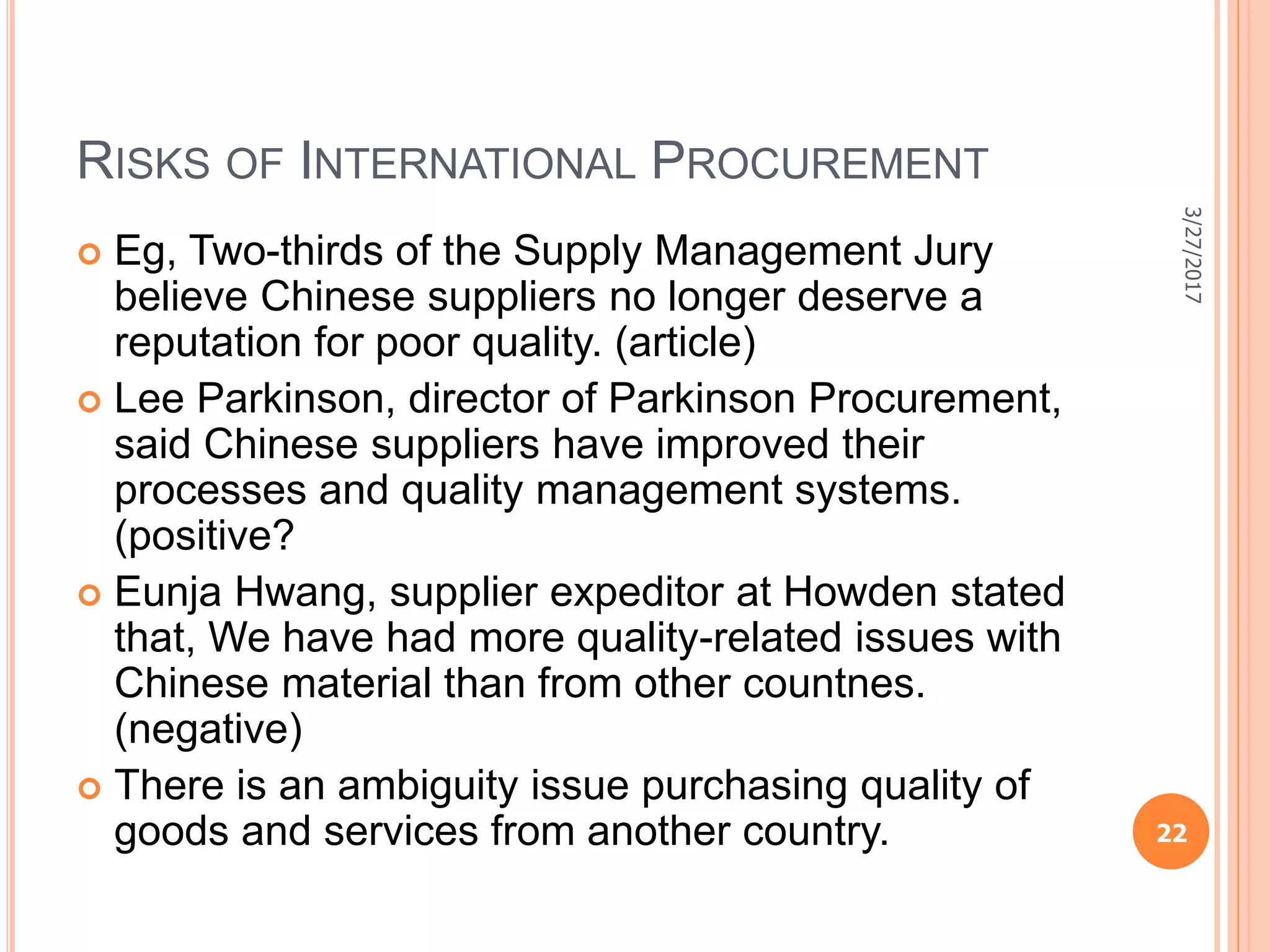
 Eg, Two-thirds of the Supply Management Jury
believe Chinese suppliers no longer deserve a
reputation for poor quality. (article)
 Lee Parkinson, director of Parkinson Procurement,
said Chinese suppliers have improved their
processes and quality management systems.
(positive?
 Eunja Hwang, supplier expeditor at Howden stated
that, We have had more quality-related issues with
Chinese material than from other countnes.
(negative)
 There is an ambiguity issue purchasing quality of
goods and services from another country.
3/27/2017
22
RISKS OF INTERNATIONAL PROCUREMENT
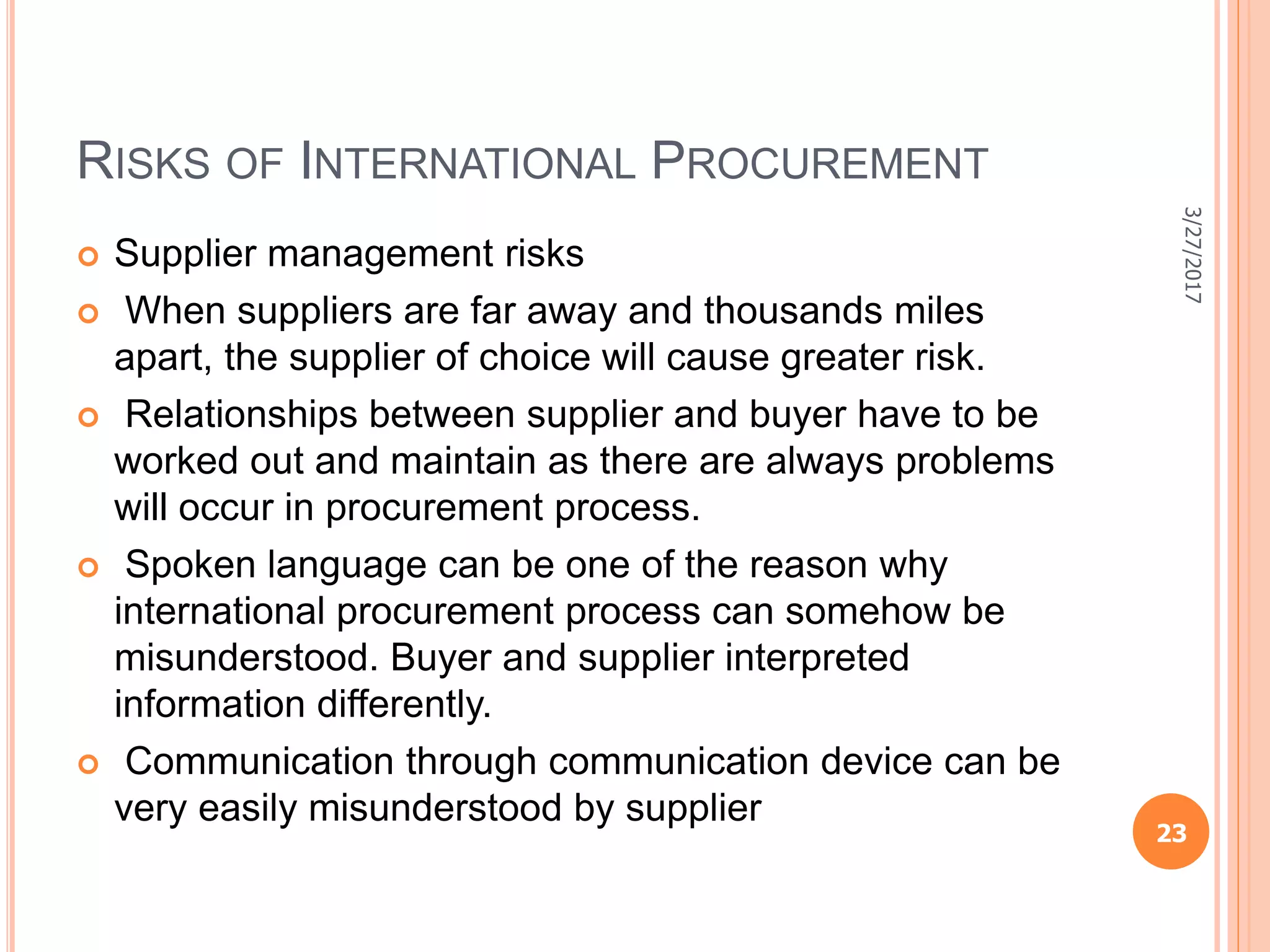
 Supplier management risks
 When suppliers are far away and thousands miles
apart, the supplier of choice will cause greater risk.
 Relationships between supplier and buyer have to be
worked out and maintain as there are always problems
will occur in procurement process.
 Spoken language can be one of the reason why
international procurement process can somehow be
misunderstood. Buyer and supplier interpreted
information differently.
 Communication through communication device can be
very easily misunderstood by supplier
3/27/2017
23
CONCLUSION
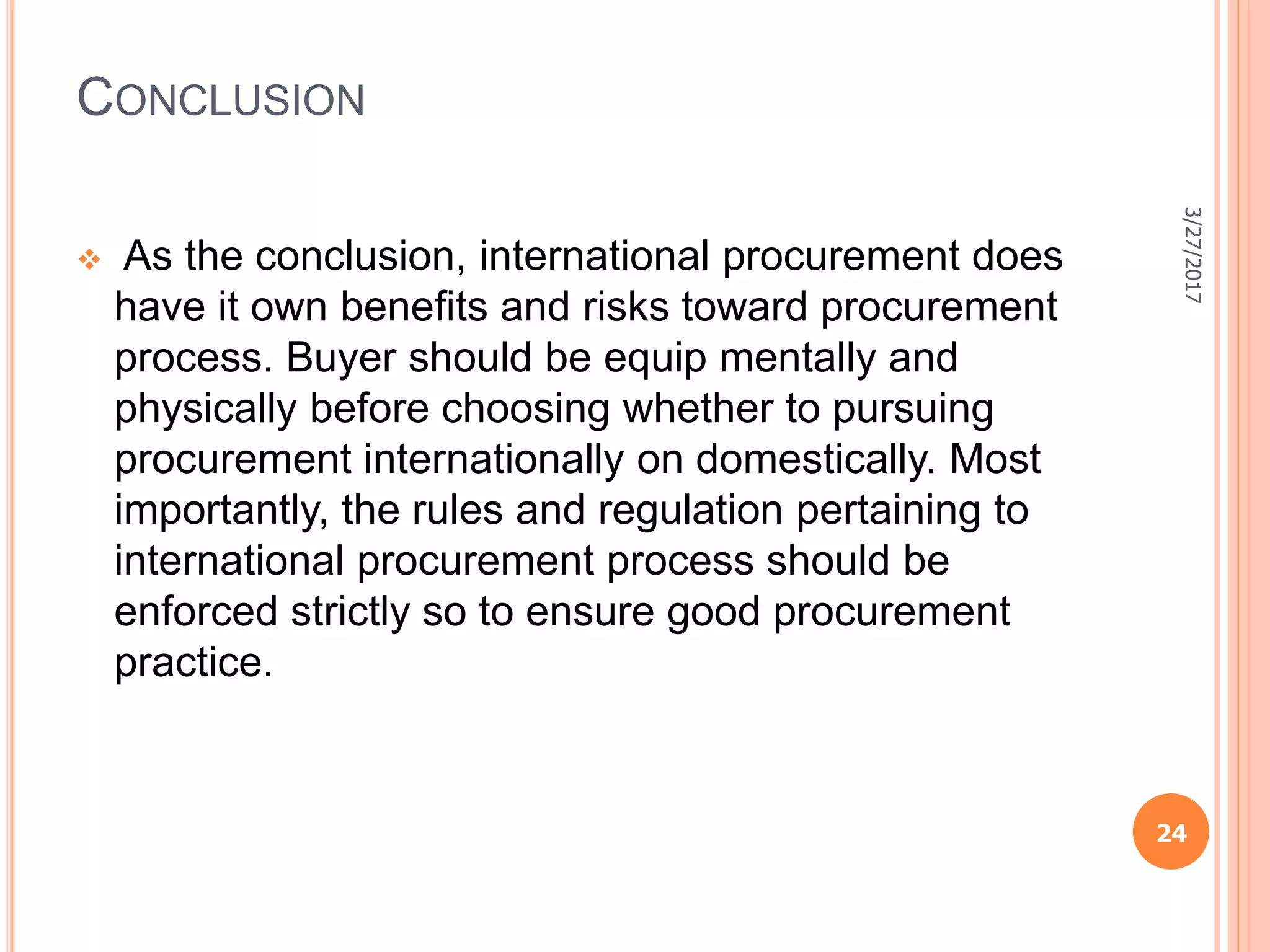
 As the conclusion, international procurement does
have it own benefits and risks toward procurement
process. Buyer should be equip mentally and
physically before choosing whether to pursuing
procurement internationally on domestically. Most
importantly, the rules and regulation pertaining to
international procurement process should be
enforced strictly so to ensure good procurement
practice.
3/27/2017
24
Sales
1st Qtr
2nd Qtr
3rd Qtr
4th Qtr
Thank
you
25
3/27/2017
26
3/27/2017

ppt on source and procurement

  • 1.
    Topic: International Procurement Presentedby Md. Abdal Hossain 3/27/2017 1
  • 2.
    INTRODUCTION Basically procurement isthe process of acquiring goods and services from outside the external sources. Goods, services and works supplied by external sources must meet the standard requirement outline by the buyer 3/27/2017 2
  • 3.
    QUESTION ? 1. Whatare the Procurement process ? 2. What are the benefits of going international procurement? 3. What are the risks of international procurement? 3/27/2017 3
  • 4.
    PROCUREMENT Procurement deals with... Identifying Requirements or Needs  Supplier Selection  Order & Track  Supply Chain Relationship  Managing Risk  Cost Control 3/27/2017 4
  • 5.
    WHY FOLLOW APROCUREMENT PROCESS ? • Why learn from your won mistakes when you can learn from others mistakes ? • The process template gives a framework to work within_  Save time  Avoid acquiring the wrong solution to a problem  Pay the right price  Avoid overlooking vital steps in the process • Potential suppliers know what to expect • Minimize the risk of making a costly mistake 5 3/27/2017
  • 6.
    5 RIGHTS OFPROCUREMENT Quality Quantity Time PlacePrice 3/27/2017 6
  • 7.
    RIGHT PRISE Prise =monetary value of product or service Right price ?  lowest available price, securing right Quality, Quantity , deliver and time  Reasonable 3/27/2017 7
  • 8.
    RIGHT QUALITY Fit forpurpose Confirm to Specification So Quality is degree which customers require are meet. Designed Expected Ability in Meeting Customers Needs Standards feature Performance 3/27/2017 8
  • 9.
    RIGHT PLACE  Propercommunication of delivery info.  Type of transport  Packaging  Direct delivery / distribution centre  Contact details  Procurement manages all this things 3/27/2017 9
  • 10.
    RIGHT QUANTITY Demand Factors:  Demand-final product  Inventory policy  Market condition (demand and supplier)  Rightly stock in and stock out by information and calculation  Informed decision making 3/27/2017 10
  • 11.
    RIGHT TIME  PurchasingPolicy  Supply chain efficiency  Quick response –customer satisfaction  Lead time internal time external time Process of buyer supplier organization 3/27/2017 11
  • 12.
  • 13.
    INTERNATIONAL PROCUREMENT In aglobal economy, international procurement is a term used to describe the process of allowing firms around the world to bid on contracts for goods and services. The concept has gained popularity as shipping and transportation costs have decreased due to an influx of cheap, readily available fuel. The globalization of large corporations has allowed them to reap the benefits of lower labor and materials costs while still selling the same quality and quantity of products. 3/27/2017 13
  • 14.
    BENEFITS OF INTERNATIONALPROCUREMENT  Lower the costs  In international procurement, industrialized nations purchase goods from countries with a lower dollar , gaining in the currency exchange.  Product specialization - some items have a lower cost of production, based on the natural or human resources available in different locations. 3/27/2017 14
  • 15.
    BENEFITS OF INTERNATIONALPROCUREMENT  Eg. Low cost-country sourcing (LCCS), mainly done to reduce the operating cost of business.  A procurement strategy in which a company uses foreign companies with lower wages to produce resources for manufacturing.  By finding companies that are operate on leaner budgets than domestic operations, a company may be able to reduce operational expenses.  The customer and the supplier countries like US, UK, Canada and Australia considered as high cost country  Whereas resource rich and regulated wage labor locations like China, India and Indonesia, considered low cost countries 3/27/2017 15
  • 16.
  • 17.
    BENEFITS OF INTERNATIONALPROCUREMENT  Stimulation of a global economy  Each nation must have some contribution or basket of goods that they can offer to potential customers.  Country which have resources that could not be produce by other country can benefit them, thus vice versa to the other country  For instance, A country with no natural oil can build an oil drilling mechanism as to be supply to country that have natural oil. 3/27/2017 17
  • 18.
    RISKS OF INTERNATIONALPROCUREMENT  Fraud risks  A particular instance of such deceit or trickery  Some of the suppliers received the buyer’s payment for deposit, but failed to deliver goods and services.  This is a transaction trap for the buyers which causes losses to be direct and difficult to recover.  Failure of either party to fulfill the conditions of the contract  Eg. (PricewaterhouseCoopers) PWC, one of the broadest and most comprehensive economic crime surveys had have ever conducted — with over 5,000 global respondents found that 29% are among procurement fraud 3/27/2017 18
  • 19.
  • 20.
  • 21.
    RISKS OF INTERNATIONALPROCUREMENT  Purchasing quality risk  Concerning to the quality of the goods and services acquired  The suppliers of the product and services doesn’t meet the standard quality requirement which will bring economic issue and corporate reputation loss to the buyer. 3/27/2017 21
  • 22.
    RISKS OF INTERNATIONALPROCUREMENT  Eg, Two-thirds of the Supply Management Jury believe Chinese suppliers no longer deserve a reputation for poor quality. (article)  Lee Parkinson, director of Parkinson Procurement, said Chinese suppliers have improved their processes and quality management systems. (positive?  Eunja Hwang, supplier expeditor at Howden stated that, We have had more quality-related issues with Chinese material than from other countnes. (negative)  There is an ambiguity issue purchasing quality of goods and services from another country. 3/27/2017 22
  • 23.
    RISKS OF INTERNATIONALPROCUREMENT  Supplier management risks  When suppliers are far away and thousands miles apart, the supplier of choice will cause greater risk.  Relationships between supplier and buyer have to be worked out and maintain as there are always problems will occur in procurement process.  Spoken language can be one of the reason why international procurement process can somehow be misunderstood. Buyer and supplier interpreted information differently.  Communication through communication device can be very easily misunderstood by supplier 3/27/2017 23
  • 24.
    CONCLUSION  As theconclusion, international procurement does have it own benefits and risks toward procurement process. Buyer should be equip mentally and physically before choosing whether to pursuing procurement internationally on domestically. Most importantly, the rules and regulation pertaining to international procurement process should be enforced strictly so to ensure good procurement practice. 3/27/2017 24
  • 25.
    Sales 1st Qtr 2nd Qtr 3rdQtr 4th Qtr Thank you 25 3/27/2017
  • 26.