NSE & BSE
By Ankit Chauhan
NSE
Board of Directors

• Mr. Ravi Narain
National Stock Exchange of India Limited
Managing Director
• Ms. Chitra Ramkrishna
National Stock Exchange of India Limited
Joint Managing Director
  [Shareholder Director ]
   Type            Stock Exchange
    Location        Mumbai, India
    Founded         1992
    Owner           National Stock Exchange of India
                                    Limited
Currency                INR
 No. of listings     More than 2000
Website              www.nse-india.com
INTRODUCTION
The national stock exchange of India was promoted
 by leading financial institution at the order of
 government of India and was incorporated in
 November 1992 as a tax paying company.
In April 1993,it was recognized as a stock exchange
 under      the    securities    contract(Regulation)
 Act, 1956…NSE commenced operation in June 1994
The capital market segment of the NSE commenced
 operation in November 1994 ,while operation in the
 derivatives segment in June 2000
PURPOSE
• Establishing a National wide trading facility for all
  type of securities.
• Ensuring equal access to investor all over the country
  through an appropriate communication network.
• Providing for a Fair, efficient and transparent
  securities market using electronic Trading system.
• Enabling shorter Settlement cycles.
• Meeting up with international benchmark and
  standard
Trading schedule
• Trading takes place on all days of the week except
  Saturdays & Sundays. The market timings are as follows:
(1) Pre-open session (Regular)
  Order entry & modification Open: 09:00 hrs
  Order entry & modification Close: 09:08 hrs*
• *with random closure in last one minute. Pre-open order
  matching starts immediately after close of pre-open order
  entry.
(2) Pre-open Session for IPO and Relist Securities
  Order entry & modification Open: 09:00 hrs
  Order entry & modification Close: 09:45 hrs*
• *with random closure in last one minute. Pre-open order
  matching starts immediately after close of pre-open order
  entry.
(3) Regular trading session
  Normal Market Open: 09:15 hrs
  Normal Market Close: 15:30 hrs
• Block deal session is held between 09:15 hrs and
  09:50 hrs.
(4) The Closing Session is held between 15.40 hrs
  and 16.00 hrs.
• The Exchange may also extend, advance or reduce
  trading hours when its deems fit and necessary.
ADVANTAGES
WIDER ACCESSIBILITY
SCREEN BASED TRADING
NON-DISCLOSURE OF THE TRADING MEMBERS
 IDENTITY
TRANSPARENT TRANSACTION
MATCHING OF ORDERS
TRADING IN DEMATERIALISED FORM
•   Raising capital for businesses
•   Mobilizing savings for investment
•   Facilitating company growth
•   Profit sharing
•   Corporate governance
•   indicator of the economy
Mile Stones

• November 1992 Incorporation
• April 1993 Recognition as a stock exchange
• October 1995 Became largest stock exchange in the
  country
• April 1996 Launch of S&P CNX Nifty
• November 1997 Best IT Usage award by Computer
  Society of India.
• May 1998 Launch of NSE's Web-site: www.nse.co.in
• February 2000 Commencement of Internet Trading
• June 2000 Commencement of Derivatives Trading
  (Index Futures)
• January 2002 Launch of Exchange Traded Funds
  (ETFs)
• June 2007 NSE launches derivatives on Nifty Junior &
  CNX 100.
• August 2008 Launch of Currency Derivatives
• November 2009 Launch of Mutual Fund Service
  System
• February 2010 Launch of Currency Futures on
  additional currency pairs
Indices
NSE has launched several stock indices, including:
 • S&P CNX Nifty(Standard & Poor's CRISIL NSE
   Index)
 • CNX Nifty Junior
 • CNX 100 (= S&P CNX Nifty + CNX Nifty Junior)
 • S&P CNX 500 (= CNX 100 + 400 major players
   across 72 industries)
 • CNX Midcap (introduced on 18 July 2005 replacing
   CNX Midcap 200)
Markets
Currently, NSE has the following major segments of the capital
market:
 • Equity
 • Futures and Options
 • Retail Debt Market
 • Wholesale Debt Market
 • Currency futures
 • MUTUAL FUND
 • STOCKS LENDING & BORROWING
Eligibility Criteria for Listing
IPOs by Companies

1. The paid up equity capital of the applicant shall
   not be less than Rs. 10 crores and the
   capitalisation of the applicant’s equity shall not
   be less than Rs. 25 crores
2. The Issuer shall have adhered to conditions
   precedent to listing as emerging from inter-
   aliance from Securities Contracts (Regulations)
   Act 1956, Companies Act 1956, Securities and
   Exchange Board of India Act 1992.
3. At least three years track record.
Certifications
• NSE also conducts online
  examination and awards
  certification, under its programmes of
  NSE's Certification in Financial
  Markets (NCFM).
  Currently, certifications are available
  in 19 modules, covering different
  sectors of financial and capital
  markets. Branches of the NSE are
  located throughout India.
BSE
Board of Directors

• Non-Executive Chairman :
Mr. S. Ramadorai
Public Interest Director
Vice Chairman
Tata Consultancy Services Ltd
About
• Original named as “The Native Share & Stock
  Brokers Association”
• Established : 1875
• Location : mumbai
• work on bid-ask quote
• In 1995 its fully computerized system (screen-based
  system)
• In 1996 SEBI permitted BSE to extend its BOLT
  network outside of mumbai.
• About 5,092 listed companies
• total market capitalization of around 59 trillion
  Rupees
• currently ranking around number four in terms of
  annual transactions.
• SENSEX is major index of BSE
• SENSEX comprise 30 scripts from different sectors.
• Other important indices originating from the Bombay
  exchange     include    the     BSE     100,   BSE
  500, BSEPSU, BSEMIDCAP, BSESMLCAP, and
  BSEBANKEX.
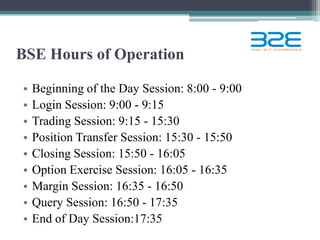
BSE Hours of Operation

•   Beginning of the Day Session: 8:00 - 9:00
•   Login Session: 9:00 - 9:15
•   Trading Session: 9:15 - 15:30
•   Position Transfer Session: 15:30 - 15:50
•   Closing Session: 15:50 - 16:05
•   Option Exercise Session: 16:05 - 16:35
•   Margin Session: 16:35 - 16:50
•   Query Session: 16:50 - 17:35
•   End of Day Session:17:35
Various stock exchange in india
•   Bombay Stock Exchange (BSE)
•   National Stock Exchange of India (NSE)
•   Indian Commodity Exchange (ICEX)
•   United Stock Exchange of India (USE)
•   Multi Commodity Exchange (MCX)
•   Over the Counter Exchange of India (OTCEI)
•   Inter-connected Stock Exchange of India (ISE)
•   Madras Stock Exchange (MSE)
•   Ahmedabad Stock Exchange (ASE)
•   Bhubaneshwar Stock Exchange (BhSE)
•   Cochin Stock Exchange (CSE)
•   Hyderabad Stock Exchange (HSE)
•   Calcutta Stock Exchange (CSE)
•   Delhi Stock Exchange (DSE)
•   Bangalore Stock Exchange
•   Madhya Pradesh Stock Exchange, Indore
•   Jaipur Stock Exchange (JSE)
•   Magadh Stock Exchange, Patna
•   UP Stock Exchange (UPSE)
•   Vadodara Stock Exchange,Vadodara (VSE)
By ANKIT CHAUHAN
MBA sem-
III(ITM, vadodara)

Nse & Bse

  • 1.
    NSE & BSE ByAnkit Chauhan
  • 2.
  • 3.
    Board of Directors •Mr. Ravi Narain National Stock Exchange of India Limited Managing Director • Ms. Chitra Ramkrishna National Stock Exchange of India Limited Joint Managing Director [Shareholder Director ]
  • 4.
    Type Stock Exchange  Location Mumbai, India  Founded 1992  Owner National Stock Exchange of India Limited Currency INR  No. of listings More than 2000 Website www.nse-india.com
  • 5.
    INTRODUCTION The national stockexchange of India was promoted by leading financial institution at the order of government of India and was incorporated in November 1992 as a tax paying company. In April 1993,it was recognized as a stock exchange under the securities contract(Regulation) Act, 1956…NSE commenced operation in June 1994 The capital market segment of the NSE commenced operation in November 1994 ,while operation in the derivatives segment in June 2000
  • 6.
    PURPOSE • Establishing aNational wide trading facility for all type of securities. • Ensuring equal access to investor all over the country through an appropriate communication network. • Providing for a Fair, efficient and transparent securities market using electronic Trading system. • Enabling shorter Settlement cycles. • Meeting up with international benchmark and standard
  • 7.
    Trading schedule • Tradingtakes place on all days of the week except Saturdays & Sundays. The market timings are as follows: (1) Pre-open session (Regular) Order entry & modification Open: 09:00 hrs Order entry & modification Close: 09:08 hrs* • *with random closure in last one minute. Pre-open order matching starts immediately after close of pre-open order entry. (2) Pre-open Session for IPO and Relist Securities Order entry & modification Open: 09:00 hrs Order entry & modification Close: 09:45 hrs* • *with random closure in last one minute. Pre-open order matching starts immediately after close of pre-open order entry.
  • 8.
    (3) Regular tradingsession Normal Market Open: 09:15 hrs Normal Market Close: 15:30 hrs • Block deal session is held between 09:15 hrs and 09:50 hrs. (4) The Closing Session is held between 15.40 hrs and 16.00 hrs. • The Exchange may also extend, advance or reduce trading hours when its deems fit and necessary.
  • 9.
    ADVANTAGES WIDER ACCESSIBILITY SCREEN BASEDTRADING NON-DISCLOSURE OF THE TRADING MEMBERS IDENTITY TRANSPARENT TRANSACTION MATCHING OF ORDERS TRADING IN DEMATERIALISED FORM
  • 10.
    Raising capital for businesses • Mobilizing savings for investment • Facilitating company growth • Profit sharing • Corporate governance • indicator of the economy
  • 11.
    Mile Stones • November1992 Incorporation • April 1993 Recognition as a stock exchange • October 1995 Became largest stock exchange in the country • April 1996 Launch of S&P CNX Nifty • November 1997 Best IT Usage award by Computer Society of India. • May 1998 Launch of NSE's Web-site: www.nse.co.in
  • 12.
    • February 2000Commencement of Internet Trading • June 2000 Commencement of Derivatives Trading (Index Futures) • January 2002 Launch of Exchange Traded Funds (ETFs) • June 2007 NSE launches derivatives on Nifty Junior & CNX 100. • August 2008 Launch of Currency Derivatives • November 2009 Launch of Mutual Fund Service System • February 2010 Launch of Currency Futures on additional currency pairs
  • 13.
    Indices NSE has launchedseveral stock indices, including: • S&P CNX Nifty(Standard & Poor's CRISIL NSE Index) • CNX Nifty Junior • CNX 100 (= S&P CNX Nifty + CNX Nifty Junior) • S&P CNX 500 (= CNX 100 + 400 major players across 72 industries) • CNX Midcap (introduced on 18 July 2005 replacing CNX Midcap 200)
  • 14.
    Markets Currently, NSE hasthe following major segments of the capital market: • Equity • Futures and Options • Retail Debt Market • Wholesale Debt Market • Currency futures • MUTUAL FUND • STOCKS LENDING & BORROWING
  • 15.
    Eligibility Criteria forListing IPOs by Companies 1. The paid up equity capital of the applicant shall not be less than Rs. 10 crores and the capitalisation of the applicant’s equity shall not be less than Rs. 25 crores 2. The Issuer shall have adhered to conditions precedent to listing as emerging from inter- aliance from Securities Contracts (Regulations) Act 1956, Companies Act 1956, Securities and Exchange Board of India Act 1992. 3. At least three years track record.
  • 16.
    Certifications • NSE alsoconducts online examination and awards certification, under its programmes of NSE's Certification in Financial Markets (NCFM). Currently, certifications are available in 19 modules, covering different sectors of financial and capital markets. Branches of the NSE are located throughout India.
  • 17.
  • 18.
    Board of Directors •Non-Executive Chairman : Mr. S. Ramadorai Public Interest Director Vice Chairman Tata Consultancy Services Ltd
  • 19.
    About • Original namedas “The Native Share & Stock Brokers Association” • Established : 1875 • Location : mumbai • work on bid-ask quote • In 1995 its fully computerized system (screen-based system) • In 1996 SEBI permitted BSE to extend its BOLT network outside of mumbai.
  • 20.
    • About 5,092listed companies • total market capitalization of around 59 trillion Rupees • currently ranking around number four in terms of annual transactions. • SENSEX is major index of BSE • SENSEX comprise 30 scripts from different sectors. • Other important indices originating from the Bombay exchange include the BSE 100, BSE 500, BSEPSU, BSEMIDCAP, BSESMLCAP, and BSEBANKEX.
  • 21.
    BSE Hours ofOperation • Beginning of the Day Session: 8:00 - 9:00 • Login Session: 9:00 - 9:15 • Trading Session: 9:15 - 15:30 • Position Transfer Session: 15:30 - 15:50 • Closing Session: 15:50 - 16:05 • Option Exercise Session: 16:05 - 16:35 • Margin Session: 16:35 - 16:50 • Query Session: 16:50 - 17:35 • End of Day Session:17:35
  • 22.
    Various stock exchangein india • Bombay Stock Exchange (BSE) • National Stock Exchange of India (NSE) • Indian Commodity Exchange (ICEX) • United Stock Exchange of India (USE) • Multi Commodity Exchange (MCX) • Over the Counter Exchange of India (OTCEI) • Inter-connected Stock Exchange of India (ISE) • Madras Stock Exchange (MSE) • Ahmedabad Stock Exchange (ASE) • Bhubaneshwar Stock Exchange (BhSE)
  • 23.
    Cochin Stock Exchange (CSE) • Hyderabad Stock Exchange (HSE) • Calcutta Stock Exchange (CSE) • Delhi Stock Exchange (DSE) • Bangalore Stock Exchange • Madhya Pradesh Stock Exchange, Indore • Jaipur Stock Exchange (JSE) • Magadh Stock Exchange, Patna • UP Stock Exchange (UPSE) • Vadodara Stock Exchange,Vadodara (VSE)
  • 24.
    By ANKIT CHAUHAN MBAsem- III(ITM, vadodara)